If a medical device caused your injury, and that device had a design flaw, a manufacturing defect, or shipped without adequate warnings, you likely have grounds for a product liability claim, provided you can show the defect caused your harm. Compensation in these cases typically covers medical expenses, lost wages, pain and suffering, and, in fatal cases, wrongful death damages for surviving family. The single most urgent thing to do right now, before anything else, is preserve the evidence. That means the explanted device itself, its packaging, your imaging, and every medical record tied to the implant and its removal.
Right now, take these three steps:
- Continue or seek the medical care you need. Your health comes first, and your treatment records become evidence.
- Ask your hospital in writing to preserve the removed device rather than discard it as waste.
- Contact a personal injury attorney before evidence disappears or a filing deadline passes.
Pro Tip: Compensation for defective devices can include categories people often overlook, like loss of consortium for a spouse or future medical monitoring costs. A full case evaluation will map out what applies to your specific situation.
Key Takeaways
A viable defective medical device lawsuit requires proof of a defect, a resulting injury, and a causal link between the two, established through preserved physical evidence and medical records.
| Point | Details |
|---|---|
| Preserve the device immediately | Request a written hold on the explanted device before your hospital discards it as waste. |
| Know your defect theory | Design, manufacturing, and failure-to-warn claims each require different types of supporting evidence. |
| Expect a multi-year timeline | MDL cases like the Cook IVC filter litigation can run for several years through bellwether trials before resolving. |
| Watch your filing deadline | The discovery rule can extend your statute of limitations, but only if you contact counsel promptly. |
| Get a free case evaluation | 2keller reviews device injury cases across Indiana, Michigan, and New Mexico on contingency, with no fee unless you recover compensation. |
Table of Contents
- What Makes a Medical Device Defective Under the Law?
- How Does Medical Device Litigation Actually Work?
- What Evidence Should You Preserve Right Away?
- What Does a Device Injury Lawyer Actually Do for You?
- How Long Do You Have to File a Device Lawsuit?
- What Should You Do Right Now If You Suspect a Device Defect?
- Which Devices Show Up Most Often in Litigation?
- What Compensation Can You Realistically Expect?
- What Makes Device Litigation Difficult to Win?
- Why Our Firm’s Multi-State Experience With Device Cases Matters
- How 2keller Handles Your Device Case From Here
- Where to Verify Recalls, MDL Status, and Legal Standards
- Sources
What Makes a Medical Device Defective Under the Law?
Product liability law recognizes three separate theories, and understanding which one fits your situation shapes what evidence you need to gather. A design defect claim argues the device was unreasonably dangerous even when manufactured exactly as intended. Think of an IVC filter designed with struts prone to fracture inside a vein regardless of how carefully it was built. A manufacturing defect claim, by contrast, argues your specific unit deviated from the approved design. Perhaps a batch of surgical mesh had a material flaw. And a failure-to-warn claim argues the manufacturer knew of risks but didn’t adequately disclose them to physicians or patients.
That third category has produced some of the most consequential verdicts in recent device litigation. A bellwether jury found Medtronic liable for failing to adequately warn surgeons about hernia mesh risks and awarded a significant sum in compensatory damages, even though the case didn’t hinge on the mesh being unsafe for every patient. The jury’s focus was narrower: did surgeons have the information they needed to make an informed choice? That distinction matters when you’re evaluating your own case, because failure-to-warn claims often survive even when a device works as designed for most patients.
Most device claims proceed under strict liability, meaning you don’t have to prove the manufacturer was careless. You have to prove the product was defective and that the defect caused your injury. Causation is where most cases are won or lost.
Injuries that commonly support a viable claim include:
- Device migration or perforation of surrounding tissue
- Mechanical fracture of struts, mesh, or hardware
- Chronic infection tied to a specific implant
- Organ damage requiring corrective surgery
- Unexpected device failure requiring emergency removal
Your medical records do the heavy lifting here. Operative notes describing the exact position and condition of the device at implantation and removal, imaging that tracks migration or fracture over time, and pathology reports on infected tissue all build the causal chain. If the explanted device itself is available for engineering analysis, that physical evidence often carries more weight than any record, because it can show metal fatigue, a manufacturing flaw, or a design failure a lab report alone cannot capture.
How Does Medical Device Litigation Actually Work?
An FDA recall is not the same thing as a lawsuit, and conflating the two trips up a lot of injured patients. A recall signals the agency has identified a risk serious enough to warrant action, and it’s genuinely useful evidence. But it doesn’t automatically entitle you to compensation. You still have to prove the defect caused your specific injury.
Most large-scale device cases get consolidated into a Multidistrict Litigation (MDL), a federal procedure that groups similar claims before a single judge for coordinated pretrial handling. The Cook IVC filter litigation illustrates the scale involved: as of April 2026, MDL 2570 in the Southern District of Indiana had several thousand pending cases, out of thousands filed over the life of the litigation.
Within an MDL, courts select a handful of representative cases, called bellwether trials, to go before a jury first. These trials don’t bind other plaintiffs’ cases, but their outcomes heavily influence how both sides value the remaining claims. Mixed bellwether results, some plaintiff wins and some defense wins, often push litigation toward staged settlement frameworks rather than one global payout.
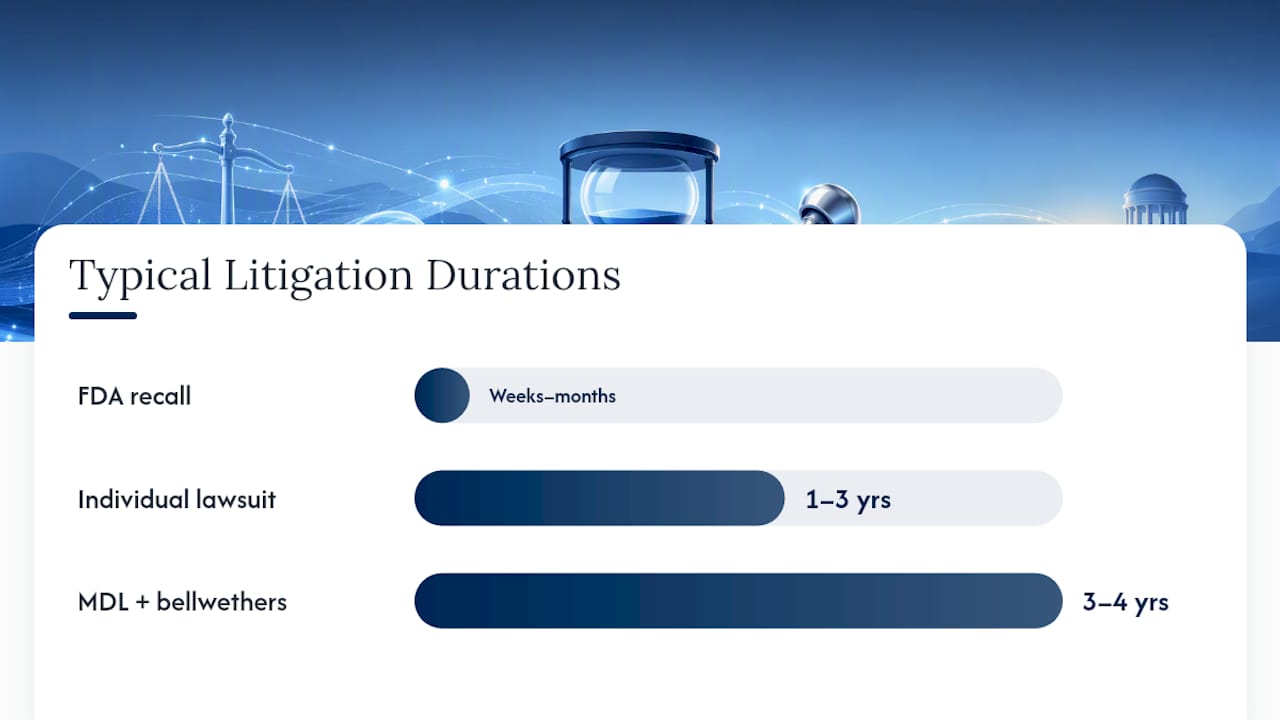
| Litigation Path | What It Determines | Typical Duration |
|---|---|---|
| FDA recall or safety communication | Product risk level, not individual fault | Weeks to months |
| Individual civil lawsuit | Liability and damages for one plaintiff | 1 to 3 years |
| MDL with bellwether trials | Case value benchmarks across many claims | 3 to 4 years |
Why so long? Discovery in device cases involves years of internal manufacturer documents, competing expert reports, and appeals over what testimony a jury even gets to hear. Federal Rule of Evidence 702, often called the Daubert standard, requires judges to screen expert testimony for scientific reliability before it reaches a jury. Industry commentary has noted that as plaintiff-side litigation has grown more organized and better funded, courts have leaned harder on this gatekeeping function, which makes scientifically sound causation theories more important than ever.
- Recalls provide supporting evidence but never guarantee a payout on their own.
- MDL consolidation speeds up pretrial discovery but doesn’t fast-track individual verdicts.
- Early legal contact preserves your options while the litigation timeline plays out around you.
What Evidence Should You Preserve Right Away?
The device that came out of your body is often the single most valuable piece of evidence in your case, and it’s also the easiest thing to lose. Hospitals routinely dispose of explanted devices as medical waste within days unless someone formally instructs them not to. Once that happens, the physical proof of how and why the device failed is gone for good.
Here’s a practical sequence to follow:
- Ask for a written preservation hold on the explanted device and its original packaging before you leave the hospital, or as soon afterward as possible.
- Request your complete medical file, including operative notes, the device’s serial and lot numbers, pre and post-operative imaging, pathology reports, and itemized billing records.
- Document everything yourself. Photograph scars, swelling, or visible complications, and keep a dated journal of symptoms and doctor visits.
- Collect contact information for witnesses, including the surgeon, treating nurses, and any family member who observed your symptoms firsthand.
- Keep original packaging, instruction inserts, or device cards you may have received at implantation, since these sometimes contain lot numbers not recorded elsewhere.
Legal resources on evidence preservation consistently point to the same lesson: chain-of-custody documentation and prompt preservation requests materially strengthen a claim, while gaps in that chain give defense attorneys an opening to question whether the device you’re pointing to is even the one that failed.
Pro Tip: If your device has already been discarded, don’t assume your case is dead. An attorney can often reconstruct the failure through imaging, operative reports, and comparison to other reported failures of the same model.
Your medical treatment always comes first. Preservation requests can be handled by a family member or your attorney’s office while you focus on recovery. Coordinate with your treating physician’s office directly. A simple written request, kept in your own records too, is often enough to stop a hospital from routinely disposing of the device.
What Does a Device Injury Lawyer Actually Do for You?
Most personal injury firms, including 2keller, handle device cases on contingency, meaning you pay no attorney fees upfront and the firm advances the costs of litigation, expert witnesses, medical record retrieval, and court filings. You only pay a percentage if the case settles or wins.
That arrangement matters more in device litigation than in almost any other injury case, because these claims are expensive to build. Proving a design or manufacturing defect usually requires:
- Medical experts who can testify about your specific injury and its connection to the device.
- Engineering or biomechanical experts who can analyze the failed device and explain what went wrong mechanically.
- Regulatory experts who understand FDA approval pathways and what the manufacturer knew when.
Because Federal Rule of Evidence 702 requires expert testimony to meet a reliability threshold before a jury ever hears it, attorneys have to prepare experts capable of surviving a Daubert challenge, a pretrial motion where the defense tries to get your expert excluded entirely. Losing that fight can end a case before trial even starts.
Manufacturers commonly raise two defenses. One is that your injury stemmed from a preexisting condition unrelated to the device. The other, called the learned intermediary doctrine, argues the manufacturer’s duty was only to warn the physician, not the patient directly, so any warning gap doesn’t create liability to you. Skilled counsel anticipates both and builds the medical timeline to counter them from the outset.
A well-prepared device case doesn’t start with a lawsuit. It starts with organized medical records, a preserved device, and expert opinions lined up before the first filing ever happens.
Bring whatever you have to your first consultation: medical records, device information, photos, and a written symptom timeline. It gives your attorney a running start.
How Long Do You Have to File a Device Lawsuit?
Every state sets its own statute of limitations for product liability claims, and most fall somewhere between two and four years. But device cases often trigger something called the discovery rule, which starts the clock not on the date of implantation, but on the date you discovered, or reasonably should have discovered, that the device caused your injury.
That distinction matters enormously in practice:
- If your implant was placed years ago but you only learned last month that a fracture or migration caused your recent symptoms, your filing window may have just opened.
- If a diagnostic scan recently confirmed a device-related injury your doctor previously attributed to something else, that confirmation date can matter more than the surgery date.
- Waiting to confirm the exact cause before contacting a lawyer risks losing evidence even if your legal deadline technically hasn’t expired.
Contacting counsel early doesn’t commit you to anything, but it starts the clock on preserving records and physical evidence before memories fade and hospitals purge old files.
What Should You Do Right Now If You Suspect a Device Defect?
- Get or continue medical care for your symptoms, and be explicit with your doctor about the device and your concerns so it’s documented in your chart.
- Request in writing that the hospital preserve the explanted device rather than dispose of it. Ask specifically for a “litigation hold” if the device has already been removed.
- Gather your operative report, device serial or lot numbers, imaging studies, follow-up notes, and billing statements before your first legal consultation.
- Report the issue to the FDA through its consumer reporting portal, which creates an independent record separate from your medical file.
- Call an attorney and come prepared with your timeline: when the device was implanted, when symptoms started, and when you connected the two.
Having these pieces organized before your first call means your attorney can evaluate your case faster and start preservation work immediately instead of chasing down basic facts first.
Which Devices Show Up Most Often in Litigation?
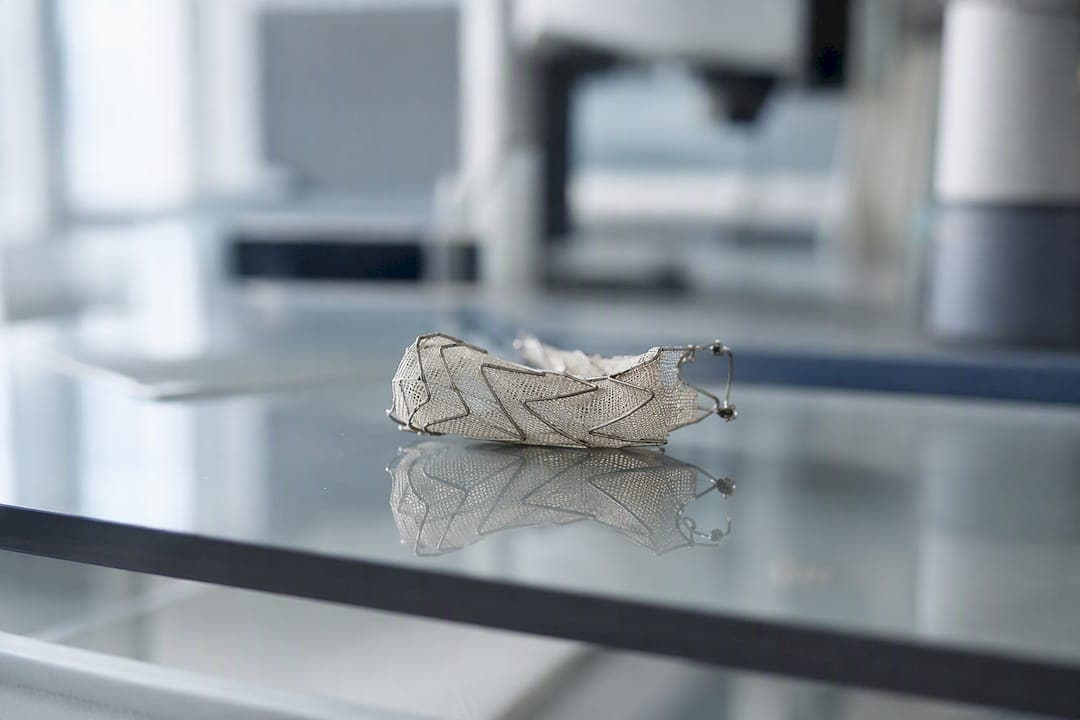
Certain device categories generate a disproportionate share of lawsuits, usually because a specific design flaw affected many patients in a similar, predictable way. Hernia mesh sits near the top of that list, with failure-to-warn claims like the Medtronic verdict driving much of the litigation. IVC filters, small cage-like devices implanted in the vena cava to catch blood clots, have generated years of claims over strut fracture and filter migration, feeding the ongoing MDL in the Southern District of Indiana.
Metal-on-metal hip implants triggered a wave of litigation after patients experienced metal debris shedding into surrounding tissue and bloodstream, a problem we’ve covered in detail given how often it required painful revision surgery. Surgical endoscopes, particularly duodenoscopes, have faced scrutiny over design flaws that trapped bacteria between uses and spread infection between patients despite proper cleaning protocols. Insulin pumps have prompted claims tied to dosing malfunctions that led to dangerous blood sugar swings. Certain IUD models have generated litigation over uterine perforation and device migration during or after insertion.
What connects these categories isn’t the type of device. It’s a pattern: a defect affecting a specific model or lot, discovered gradually as more patients experienced the same complication, eventually surfacing in FDA reports, then in litigation. If your device belongs to a family already under scrutiny, that existing body of evidence can actually work in your favor.
What Compensation Can You Realistically Expect?
Every device case is valued individually based on injury severity, medical costs, and how strong the causation evidence is, so there’s no single number that applies across the board. That said, the damages categories are consistent. Plaintiffs can pursue medical expenses, lost income, pain and suffering, and loss of consortium, and awards have in some cases reached into the millions depending on injury severity and evidence quality.
Several factors drive that range more than anything else. The severity and permanence of your injury matters most. A case involving a single corrective surgery and full recovery is valued very differently from one involving permanent organ damage or a wrongful death claim. The strength of your causation evidence matters just as much. A preserved device with clear engineering analysis showing a manufacturing flaw supports a stronger claim than one relying solely on medical records and circumstantial timing.
Bellwether outcomes within an MDL also shape settlement ranges for everyone else in that litigation, even plaintiffs who never go to trial themselves. When bellwether verdicts favor plaintiffs, it typically pushes settlement offers upward across the remaining docket. When they favor the defense, it can slow negotiations or push manufacturers toward more selective settlements. Wrongful death claims involving a device failure carry their own damages calculation, covering funeral costs, lost future income, and the loss of companionship, and these claims often proceed on a different timeline than injury-only cases within the same litigation. Families pursuing these claims should understand the distinct legal requirements involved, which vary somewhat by state.
What Makes Device Litigation Difficult to Win?
Manufacturers rarely settle device cases quickly, and they defend them with substantial resources. Understanding the obstacles ahead helps you set realistic expectations rather than get discouraged partway through.
Causation is the single hardest thing to prove. Defense attorneys routinely argue your injury stemmed from a preexisting condition, a separate medical event, or normal surgical risk rather than the device itself. Without a preserved explant and clear medical documentation tying your symptoms to the specific defect, this defense can be difficult to overcome.
Expert testimony faces real scrutiny before it ever reaches a jury. Under Federal Rule of Evidence 702, judges act as gatekeepers, screening whether an expert’s methodology is scientifically sound enough to be reliable. Losing a Daubert challenge on your key expert can gut a case regardless of how sympathetic your injury is.
The learned intermediary doctrine shields manufacturers in many failure-to-warn cases, since courts often find the duty to warn ran to your physician rather than to you directly. Overcoming it requires showing the warning given to physicians was itself inadequate, which takes detailed regulatory and medical expert work.
Statute of limitations disputes are common, particularly around when your discovery clock actually started. Manufacturers frequently argue you should have discovered the connection earlier than you claim, making early legal contact and thorough documentation essential to protecting your filing window.
None of these obstacles make a claim unwinnable. They make preparation and experienced counsel the difference between a case that survives pretrial motions and one that doesn’t.
Why Our Firm’s Multi-State Experience With Device Cases Matters
Handling defective drug and device claims across Indiana, Michigan, and New Mexico means seeing how the same device defect plays out under different state deadlines, evidentiary rules, and court procedures. That cross-state pattern recognition shapes how we build a case from day one. It also informs the defective drug litigation analysis our team regularly contributes to, work grounded in coordinating medical experts and engineering analysis early enough to survive the pretrial scrutiny these cases attract. A no-cost case evaluation covers your medical history, your device, and your timeline, with no fee unless we recover compensation for you.
Adam
How 2keller Handles Your Device Case From Here
If you’ve read this far, you already understand why device litigation rewards speed and organization. That’s exactly where a firm like 2keller earns its keep: coordinating medical experts, preserving your explanted device before a hospital discards it, and managing the FDA reporting and record requests while you focus on getting better.

We take defective device cases on contingency, so there’s no attorney fee unless we recover compensation for you, and we advance the costs of expert witnesses and record retrieval upfront. During your free case evaluation, bring whatever you have: your operative report, device information, imaging, and a timeline of symptoms. If you don’t have everything yet, that’s fine. Intake includes helping you identify what’s missing and requesting it directly from your providers. From there, we build your evidence file, line up the right medical and engineering experts, and map out the litigation path, whether that means an individual suit or joining an existing MDL. Reach out today for a free, no-obligation review of your situation.
Where to Verify Recalls, MDL Status, and Legal Standards
Check the FDA’s recall and reporting portal for device safety communications, and review MDL case filings for active litigation status. FindLaw’s product liability overview explains general legal standards, and biotech law resources detail evidence-preservation best practices.
This article is general information, not a substitute for advice from a qualified lawyer. Consult a qualified legal professional about your own circumstances before acting on anything here.
Sources
- MDL case information, Southern District of Indiana
- Defective Medical Device Laws, FindLaw
- U.S. Food and Drug Administration (FDA)
- Jury Orders Medtronic to Pay $88 Million After Finding Surgeons Were Not Adequately Warned About a Hernia Mesh, Medical Daily
- Preserving physical evidence, biotech law resources (LSU)