
A loss of consortium claim seeks compensation for a spouse (and in some states a parent or child) for the loss of companionship, intimacy, and household support caused by a family member’s serious injury or death. If someone you love was hurt or killed by another party’s negligence, call a personal injury attorney now to preserve evidence before memories fade and records disappear. The Restatement of Torts recognizes this as a distinct category of harm, though state statutes, medical records, and witness testimony determine whether your specific claim holds up.
Key Takeaways
Loss of consortium claims recover compensation for a spouse’s lost companionship, intimacy, and household support, but standing, scope, and value depend entirely on state law.
| Point | Details |
|---|---|
| Standing depends on marriage | Most states limit consortium claims to legally married spouses, with some extending rights to domestic partners or parents. |
| Claims are derivative | If the underlying injury or wrongful-death claim fails, the consortium claim typically fails alongside it. |
| Discovery gets personal | Expect deposition questions about intimacy, household roles, and marital history, so prepare witnesses in advance. |
| Values vary widely by state | Settlements range from a few thousand dollars to several hundred thousand or more, depending on injury severity and state caps. |
| Contingency-fee help is available | 2keller evaluates consortium claims across Indiana, Michigan, and New Mexico at no upfront cost through a free consultation. |
Table of Contents
- Who Can File a Loss of Consortium Claim
- How Loss of Consortium Fits Into a Personal Injury Case
- What Evidence Proves a Loss of Consortium Claim
- How State Law Changes Your Loss of Consortium Rights
- How Long Do You Have to File a Consortium Claim
- What Is a Loss of Consortium Claim Worth
- Why You Need an Attorney for a Consortium Claim
- How Keller & Keller Injury Lawyers Handles Loss of Consortium Cases
- Frequently Asked Questions
- Sources
Who Can File a Loss of Consortium Claim
Most states limit standing to legally married spouses, though the rules widen or narrow depending on where you live. Same-sex spouses hold identical standing to opposite-sex spouses nationwide following federal marriage recognition, so married status, not the gender of the spouses, is what courts examine. A handful of states extend limited rights to registered domestic partners, and some states allow some form of parental or filial consortium claim when a child is catastrophically injured or a parent dies. Standing questions turn entirely on your state’s statutes and case law, according to Personal Injury Authority, which means the same facts could produce a valid claim in one state and none at all in another.
- Legally married spouses, in nearly every state
- Registered domestic partners, only where state law recognizes the relationship
- Parents or children, in states permitting filial or parental consortium
- Unmarried partners, generally excluded regardless of relationship length
How Loss of Consortium Fits Into a Personal Injury Case
A consortium claim is derivative. It rides on the back of the injured or deceased person’s underlying tort claim, so if that primary claim fails at trial or gets dismissed, the consortium claim typically collapses with it. Courts sometimes treat consortium as its own distinct cause of action; in wrongful death cases, it often functions instead as a category of damages folded into the broader wrongful-death award. Which framework applies depends entirely on your state’s wrongful-death and tort statutes.
The damages themselves fall into a few recognized categories:
- Loss of society and companionship: the day-to-day emotional connection and shared activities that disappear after a debilitating injury or death
- Loss of sexual relations and intimacy: a component some states treat as central to the claim, others as one factor among many
- Loss of household services: cooking, childcare, home repair, and other contributions the injured spouse can no longer provide
- Loss of parental guidance: available in select states when a parent’s injury or death deprives a child of care and mentorship
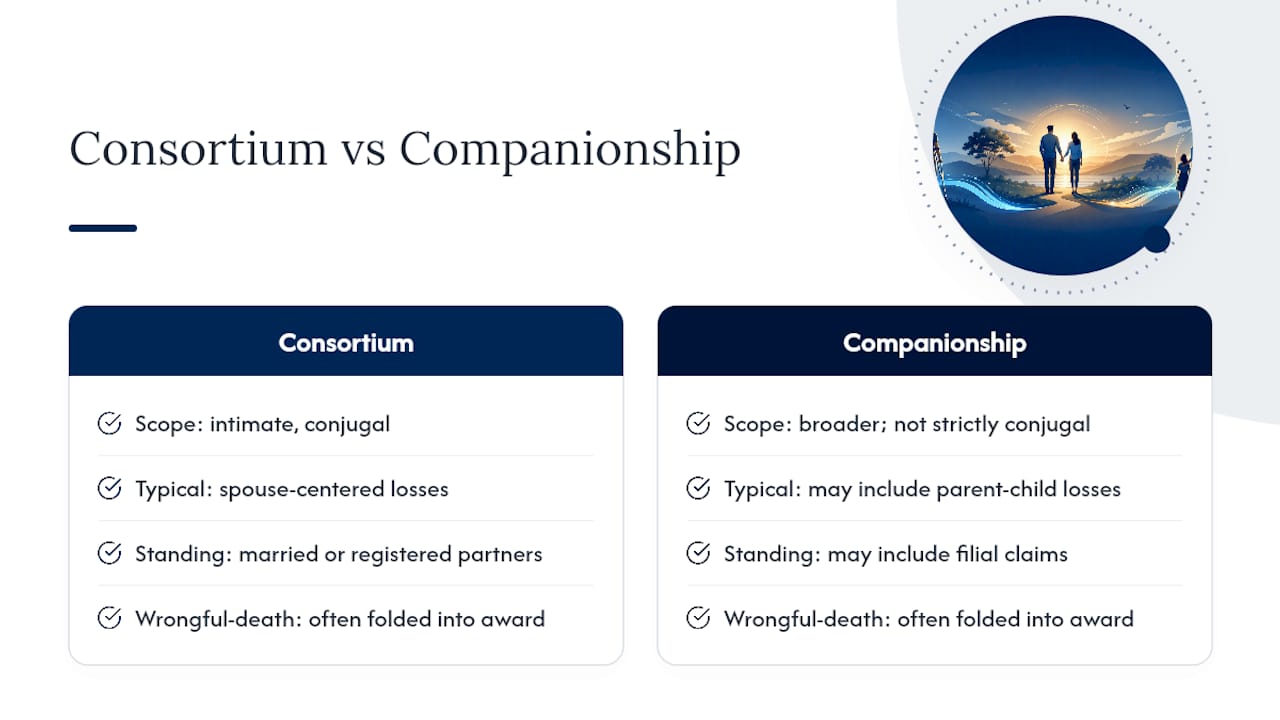
Terminology matters here. “Loss of consortium” and “loss of companionship” get used interchangeably in casual conversation, but consortium traditionally emphasizes the intimate and conjugal dimension of marriage, while companionship can apply more broadly to parent-child relationships. Your attorney will frame the claim using whichever term your state’s statutes recognize.
What Evidence Proves a Loss of Consortium Claim
Winning a consortium claim means documenting a relationship that existed before the injury and showing exactly how it changed. That requires more personal disclosure than most plaintiffs expect. According to Nolo’s legal guide, proving these damages often involves invasive discovery precisely because the losses are personal rather than financial.
Build your case around this evidence:
- Medical records documenting the injured spouse’s condition and prognosis
- Testimony from treating physicians and mental health counselors
- Direct testimony from the uninjured spouse describing the relationship’s change
- Household logs showing who performed which chores and caregiving duties before and after
- Photos, videos, and text messages that capture the relationship’s texture over time
Expect deposition questions covering marriage history, the frequency of intimacy before and after the injury, division of household labor, and any counseling you have attended. Plaintiff Magazine notes that opposing counsel routinely probes these topics in detail, so witnesses need preparation before they ever sit for a deposition.
Pro Tip: Start a simple journal now, before litigation begins, noting specific ways your daily routine and relationship have changed. Contemporaneous notes carry far more weight in a deposition than memories reconstructed months later.
How State Law Changes Your Loss of Consortium Rights
Availability, scope, and dollar caps on consortium damages vary so much by state that the same injury can produce wildly different outcomes depending on where it happened. Some states have abolished or sharply limited the common-law consortium action altogether, while others actively extend it to parents and children beyond the traditional spousal claim.
- A handful of states cap noneconomic damages, including consortium awards, under medical malpractice reform statutes modeled on California’s MICRA framework
- States with damage caps on wrongful-death claims often fold consortium losses into that capped total rather than allowing a separate uncapped recovery
- Wrongful-death consortium claims involving multiple family members raise apportionment questions, since juries must divide the award among spouses, children, and sometimes parents
Because these rules shift so much from state to state, treat any general guide, including this one, as a starting point rather than a final answer. Confirm your specific rights with an attorney licensed in your state before assuming a claim exists or estimating its value.
How Long Do You Have to File a Consortium Claim
Consortium claims generally follow the same statute of limitations as the underlying injury or wrongful-death claim, which runs two to three years in most states, though exact deadlines and tolling rules vary considerably. Missing that window typically bars the claim regardless of its merits.
- Act immediately by preserving medical records, correspondence, and any documentation of the relationship’s condition before and after the injury.
- File within your state’s deadline, since consortium claims usually cannot proceed once the primary claim’s limitations period expires.
- Watch for tolling exceptions, such as delayed discovery of an injury or the victim’s minority, which can extend the filing window in some states.
Do not delete text threads, social media posts, or calendar entries related to your relationship or caregiving routine. Opposing counsel may argue that gaps in your documentation reflect a weaker relationship rather than simple record-keeping habits.
What Is a Loss of Consortium Claim Worth
Settlement values for consortium damages swing widely because the loss itself is subjective and hard to price. According to US Injury Act, consortium settlements can range from a few thousand dollars in cases involving minor, temporary injuries to several hundred thousand dollars or more in catastrophic injury and wrongful-death cases, depending heavily on jurisdiction and applicable caps.
Several factors drive that range up or down:
- Severity and permanence of the injury, since a temporary limitation settles for far less than a permanent disability
- Quality and duration of the marriage or relationship before the injury occurred
- Age of both spouses, since younger claimants face a longer projected loss
- Available insurance policy limits, which often cap total recovery regardless of the claim’s true value
- Comparative fault rules, which can reduce the award if the injured spouse bears partial responsibility for the underlying accident
A quick reality check: insurers evaluate consortium damages far more skeptically than medical bills or lost wages, precisely because they are harder to quantify with receipts. Strong documentation and credible testimony move the needle more here than in almost any other category of damages.
Why You Need an Attorney for a Consortium Claim
A personal injury lawyer does far more than file paperwork on a consortium claim. Counsel evaluates whether you have standing under your state’s law, joins the consortium claim to the primary injury complaint, and builds the relational evidence that insurers and juries actually find persuasive.
- Assessing standing and the applicable statute of limitations before you lose the right to sue
- Gathering medical records, household documentation, and witness statements that support the claim
- Preparing you and your spouse for deposition questions about intimacy, household roles, and relationship history
- Negotiating with insurance adjusters who routinely undervalue noneconomic damages
- Presenting compelling evidence of the relationship’s loss to a jury, if the case goes to trial
Most personal injury firms, including 2keller, work on contingency, meaning you pay no attorney fees unless the case settles or wins. A free consultation lets you learn whether you have a viable claim before committing to anything.
What We See in Real Cases
Clients often wait too long to document their losses, assuming the relationship changes are obvious. They rarely are to a skeptical insurance adjuster. Our multi-state practice across Indiana, Michigan, and New Mexico has shown us that early evidence preservation, not eloquence at trial, wins these claims most often.

How Keller & Keller Injury Lawyers Handles Loss of Consortium Cases
If you are weighing whether to pursue a consortium claim after a spouse’s serious injury or a family member’s wrongful death, waiting rarely helps your case. Evidence fades, memories blur, and statutes of limitations keep running whether or not you feel ready.

2keller builds consortium claims around the same evidence discipline that wins the underlying injury case: preserved medical records, prepared witnesses, and documentation gathered before opposing counsel starts asking hard questions in deposition. We handle evidence preservation, deposition preparation, and settlement negotiation with insurers who routinely lowball noneconomic damages. Our firm represents injured families across Indiana, Michigan, and New Mexico on a contingency basis, so you pay nothing unless we win or settle your case. If a car accident or negligence case in New Mexico led to your family’s losses, our guide to uninsured motorist claims covers related compensation you may also be owed. Schedule a free consultation with 2keller today to find out whether you have a viable loss of consortium claim in your state.
Frequently Asked Questions
Is loss of consortium the same as loss of companionship?
Not exactly. Consortium traditionally emphasizes the intimate and conjugal aspects of marriage, while loss of companionship is a broader term that can extend to parent-child relationships in states that recognize filial claims.
Can I file a loss of consortium claim if we are not married?
Generally, no. Most states restrict standing to legally married spouses or, in some jurisdictions, registered domestic partners. Unmarried partners typically lack standing regardless of how long they lived together.
Does loss of consortium apply to wrongful death cases?
Yes. Many states fold consortium damages into the broader wrongful-death award rather than treating it as a separate cause of action, though the exact structure depends on your state’s wrongful-death statute.
How long do I have to file a consortium claim?
Consortium claims generally follow the same statute of limitations as the underlying injury claim, commonly two to three years, but exact deadlines vary by state and case type.
Do I need a lawyer to file a loss of consortium claim?
You are not legally required to have one, but the invasive discovery process and jurisdiction-specific standing rules make experienced counsel valuable. Most firms, including 2keller, offer free consultations and work on contingency.
This article is general information, not a substitute for advice from a qualified lawyer. Consult a qualified legal professional about your own circumstances before acting on anything here.
Sources
Consult the Cornell Legal Information Institute for doctrinal background and Ammons Law’s overview of companionship damages for wrongful-death context. When contacting an attorney, have your state and case facts ready.
- Loss of Consortium, Cornell Law School Legal Information Institute
- What Is Loss of Consortium In a Personal Injury Case? Nolo
- Loss of Consortium in Personal Injury Claims, Personal Injury Authority
- Loss of Consortium: Definition, Claim, Coverage, Defense – U.S. | US Injury Act
- Loss of consortium, Plaintiff Magazine