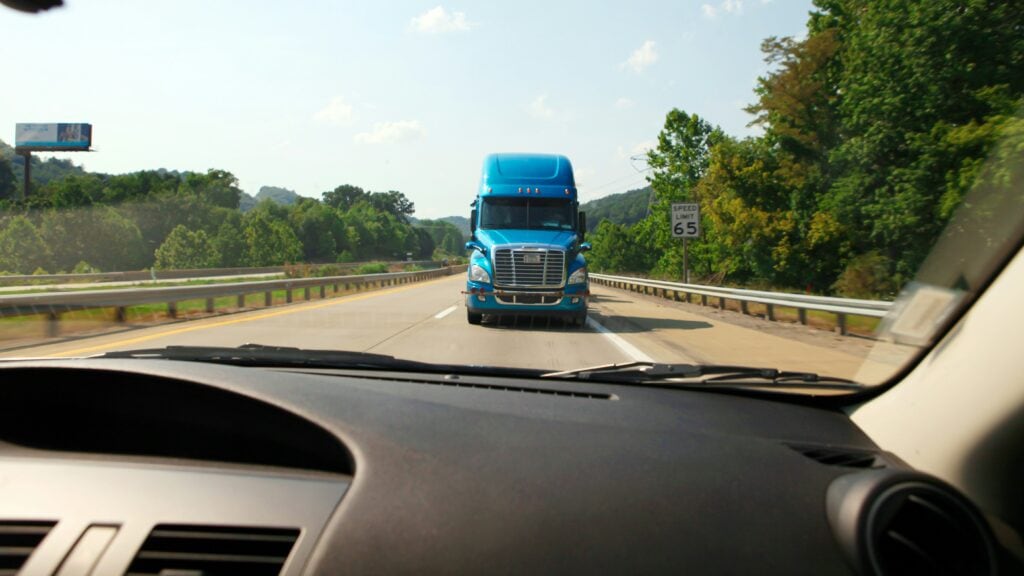
Being hit by a semi in Michigan while stopped in traffic can leave you with a troubling question: if your vehicle was already stopped, why couldn’t the truck behind you stop, too?
A rear-end collision can provide important evidence of negligence, but a serious truck claim still requires investigation. Video, vehicle records, witness accounts, and physical evidence can help establish the sequence of impacts, explain the truck’s approach, and identify who may be legally responsible.
Those questions matter even when the damage appears to tell an obvious story.
A Recent I-96 Crash Shows Why the Moments Before Impact Matter
In a November report about a semi-truck crash on eastbound I-96 in Ionia County, FOX 17 described a collision in Boston Township that killed a 77-year-old Greenville man and injured several others.
According to the report, Michigan State Police said a semi failed to stop for standstill traffic, struck a Chrysler Pacifica, and pushed it into a Ram pickup. Troopers believed speed was a factor, and the investigation remained ongoing.
That is a preliminary reported account, not a court determination of fault. It does not establish distraction, fatigue, defective brakes, or a trucking company’s responsibility.
For people injured in similar crashes, however, it illustrates an important distinction: documenting the collision is only the beginning. Understanding how the truck reached stopped traffic without stopping may require evidence that is not visible in photographs.
Is the Rear-Ending Truck Automatically at Fault?
Michigan law gives rear-end collisions particular significance.
Under MCL 257.402, Michigan’s rear-end collision statute, competent evidence that a vehicle overtook and struck another vehicle traveling in the same direction—or lawfully standing on a highway—can establish prima facie evidence of negligence.
In plain language, that can support an initial showing against the following driver. It does not eliminate every factual dispute or guarantee compensation.
A chain-reaction crash may raise additional questions. Did your vehicle strike the car ahead before the truck arrived, or were you pushed into it? Was there one impact or several? Did another vehicle change lanes immediately beforehand?
The answers can affect how responsibility is assigned. Your account, vehicle damage, independent witnesses, and recordings should be considered together.
“Below the Speed Limit” Does Not End the Inquiry
A driver does not necessarily act reasonably merely by staying below the posted limit.
Michigan’s basic speed law requires a careful, prudent speed appropriate to traffic and other existing conditions. It also prohibits driving faster than permits stopping within the assured clear distance ahead.
For applicable commercial operations, federal hazardous-condition rules require extreme caution and reduced speed when conditions such as snow, ice, fog, or rain impair visibility or traction.
Those are general legal standards, not findings about the Ionia County crash.
In another case, an investigation might examine the truck’s speed relative to a visible backup, available sight distance, following distance, road conditions, and braking. A speed-limit sign supplies only part of that picture.
Five Types of Evidence Worth Investigating
1. Video Showing the Approach to the Backup
A recording may show when brake lights became visible, how traffic slowed, whether a lane change occurred, or how long vehicles remained stopped.
Potential sources include the truck, passenger vehicles, and nearby properties. A camera’s presence does not guarantee that useful footage exists or remains available.
Preserve original recordings you possess. A short clip posted online may omit the seconds needed to understand the sequence.
2. Vehicle Electronics and Fleet Records
Depending on the equipment and available records, vehicle electronics or fleet systems may help investigate movement, speed, or braking.
Avoid treating every electronic record as the same thing. An electronic logging device, or ELD, primarily records duty status. The Federal Motor Carrier Safety Administration explains that ELD specifications do not require recording speed, braking, or steering.
A request for “the black box” may therefore be too vague. The useful task is identifying the systems actually installed, what they recorded, and how to preserve relevant information.
3. Driver Hours and Dispatch Communications
Duty records can help reconstruct a driver’s work schedule. Dispatch messages may clarify trip timing and instructions.
These records do not automatically prove fatigue or improper pressure. They provide facts to compare with the driver’s account and other evidence.
FMCSA guidance generally requires carriers to retain required duty-status records and supporting documents for six months. That is not a reason to wait: other evidence may follow different retention cycles.
4. Inspection and Maintenance Information
If braking performance becomes an issue, relevant evidence may include inspection reports, repair records, reported defects, and examination of the equipment itself.
An allegation that brakes failed needs support. So does an assumption that a truck must have been mechanically sound because it was operating.
Preservation planning may need to address the tractor and trailer separately, including inspection before repair or disposal.
5. The Physical Sequence of Impacts
Damage locations, debris, photographs, witness observations, and reconstruction may help distinguish an initial collision from later impacts.
For example, front-end damage on your car does not alone establish that you independently rear-ended another driver. You may have been pushed forward.
Keller & Keller’s discussion of truck accidents and traffic in southwest Michigan explains why commercial vehicle investigations often extend beyond the police report.
What Injured People and Families Can Do
You do not need to investigate a trucking company yourself. Once immediate medical needs are addressed, a few organized steps can protect information:
- Save your own account. Record what you remember about stopping, impact sounds, vehicle movement, and anything you observed beforehand. Separate memories from later information.
- Keep original evidence. Preserve photographs, recordings, witness contacts, and the police report number.
- Identify where the vehicle went. Keep towing and storage information, and seek advice about inspection before repairs or disposal.
- Track treatment and losses. Retain medical instructions, bills, work restrictions, and records of missed income.
- Ask promptly about preservation. An attorney can identify appropriate recipients and request relevant records, recordings, and equipment be preserved.
Keller & Keller’s guide to which Michigan car accident documents to keep offers a practical way to organize the growing paperwork.
Medical Benefits and a Claim Against the Trucking Parties Are Different
Determining fault does not answer every insurance question.
Michigan PIP benefits may cover qualifying losses, subject to eligibility, applicable coverage, limits, and other rules. Do not assume the trucking company’s insurer automatically handles all medical bills.
A liability claim addresses damages recoverable from responsible parties. Under Michigan’s motor vehicle liability statute, recovery for noneconomic loss generally requires death, serious impairment of body function, or permanent serious disfigurement. Certain excess economic losses may also be recoverable.
Who may be responsible depends on evidence about the driver, vehicle ownership, employment, and any independently negligent conduct. A company’s connection to the shipment does not alone establish liability.
Short Answers to Common Questions
Should I wait for the investigation to finish?
You can seek legal advice while police investigate. Evidence preservation and insurance notice questions may need attention before a final report is available.
Can a passenger have an individual claim?
Yes. Each injured person’s coverage, injuries, and losses require separate evaluation. One occupant’s claim does not automatically address everyone else’s.
What if I could not collect anything at the scene?
Start with what you have. Hospital records, the crash location, a report number, and towing information may provide a starting point.
Get Help Understanding What Happened
After a serious truck crash, recovery can leave little room for sorting records or answering insurance questions. Keller & Keller Injury Lawyers offers free case evaluations for people injured in Michigan.
Bring the information available to you. An early review can help identify potential claims, necessary evidence, and the next steps while you focus on your care.