

Indiana Motorcycle Accident Lawyers
Keller & Keller Injury Lawyers’ Winning Approach
Free Case EvaluationInjured in a Motorcycle Accident?
Get started with a free case evaluation. No Fee Until We Win.
100% Free Evaluation
Provide a few details and our team will handle the rest.
"*" indicates required fields

“As a busy mom of three, I’m so grateful I didn’t have to face the legal battle alone. Thank you, Keller & Keller Injury Lawyers.”
Kelly


When you’ve been hurt in a motorcycle accident, you need more than just any lawyer. You need a battle-tested sword and shield fighting for your rights
At Keller & Keller, we’ve been maximizing client settlements and delivering justice since 1936, establishing our firm as one of Indiana’s leading injury law firms. With over 90 years of experience taking on insurance companies that unfairly stereotype motorcyclists, we’ve recovered millions of dollars for our clients. That’s not just a number. That’s thousands of Indiana families we’ve helped get their lives back on track after devastating motorcycle crashes.
Why You Need a Motorcycle Accident Lawyer After a Crash
The aftermath of a motorcycle accident can turn your life upside down in an instant. This is when having an experienced Indiana motorcycle accident lawyer becomes crucial.

Navigating Complex Legal Claims

Understanding Insurance Company Tactics

Understanding Statute of Limitations
Navigating Complex
Legal Claims
Determining fault, establishing negligence, calculating long-term damages, and interpreting insurance policies requires specialized knowledge. Our lawyers understand these complexities and the unique challenges facing motorcyclists in Indiana courts.

Understanding Insurance Company Tactics
Insurance companies often operate with built-in biases against motorcyclists, viewing them as reckless risk-takers rather than victims of negligent drivers. Without proper legal representation, you risk accepting settlements that don’t reflect the true impact of your injuries.

Understanding Statute of Limitations
Time is not on your side after a motorcycle accident. Indiana has deadlines for filing personal injury claims, typically two years from the date of the accident. Missing these deadlines means forfeiting your right to compensation permanently. Our motorcycle accident lawyers ensure all paperwork is filed correctly and on time.

What to Do After a Motorcycle Accident
Taking the right steps after a crash can protect both your health and your legal claim.
See What Your Case Is WorthMove to a safe location away from traffic and check for injuries.
File an official police report. This is crucial for your case, especially since police may have their own biases about motorcycle accidents
See a doctor right away, as adrenaline can mask serious injuries.
Take photos & videos of injuries, vehicles, the scene, skid marks, road hazard, and collect witness information.
Collect contact and insurance details from all drivers and bystanders involved.
Notify your insurance company about the accident.
Keep your helmet, jacket, and other protective equipment as evidence of the impact and your safety-conscious approach
Save all medical bills, repair estimates, and accident-related documents.
Politely decline insurance adjuster requests for comment.
Refrain from posting your accident on social accounts.
The sooner we start working, the better we can protect your interests and counter unfair stereotypes

The Keller & Keller Injury Lawyers Approach:
Indiana Injury Lawyers Who Fight to Win
From the moment you contact us, you’ll notice the difference in our approach. Our client-first philosophy means we take the time to understand not just the details of your accident but how it has affected your life, your work, your family, and your future in Indiana. We clearly communicate every step of the process in plain language you can understand, no confusing legal jargon. This approach has earned us countless 5-star reviews from real Indiana clients who’ve experienced the Keller & Keller difference firsthand.
We understand that being injured in an accident is stressful enough without having to chase down your lawyer for updates. That’s why we’ve built our practice around transparent, consistent communication.
When you hire us, you’ll have direct access to the Indiana-based attorney handling your case as well as a dedicated paralegal who monitors its daily status. We keep you informed throughout every stage of your claim, explaining what’s happening, what to expect next, and how it affects your case.
Our 90+ years of experience isn’t just about longevity. It’s about results. Our attorneys have successfully handled thousands of cases in Indiana and recovered thousands of millions of dollars for our clients. We’ve gone toe-to-toe with the biggest insurance companies and won. Our courtroom experience means we’re always prepared to take your case to trial if that’s what it takes to secure fair compensation. This willingness to fight, and our track record of success, often motivates insurance companies to offer better settlements to avoid facing us in court.
The Motorcycle Accident Claim Process with Keller & Keller Injury Lawyers
When you choose our firm to handle your Indiana motorcycle accident claim, you can expect a clear, structured process designed to maximize your compensation while minimizing your stress.
Types of Motorcycle Accidents We Handle
Our extensive experience covers all types of motorcycle accidents throughout Indiana, each with unique challenges and considerations:
A left-turn accident happens when a driver fails to see an oncoming motorcycle and turns in front of the rider. The bike’s slim outline can make its distance and speed hard to judge, and the rider may have only a moment to react. These cases usually come down to two questions: whether the driver should have waited, and whether anything the rider did played a part.
What Indiana Asks of a Turning Driver
A driver turning left within an intersection must yield to any opposing vehicle that is in the intersection or close enough to be an immediate hazard (Ind. Code § 9-21-8-30). Once the driver has yielded and signaled, the turn may be made and other traffic must yield. So the argument tends to focus on where the bike was when the car began to move.
“I looked and didn’t see anyone” may be sincere, but it doesn’t settle much. If the motorcycle was close enough to be a hazard, the duty to yield generally applied whether or not the driver noticed it. A clear view down the road may make that excuse harder to accept, while a parked van or a crest in the road may explain it. Our post on what causes Indiana motorcycle crashes looks at this driver error alongside others.
If the Insurer Claims You Were Speeding
Because the yield rule depends on distance, the next step is often an attack on your speed. An adjuster may say the gap looked safe and that you closed it too quickly. Every driver and rider must keep to a speed that is reasonable and prudent under the conditions (Ind. Code § 9-21-5-1), so the claim deserves a real answer rather than a denial.
Indiana uses modified comparative fault. Any share of fault assigned to you generally reduces your compensatory damages in proportion (Ind. Code § 34-51-2-5).
Recovery is barred only if your fault is greater than the combined fault of everyone who contributed, which means more than 50 percent (Ind. Code § 34-51-2-6). A 50/50 split doesn’t bar the claim. Our plain-language explanation of comparative negligence shows how the math works.
Rebuilding the Seconds Before Impact
A rider’s real speed is better proven than guessed at, and the turn can be measured as well. Depending on the crash, useful proof may include:
- Sight lines. Measurements from the driver’s stopping point can show how far up the road the bike was visible.
- Marks and resting places. Skid marks, gouges and where the bike came to rest can help a reconstructionist estimate speed.
- Car data. A car equipped with an Event Data Recorder (EDR) may show how quickly the driver accelerated into the turn.
- Signal timing. At a light, the timing plan can show whether the driver had a protected arrow or was turning on a plain green.
- Nearby cameras. Business, doorbell and dash cameras may have caught the approach, though recordings can be overwritten.
A lane-change collision happens when a car strikes a motorcyclist during a sudden or improper lane change. The driver may never check a mirror, or may check it and miss a bike sitting just off the rear quarter. What would be a scraped door between two cars can knock a rider to the pavement at highway speed.
Your Lane Is Yours, All of It
Indiana gives a motorcycle the full use of a traffic lane, and no vehicle may be driven in a way that deprives it of that use (Ind. Code § 9-21-10-6). A driver who squeezes over because “there was room” beside a bike may be violating that rule even without much of a swerve. Your position inside the lane doesn’t give up any part of it.
A second statute covers the move itself. Nobody may slow, stop, turn from a direct course or change lanes unless it can be done with reasonable safety, and a signal is required as well (Ind. Code § 9-21-8-24). Put simply, a blinker alone doesn’t make the move safe. A driver can signal and still be at fault if a rider was already there.
Where These Crashes Tend to Happen
Multi-lane roads give drivers the most chances to make this mistake. Common settings include:
- Interstate merges. On I-465 or I-65, a driver leaving a ramp may cross into the next lane while watching only for cars.
- Exits taken late. A driver who spots an exit at the last second may cut across a lane with little warning.
- Backed-up traffic. Someone hunting for the faster lane may move as soon as a gap opens, and a bike can fill less of the mirror than a car.
- Blind spots. A motorcycle can disappear beside a vehicle’s rear pillar, which is why a head check matters.
Could an Insurer Blame Your Position in Traffic?
Often the driver’s first claim is that the rider came out of nowhere. Expect questions about where you were riding and whether you were passing between vehicles. Our post on lane splitting, white-lining and filtering in Indiana covers why these terms come up. Riding two abreast is allowed with both operators’ consent, but not more than two, and that detail can matter in a group ride.
Physical evidence often answers these arguments better than either person’s memory. Scrapes along the car’s side and mirror damage can show which vehicle moved into which, and paint on the bike’s crash bars or saddlebags may help. Riders with helmet cameras may have the whole sequence on video, so that footage is worth keeping. Our guide to Indiana motorcycle laws covers other rules of the road for riders.
A motorcycle rear-end accident often happens when a driver doesn’t see a stopped rider at an intersection and keeps coming. A bumper tap that would dent a car can throw a rider off the seat. You have no crumple zone behind you, and the bike may be shoved into the cross traffic you were waiting for.
Why a Stopped Rider Is So Exposed
A driver may not follow another vehicle more closely than is reasonable and prudent, given speed, the time gap and the condition of the highway (Ind. Code § 9-21-8-14). The same duty to control speed applies when approaching a light or stop sign. A small rear profile and a single brake light give a distracted driver less to notice than the back of a car.
Stopped traffic isn’t the only setting. A rider may slow to turn into a driveway, or brake for a hazard a following driver hasn’t seen. Motorcycles can also slow without much brake light if the rider downshifts, so an insurer may argue the rider stopped suddenly. Video and witness accounts can show how much warning the driver really had.
Waiting at a Light That Won’t Change
Indiana has a rule many drivers have never heard of. Some signals depend on sensors that may not detect a bike, so a motorcycle facing a red light may proceed after stopping for at least 120 seconds, and only with due caution (Ind. Code § 9-21-3-7). If you were hit while waiting out that signal, the time you’d been stopped may become part of the case.
That rule also has a limit. A rider who is struck after moving into the intersection on a red may face questions about whether the 120 seconds had passed and whether due caution was used. Those questions go to how fault is shared, not automatically to whether a claim exists.
What If You Weren’t Wearing a Helmet?
Being thrown from the bike makes this question common. Indiana’s helmet requirement is written for riders under 18 (Ind. Code § 9-19-7-1) and for people riding on a motorcycle learner’s permit, whatever their age (Ind. Code § 9-24-8-3). Most licensed adult riders aren’t covered by that section.
An insurer may raise it anyway, especially on a head injury claim. Whether that argument has any effect on your case depends on the facts, so it shouldn’t be assumed in either direction. Medical records can help here by separating injuries a helmet couldn’t have changed, such as a broken wrist or a damaged spine, from the rest. Our guide to Indiana’s motorcycle helmet law goes through the requirement, and our overview of common motorcycle accident injuries shows what these crashes can do.
A T-bone or side-impact accident usually happens at an intersection when a car fails to yield the right-of-way and hits a motorcycle broadside, or pulls out and leaves the rider nothing to do but strike its door. Either way, a rider’s leg and hip often take the first blow. The dispute is usually about who had the right to be in the intersection at that moment.
Who Had the Right-of-Way?
The answer depends on the kind of intersection, and the rules are specific:
- Signal lights. Traffic facing a steady red must stop, and even a green requires yielding to vehicles lawfully in the intersection (Ind. Code § 9-21-3-7).
- Uncontrolled corners. When two vehicles approach from different highways at about the same time, the driver on the left yields to the one on the right, unless signs say otherwise (Ind. Code § 9-21-8-29). Through highways are an exception.
- Left turns across your path. A separate duty applies, covered in the Left-turn Accidents panel on this page.
Rural two-lane roads and county intersections can raise the “about the same time” question, since there may be no signal and no neutral witness. Near the Indianapolis beltway or in a busy downtown, the fight is more likely to be over who had the green.
When Each Side Claims the Green Light
Two people swearing to the same green can leave an insurer unwilling to pay either way. Outside proof tends to break the tie. Signal timing records can show the cycle in use that day, and traffic or nearby business cameras may show the light itself. A witness who was stopped at the cross street can be especially useful, because that person knows when their own light changed.
Our article on T-bone accidents in Indiana covers side-impact crashes generally, though a rider’s injuries differ from a car occupant’s. With no door or side curtain, the force goes straight to the body. Lower-leg fractures, pelvic injuries and road rash are common, and our post on motorcycle visibility explains why drivers miss bikes at cross streets.
A Hedge, a Parked Truck or a Bad Sign
Sometimes the driver’s view really was blocked, and that can bring in someone besides the driver. Indiana law here is narrow. An adjoining landowner has no common-law duty over visual obstructions that sit wholly on its own land, but it must not create hazards on the roadway, and that includes traffic-control devices in the public right-of-way (Reece v. Tyson Fresh Meats, Inc., 173 N.E.3d 1031; Martinez v. Smith, No. 26S-CT-112).
In plain terms, that means a tall crop or sign entirely on private land may not create a claim, while something sticking into the road or blocking a stop sign in the right-of-way might. Photos taken soon after the crash matter here, because vegetation gets cut and seasons change. A driver’s blocked view also doesn’t excuse pulling out without first making sure the way is clear.
A hit and run accident happens when a driver flees after striking a motorcyclist. Indiana requires a driver in an accident to stop, stay long enough to give a name, address and registration and show a license, and, if someone is hurt, provide reasonable assistance and notify police or 911 (Ind. Code § 9-26-1-1.1). For a rider left on the shoulder, the urgent question is who pays if that driver is never found.
The Driver May Face Charges, but That Doesn’t Pay Your Bills
Knowingly leaving the scene is a crime in Indiana, and the penalty rises with the harm. It’s generally a misdemeanor at the low end, and a felony where moderate or serious bodily injury, catastrophic injury or death is involved. Identifying the driver opens the door to a claim against that person and any liability insurance.
Police lead the search, but evidence fades fast. Parts left at the scene can point to a make and model. Paint on the bike, surveillance video from nearby businesses and body shop records can narrow things further.
Witnesses may recall a partial plate or a damaged fender. Our post on hit and run accidents in Indianapolis describes how these cases tend to unfold.
Does Your Own Policy Cover a Driver Who Disappears?
Often the best remaining source is uninsured motorist coverage, if you have it. Insurers must make uninsured and underinsured motorist coverage available in each auto liability policy issued in Indiana, unless it’s rejected in writing (Ind. Code § 27-7-5-2). A written rejection by a named insured binds everyone else on the policy. That makes it worth checking both your motorcycle policy and any household auto policy before assuming the answer.
Don’t assume coverage applies just because the driver fled. Whether a hit and run counts depends on your policy’s wording. Our guide to uninsured and underinsured motorist coverage in Indiana explains how these benefits generally work.
What If the Car Never Touched You?
Riders can go down without any contact. A car drifts over, the rider swerves or brakes hard, and the car keeps going. That “phantom vehicle” scenario is where hit and run claims can fail. Where a policy’s hit-and-run definition requires the unknown vehicle to strike the insured or the insured’s vehicle, the Indiana Court of Appeals has enforced that wording, even with independent evidence that a phantom driver existed (Von Hor v. Doe, 867 N.E.2d 276).
That’s a ruling on the contract language in those policies, not a universal rule, so yours may read differently. Any mark on the bike or your gear that suggests contact may be important. Damage to your motorcycle raises a separate problem: for uninsured motorist property damage, an insurer has no liability where the other vehicle’s owner or operator can’t be identified (Ind. Code § 27-7-5-3). Keep the damaged bike unrepaired until it has been looked at, because a faint scrape may be the proof of contact that a policy requires.
A multi-vehicle accident is a chain-reaction crash involving several vehicles, often on a busy interstate or at a backed-up exit. A rider caught in one can be struck more than once, or thrown into the path of traffic after the first impact. With several drivers pointing at each other, working out who pays can be as hard as working out what happened.
Sorting Out Several Impacts
The order of events can shape the whole claim. On a road such as I-69 or I-465, one sudden slowdown can send a line of vehicles into each other within seconds. For a rider, the second or third hit may do more harm than the first. Doctors and reconstructionists may need to connect specific injuries to specific impacts, because each driver will want to pin the worst harm on someone else.
Our post on why accidents happen on the I-465 beltway describes the kind of traffic that sets these crashes off. If a commercial truck was part of the chain, see our semi truck accident page.
Each Driver Pays Only a Share
Indiana no longer makes one defendant cover the whole loss in most of these cases. With multiple defendants, the jury enters a verdict against each one for that defendant’s percentage of fault times the total damages (Ind. Code § 34-51-2-8). Joint and several liability doesn’t apply to cases under the Comparative Fault Act (Davidson v. State, 211 N.E.3d 914). That rule has real consequences in a pileup:
- An absent driver can still take a share. A defendant may name a nonparty as partly at fault, though it must plead and prove that defense (Ind. Code § 34-51-2-15).
- You can’t collect from someone you didn’t sue. An injured person can’t recover a nonparty’s share unless that person is sued.
- Fault goes to anyone who contributed. The jury considers everyone, whether or not they were or could have been named as a party.
So identifying every driver early matters. A crash report may list some vehicles and miss one that left. Where a government vehicle or road is part of the crash, Indiana generally requires government and private defendants to be sued together in one lawsuit (Davidson).
When One Policy Has to Cover Many People
Pileups often leave more injured people than insurance. Indiana’s minimum liability limits are $25,000 for one person’s injury or death and $50,000 for two or more in an accident (Ind. Code § 9-25-4-5). If several people claim against a driver with those limits, the money may run out quickly, particularly for a rider with serious injuries.
Underinsured motorist coverage may help, but the test is easy to misread. A vehicle generally counts as underinsured when its available bodily injury limits are less than your own underinsured limits (Ind. Code § 27-7-5-4).
That compares limits to limits, not limits to the size of your losses. A driver who carries the same limits as you may not qualify, even if your bills are far higher. How other payments reduce the claim depends on the policy and the statute, so the wording matters.
Construction zone accidents occur in Indiana’s numerous work zones, where lanes narrow, traffic bunches up and the road surface can change without much warning. A bump that a car absorbs can upset a motorcycle. These crashes may involve a careless driver, a contractor who left the road in poor shape, a public agency, or some mix of all three.
Pavement Hazards That Can Throw a Bike
Two wheels depend on a small contact patch, so surfaces that are only annoying in a car can be dangerous on a motorcycle. Common trouble spots include:
- Uneven lanes. A drop-off between milled and finished pavement can catch a front tire during a lane shift.
- Grooved surfaces. Milled pavement can make a bike wander or squirm.
- Loose material. Gravel, sand and tack from the work can wash across the driving lane.
- Steel plates and raised covers. These can be slick, especially when wet.
- Poor lane guidance. Faded or leftover paint lines can steer a rider the wrong way at night.
Our post on handling dangerous surfaces on your motorcycle describes what riders are up against. Because these conditions change daily, photos from the day of the crash may be the only record of what the lane looked like.
Drivers Who Ignore the Orange Signs
Work zone rules are stricter for a reason. A worksite speed limit must be at least 10 mph below the established maximum, and a first violation is a Class B infraction with a fine of at least $300 (Ind. Code § 9-21-5-11). Recklessly driving near a highway worksite when workers are present is a Class A misdemeanor, and more serious if a worker is hurt (Ind. Code § 9-21-8-56).
Traffic often stops without warning near a lane closure, so a rider may be hit from behind by someone who kept up highway speed. As our post on how work zone danger can start before the construction points out, the queue can begin well ahead of the first cone.
Was It a Contractor or a Public Agency?
Road work usually involves a government owner and private contractors, and the difference changes the rules. Private defendants fall under the Comparative Fault Act. Claims against government don’t.
Against a city, county, state agency or public employee, contributory negligence applies, so even slight fault on your part can bar recovery (Funston v. School Town of Munster, 849 N.E.2d 595). Immunity may also apply to some road design claims, although the duty to maintain public highways in a reasonably safe condition continues (Ind. Code § 34-13-3-3).
Timing is unique here. Notice of a claim is generally due within 180 days for a political subdivision and 270 days for the state, and our guide to the Indiana Tort Claims Act explains that process. If both kinds of defendants are involved, they generally must be sued in one lawsuit (Davidson v. State, 211 N.E.3d 914). Contracts, traffic control plans and daily work records can show who was responsible for that stretch of road.
A drunk driving accident involves an intoxicated driver who can barely see cars, let alone motorcycles. Alcohol can slow reaction time and dull a driver’s judgment of distance, so a rider may get no warning at all. Besides the driver, these cases can raise questions about who served the alcohol and whether extra damages are possible.
The Criminal Case Runs Alongside Your Claim
Operating a vehicle at 0.08 or more but under 0.15 is a Class C misdemeanor, and 0.15 or more is a Class A misdemeanor (Ind. Code § 9-30-5-1). The law also reaches a Schedule I or II controlled substance in the blood. Causing serious bodily injury is a Level 5 felony (Ind. Code § 9-30-5-4).
Your injury claim is separate. Prosecutors decide what to charge, and a plea or dropped charge doesn’t end your right to pursue compensation. Still, the investigation can produce useful proof, such as breath or blood results, body camera video, field sobriety notes and witness statements. Our post on Indiana drunk driving accidents gives more background.
Can the Bar or Host Be Held Responsible?
Possibly, but Indiana sets a high bar. A person who furnishes alcohol isn’t civilly liable for what the drinker does unless two things are true. The furnisher had actual knowledge the person was visibly intoxicated when served, and the intoxication was a proximate cause of the harm (Ind. Code § 7.1-5-10-15.5).
Actual knowledge is the hard part. A tab showing ten beers doesn’t prove someone at the bar saw the signs. Evidence that may help includes:
- Receipts and tabs. They show what was served and when.
- Video. Bar cameras may show stumbling or slurred behavior at the moment of a sale.
- Employee and patron accounts. Someone may remember cutting the person off, or failing to.
- Timing. The gap between the last drink and the crash may matter.
The statute speaks of “a person” who furnishes, not only licensed sellers, and the Indiana Supreme Court has said the Dram Shop Act modified but didn’t eliminate common-law negligence claims (WEOC, Inc. v. Adair, 226 N.E.3d 771). A negligence claim must still meet the Act’s requirements. Be aware, too, that a defendant driver may try to name the bar as a nonparty to shrink its own share.
Damages Meant to Punish
Drunk driving can go beyond ordinary carelessness, so riders often ask about punitive damages. Whether a court would allow them depends on the facts. Three limits apply:
- The proof. A jury needs clear and convincing evidence of each supporting fact (Ind. Code § 34-51-3-2).
- The cap. The statutory ceiling is three times compensatory damages or $50,000, whichever is greater (Ind. Code § 34-51-3-4).
- Who receives it. The plaintiff gets 25 percent of the amount paid, and the state’s violent crime victims compensation fund gets the rest (Ind. Code § 34-51-3-6).
Our guide to Indiana punitive damages explains these limits. Different rules apply when a rider is killed, and our wrongful death page covers them.
Distracted driving accidents are increasingly common due to cellphone use while driving. A driver who looks down for a few seconds may never notice a motorcycle ahead, drifting across a center line or rolling through a stop. A bike already takes a closer look to spot, and a glance at a screen can be all it takes to miss one.
What Indiana’s Phone Law Covers
Indiana’s rule isn’t limited to texting. A person may not hold or use a telecommunications device while operating a moving motor vehicle, except for hands-free use or a 911 call in a bona fide emergency (Ind. Code § 9-21-8-59). Scrolling, typing or holding a phone to an ear may all fall within that language.
The wording has limits, and they matter. The statute speaks of a “moving” vehicle, and a hands-free call is allowed even though it can still pull attention from the road.
A violation of the phone law also isn’t the only route. Dashboard screens, food, passengers and navigation can distract a driver just as well, and a claim can rest on ordinary negligence whether or not a citation was issued. Our post on proving negligence in an Indiana crash explains what that takes.
Proving Someone Was Looking at a Screen
Few drivers volunteer this. Proof usually has to come from somewhere else, and much of it is built on timing:
- Carrier records. These can show when calls and texts were sent or received, though usually not whether the driver was the one using the device.
- The phone itself. App activity may show a driver was typing or streaming at the moment of the crash, and a forensic review may be needed to get it.
- The car’s systems. A car with an Event Data Recorder (EDR) may show whether the brakes were applied at all.
- Missing skid marks. A driver who never braked or swerved may not have been watching the road.
- Witnesses. Other drivers may have seen a head down at a light or a car weaving before impact.
Our post on Indiana distracted driver motorcycle crashes explains why riders face particular risk from this behavior.
Keeping the Phone Evidence From Disappearing
Phones get replaced, reset and traded in, and app data may not last. Indiana doesn’t recognize a separate tort for first-party spoliation, meaning a party to the case who destroys evidence generally can’t be sued for that alone. The remedy comes inside the case itself, such as an inference (Gribben v. Wal-Mart Stores, Inc., 824 N.E.2d 349). The Indiana Supreme Court has also said it hasn’t decided whether mere negligence justifies an adverse-inference instruction (Rosen v. Community Healthcare System, No. 25S-CT-217).
In plain terms, that means a court’s response to lost data isn’t guaranteed, so it’s better to preserve the evidence than to argue about it later. A prompt preservation letter can put the driver and any insurer on notice.
If the driver was working, such as making deliveries, an employer may be involved too. When an employer admits the employee was acting within the scope of employment, a separate negligent hiring claim is generally precluded (Sedam v. 2JR Pizza Enterprises, LLC, 84 N.E.3d 1174).
The Hard Truth
Indiana Motorcycle Accident Statistics & Data
When we talk about motorcycle accidents in Indiana, we’re addressing a crisis that touches hundreds of Hoosier lives every year.
Indiana recorded 116 motorcyclist deaths in 2022, representing 15% of all traffic fatalities despite motorcycles comprising less than 2% of total crashes. 66% of these fatalities involved riders not wearing helmets, a direct result of Indiana’s limited helmet law requiring only riders under 18 to wear protection.
Motorcyclists are 28 times more likely to die per mile traveled than car occupants. The injury rate per 100 million vehicle miles traveled for motorcycles is 421 compared to just 103 for passenger cars, a four-fold difference that highlights the devastating vulnerability motorcyclists face.
Motorcyclists are 28 times more likely to die per mile traveled than car occupants. The injury rate per 100 million vehicle miles traveled for motorcycles is 421 compared to just 103 for passenger cars, a four-fold difference that highlights the devastating vulnerability motorcyclists face.
Leading Causes of Indiana Motorcycle Accidents
Understanding these causes helps us build stronger cases and hold negligent drivers accountable:
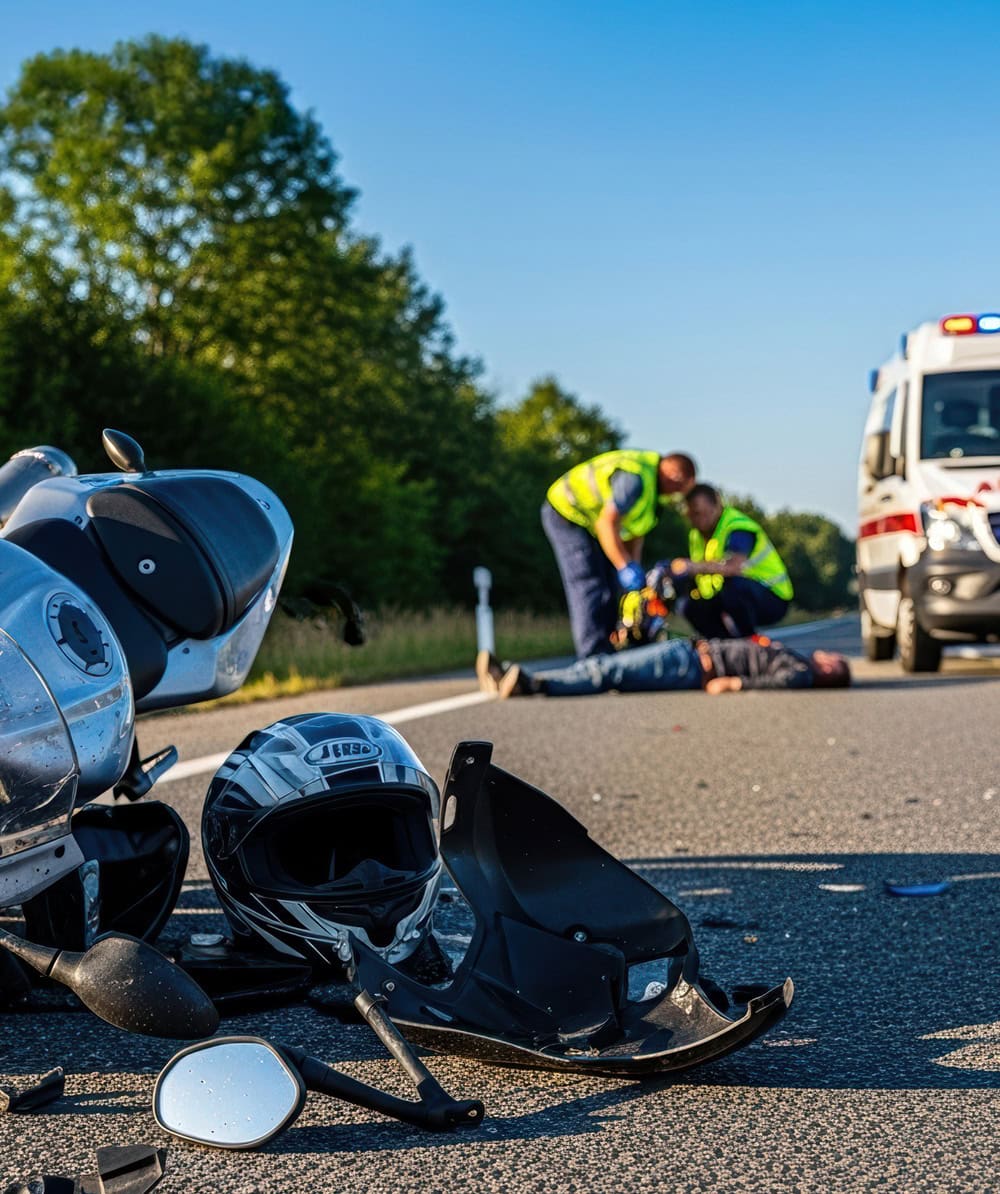
Motorcycle Accident Injuries We Represent
Motorcycle accidents don’t cause fender-benders. They cause life-changing injuries that turn families upside down.
Compensation Available for Indiana Motorcycle Accident Victims
If you’ve been injured in a motorcycle accident due to someone else’s negligence, you may be entitled to various types of compensation:
Economic Damages
These are quantifiable financial losses, including:
- Medical expenses (past, current, and future)
- Lost wages and reduced earning capacity
- Property damage to your motorcycle
- Rehabilitation and therapy costs
- Home modification expenses
Non-Economic Damages
These more subjective damages compensate for:
- Pain and suffering
- Emotional distress
- Loss of enjoyment of life
- Disfigurement and scarring
- Loss of consortium (impact on marital relationship)
Punitive Damages
In rare cases involving extreme recklessness or intentional misconduct, Indiana courts may award punitive damages designed to punish the wrongdoer and deter similar behavior.
Wrongful Death Damages
When motorcycle accidents result in fatalities, surviving family members may recover compensation for funeral expenses, loss of financial support, loss of companionship, and the pain and suffering of their loved one before death.
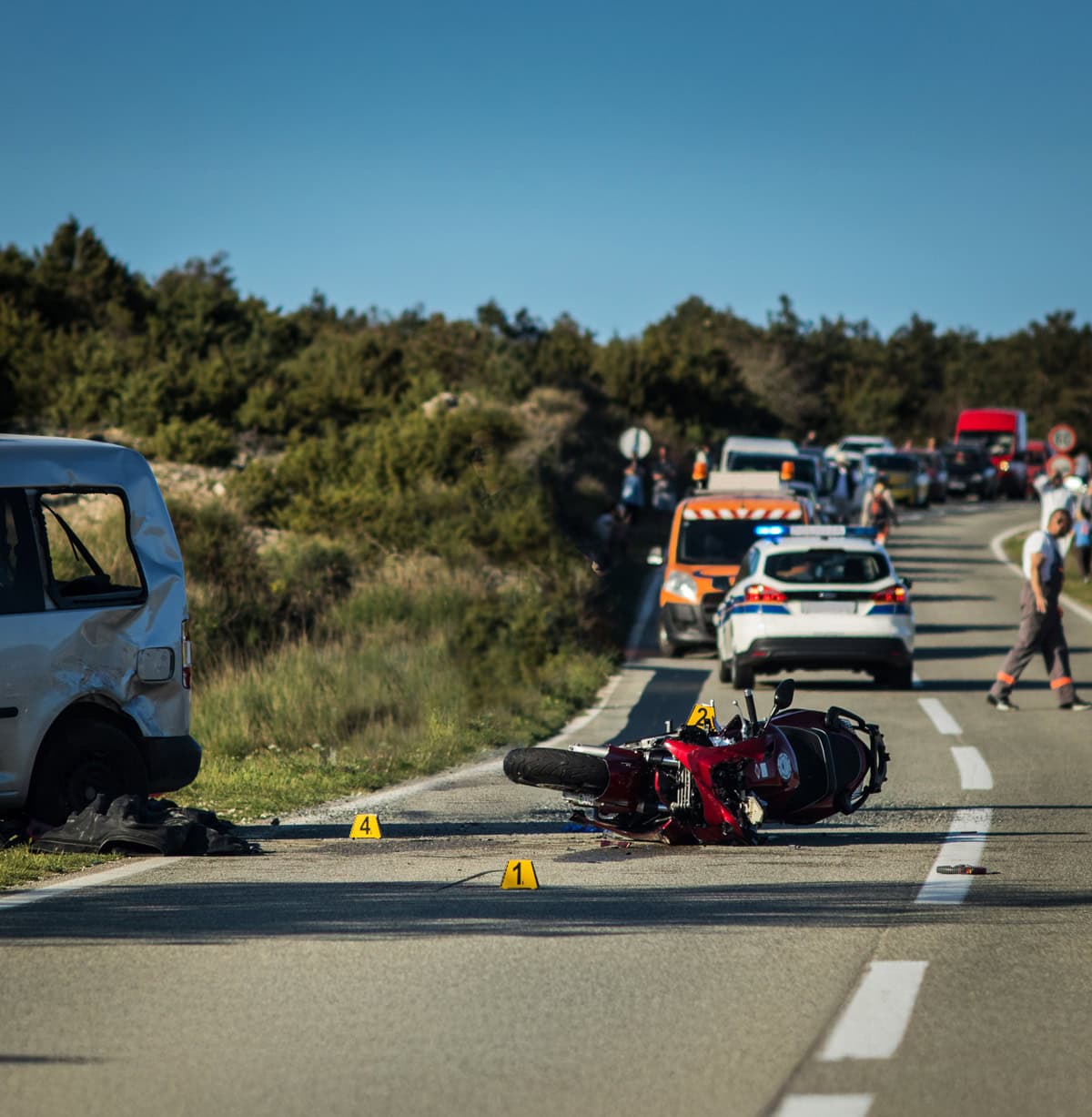
How Keller & Keller Injury Lawyers Investigates Indiana Motorcycle Accident Cases
Our meticulous approach to evidence gathering builds the strongest possible foundation for your claim.
Setting the Indiana Standard
Cutting-Edge Investigation Technology
While other law firms rely on outdated methods, Keller & Keller leverages cutting-edge technology to build stronger cases and win bigger settlements for our Indiana motorcycle accident clients.
Precision drone documentation
Captures accident scenes from angles impossible with traditional methods, providing evidence like skid marks, vehicle positions, and road obstructions that contributed to your motorcycle accident
Advanced voice-over-IP networks
Enables real-time collaboration between attorneys, investigators, and expert witnesses, ensuring no detail is overlooked in building your case
Forensic data extraction
Our technicians retrieve crucial evidence, including medical records, electronic communications, and surveillance footage that often prove negligence in motorcycle accident cases
Cloud-based case management
Provides you 24/7 access to your case information and status updates, keeping you informed during this difficult time without overwhelming you with unnecessary details
Rapid-response investigation
Allow us to conduct on-site evidence gathering within hours of an incident, preserving crucial evidence before it disappears or gets compromised
Service Areas
Indiana Cities We Serve
What Sets Keller & Keller Injury Lawyers Apart
With so many law firms advertising their services, why choose Keller & Keller? The differences are clear.
Zero Fee Guarantee
We believe everyone deserves quality legal representation, regardless of their financial situation. That’s why we work on a contingency basis. You pay absolutely nothing unless and until we win your case. No upfront costs, no hidden fees, no financial risk to you.
* Clients may owe court costs if they lose





No Fee Until We Win!
Get Started TodayDon’t Take Our Word For It!
See what our clients have to say about their experience with Keller & Keller.
View More Testimonials“I will refer and recommend Keller & Keller to any and everyone I know”
Charles
Not only will I choose Keller & Keller again, but I will refer and recommend Keller & Keller to any and everyone I know. If anyone comes to me and asks me for a law firm to represent their personal injury case, I will most definitely give you a five, no I’ll give you an eight-star. Yes, most definitely.
Take Action Now
Your Indiana Motorcycle Accident Claim Starts Here
Free Consultation
We’ll evaluate your case honestly and explain your options in plain English. We’ll come to you, whether you’re at home, in the hospital, or wherever is convenient.
We Fight
Our experienced team fights to investigate thoroughly, deal with insurance companies, and handle all the legal complexities while you focus on getting better.
You Recover
Focus on healing while we handle the rest. We’ll fight for you like we’d fight for our own family, because that’s exactly how we see you.
Zero Fee Guarantee
We believe everyone deserves quality legal representation, regardless of their financial situation. That’s why we work on a contingency basis. You pay absolutely nothing unless and until we win your case. No upfront costs, no hidden fees, no financial risk to you.
* Clients may owe court costs if they lose

The Keller Tradition:
Three Generations of Fighting for Indiana Families
Frequently Asked Questions
Have Questions? We’re here to help.
Injured and not sure what to do next?
We’ll help guide you through everything you need to know