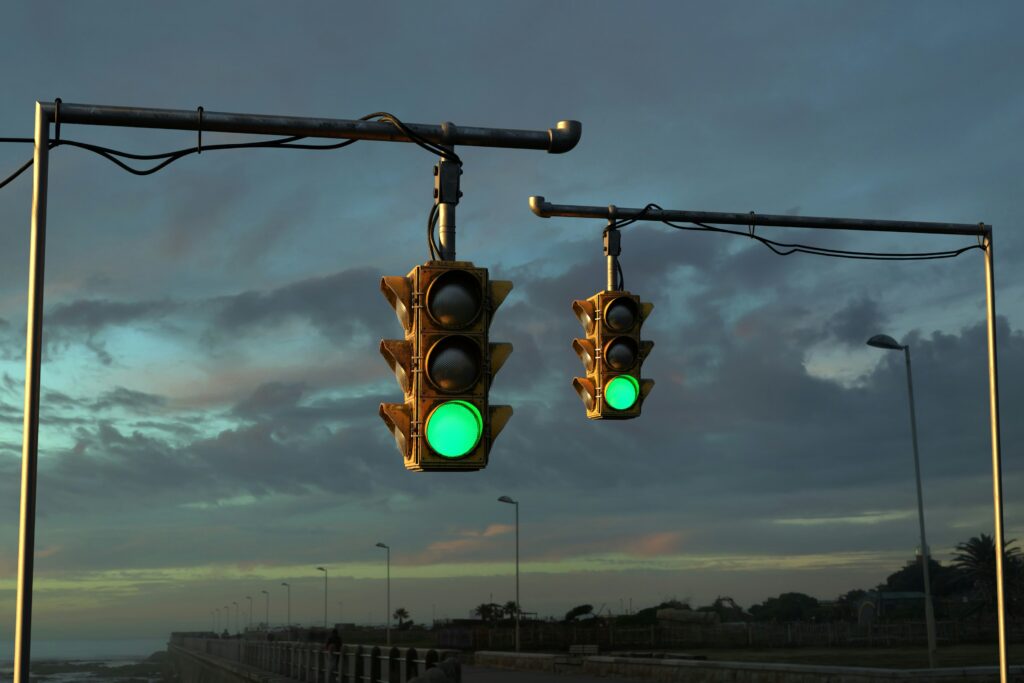
Albuquerque traffic signals are attracting attention for an unusual approach to speeding: making a timely green light part of the incentive to slow down.
An August 29, 2026, Associated Press report highlighted the city’s use of speed-sensitive signals along Lead and Coal avenues. The technology can give an earlier green to an approaching driver traveling at or below the posted limit. Read the AP report.
That raises an interesting question after a collision: if a driver had a green light, does that prove the driver was traveling safely?
A signal color alone cannot explain the full sequence of a crash.
How These Albuquerque Traffic Signals Work
The city’s technical study describes “rest-in-red” operation as a system that returns to red when no traffic is detected. Advanced detection can use an approaching vehicle’s speed to determine when to request a green signal.
The study explains that a vehicle exceeding a configured speed may not trigger the advance request and may encounter the red signal until reaching detection near the stop line. Read the city’s technical study.
The system is intended to influence driving behavior. It should not be treated as a certificate of safe driving for every vehicle that passes through on green.
Why “I Had the Green” May Leave Questions Unanswered
A driver’s account of the signal is important, but an investigation may need to examine more:
- Where was each vehicle when the signal changed?
- Was either driver turning?
- Was anyone already within the intersection?
- What do available records show about speed and braking?
- Did witnesses see the approach or only the impact?
These questions do not assume either driver was at fault. They help establish what happened.
A photograph taken afterward may show the intersection’s layout. It generally cannot establish the signal displayed at the moment of the crash.
A Traffic Sensor Is Not Necessarily a Video Camera
Equipment mounted near an intersection can serve different purposes. Do not assume that a device detecting vehicles also records video or stores information that can reconstruct a particular crash.
An attorney may investigate whether relevant signal records, recordings, or other data exist. Availability, retention, and access need to be confirmed.
Vehicle information may provide another piece of the picture. Keller & Keller’s article on black box data in New Mexico car accident cases explains how available technical data can be considered alongside other evidence.
Record the Exact Intersection and Direction
After addressing safety and medical needs, save the location, approximate time, and direction of travel.
Be specific. “Lead Avenue” covers more than one intersection, and different approaches may have different signals or movements.
Keep original photographs, witness contacts, and any available dashcam footage. Write down what you actually remember without guessing about a signal you did not see.
Keller & Keller’s guide to what to do immediately after a New Mexico car crash provides additional steps.
Technology Does Not Replace an Investigation
Albuquerque traffic signals can support safer streets, but resolving an individual crash still requires evidence.
The city continues to discuss safety measures along Lead and Coal, including signal improvements and other roadway alternatives. Proposed changes should not be confused with completed work at a particular intersection. City corridor-safety information.
If you were injured and the drivers disagree about what happened, contact Keller & Keller’s New Mexico team for a free case evaluation.