After a serious truck or commercial vehicle accident in New Mexico, the story told at the scene does not always match what really happened. Drivers, companies, and insurers may offer conflicting versions, and sometimes the person hurt or killed cannot speak for themselves.
That is where a truck’s “black box” — more accurately called an Event Data Recorder (EDR) or electronic control module data — can make a powerful difference. These systems record technical information about how a vehicle was being operated just before and during a crash, helping investigators reconstruct the collision with far more precision than eyewitness memories alone.
Local Crash Statistics: Why Black Box Data Matters in Albuquerque and New Mexico
Crashes happen far too often in Albuquerque, and when they do, the facts are not always clear. In one recent year, there were more than 19,000 reported crashes here, averaging about one crash every 27 minutes in Bernalillo County. Even in more recent years, Albuquerque has still seen well over 12,000 collisions annually, including thousands of injury crashes and dozens of fatal crashes—roughly 34 wrecks every single day. Across New Mexico, more than 48,000 crashes in a single year mean a collision somewhere in the state about every 11 minutes.
A number of familiar roads and intersections in Albuquerque see a disproportionate share of crashes. A Vision Zero review found that just a couple dozen road corridors account for a large percentage of traffic deaths in the city over a five‑year period. Intersections like Academy and San Mateo, Central and Rio Grande, and Central and Wyoming have each been the site of hundreds of crashes, with many involving serious injuries or the loss of life. When a crash happens on one of these busy routes, the “black box” in a vehicle can tell us what really happened in the moments before impact—how fast a driver was going, whether they braked, and how the vehicle responded.
New Mexico’s own crash reports line up with what these devices record. Common causes include driver inattention, failure to yield, and following too closely, while alcohol or drug use and speeding are major factors in many fatal wrecks. Black box data is designed to capture exactly this kind of information, including speed, throttle and brake use, and seatbelt status. For someone who has been hurt in a crash in Albuquerque or anywhere in New Mexico, that objective data can be a powerful piece of evidence. It can help cut through conflicting stories, support your version of events, and give our team the tools we need to fight for the full and fair recovery you deserve.
What is a truck black box?
In aviation, people think of a black box as a device that records flight data and cockpit audio. Most modern motor vehicles have their own version of this technology. NHTSA defines an Event Data Recorder as a device installed in a vehicle to capture safety-related technical information for a brief period of time before, during, and after a crash.
In passenger vehicles, EDR functions are commonly integrated into the air bag control module. In commercial trucks and other heavy vehicles, relevant electronic evidence may be stored in several different components, such as the engine control module, braking system modules, or other onboard computers tied to car use.
What data can these systems record?
The exact information depends on the vehicle’s year, make, model, and installed systems, but for many light vehicles NHTSA’s EDR framework may include data points such as:
- Indicated vehicle speed.
- Engine throttle position.
- Brake on/off status.
- Seat belt status for certain seating positions.
- Change in velocity over time and air bag deployment timing.
Additional data elements that may be available on some vehicles include:
- Anti-lock brake system (ABS) activity.
- Steering-related information, such as steering wheel angle.
- Engine RPM and stability-control activity.
- Front passenger belt status and occupant detection, where supported.
Commercial trucks can store operating and crash-related data in multiple modules rather than a single EDR unit, which makes it important to identify every source of electronic evidence. FMCSA and research materials discuss the role of electronic control module and crash data in understanding large truck and bus crashes.
EDRs in trucks, buses, and trains
Although most people associate black boxes with cars and trucks, the same concept shows up in other transportation modes. Event Data Recorder systems are used in rail transit to log information such as train speed, braking commands, and automatic control system inputs. Research and agency publications have also examined EDR-style systems in commercial motor vehicles, including buses and school buses, to improve understanding of crash data and safety issues.
Many modern school buses use electronic telemetry that can record GPS information, door status, warning light activation, and other parameters that can be critical after a serious incident. When combined with video and other evidence, this kind of data can provide a timeline of what the driver and vehicle were doing at key moments.
Why this evidence matters in New Mexico truck cases
Truck and bus accidents frequently cause life-changing injuries or wrongful death, and liability is often heavily contested. Black box data helps move a case beyond “he said, she said.” Technical crash data can be used to evaluate whether:
- The truck was speeding or traveling too fast for conditions.
- The driver braked late, not at all, or in an unusual pattern.
- There was any evasive steering input before impact.
- Cruise control or other systems were engaged.
- Safety systems activated as expected.
This is especially important in New Mexico because the state follows a pure comparative fault system. Under New Mexico’s comparative fault rules and several liability statute, an injured person’s compensation can be reduced by their percentage of fault but is not automatically barred unless they are 100 percent at fault. Strong technical evidence can push back against unfair attempts to shift blame onto the victim.
Case example: Fire truck runs a long red light
In one Keller & Keller Injury Lawyers case, a fire truck struck and killed a motorist in an intersection. The fire truck operator told law enforcement that they had the green light and that the other driver ran the red light, and tragically the victim did not survive to give a statement.
Keller & Keller’s investigation uncovered video surveillance showing the traffic signal had been red for 24 seconds before the fire truck entered the intersection. Event data from the fire truck’s electronic systems was then obtained, and the combined evidence revealed that the fire truck driver drove through a long-red light at approximately 59 miles per hour before impact. Together, the electronic data and video helped establish what really happened and contributed to a successful recovery for the client’s family.
Case example: School bus telemetry in a wrongful death
We also represented the family of a young school-aged client who was tragically killed because a school bus operator failed to follow established safety procedures. Modern school buses can record telemetry data specific to their operation, such as GPS location, door status, activation of yellow warning lights, flashing red lights, and deployment of stop arms.
In that case, the telemetry data demonstrated that the driver did not activate and sequence the safety systems as required, supporting the allegation that the driver violated policies designed to protect students. When paired with other evidence, this helped secure a judgment for the grieving family, providing financial security and accountability even though no legal result can truly make up for the loss of a child.
Trains and other heavy systems
Event Data Recorders are also widely used in rail transit and train locomotives. Federal research and guidance describe how these devices log train speed, braking commands, automatic train control information, and other operational data that can later be analyzed after an accident. Similar to trucks, this type of data can be matched with video and physical evidence to reconstruct events and evaluate whether safety rules were followed.
Why timing is critical for black box data
Electronic data is fragile in the sense that it can be lost if not preserved correctly. Trucks may be repaired, returned to service, sold, or scrapped. Modules may be reset, overwritten, or damaged. To protect the evidence:
- Spoliation and preservation letters should be sent quickly.
- The truck, bus, or train should be secured and made available for inspection.
- Qualified experts should be engaged early to identify, image, and download all relevant modules using proper tools and protocols.
NHTSA’s regulations require that manufacturers provide commercial tools to retrieve EDR data from covered vehicles, but retrieval still depends on proper access and technical expertise. For heavy trucks and buses, the process can involve several different systems and brands of equipment.
EDR technology and download tools
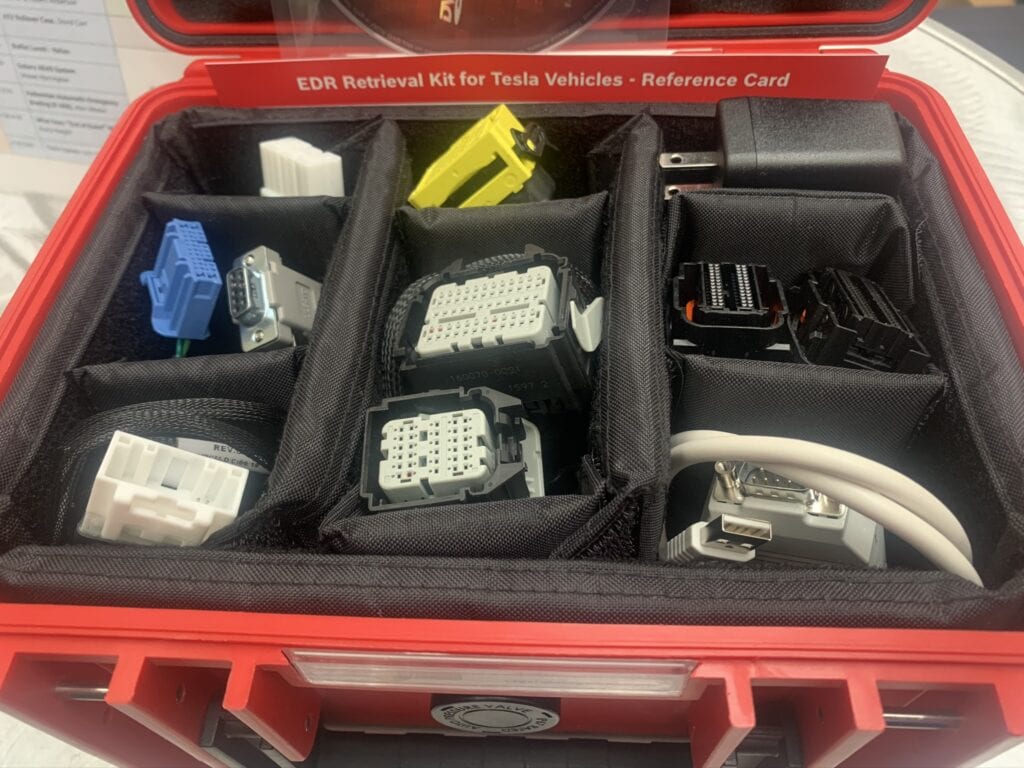
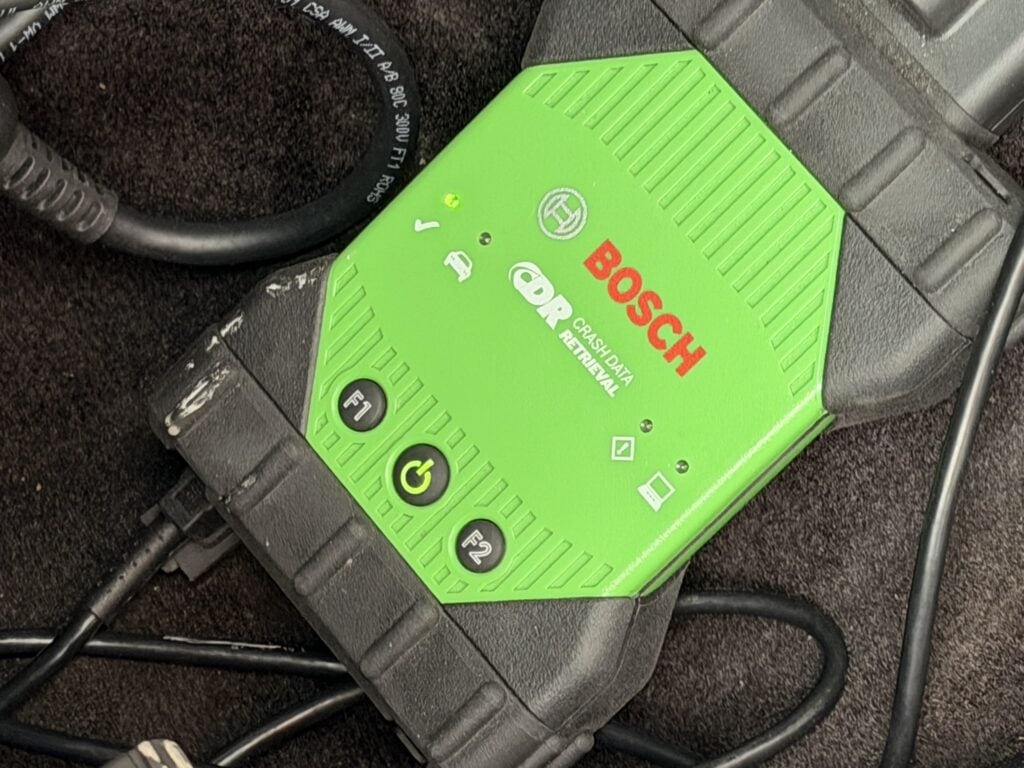
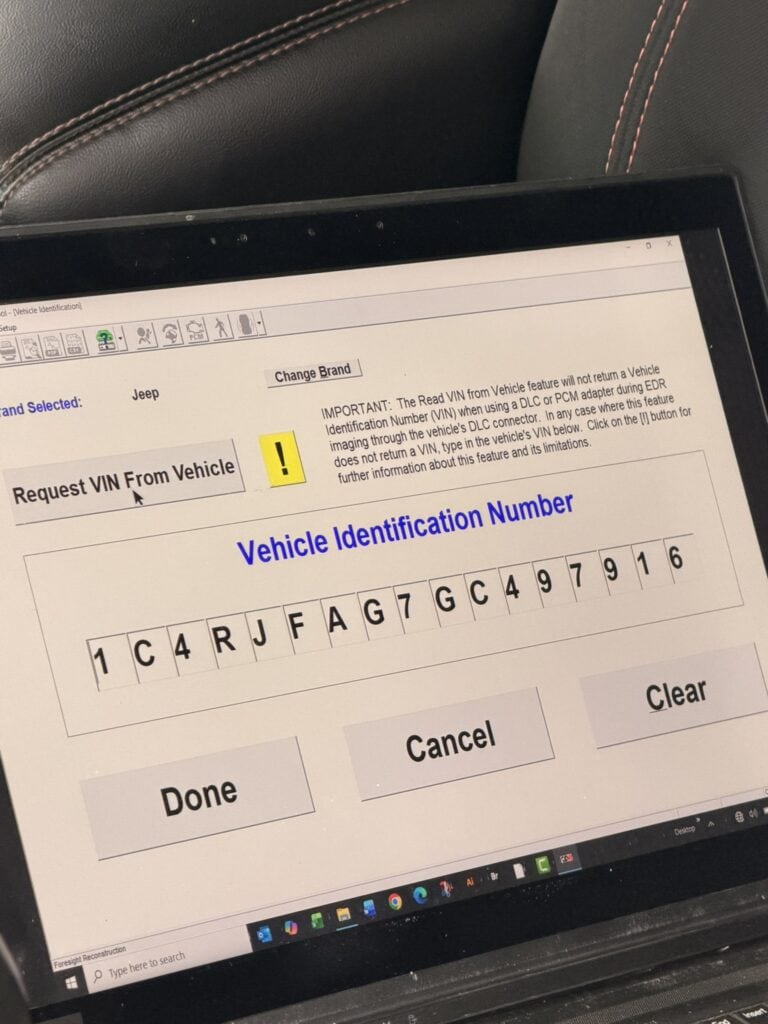
Because there is no single universal standard across all manufacturers, crash investigators often rely on specialized hardware and software to access EDR and module data. Bosch’s Crash Data Retrieval (CDR) system is one of the most widely used tools, and its published coverage lists show thousands of supported year–make–model combinations across passenger vehicles and light trucks.
Some manufacturers require brand-specific hardware, and others, such as certain electric vehicle brands, like Tesla, offer their own proprietary solutions. Publicly available coverage lists and kits help trained professionals determine which cables, adapters, and software versions are required for a particular vehicle. Choosing the right tool and procedure matters because an improper attempt can risk losing data or producing incomplete downloads.
How black box data fits into a full investigation
Black box data is a powerful supplement to traditional investigative work. The most effective truck, bus, and train cases combine:
- EDR or module data from all relevant systems.
- Scene photographs, measurements, and physical evidence.
- Vehicle inspections and engineering analysis.
- Surveillance footage and onboard camera video when available.
- Witness statements and law enforcement reports.
- Expert crash reconstruction testimony.
When those layers of evidence point in the same direction, the result can be a compelling, fact-based narrative that stands up to insurance-company scrutiny and defense arguments.
How New Mexico Law Treats EDR Evidence
The Daubert–Alberico standard for experts
EDR evidence in a New Mexico truck or bus case only reaches the jury through expert testimony, and that testimony must pass New Mexico’s Daubert–Alberico test. New Mexico’s Supreme Court adopted a Daubert-style reliability framework in State v. Alberico, replacing the old Frye “general acceptance” test for scientific evidence.
Under the Alberico portion of the standard, three things must be true before an expert can talk about EDR data: the witness must be qualified in the relevant field, the testimony must actually help the jury decide an issue in the case, and the opinions must be limited to scientific, technical, or specialized knowledge within that expert’s real expertise. On top of that, New Mexico courts look to the familiar Daubert factors: whether the technique can be and has been tested, whether it has been peer-reviewed and published, its known or potential error rate, and whether it is generally accepted in the relevant scientific community.
New Mexico adds a fifth, explicit expectation: courts ask whether the expert’s scientific methodology is grounded in established scientific methods and principles, not just in experience alone. In practical terms, that means an EDR expert in a New Mexico truck case needs more than a résumé — there should be clear documentation that Bosch CDR technology and EDR-reconstruction practices are testable, peer-reviewed, have known error characteristics, and are widely accepted among crash reconstruction professionals.
For a firm like Keller & Keller, the takeaway is easy: every EDR case in Albuquerque or anywhere in New Mexico should be built with a Daubert–Alberico hearing in mind. That means retaining Bosch CDR–certified reconstructionists, citing peer-reviewed literature and industry standards on EDR reliability, and being ready to walk the court through why the download method, error rates, and interpretive steps all meet New Mexico’s five-part reliability test.
Computer-generated evidence: animations vs. simulations
New Mexico has also drawn a clear line between two types of computer-generated evidence, and that distinction matters when EDR data is used in graphics or models. In State v. Tollardo, the Court of Appeals explained that “computer animations” are demonstrative aids used to illustrate an opinion formed independently of the computer, while “computer simulations” are exhibits where the computer processes data and generates the conclusion itself.
Because animations are treated as demonstrative evidence, the key question for admissibility is whether the animation fairly depicts what it is supposed to show. In contrast, if an expert’s opinion depends on a computer simulation — for example, a program that calculates impact speed from EDR inputs — the proponent has to show that the underlying model and the way the data were processed are scientifically valid and reliable.
For EDR-heavy trucking cases, that framework creates a strategic opening. When Keller & Keller Injury Lawyers uses an animation that visually illustrates speed, braking, or other uses with already accepted EDR numbers, the animation itself is usually easier to admit because it is treated as a visual aid, not a separate scientific test. But if the story is “the software computed 72 mph,” we must be ready to prove that the software’s calculation method and use of EDR data satisfy the Daubert–Alberico reliability requirements just like any other scientific technique.
Spoliation: plaintiff-favorable preservation rules
New Mexico’s spoliation law is extremely helpful to injured plaintiffs when crucial electronic evidence is altered or lost. In Torres v. El Paso Electric Co., the New Mexico Supreme Court held that the duty to preserve evidence arises when litigation is reasonably foreseeable, not only after a lawsuit is filed or formal notice is given. The court framed the key question as whether the party knew there was a probability of a future lawsuit, which is often true immediately after a serious truck or bus crash.
New Mexico courts also have broad authority to impose sanctions when evidence is destroyed or not preserved, and they look at several factors before doing so. Those factors include the fault of the party who lost or altered the evidence, the level of prejudice to the other side, and whether a lesser sanction could avoid substantial unfairness. Importantly, New Mexico case law explains that a finding of bad faith or an “evil motive” is not always required before sanctions can be imposed for destroyed evidence, especially where the prejudice is substantial.
When spoliation is found, New Mexico’s uniform jury instruction allows the court to tell jurors they may infer that missing evidence would have been unfavorable to the party who controlled it. The duty to preserve extends to electronically stored information under New Mexico’s civil discovery rules, which means EDR data is squarely within the preservation obligation once litigation is foreseeable.
For Keller & Keller, that means trucking companies and their insurers who repair, sell, or put a damaged tractor back into service — thereby cycling the ignition and risking overwriting EDR memory — can face serious consequences even without a proven malicious intent. If the plaintiff can show foreseeability of litigation, loss of critical black box data, and resulting prejudice, an adverse inference instruction can become a great tool in a close liability case.
No New Mexico EDR-specific privacy statute
While many states have enacted specific privacy statutes governing who can access EDR data and under what conditions, New Mexico has not adopted a dedicated EDR privacy law. Surveys of state EDR statutes list more than a dozen states with EDR access and privacy provisions, and New Mexico is not among them.
In practice, this means access to EDR information in New Mexico civil cases is governed by the ordinary discovery rules in Rule 1‑026 NMRA and related provisions. A plaintiff’s lawyer generally does not need to navigate a special state consent statute; instead, properly drafted requests for production, subpoenas, or preservation and inspection orders are the primary tools for obtaining crash data from defendants once litigation is underway.
At the same time, the federal Driver Privacy Act of 2015 provides that EDR data is the property of the vehicle’s owner or lessee, which creates a default ownership rule that still takes effect in New Mexico. In a civil lawsuit, that ownership interest typically gets resolved through discovery and court orders rather than blocking access altogether.
Rule 11‑702 NMRA: the expert rule behind it all
All of these concepts are anchored in New Mexico’s core expert testimony rule, Rule 11‑702 NMRA. The rule, which parallels the federal rule, requires that expert testimony be based on sufficient facts or data, be the product of reliable principles and methods, and reflect a reliable application of those methods to the facts of the case.
New Mexico appellate decisions interpreting Rule 11‑702 emphasize the trial court’s “gatekeeper” role — judges must ensure that expert opinions on technical topics like EDR downloads, speed calculations, and crash reconstructions rest on a sound foundation before the jury ever hears them. That gatekeeping function is where the Daubert–Alberico factors, Tollardo’s animation–simulation distinction, and the spoliation framework all intersect in serious Albuquerque truck cases that depend heavily on black box evidence.
The strategic checklist in an Albuquerque EDR case is clear: move fast on preservation under Torres, hire Bosch CDR–certified reconstruction experts who can satisfy all five Daubert–Alberico factors, decide early whether to present EDR-based visuals as animations under Tollardo, use standard discovery tools to compel access to EDR data in the absence of a restrictive state privacy statute, and, if key data was lost, be prepared to pursue a spoliation instruction that let a jury draw their own inferences.
Keller & Keller’s truck and commercial vehicle results
Keller & Keller Injury Lawyers has decades of experience representing injured people and their families and maintains an office and full-service practice in New Mexico. Some of our New Mexico cases have resulted in:
- A $48.5 million semi-truck settlement described as one of New Mexico’s largest pre-trial settlements, obtained after an aggressive investigation into a fatal head-on collision.
- A $20 million semi-truck settlement following a collision that caused catastrophic injuries, including an above-knee amputation, where extensive reconstruction and expert work were emphasized in the firm’s public materials.
- A $1.1 million semi-truck accident and a $600,000 semi-truck accident.
While past results do not guarantee future outcomes, they showcase our ability to handle high-stakes commercial trucking cases that require granular reconstruction and expert testimony.
When you’re dealing with serious injuries, these numbers are more than simple statistics—they reflect a real family whose lives changed in an instant on Albuquerque’s roads. In case after case, we’ve seen how black box data can help fill in the gaps when memories are blurry or the other driver won’t accept responsibility.
Our Albuquerque legal team works with investigators and crash reconstruction experts to secure and analyze this data as early as possible, so it isn’t lost or overwritten. If you were hurt in a crash anywhere in New Mexico, we can review whether your vehicle’s black box information may help prove what really happened and use it to build the strongest claim on your behalf.