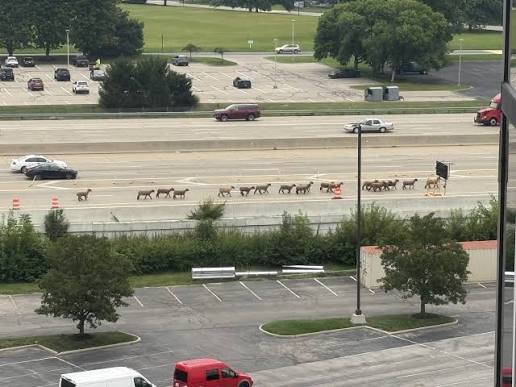
Quick summary: On August 6, 2026, a three-vehicle crash on I-465 eastbound near Keystone Avenue in Indianapolis sent 18 sheep wandering across the interstate after the trailer hauling them was involved in a collision with two semi trucks. One sheep was injured, no people were hurt, and quick-thinking drivers helped corral the animals until authorities arrived. The story went viral for its unusual visuals — but it’s also a useful, real-world example of how multi-vehicle and commercial crashes get investigated, and who can be held responsible when they happen.
What Happened on I-465
According to Indiana State Police and local reporting, a pickup truck hauling a livestock trailer collided with a semi tractor-trailer and a semi tractor-tanker on I-465 eastbound near Keystone Avenue during the Thursday afternoon commute. The crash caused the trailer carrying 18 sheep to open, and the animals began walking across the interstate. Indiana State Police Sgt. John Perrine said several motorists used their own vehicles to help corral the sheep into a contained area until first responders arrived. One sheep was injured in the trailer; no people involved in the crash were hurt. INDOT closed three lanes between Westfield Boulevard and Meridian Street while crews cleared the scene and loaded the sheep onto a replacement trailer.
It’s an unusual and even funny story on the surface. But strip away the sheep, and this is a textbook example of the kind of multi-vehicle, commercial-vehicle crash Keller & Keller Injury Lawyers handles regularly on Indiana’s interstates.
Why This Type of Crash Is More Complicated Than It Looks
Most people picture an Indianapolis car accident as a simple two-vehicle fender bender. But crashes involving multiple vehicles — especially when commercial trucks or trailers are involved — raise legal questions that a standard accident doesn’t.
Key complicating factors in a crash like this include:
- Multiple potentially liable parties. When three vehicles are involved, determining fault isn’t always a straight line — it may involve more than one driver, a trucking company, or a cargo-securement failure.
- Commercial vehicle regulations. Semi trucks and trailers hauling cargo (including livestock) are subject to federal and state regulations covering weight limits, cargo securement, and driver hours-of-service. A violation of any of these can become central to a liability claim.
- Cargo and load securement issues. Whether it’s livestock, freight, or equipment, an improperly secured or contained load that escapes or shifts during a crash can create additional liability exposure for the trucking company or owner, separate from the initial collision itself.
- Roadway hazard exposure. Once cargo, debris, or in this case, animals, end up in the roadway, every driver approaching that stretch of highway is suddenly at risk of a secondary crash — which can create a second wave of claims entirely separate from the original collision.
What Drivers Should Do If They’re Involved in a Multi-Vehicle Crash
Whether the hazard is spilled cargo, a jackknifed trailer, or something as unusual as loose livestock, the fundamentals of protecting yourself after a crash stay the same:
- Check for injuries and call 911 — even if injuries seem minor at first.
- Move to safety if possible, but don’t leave the scene.
- Document everything — photos of all vehicles involved, the roadway, skid marks, and any cargo or debris in the road.
- Get the official crash report — for multi-vehicle wrecks involving commercial trucks, the state police or INDOT report will be a key piece of evidence.
- Avoid giving recorded statements to other parties’ insurance companies before speaking with an attorney, especially when a commercial vehicle is involved.
- Get medical care and keep records — insurance companies for trucking or cargo companies often move quickly to limit their exposure.
Frequently Asked Questions
Q: Who is liable if a commercial vehicle’s cargo causes a secondary accident? A: It depends on the facts, but liability can extend to the vehicle’s driver, the trucking or hauling company, and in some cases, whoever was responsible for securing the load. Federal trucking regulations often play a role in these determinations.
Q: Does it matter that no one was seriously hurt in the I-465 crash? A: Not every multi-vehicle crash results in serious injury, but the same legal principles apply regardless of injury severity. When injuries do occur — including from secondary crashes caused by road hazards — the liability analysis is the same.
Q: What makes commercial truck crashes different from regular car accidents in Indiana? A: Commercial vehicles are subject to additional state and federal regulations that don’t apply to passenger vehicles, including rules on cargo securement, vehicle maintenance, and driver hours of service. These add extra layers of evidence and potential liability.
Q: What should I do if I’m involved in a crash caused by something unusual in the roadway, like debris or an animal? A: Treat it like any other crash — prioritize safety, document the scene, and consult an attorney before accepting blame or giving statements to other insurers, since fault may lie with whoever failed to secure the hazard in the first place.
The Bottom Line
The I-465 sheep story made headlines because it’s unusual — but the legal issues underneath it are ones Keller & Keller Injury Lawyers sees often on Indiana’s interstates: multi-vehicle crashes, commercial trucking liability, and the dangers created when something ends up in the road that shouldn’t be there. If you’ve been involved in a multi-vehicle or commercial truck crash in Indiana, Keller & Keller Injury Lawyers can help you understand who may be responsible and what your options are — with no fee unless we win your case.