The Fourth Amendment to the United States Constitution guarantees the right of the people
to be secure in their persons, houses, papers, and effects against unreasonable searches
and seizures.
In nearly every political ad, candidates often mention they want to increase your safety. The
government is expected to provide public safety as a core function of governance. Between
$300 billion and $450 billion is spent annually on criminal justice, law enforcement, and
corrections in the United States. Technological advancements in modern crime-fighting
tools have raised — and will continue to raise — important questions about the privacy rights
of citizens.
From Boots on the Ground to Specialized Task Forces
Traditionally, increased enforcement efforts focused on putting more officers on the streets,
based on the idea that a greater police presence would improve the odds of catching
criminals in the act. This approach later evolved into specialized task forces, where officers
with shared expertise collaborated to address specific threats, such as Joint Terrorism Task
Forces or Internet Crimes Against Children Task Forces. These largely effective teams still
exist.
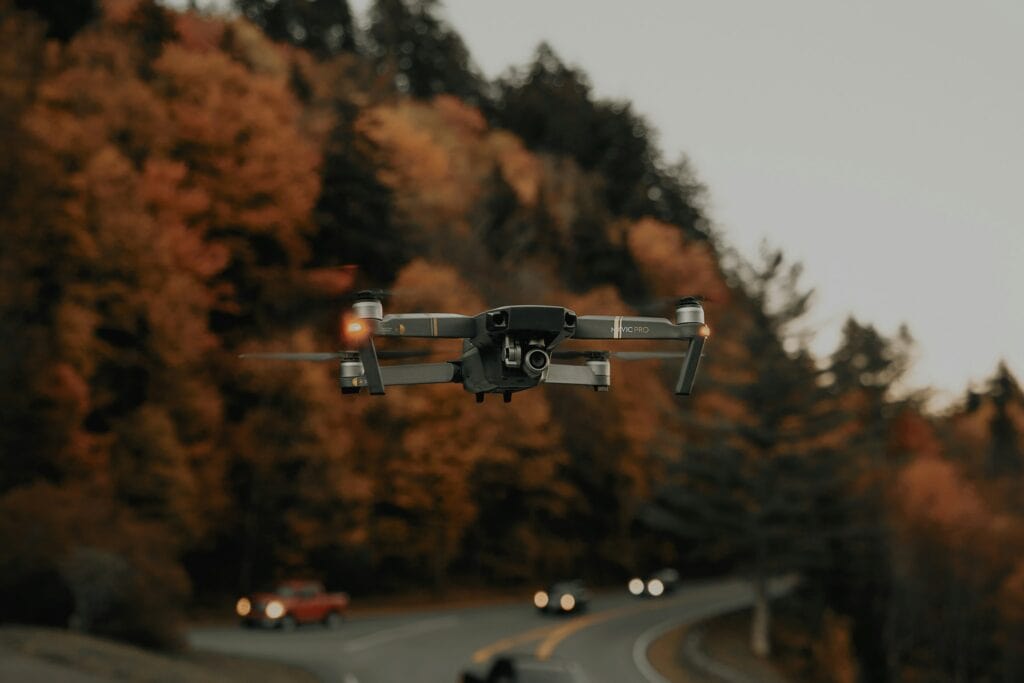
The Rise of Drone Technology in Policing
Today’s law enforcement leaders are frequently required to “do more with less.” As a result,
they have turned to creative and technological solutions to combat crime. In the 2010s,
while some agencies disbanded traditional aviation units due to high operating costs, drone
technology was simultaneously entering mainstream use. Law enforcement quickly
adopted drones to search for fleeing suspects. Drones equipped with thermal imaging
sensors now help locate missing persons with mental illness or medical conditions, as well
as those swept away by floodwaters. They are also used to map crash scenes and reopen
roadways more quickly than traditional methods. Some agencies have implemented Drones
as First Responders (DFR) programs, staging fixed drones on buildings that operators in a
station or real-time crime center can launch to rapidly assess scenes and threats before
ground units arrive. SWAT teams even use drones to enter structures where armed
individuals are barricaded, identifying threats and their locations to improve safety.
Indiana’s Drone Privacy Law: IC 35-33-5-9
Privacy concerns surrounding drones led to new laws, such as Indiana’s IC 35-33-5-9. This
statute requires law enforcement to obtain a search warrant before using a drone on or over
private property, or to conduct a search, perform surveillance, obtain photographs, or
capture videos of private property or of individuals, items, or structures located on private
property without the owner’s consent.
History shows that technological growth is often followed by laws like IC 35-33-5-9 that
establish privacy guardrails. However, technology typically advances faster than legislators
can react. One example is the widespread adoption of automated license plate reader
(ALPR) technology, with Flock Safety among the leading providers.
Automated License Plate Readers and Flock Safety
ALPR systems use cameras to capture still images of passing license plates. Optical
character recognition and advanced image analysis then record the plate numbers along
with vehicle characteristics such as color, make, and other distinguishing features. This data
is time-stamped, stored for a set period, and made searchable by authorized users. For
instance, if a suspect flees a crime scene in a red Ford with a rear bumper sticker,
investigators can search the system for matching vehicles in the relevant area and
timeframe, often generating leads quickly. Agencies that heavily use Flock Safety ALPRs
have reported success locating suspects in murders, road-rage shootings, domestic
violence cases, missing-person incidents, and hit-and-run crashes.
Although Flock Safety is best known for ALPRs, the company offers roughly two dozen
product lines. In addition to plate readers, it provides AI-enabled video cameras for
monitoring parking lots, intersections, and parks; mobile camera trailers for temporary
deployment; and audio detection devices that can alert agencies to gunshots, severe
crashes, street takeovers, or the sound of catalytic converters being stolen. The company
also markets tools for monitoring in-progress 911 calls and advanced search capabilities
that allow investigators to query video and vehicle data using natural-language descriptions
(for example, “red truck with a ladder”). Flock even offers Drone as First Responder systems.
Its portfolio is far broader and more sophisticated than ALPRs alone.
Facial Recognition and AI-Enabled Search
Other emerging technologies involve utilizing facial recognition technology with advanced
artificial intelligence and video/image search capabilities. With the power of robust
advanced data centers becoming more commonplace, expect to see increased utilization
of facial recognition technology in law enforcement as the ability to quickly search millions
of electronic images efficiently continues to increase.
Body-Worn Cameras and Retrofitted ALPR Capability
For years, agencies nationwide have been encouraged to adopt body-worn and dashboard
cameras despite their significant cost. The public and jurors have largely come to expect this
technology. Modern systems now allow many of these cameras to be retrofitted with ALPR
capabilities, enabling them to capture plate and vehicle data as well. This has proven
valuable: officers arriving at violent crime scenes often unknowingly pass the suspect as
they flee. The ability to search responding officers’ footage for vehicle information can rapidly
identify — or exonerate — suspects when combined with other investigative tools.
Some members of the public view these technologies as unreasonable “searches and
seizures” that they feel violate constitutional rights. In some cases, people have vandalized
or stolen Flock ALPR units. Yet one must ask: what is the fundamental difference between
an officer standing on a street corner photographing passing cars and a network of cameras
doing the same work at greater scale and efficiency? Do we want law enforcement to be
efficient and effective?
The Need for Guardrails as Technology Evolves
Law enforcement misuse of technologies is a popular media headline and rightfully
amplifies public concerns. Most roads have curves, and many curves have guardrails; the
need for guardrails to establish reasonable and appropriate use policies and oversight is
clear and universally embraced among both the public and law enforcement professionals.
If history is a guide, courts and legislators will eventually establish additional guardrails for
these and future technologies. With the growth of data centers, even more data-intensive
crime-fighting tools are likely to emerge. Society will ultimately need to decide how to
balance perceived or potential privacy concerns against the benefits of detecting and
preventing violent crime and swiftly apprehending those who victimize law-abiding citizens.
Moving Forward: Transparency and Public Trust
In the meantime, it is incumbent upon law enforcement to share the successful utilizations
of these technologies so that those who feel uncertain about their use can better understand
how these technologies make them safer, catch criminals, and exonerate the innocent.
About the author: Bryan Wolfe graduated from the University of Indianapolis and the Indiana Law Enforcement Academy in 1999 and has served as a law enforcement officer since 1998. While continuing multiple decades of public service, he is also the Chief Investigator for the multi-state Keller & Keller Injury Lawyers law firm headquartered in Indianapolis, IN.