
Michigan repealed its unique drug immunity statute effective February 13, 2024)/mileg.aspx?objectname=2023-SB-0410&page=GetObject), when Public Act 285 of 2023 (Senate Bill 410) took effect. FDA approval no longer gives pharmaceutical manufacturers an absolute statutory shield against product liability claims in Michigan. For injuries occurring on or after that date, most legislative analysis indicates injured Michigan residents can now sue drug makers under ordinary product liability theories, much as residents of other states already could.
TL;DR:
- Michigan residents injured after February 13, 2024, can now sue drug manufacturers under standard product liability theories, no longer blocked by absolute FDA approval immunity.
- The repeal removes the presumption that FDA-approved drugs are not defective, with courts likely to treat FDA approval as one factor, not a complete defense.
- Lawsuits for injuries occurring before the repeal date are still governed by the old immunity law unless specific exceptions apply, and case timing is crucial.
- The change aligns Michigan with other states, especially impacting failure-to-warn claims where prior immunity discouraged litigants from pursuing claims.
- Manufacturers and insurers must now reassess legal risk and coverage for Michigan-based injuries, as previous protections no longer apply after February 13, 2024.
Table of Contents
- What the legislature changed: SB 410 and the statutory text
- How the repeal works in practice: retroactivity, accrual, and choice of law
- What this means for product liability claims in Michigan
- Practical steps for plaintiffs and governments considering a claim
- Why trust this guidance: Keller & Keller and the author’s credentials
- Historical background and purpose of the original Michigan drug immunity law
- Key legal definitions and scope of the original immunity
- Implications for healthcare providers and pharmaceutical companies
- Potential impact on insurance claims and coverage related to drug injury lawsuits
- Guidance for plaintiffs: how repeal affects filing new claims or ongoing cases
- Author perspective: measured view on accountability versus litigation risk
- Keller & Keller product liability services and free case evaluation
- FAQ
- Sources
- Primary sources and official documents
What the legislature changed: SB 410 and the statutory text
The repeal came through Senate Bill 410)/mileg.aspx?objectname=2023-SB-0410&page=GetObject), enacted as Public Act 285 of 2023. The bill struck language from Mich. Comp. Laws § 600.2946 that had been in place since 1995, when Public Act 249 created a presumption that an FDA-approved drug was not defective or lacking proper warnings, according to the Senate Fiscal Agency’s bill analysis. That presumption functioned, in practice, as something close to an absolute defense for manufacturers.
The key changes include:
- The repeal of the subsection that treated FDA approval as conclusive proof a drug was not defective.
- Removal of the near-total bar on product liability suits involving federally regulated prescription drugs.
- Retention of other evidentiary provisions in § 600.2946 governing what counts as admissible evidence in a product liability action, which still shape how a case gets built and argued.
Michigan had been the only state in the country with this kind of absolute statutory protection. The legislative analysis frames the repeal as bringing Michigan in line with the rest of the country, rather than creating a new or experimental legal standard.
How the repeal works in practice: retroactivity, accrual, and choice of law
Whether the repeal reaches a particular case depends heavily on timing. Michigan courts apply a presumption against retroactivity unless the legislature says otherwise in the statutory text, a standard shaped by the Michigan Supreme Court’s LaFontaine framework. SB 410 contains no explicit retroactivity language, so legal commentary generally treats the change as prospective.
- A cause of action for a drug injury typically accrues when the injury occurs or is discovered, not when the lawsuit is filed.
- Injuries that happened before February 13, 2024 will likely remain governed by the old immunity provision, even if the lawsuit itself is filed afterward.
- For injuries split across state lines, or where manufacturers are headquartered elsewhere, choice-of-law rules may still pull in Michigan’s former immunity for conduct and injuries that predate the repeal, which matters for multidistrict litigation involving Michigan plaintiffs.
Practitioner commentary, including analysis published on Lexology, expects early court rulings to test exactly where that line falls.
What this means for product liability claims in Michigan
For injuries accruing on or after February 13, 2024, Michigan plaintiffs can now pursue the same core theories available in most other states: negligence, failure to warn, design defect, and misrepresentation. The difference between the old law and the new landscape comes down to the type of legal barrier involved.
- The old statute created an absolute bar: FDA approval meant the drug was presumed, as a matter of law, not to be defective.
- The repeal removes that bar for qualifying claims, though it does not eliminate FDA approval as a piece of evidence.
- Courts will likely treat FDA approval as one factor a jury can weigh, rather than a fact that forecloses the case before it starts.
No other state currently has a statute matching Michigan’s former absolute immunity provision, according to the Senate Fiscal Agency’s bill analysis, which means Michigan plaintiffs are now litigating on closer to the same footing as claimants nationwide. That shift matters most for failure-to-warn claims, where plaintiffs argue a manufacturer knew about a risk and did not adequately disclose it, regardless of what the FDA approved at the time.
Practical steps for plaintiffs and governments considering a claim
Michigan’s general product liability limitations period runs three years from accrual, with accrual tied to when the injury happened or reasonably should have been discovered, per provisions referenced in MCL § 600.5805. Given the retroactivity questions above, the exact accrual date for a drug injury claim deserves careful attention before anyone assumes a deadline has or has not passed.
- Gather medication bottles, labels, and any remaining product samples before they get discarded or lost.
- Request complete pharmacy and prescription records showing dosage, refill dates, and prescribing physicians.
- Collect medical records documenting the injury, diagnosis, and treatment timeline.
- Note any employer or usage records if the medication relates to a workplace injury or occupational exposure.
- Speak with an attorney promptly to confirm when your claim accrued and whether the old or new law applies.
Pro Tip: Keep a written timeline of when you started the medication, when symptoms appeared, and when you saw a doctor. That record often matters more than people expect once a case moves into litigation.
Local governments and the state itself have a separate interest here. The repeal strengthens Michigan’s position in Medicaid recoupment efforts and participation in national opioid settlement funds, which is distinct from an individual’s personal injury claim and generally handled through the Attorney General’s office rather than private counsel.
Why trust this guidance: Keller & Keller and the author’s credentials
A law firm represents injured people in Michigan across defective drug and device cases, product liability, and related personal injury claims, operating on a contingency basis so clients pay nothing unless the firm wins. The firm’s Michigan practice covers the same statutory terrain discussed here, including how FDA approval interacts with civil liability in cases that predate this repeal.
A free case evaluation involves no upfront cost and no obligation. Potential clients bring their medical records and medication history, and attorneys assess whether a viable claim exists under current Michigan law before any fee arrangement begins.
Historical background and purpose of the original Michigan drug immunity law
Michigan’s drug immunity provision dates to 1995, when Public Act 249 added the presumption that FDA-approved drugs were not defective. Supporters at the time argued that federal review already provided adequate scrutiny of safety and labeling, and that allowing state juries to second-guess federal approval invited inconsistent outcomes and discouraged pharmaceutical innovation.
The practical effect went further than many lawmakers anticipated. Because the presumption was difficult to overcome, Michigan became the only state where FDA approval functioned as something close to an automatic defense, according to the Senate Fiscal Agency’s bill analysis. Residents injured by drugs that were later recalled, relabeled, or shown to carry undisclosed risks often found Michigan courts closed to claims that would have proceeded in neighboring states.
Over nearly three decades, that gap drew criticism from consumer advocates, plaintiffs’ attorneys, and eventually state officials who argued the law let manufacturers avoid accountability even when internal company knowledge outpaced what the FDA had reviewed. Governor Whitmer’s office described Michigan as the last state in the country still carrying this kind of blanket protection when she signed the repeal in December 2023. The repeal did not create a new legal theory so much as remove an outlier protection that had set Michigan apart from the rest of the country for a generation.
Key legal definitions and scope of the original immunity
The original immunity under § 600.2946 applied specifically to drugs and devices that had gone through FDA approval and were manufactured, labeled, and distributed in accordance with that approval. The presumption covered claims alleging the drug itself was defective in design or that its warnings were inadequate, provided the manufacturer had complied with the applicable FDA-approved labeling at the time.
The scope was broad in one sense and narrow in another. It applied across prescription pharmaceuticals generally, not to a specific drug class, which is part of why it drew so much attention from both industry and plaintiffs’ lawyers. At the same time, the presumption could be overcome in limited circumstances, such as when a plaintiff could show the manufacturer withheld or misrepresented safety information from the FDA itself, fraud that undercut the validity of the approval, or bribery affecting the approval process. Those exceptions existed on paper but proved difficult to establish in practice, which is largely why Michigan earned its reputation as the hardest state in the country for drug injury claims.
The 2024 repeal did not rewrite these exceptions so much as remove the core presumption they were designed to pierce. What remains in the statute are the general evidentiary rules under § 600.2946 governing what counts as admissible proof in a product liability case, separate from the immunity question itself.
Implications for healthcare providers and pharmaceutical companies
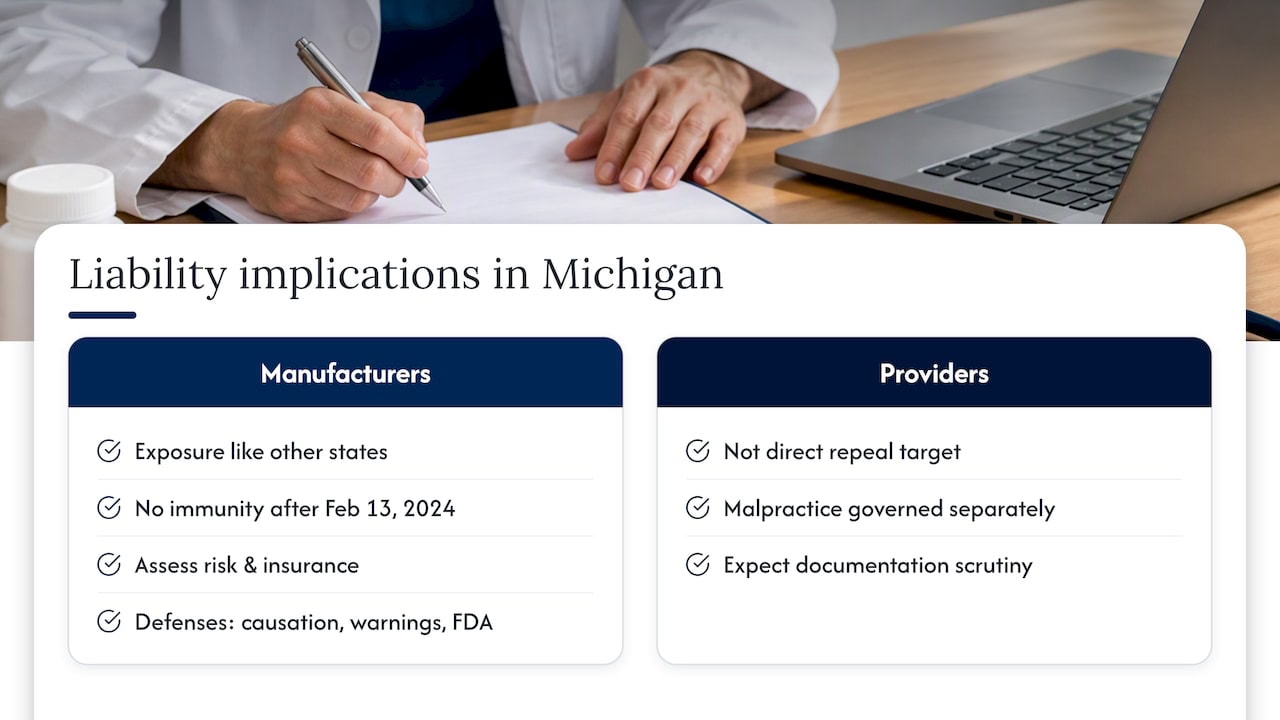
Pharmaceutical companies selling in Michigan now face the same litigation exposure as in most other states, which means product liability risk assessment and insurance planning likely need to account for Michigan differently than before. Manufacturers that previously treated Michigan sales as carrying minimal litigation risk because of the immunity provision no longer have that advantage for injuries occurring after February 13, 2024.
Healthcare providers, including prescribing physicians and pharmacies, are not the direct target of this repeal, since the statute addressed manufacturer liability rather than provider liability. Medical malpractice claims against doctors and pharmacists remain governed by separate standards and separate statutes of limitations. That said, providers may see more scrutiny of their own documentation practices as plaintiffs’ attorneys build broader cases that examine the full chain from manufacturer to prescriber to patient.
Pharmaceutical companies operating nationally will likely treat Michigan claims the way they already treat claims from most other states: as ordinary product liability exposure requiring the usual defenses around causation, warning adequacy, and compliance with FDA labeling requirements. FDA approval remains meaningful evidence that a company followed federal protocol, but it no longer ends the conversation on its own, a point underscored in federal materials describing FDA’s role in reviewing drug safety and efficacy separate from civil litigation.
Potential impact on insurance claims and coverage related to drug injury lawsuits
Product liability insurance for pharmaceutical manufacturers is typically priced based on expected litigation exposure across the states where a company sells its products. Michigan’s long-standing immunity meant insurers could treat Michigan sales as lower risk for drug injury claims specifically, compared to states without such protection.
That calculation changes going forward. Insurers covering manufacturers that distribute into Michigan will likely need to reassess reserve levels and premium structures for policies covering injuries occurring after February 13, 2024, since the absolute defense that limited payout exposure in Michigan cases no longer applies. This mirrors adjustments insurers have made in other states after major changes to product liability standards.
For injured individuals, the practical insurance question usually involves their own health coverage rather than the manufacturer’s liability insurer. Medical costs tied to a drug injury often get billed through the patient’s health insurance or Medicaid first, with any eventual settlement or judgment addressing reimbursement obligations to those payers. This is part of why documentation matters so much: insurers and attorneys on both sides will look closely at billing records, prescription history, and the sequence of medical treatment when evaluating a claim’s value.
Government recovery efforts, including Medicaid recoupment and participation in opioid settlement funds, operate on a parallel track. Governor Whitmer’s office noted that Michigan stood to see nearly $800 million in opioid-related settlement funds flow to the state, separate from any individual lawsuits, underscoring how the repeal affects both private claims and public recovery efforts simultaneously.
Guidance for plaintiffs: how repeal affects filing new claims or ongoing cases
If your injury occurred on or after February 13, 2024, the repeal likely means you have access to product liability theories that were effectively closed to Michigan residents before this date. That includes failure-to-warn claims, design-defect claims, and misrepresentation claims against drug manufacturers, evaluated the same way courts evaluate these claims in most other states.
If your injury occurred before February 13, 2024, your case likely remains governed by the old immunity provision, even if you have not yet filed suit. This does not necessarily mean you have no options. The statutory exceptions that existed under the old law, involving fraud on the FDA or withheld safety information, may still apply, and a careful review of your specific facts and timeline matters more than ever.
If you already have a pending case that was filed before the repeal, the change in law generally does not retroactively alter how your existing claim gets evaluated, since Michigan courts presume statutes apply prospectively absent clear legislative intent otherwise. Attorneys handling ongoing litigation will need to track how courts apply this presumption as early rulings come down.
Anyone considering a new claim should move promptly. Evidence like medication labels, pharmacy records, and contemporaneous medical notes becomes harder to obtain the longer you wait, and the three-year limitations period for product liability claims in Michigan does not pause while you decide whether to pursue legal action.
Author perspective: measured view on accountability versus litigation risk
Repealing an outlier immunity law restores a basic form of accountability that most of the country already takes for granted. That said, the retroactivity question is not fully settled, and courts will spend the next several years working out exactly where the line falls between old injuries and new ones. If you believe you have a Michigan drug injury claim, preserve your records now and get a timeline review from an attorney before assuming either law applies to your case.
— Adam
Keller & Keller product liability services and free case evaluation
If a prescription drug injured you or a family member in Michigan, a local law firm handles defective drug and device claims alongside broader product liability cases, working on a contingency basis so you owe nothing unless the case is won. Bring your medication records, prescription history, and medical documentation to a free case evaluation, and we will walk you through whether your injury timeline falls under the repealed immunity or the current law.
This article is general information, not a substitute for advice from a qualified lawyer. Consult a qualified legal professional about your own circumstances before acting on anything here.
FAQ
What are the new laws in Michigan for 2026?
Michigan’s drug immunity repeal took effect February 13, 2024)/mileg.aspx?objectname=2023-SB-0410&page=GetObject) and continues to apply to qualifying injuries accruing thereafter. No subsequent statute has reversed or modified that repeal, so the current framework described above remains the governing law for Michigan drug injury claims.
What is the 180 day rule in Michigan?
This article does not address a specific notice period or deadline tied to Michigan’s drug immunity repeal, and no source reviewed here defines one in this context. If you are thinking of a different deadline, such as notice requirements in certain government claims, consult an attorney about the specific rule that applies to your situation.
What is the punishment for drug possession in Michigan?
Drug possession penalties are a separate area of Michigan criminal law from the civil product liability issues covered in this article, and the sources reviewed here do not address possession penalties. Anyone facing a possession charge should consult Michigan’s controlled substances statutes or a criminal defense attorney directly.
What are the exceptions to governmental immunity in Michigan?
Governmental immunity in Michigan generally shields state and local government entities from certain lawsuits, but it is a distinct legal doctrine from the drug manufacturer immunity discussed in this article. The sources reviewed here focus on the repeal of manufacturer drug immunity, so questions about governmental immunity exceptions should go to an attorney familiar with that specific area of Michigan law.
Sources
- AG press release: AG Nessel celebrates bill signing for drug immunity repeal
- Governor Whitmer signs bipartisan bill to hold drug companies accountable
- SB0410: Analysis as enacted – Michigan Legislature
Primary sources and official documents
- AG press release: AG Nessel celebrates bill signing for drug immunity repeal
- Governor Whitmer signs bipartisan bill to hold drug companies accountable
- SB0410: Analysis as enacted – Michigan Legislature
- MCL §600.2946 — Michigan Compiled Laws
- What FDA does — FDA
- Guest Post — Retroactivity of New Law and Primer (Lexology)