
Mild traumatic brain injury claims in New Mexico often settle within a lower range, moderate injuries commonly reach mid-range settlements, and severe or catastrophic cases can run from high amounts into multi-million dollar territory. These figures swing widely because the facts of each case, not a formula, determine the outcome. Future medical care and the permanency of a client’s deficits typically drive value more than any other factor, and the New Mexico-specific rules and case examples below show why.
TL;DR:
- Cases with stronger documentation of ongoing cognitive deficits and long-term care needs tend to reach higher settlement amounts, especially in moderate to severe TBI claims.
- New Mexico-specific factors such as comparative fault, liens, and state injury services can significantly reduce net recovery despite high headline verdicts.
- The actual settlement value heavily depends on expert-produced life-care plans and vocational assessments that project decades of future costs and lost earnings.
- Large verdicts often involve clear liability, substantial medical expenses, and long-term functional loss supported by detailed case evidence.
- Families should prioritize obtaining comprehensive life-care plans and vocational assessments before evaluating settlement offers to ensure future needs are properly accounted for.
Table of Contents
- Typical Settlement and Verdict Ranges by TBI Severity
- How Damages Are Calculated in TBI Claims
- New Mexico Legal Context That Affects Value
- Representative New Mexico Cases and Public Settlements
- Net Recovery: Fees, Liens, and a Worked Example
- Should You Accept a Settlement? A Practical Checklist
- Our New Mexico Practice and How We Value TBI Claims
- What New Mexico Families Often Get Wrong About TBI Value
- Get a Free New Mexico TBI Case Evaluation
- FAQ
- Sources
Typical Settlement and Verdict Ranges by TBI Severity
Severity classification shapes almost every downstream valuation decision, because it signals how much future care a person will likely need. The CDC’s epidemiology and rehabilitation report identifies motor vehicle crashes and falls as the leading causes of TBI in the United States, which is why so many high-value New Mexico claims originate from car accidents and workplace falls.
Mild TBI, often called post-concussion syndrome, usually involves headaches, memory lapses, and sensitivity to light that resolve within months. When symptoms clear quickly and medical bills stay modest, settlements tend to be lower. When post-concussion symptoms persist long term and a neuropsychologist documents ongoing cognitive deficits, value increases significantly.
Moderate TBI cases look different. These involve a measurable period of unconsciousness, confirmed structural brain injury on imaging, and a recovery path that includes months of therapy. Vocational impact starts to matter here: a person who cannot return to their prior job, even part time, adds a lost earning capacity component that a mild case rarely has.
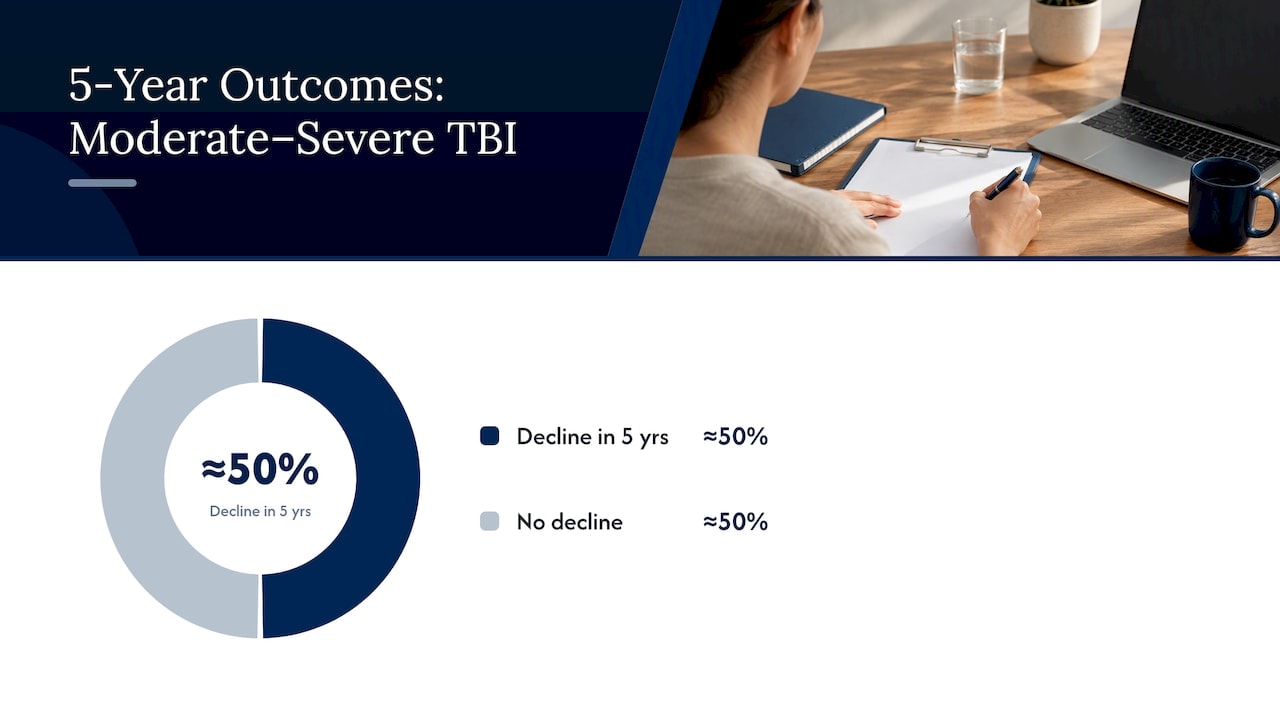
Severe and catastrophic TBI cases involve permanent cognitive or physical impairment, often requiring lifelong supervision or in-home care. According to a CDC report on moderate to severe TBI, about 50% of people with moderate to severe TBI who receive inpatient rehabilitation experience further functional decline within five years. That statistic matters for valuation because it supports claims for extended, escalating future care rather than a flat, one-time cost estimate.
A few variables push any of these ranges up or down:
- Co-occurring injuries such as spinal damage or orthopedic trauma add separate damages categories and increase total value.
- Wrongful-death claims following a fatal TBI follow different damages rules and often involve longer settlement timelines.
- Insurer defense strategies, including disputing causation or pointing to pre-existing conditions, can suppress offers regardless of injury severity.
The CDC’s national rehabilitation data shows roughly half of moderate-to-severe TBI patients decline further within five years of treatment, which is a central reason life-care planning, not just past medical bills, anchors high-value claims.
How Damages Are Calculated in TBI Claims
A TBI claim’s dollar value is built from two broad categories: economic damages and non-economic damages. Understanding how each is documented helps explain why two cases with similar diagnoses can settle for very different amounts.
- Economic damages cover costs with a receipt or a projection behind them: itemized medical bills, prescription costs, home modification expenses, and lost wages supported by pay stubs or tax returns.
- Future economic damages rely on expert projections rather than past bills, including vocational assessments that estimate lost earning capacity and life-care plans that price out decades of anticipated therapy, equipment, and attendant care.
- Non-economic damages compensate for pain, suffering, and loss of enjoyment of life, and attorneys typically argue for these using either a multiplier of economic damages or a per diem approach tied to the length of expected suffering.
- Punitive damages are rare in TBI litigation and generally require proof of willful or reckless conduct beyond ordinary negligence, so most New Mexico TBI claims do not include them.
Life-care plans deserve particular attention because they often determine whether a moderate or severe TBI claim settles for a few hundred thousand dollars or several million. A qualified life care planner projects decades of costs, including attendant care, cognitive therapy, assistive technology, and periodic medical reassessment. The CDC’s long-term outcome data gives these projections scientific grounding, since insurers and juries respond better to figures tied to published outcome research than to speculation.
Pro Tip: Ask whether your life-care plan includes both a conservative and an aggressive cost scenario, since insurers often negotiate around the gap between the two.
New Mexico Legal Context That Affects Value
New Mexico’s legal rules shape net recovery as much as the underlying medical facts do. A few state-specific issues come up in nearly every TBI case we evaluate.
- Comparative fault reduces an award by the percentage of fault assigned to the injured person, so a jury that finds a plaintiff 20% at fault will cut a $500,000 verdict to $400,000.
- Medical malpractice claims carry different caps and procedural requirements than ordinary negligence cases, including stricter timelines detailed on our New Mexico malpractice cap page.
- Hospital liens often attach automatically to a settlement, and providers can negotiate reduced payoff amounts rather than collect the full billed charge.
- State brain injury services through New Mexico’s Brain Injury Services Fund require documented eligibility, which affects both immediate care access and how future-care costs are projected in a lawsuit.
A New Mexico Court of Appeals opinion involving a hospital negligence claim illustrates how negotiated settlements with medical providers and the allocation of a jury award can change what a plaintiff actually keeps, separate from the headline verdict figure.
On the state-support side, the New Mexico Health Care Authority’s BISF application requires confirmation of a qualifying ICD-10 diagnosis code before a person can access brain injury waiver services. Confirming this code early matters for litigation too, since it creates an independent, state-verified record of diagnosis severity that can support both benefits eligibility and damages claims.
Representative New Mexico Cases and Public Settlements
Public court records give the clearest picture of how New Mexico juries and judges actually value brain injury claims, far more reliable than national averages pulled from other states.
The Christopherson v. St. Vincent Hospital appellate opinion documents a $2.25 million verdict and walks through how the appellate court evaluated the relationship between medical bill evidence, provider settlements, and the final damages allocation. Cases like this show that large New Mexico TBI verdicts tend to share a few traits: clear liability, well-documented and substantial medical expenses, and expert testimony connecting the injury to long-term functional loss.
Smaller reported awards in New Mexico litigation often involve cases where medical bills were the primary driver of damages, with comparatively limited non-economic components, usually because injuries resolved faster or liability was contested. Several patterns emerge across the appellate record:
- Age and life expectancy affect future-care projections, since a younger plaintiff generates more years of anticipated cost.
- Pre-existing conditions can reduce an award when a defendant successfully argues the injury aggravated, rather than caused, a prior impairment.
- Comparative fault findings mechanically reduce the final number regardless of how strong the medical evidence was.
New Mexico appellate opinions document verdicts ranging from modest medical-expense-driven awards to multi-million dollar judgments like the $2.25 million result in Christopherson, reflecting how fact-specific these outcomes are. No single case guarantees a particular result, but the pattern of what drives larger and smaller awards repeats across the record.
Net Recovery: Fees, Liens, and a Worked Example
A settlement figure in a news headline is rarely what a plaintiff deposits in the bank. Several deductions typically apply before funds reach a client.
- Contingency fees in personal injury cases commonly range from roughly one-third of the recovery, with fees sometimes increasing if a case proceeds through appeal or extended litigation.
- Medical liens, including Medicare, Medicaid, and private insurer subrogation claims, are paid from the settlement before the client receives the remainder.
- Hospital liens can often be negotiated down from the full billed amount, as illustrated in the New Mexico appellate discussion of provider settlements.
- Case costs, such as expert witness fees and court filing costs, are typically deducted as well.
Here is a simplified illustration using round numbers: say a case settles for $500,000. After a one-third contingency fee of roughly $167,000, the remaining $333,000 might face $60,000 in Medicare and hospital liens along with $15,000 in case costs, leaving the client with approximately $258,000 net. The exact figures vary by case, lien type, and how aggressively liens are negotiated down.
Pro Tip: Start lien negotiations as early as possible, since providers are often more flexible before litigation concludes than after a settlement is already finalized.
Should You Accept a Settlement? A Practical Checklist
Deciding whether to accept an offer requires more than comparing a number to what you expected. Before signing anything, confirm these items.
- Medical stability: has your treating physician confirmed your condition has plateaued, or could future complications still emerge?
- Life-care plan: does the settlement account for a documented projection of future therapy, equipment, and caregiver costs?
- Wage and earning capacity: does the offer reflect a vocational expert’s assessment of reduced future earnings, not just time missed so far?
- Net math: have you calculated what you will actually receive after fees and liens, not just the gross number on the table?
- Release language: does the settlement agreement limit your ability to pursue related claims against other parties later?
Structured settlements or periodic payments can make sense for younger plaintiffs facing decades of future care, since they provide predictable income rather than a single lump sum that must be managed for a lifetime. Our TBI settlement guidance page walks through these decision factors in more detail. Watch for red flags: an offer that ignores documented future-care costs, demands an unusually broad release, or arrives with pressure to decide within days of the accident almost always deserves a second opinion before you sign.
Our New Mexico Practice and How We Value TBI Claims
We represent injured people and families across New Mexico in car accident, truck accident, wrongful death, and other personal injury matters, and brain injury cases are a significant part of that work. Our approach pairs national outcome research, like the CDC’s TBI Model Systems data, with New Mexico-specific documentation, including BISF eligibility records and appellate case law, so that every valuation reflects both medical reality and local legal rules.
You can schedule a case evaluation with our legal team to review your medical records, accident report, and related documentation. We work on a contingency basis, so there are no fees unless compensation is recovered.
What New Mexico Families Often Get Wrong About TBI Value
The biggest mistake we see is treating a TBI settlement like a math problem with a single correct answer. Readers searching for “average settlement” often want a number, but the honest answer is that national TBI outcome data and New Mexico’s own appellate record both show enormous variation tied to permanency, not diagnosis labels.
Conventional advice tends to overweight the initial medical bill total and underweight future decline. The CDC’s finding that roughly half of moderate-to-severe TBI patients decline further within five years should change how families think about early settlement offers: an offer that looks generous against today’s bills can look inadequate against tomorrow’s needs.
If you take one thing from this article, prioritize getting a real life-care plan and vocational assessment before evaluating any offer. Everything else, the multiplier, the comparative fault percentage, the lien negotiation, matters less than getting that foundational projection right first.
— Adam
Get a Free New Mexico TBI Case Evaluation
We take TBI and brain injury cases on contingency, which means we only get paid if we recover compensation for you. There is no upfront cost to find out what your case may be worth.

A free consultation with our team will typically clarify:
- Liability: who was responsible and whether comparative fault could reduce your claim.
- Value range: a realistic estimate based on your medical records and New Mexico case law.
- Preservation steps: what evidence, records, and documentation to secure now before it disappears.
If your accident also left you dealing with a damaged vehicle, our partners at Tri-State Cash for Cars can walk you through selling or transferring a vehicle after a crash. Reach out to our team at 2keller to schedule your free, no-obligation case evaluation.
This article is general information, not a substitute for advice from a qualified lawyer. Consult a qualified legal professional about your own circumstances before acting on anything here.
FAQ
How much is a TBI settlement worth?
TBI settlement values depend heavily on severity and permanency, with mild cases settling lower, moderate cases reaching mid-range settlements, and severe or catastrophic cases running up to multi-million dollar territory. The single biggest factor is whether future medical care and lost earning capacity are well documented with expert reports.
What is the typical settlement amount for a post-concussion syndrome lawsuit?
Post-concussion syndrome claims typically fall toward the lower end of the mild TBI range when symptoms resolve within months. Cases where cognitive symptoms persist for a year or more and are confirmed by a neuropsychologist tend to settle closer to the higher end of that range.
How much money can you get for TBI?
The amount depends on injury severity, documented medical costs, lost income, and the strength of liability evidence, with ranges spanning from the tens of thousands for mild injuries to several million dollars for catastrophic, lifelong impairments. New Mexico cases also factor in comparative fault, which can reduce the final award based on the percentage of fault assigned to the injured person.
How much of a $20,000 settlement will I get?
After typical deductions like a contingency fee of roughly one-third and any applicable medical liens or case costs, a plaintiff nets the remainder of the settlement. The exact amount depends on your fee agreement and outstanding liens. Discussing the specific fee structure and lien amounts with your attorney before signing gives you an accurate net figure.
Sources
- MAD 386 Revised Application — Brain Injury (New Mexico HCA)
- Christopherson v. St. Vincent Hospital (New Mexico Court of Appeals opinion)
- Traumatic Brain Injury in the United States: Epidemiology and Rehabilitation