
Michigan’s mini tort law lets you recover up to $3,000 for vehicle damage from the driver who caused your accident, under MCL 500.3135. That recovery applies to accidents occurring after July 1, 2020, and covers damage your own insurance did not pay, such as your collision deductible.
One critical qualifier: you must be 50% or less at fault for the crash. If you share some blame, your recovery is reduced by your percentage of fault. If you are found more than 50% responsible, you recover nothing under this statute.
MCL 500.3135 is the controlling authority for Michigan’s mini tort. It sets the dollar cap, the fault threshold, and the condition that damages must not already be covered by insurance. If your out-of-pocket vehicle damage is approaching $3,000 and fault is disputed, a brief consultation with a Michigan attorney is worth your time.
- The maximum recovery is $3,000 (for accidents after July 1, 2020).
- You must be 50% or less at fault.
- Recovery is limited to vehicle damage not covered by your own insurance.
- Mini tort does not cover medical bills, rental cars, or personal property.
Table of Contents
- What does the Michigan mini tort law actually cover?
- Who actually pays a mini tort claim?
- What does mini tort pay, and what does it exclude?
- How does the $3,000 cap and the 50% fault rule work?
- How do collision coverage and your deductible affect a mini tort claim?
- How to file a Michigan mini tort claim, step by step
- What if the at-fault driver or their insurer refuses to pay?
- When should you hire a lawyer for a mini tort claim?
- A worked example and the primary sources behind this article
- Key Takeaways
- What most drivers get wrong about mini tort
- Get a free consultation from 2keller’s Michigan attorneys
- Useful sources
What does the Michigan mini tort law actually cover?
Michigan operates under a no-fault insurance system, which means your own insurer pays most of your accident-related expenses regardless of who caused the crash. That framework works well for medical bills and lost wages, but it leaves a gap: vehicle damage. Your collision coverage pays for repairs, but you still owe your deductible out of pocket. The mini tort fills that gap.
Michigan’s no-fault law creates a general bar against suing another driver for most accident losses. The mini tort is a statutory exception carved out by MCL 500.3135. It is not a broad right to sue for pain and suffering or any other personal injury. It is narrowly limited to property damage to your vehicle, specifically the portion your own insurance did not cover.
Mini tort is limited property-damage liability. The Michigan FIS-PUB summary published by the state defines it as a recovery for vehicle damage “to the extent that the damages are not covered by insurance.” Nothing more.
A practical example: you carry collision coverage with a $1,000 deductible. The at-fault driver hits your car and causes $4,500 in damage. Your insurer pays $3,500; you pay the $1,000 deductible yourself. That $1,000 out-of-pocket cost is exactly what a mini tort claim in Michigan is designed to recover, provided you were 50% or less at fault.
The current $3,000 cap took effect July 1, 2020, replacing the prior $1,000 limit. Accidents before that date are governed by the older, lower cap.
Who actually pays a mini tort claim?
The at-fault driver is personally liable for the mini tort amount, up to the statutory cap. In practice, however, their auto insurer usually handles payment.
Some insurers offer an optional limited property damage liability endorsement specifically to cover mini tort claims on behalf of their policyholders. This coverage is not required by Michigan law, but many drivers carry it. If the at-fault driver has this endorsement, you submit your claim directly to their insurer, which processes and pays it much like a standard liability claim.
- At-fault driver with optional limited property damage coverage: their insurer pays directly, up to $3,000.
- At-fault driver without that endorsement: you may still pursue the driver personally, and their insurer may still negotiate on their behalf depending on the policy.
- Uninsured at-fault driver: you pursue the individual directly, which creates collection challenges discussed later.
Subrogation is a related concept worth understanding. If your own insurer paid your deductible as part of a settlement or repair arrangement, it may pursue the at-fault driver’s insurer to recover that payment. When your insurer recoups the money through subrogation, it typically reimburses your deductible to you. Check with your insurer about whether a subrogation claim is already in progress before you file a separate mini tort demand, since a double recovery is not permitted.
What does mini tort pay, and what does it exclude?
DIFS guidance is clear on this point: mini tort is not a general reimbursement for everything you lost in a crash. The coverage is narrow by design.
Mini tort covers:
- Out-of-pocket vehicle repair costs not paid by your own insurance.
- Your collision deductible, to the extent it represents uninsured vehicle damage.
- Repair costs when you carry no collision coverage and the damage is entirely out of pocket (subject to the $3,000 cap).
Mini tort does NOT cover:
- Rental car expenses while your vehicle is being repaired.
- Lost use of your vehicle.
- Personal property inside the vehicle (a laptop, a phone, clothing).
- Medical bills, pain and suffering, or any personal injury loss.
- Diminished value claims or other consequential losses.
DIFS guidance draws a firm line: mini tort is limited to vehicle damage not covered by insurance. Rental costs, lost use, and personal injury losses fall entirely outside its scope, regardless of how significant those losses are.
Edge cases do arise. If you have partial insurance coverage, say a policy that covers only a portion of repairs due to a coverage dispute, the recoverable mini tort amount is the gap between what insurance paid and the actual repair cost, capped at $3,000. In a total-loss scenario, the same logic applies: the mini tort claim covers the difference between the insurer’s payout and the vehicle’s actual cash value, again capped at $3,000.
How does the $3,000 cap and the 50% fault rule work?
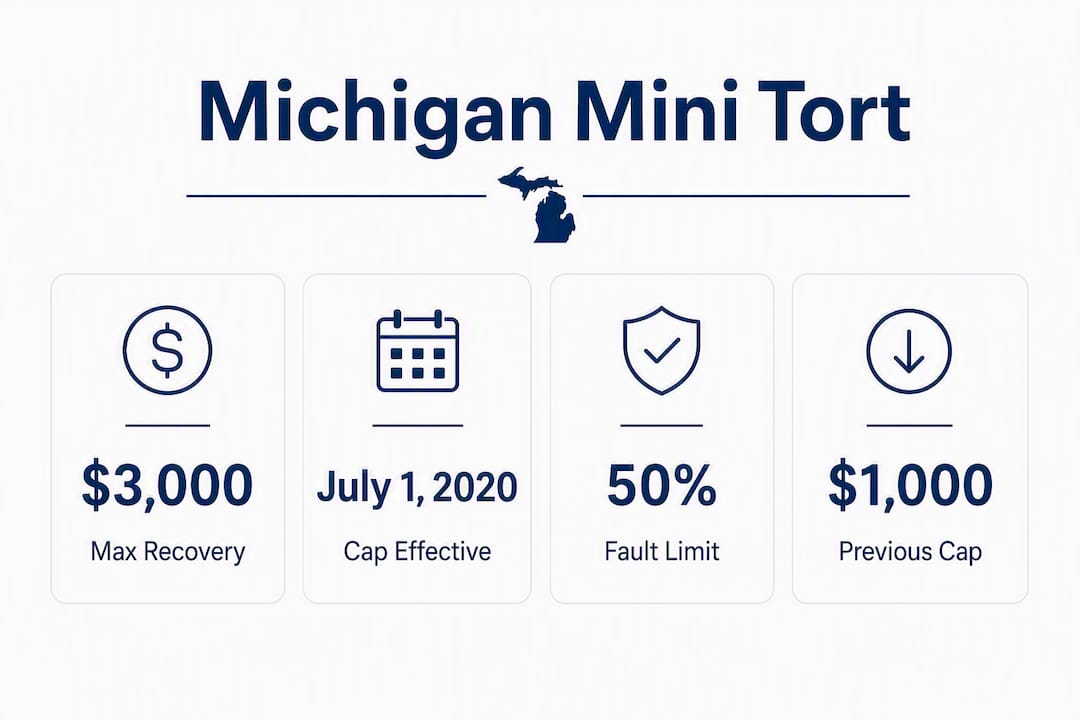
The current maximum recovery under Michigan’s mini tort is $3,000, applicable to accidents occurring after July 1, 2020. Before that date, the cap was $1,000. The statute at MCL 500.3135 ties the dollar limit directly to the condition that damages are “not covered by insurance.”
The comparative fault rule works as follows:
- If you are 0% at fault, you recover up to $3,000 of your uninsured vehicle damage.
- If you are 25% at fault, your recovery is reduced by 25%.
- If you are 50% at fault, your recovery is reduced by 50%.
- If you are 51% or more at fault, you recover nothing.
MCL 500.3135 bars recovery entirely for any claimant found more than 50% at fault. Below that threshold, the recovery is reduced proportionally, not eliminated.
Worked example:
- Repair bill: $5,000
- Your collision deductible (uninsured portion): $1,500
- Your percentage of fault: 20%
- Gross mini tort claim: $1,500 (the uninsured damage, which is below the $3,000 cap)
- Fault reduction: 20% of $1,500 = $300
- Net recovery: $1,200
Now consider a scenario where your deductible is $3,500 and you are 0% at fault. Your gross claim is $3,500, but the statutory cap limits recovery to $3,000. You absorb the remaining $500.
Key points on the cap and fault rule:
- The $3,000 cap is a ceiling, not a guaranteed amount.
- Fault percentages are often disputed; insurers and drivers rarely agree immediately.
- A police report and witness statements are your strongest tools for establishing fault.
How do collision coverage and your deductible affect a mini tort claim?
Your collision coverage choice directly shapes whether a mini tort claim is worth pursuing.
Standard collision: your insurer pays for repairs minus your deductible. The mini tort claim targets that deductible. If your deductible is $500 and fault is clear, pursuing $500 through a mini tort demand is usually straightforward and worth the effort.

Broad collision (also called “broadened collision”): some Michigan policies include broad collision coverage, which waives the deductible when the other driver is primarily at fault. If your policy includes this feature, your out-of-pocket exposure may already be zero, which eliminates the need for a mini tort claim entirely.
No collision coverage: if you carry only liability coverage and no collision, your entire repair bill is out of pocket. The mini tort cap of $3,000 becomes the ceiling on what you can recover from the at-fault driver, regardless of total repair costs.
- Check your declarations page for “broad collision” or “limited collision” language before filing a mini tort demand.
- If your insurer is already pursuing subrogation, coordinate with them before sending a separate demand.
- Some insurers offer the optional limited property damage liability endorsement on the at-fault driver’s policy, which simplifies payment significantly.
Pro Tip: If your deductible is $250 and the at-fault driver’s insurer is cooperative, a mini tort demand letter takes an hour to write and often resolves in two to four weeks. If your deductible is $3,000, fault is disputed at 40/60, and the at-fault driver is uninsured, the math changes entirely. Calculate your expected net recovery after fault reduction before deciding whether to file or simply absorb the loss.
How to file a Michigan mini tort claim, step by step
Filing a mini tort claim is not complicated, but the sequence matters. Missing documentation early can undermine an otherwise valid claim.
- At the scene: exchange insurance and contact information with all drivers. Photograph all vehicle damage, road conditions, and the accident scene from multiple angles.
- Get the police report: request a copy of the UD-10 (Traffic Crash Report) from the responding agency. This document establishes the official fault narrative and is often the first thing an insurer asks for.
- Seek a repair estimate: get at least one written estimate from a licensed repair shop. If your vehicle has already been repaired, preserve all receipts and invoices.
- Determine your uninsured loss: confirm what your own insurer paid and what you paid out of pocket. Your explanation of benefits or insurer payment summary documents this.
- Send a demand letter to the at-fault driver’s insurer: the letter should include:
- Date, location, and description of the accident.
- Summary of vehicle damage and repair costs.
- Amount your insurer paid and your out-of-pocket deductible.
- Your stated percentage of fault (and basis for that position).
- The statutory basis: MCL 500.3135.
- A reasonable deadline to respond (typically 30 days).
- Follow up in writing: if the insurer does not respond within the deadline, send a written follow-up and document all communications.
- File in small claims or municipal court if needed: the Michigan FIS-PUB guidance recommends small claims court as the standard venue for mini tort actions. Either party may request removal to a higher court under certain circumstances, which can increase costs and complexity.
Statute of limitations: Michigan’s general tort statute of limitations is three years from the date of the accident. Confirm the applicable period with an attorney before filing, since specific circumstances can affect the deadline.
- Keep copies of every document you send and receive.
- Send demand letters by certified mail with return receipt.
- Preserve all repair receipts, estimates, and insurer correspondence.
What if the at-fault driver or their insurer refuses to pay?
Denial is not the end of the road, but it does require a clear-eyed assessment of your options.
When an insurer denies your demand:
- Request the denial in writing and ask for the specific reason.
- Provide any additional documentation the insurer requests (supplemental estimates, police report, photos).
- Escalate to a claims supervisor if the adjuster is unresponsive or the denial seems unsupported.
- File a complaint with the Michigan Department of Insurance and Financial Services (DIFS) if you believe the insurer is acting in bad faith.
Filing in small claims court:
Small claims court is designed for exactly this situation. The filing fee is modest, no attorney is required, and the process moves faster than circuit court. The Michigan courts small claims process is accessible to self-represented litigants. If you win a judgment, however, collecting it is a separate step.
Collection realities:
- A judgment against an insured driver is typically satisfied by the insurer.
- A judgment against an uninsured driver may require wage garnishment or a bank levy, both of which take time and are not guaranteed if the defendant has limited assets.
- If the at-fault driver is uninsured and effectively judgment-proof, settling for a reduced amount or absorbing the loss may be more practical than pursuing a judgment you cannot collect.
Alternatives to consider:
- File under your own collision coverage if the insurer dispute is prolonged and your deductible is your primary loss.
- Negotiate a partial settlement with the at-fault driver directly if they acknowledge fault but cannot pay the full amount.
- Consult an attorney if the insurer’s denial is based on a disputed fault percentage that you believe is incorrect.
When should you hire a lawyer for a mini tort claim?
Most straightforward mini tort claims, where fault is clear and the at-fault driver is insured, can be handled without an attorney. But several situations shift that calculus.
Hire a lawyer when:
- Fault is genuinely disputed and the insurer is assigning you more than 50% responsibility.
- Your out-of-pocket damage is close to or at the $3,000 cap and you want to maximize recovery.
- The at-fault driver’s insurer has denied the claim without a clear legal basis.
- The case needs to be filed and litigated in court, especially if removal to a higher court is likely.
- You also have personal injury claims arising from the same accident, which require separate legal analysis under Michigan’s no-fault threshold rules.
What a Michigan personal injury attorney does on a mini tort matter:
- Prepares and sends a formal demand letter with the correct statutory citations.
- Gathers and organizes documentation (police report, estimates, insurer correspondence).
- Negotiates directly with the at-fault driver’s insurer.
- Files in small claims or municipal court and represents you at the hearing.
- Handles post-judgment collection steps if the defendant does not pay voluntarily.
Fee model: most Michigan personal injury attorneys handle mini tort matters on a contingency basis, meaning you pay no attorney fee unless they recover money for you. The fee is a percentage of the recovery. For a $3,000 cap case, discuss the fee structure upfront so you understand your net recovery after legal costs.
Pro Tip: If your mini tort claim is straightforward and the at-fault driver’s insurer is cooperative, a demand letter you write yourself may be all you need. If fault is contested at 40/60 or the insurer has gone silent after 30 days, an attorney’s involvement often resolves the dispute faster than continued self-advocacy, and the contingency model means you pay nothing if the claim fails.
A worked example and the primary sources behind this article
Fact pattern:
- Total repair cost: $4,200
- Your collision deductible (uninsured portion): $2,500
- Your insurer paid: $1,700
- Your percentage of fault: 30%
- Gross mini tort claim: $2,500 (the uninsured damage, below the $3,000 cap)
- Fault reduction: 30% of $2,500 = $750
- Net recovery: $1,750
The $3,000 cap does not come into play here because the uninsured damage is $2,500. If the deductible were $3,800 and fault were 0%, the cap would limit recovery to $3,000, leaving $800 unrecovered.
The statute’s exact condition: MCL 500.3135 limits mini tort recovery to vehicle damage “to the extent that the damages are not covered by insurance.” That phrase is the legal test for every mini tort calculation.
Primary sources used to verify this article:
- MCL 500.3135, Michigan Legislature: the controlling statute setting the $3,000 cap, the 50% fault bar, and the insurance-coverage condition.
- Michigan FIS-PUB summary (FIS-PUB 0206a): the state’s official plain-language explanation of mini tort, covering court venues, insurer options, and procedural guidance.
- Michigan Department of Insurance and Financial Services (DIFS): the regulatory body whose guidance clarifies covered and excluded losses and provides consumer complaint resources.
This article was written by Adam, a Michigan personal injury attorney at 2keller. For related reading on how Michigan’s no-fault framework shapes vehicle and injury claims, see 2keller’s guide to Michigan’s no-fault law order of priority.
Key Takeaways
Michigan’s mini tort law caps vehicle-damage recovery at $3,000 for accidents after July 1, 2020, and bars any recovery if you are more than 50% at fault under MCL 500.3135.
| Point | Details |
|---|---|
| $3,000 statutory cap | Applies to accidents after July 1, 2020; prior accidents are subject to the $1,000 cap. |
| 50% fault bar | Recovery is reduced by your fault percentage and eliminated entirely above 50%. |
| Vehicle damage only | Mini tort covers uninsured repair costs and deductibles; rental, medical, and personal property are excluded. |
| Small claims is the right venue | Michigan’s FIS-PUB guidance recommends small claims court for most mini tort actions to keep costs low. |
| 2keller can help | If fault is disputed or the insurer has denied your claim, 2keller’s Michigan attorneys handle mini tort matters on a contingency basis. |
What most drivers get wrong about mini tort
The mini tort law is genuinely useful, but it is also one of the most misunderstood pieces of Michigan’s auto insurance framework. Drivers routinely expect it to cover rental cars, personal property, or even pain and suffering, and then feel blindsided when an insurer denies those items. The statute was never designed to do any of that.
What strikes me after handling Michigan accident cases is how often the real value of a mini tort claim goes unclaimed, not because the law is unclear, but because drivers assume the process is too complicated or the amount too small to bother with. A $1,000 deductible is real money. A demand letter sent to the right insurer, backed by a police report and a repair estimate, often resolves in a matter of weeks with no court filing required.
The cases that genuinely need an attorney are the ones where fault is contested near the 50% line. An insurer that assigns you 55% fault has effectively zeroed out your claim. That is not always a fair or accurate assessment, and it is worth challenging. The comparative fault determination is where the real legal work happens in most mini tort disputes, not the dollar math.
One more thing worth saying plainly: if your accident also caused personal injuries, the mini tort is the least of your legal concerns. Michigan’s no-fault threshold rules govern whether you can sue for pain and suffering, and that analysis is entirely separate from the vehicle-damage claim. Do not let a $3,000 property claim distract you from a potentially much larger injury recovery.
Get a free consultation from 2keller’s Michigan attorneys
When your vehicle damage is close to the $3,000 cap, fault is disputed, or the at-fault driver’s insurer has gone quiet, handling the claim alone carries real financial risk. 2keller’s Michigan personal injury attorneys work on a contingency basis: no recovery, no fee. You pay nothing unless we win or settle your case.

Our team handles mini tort claims alongside the full range of Michigan accident cases, from no-fault disputes to serious injury claims. If you have a UD-10 Traffic Crash Report, a repair estimate, or an insurer denial letter, bring it to your consultation. We review the documents, assess fault, and tell you plainly whether legal representation adds value in your situation.
Conflicts of interest are screened at intake. We represent injured individuals and accident victims, not insurers or at-fault drivers. To get started, call us directly or submit your information through our contact form at 2keller.com. A member of our Michigan team will follow up promptly to schedule your free consultation.
Useful sources
The facts in this article are drawn from Michigan’s primary legal and regulatory sources. Verify current figures directly before relying on them for a legal decision.
- MCL 500.3135, Michigan Legislature: the full statute text confirming the $3,000 cap, the 50% fault bar, and the insurance-coverage condition.
- FIS-PUB 0206a, Michigan.gov: the state’s official plain-language mini tort summary covering court venues, insurer options, and procedural steps.
- Michigan Department of Insurance and Financial Services (DIFS): regulatory guidance on covered and excluded losses, consumer complaint resources, and insurer obligations.
- Michigan Courts Small Claims Forms: official forms and procedural information for filing a mini tort action in small claims court.
Last reviewed: 2026. Laws and dollar caps are subject to legislative change; confirm current figures with the Michigan Legislature or a licensed Michigan attorney.
This article provides general legal information, not legal advice. Consult a qualified Michigan attorney or verify current rules with the Michigan Legislature and DIFS before making decisions about your specific claim.
Recommended
- Michigan Fourth of July Driving Safety Guide | Keller & Keller Car Accident Lawyers – Keller & Keller
- Permanent Daylight Saving Time and Michigan Drivers: What You Need to Know – Keller & Keller
- Truck Accidents and Traffic in Southwest Michigan – Keller & Keller
- Indiana Motorcycle Laws – Keller & Keller