Michigan no-fault insurance requires every driver to carry three mandatory coverages: Personal Injury Protection (PIP), Property Protection Insurance (PPI), and residual Bodily Injury and Property Damage liability (BI/PD). PIP pays your medical bills and a portion of lost wages regardless of who caused the crash. If you’ve been injured, your immediate priorities are:
- Seek medical care right away, even if injuries seem minor at first
- File a PIP claim with your own insurer as soon as possible
- Preserve evidence: photograph the scene, obtain the police report, and save all medical records
- Document work loss: keep wage statements, employer letters, and records of missed shifts
- Consult a lawyer if your insurer denies benefits, delays payment, or your injury may qualify for a tort claim
The Michigan Department of Insurance and Financial Services (DIFS) oversees insurer compliance with Michigan auto insurance laws. Public Acts 21 and 22 (2019) reshaped how PIP works. If your claim is disputed or your injuries are serious, 2keller’s Michigan personal injury team is available for a free consultation.
Table of Contents
- How Michigan’s no-fault system works: three coverages and who pays
- What PIP actually pays for and how benefits are calculated
- How the 2019 reforms changed your PIP choices and why it matters
- When you can step outside no-fault and sue the at-fault driver
- Common PIP claim problems and how to respond
- How a Michigan personal injury lawyer helps with no-fault cases
- What to expect: timeline, costs, and questions to ask
- Key Takeaways
- The part of Michigan no-fault that most people get wrong
- 2keller is ready to evaluate your Michigan no-fault claim
- Useful sources and further reading
How Michigan’s no-fault system works: three coverages and who pays
Michigan law requires all drivers to carry no-fault auto insurance with three distinct parts. Understanding each one tells you where to look when bills arrive after an accident.
| Coverage | What It Pays | Key Limit |
|---|---|---|
| Personal Injury Protection (PIP) | Your medical expenses, work loss, replacement services | Varies by selected level |
| Property Protection Insurance (PPI) | Damage your vehicle causes to others’ property in Michigan | $1 million per accident |
| Residual BI/PD Liability | Injuries or property damage you cause in tort-eligible situations | Statutory minimums |
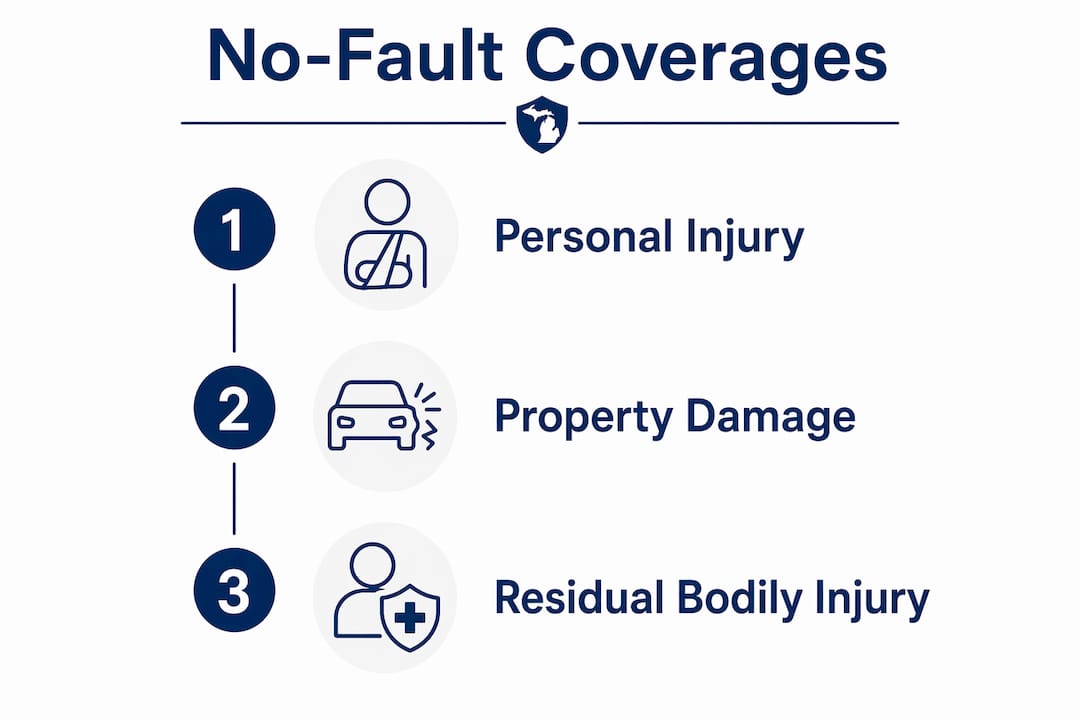
Order of priority determines which insurer pays your PIP benefits when multiple policies exist. Generally, your own policy pays first. If you have no policy, coverage flows to a resident relative’s policy, then to the vehicle owner’s insurer, and so on. Order-of-priority disputes are among the most contested issues in Michigan no-fault claims, because insurers sometimes shift responsibility to avoid paying. PPI covers damage to buildings, fences, and properly parked vehicles — it does not cover your own car. Residual BI/PD liability matters when a tort exception applies and the at-fault driver faces a lawsuit.
What PIP actually pays for and how benefits are calculated
PIP is the financial backbone of Michigan’s no-fault system. Under MCL 500.3107, it covers:
- Reasonable and necessary medical expenses: hospital bills, surgery, physical therapy, prescription medications, prosthetics, and medical devices
- Attendant care: in-home nursing or personal care services when injuries prevent self-care
- Replacement services: household tasks you can no longer perform, such as cleaning or yard work
- Work-loss benefits: up to 85% of your lost income for up to three years, with the monthly maximum adjusted annually for cost-of-living changes
- Transportation to medical appointments
Statistic: PIP work-loss benefits replace a substantial portion of gross lost income for up to several years, with the maximum amount adjusted annually under statute.
Your policy also covers household family members and extends to situations where they are passengers in another vehicle or pedestrians struck by a car. PIP does not pay for vehicle repairs — that falls under collision coverage or PPI.
Pro Tip: Keep a running file of every bill, receipt, wage statement, and provider note from day one. Insurers routinely challenge medical necessity months after treatment; contemporaneous records are your strongest defense.

How the 2019 reforms changed your PIP choices and why it matters
Public Acts 21 and 22 fundamentally restructured Michigan no-fault law. Before 2019, PIP medical coverage was unlimited for everyone. The 2019 reforms introduced a tiered selection system and required insurers to reduce statewide average PIP medical rates for an eight-year period, with DIFS overseeing rate filings.
PIP medical coverage options now include:
- Unlimited medical coverage (the pre-reform default)
- Upper tiers of medical coverage available to selected insureds
- Mid-range medical coverage options
- Low coverage options for those enrolled in Medicaid
- Opt-out possibility for those with qualifying Medicare coverage
Choosing a lower level reduces your premium today but can leave you with catastrophic out-of-pocket exposure after a serious crash. DIFS warns explicitly that lower PIP selections require qualifying health coverage to fill the gap — and that health insurers may not cover all accident-related care the same way PIP would.
Insurers and agents sometimes steer customers toward lower PIP levels to close a sale quickly. Treat your PIP selection as a long-term financial decision, not just a line-item on a premium quote.
Pro Tip: Request a copy of your signed PIP selection form from your insurer and confirm it matches your current policy declarations page. Discrepancies between the signed form and the policy on file are more common than most people expect.
When you can step outside no-fault and sue the at-fault driver
Michigan’s no-fault system limits most lawsuits between drivers, but tort exceptions exist for specific circumstances:
- Death resulting from the accident
- Serious impairment of body function: an objectively manifested impairment of an important body function that affects the person’s general ability to lead a normal life
- Permanent serious disfigurement
- Out-of-state accidents where Michigan no-fault does not govern
- Nonresident drivers who do not carry Michigan no-fault coverage
If any of these thresholds apply, you may be able to pursue a pain-and-suffering claim or a full tort lawsuit against the at-fault driver. Whether your injury meets the “serious impairment” standard is highly fact-specific — courts look at medical evidence, functional limitations, and how the injury affects daily life. For out-of-state drivers involved in Michigan crashes, different rules may apply. Consult a Michigan personal injury attorney before assuming your injury does or does not qualify.
Common PIP claim problems and how to respond
Claim denials and delays are not rare. Knowing the typical insurer tactics helps you respond quickly.
- Denial for lack of medical necessity: The insurer argues treatment was not required. Counter with detailed provider notes and, if needed, an independent medical opinion.
- Delayed payment: Insurers sometimes stall past statutory deadlines. Document every communication with dates and request written explanations for any delay.
- Work-loss disputes: Insurers may challenge your income documentation or the duration of disability. Wage statements, employer letters, and physician work-restriction notes are critical.
- Wrong order-of-priority decisions: An insurer may incorrectly claim it is not the primary payer. Experienced counsel will pull policy-selection forms and enrollment records to resolve this.
- Coordination-of-benefits conflicts: When health insurance and PIP overlap, insurers sometimes push costs onto the other carrier. Understanding which policy pays first prevents unpaid bills from falling to you.
If your claim is denied or underpaid, DIFS provides consumer complaint resources and can be reached at 877-999-6442. Filing a DIFS complaint is one option; litigation is another when the insurer acts in bad faith.
Pro Tip: Request the insurer’s written denial letter and claim notes immediately. Verbal explanations disappear; written records become evidence.
How a Michigan personal injury lawyer helps with no-fault cases
Many claimants believe they must sue the at-fault driver to recover anything. In Michigan, PIP benefits are available regardless of fault — litigation is typically necessary only when an insurer wrongfully denies benefits or a tort exception applies. A Michigan personal injury lawyer helps by:
- Identifying all applicable policies and resolving order-of-priority disputes
- Collecting and organizing medical records, billing statements, and wage documentation
- Filing PIP claims and administrative appeals on your behalf
- Evaluating whether your injury meets a tort threshold for a pain-and-suffering claim
- Negotiating directly with insurers to resolve underpayment
- Litigating in court when negotiation fails
2keller handles Michigan no-fault cases on a contingency-fee basis: you pay no attorney fees unless the firm wins or settles your case. Free consultations are available, and the initial evaluation covers your coverage situation, the strength of your claim, and realistic next steps. Ask any prospective attorney about their experience with order-of-priority disputes specifically — that issue alone can determine whether your bills get paid.
What to expect: timeline, costs, and questions to ask
Realistic expectations help you plan and avoid being pressured into a low settlement.
- Immediate phase (days to weeks): Emergency medical care, accident report, initial PIP claim filing, and insurer acknowledgment.
- Active claim phase (weeks to months): Ongoing medical treatment, work-loss documentation, and insurer review. Disputes over medical necessity or work loss often surface here.
- Appeal or litigation phase (months to years): If benefits are denied or a tort claim is filed, formal appeals, mediation, or court proceedings may follow. Complex order-of-priority disputes can extend this timeline.
Questions to ask a lawyer at your free consultation:
- What percentage is your contingency fee, and who covers case costs if we lose?
- How many Michigan no-fault cases have you handled, including order-of-priority disputes?
- What is the realistic timeline for my specific situation?
- What documentation should I gather before our next meeting?
Pro Tip: Keep copies of every letter, email, and claim form you send or receive. Deadlines for appeals and proof submissions are statutory — missing one can forfeit a benefit.
Key Takeaways
Michigan no-fault insurance pays PIP benefits regardless of fault, but the 2019 reforms mean your coverage level directly determines your financial exposure after a serious crash.
| Point | Details |
|---|---|
| Verify your PIP level | Check your signed selection form against your policy declarations page — discrepancies are common. |
| File PIP promptly | Submit your PIP claim to your own insurer immediately after an accident; delays can complicate recovery. |
| Preserve all evidence | Save medical records, bills, wage statements, and all insurer correspondence from day one. |
| Know the tort thresholds | Death, serious impairment, and permanent disfigurement may allow a pain-and-suffering lawsuit against the at-fault driver. |
| 2keller can help | 2keller handles Michigan no-fault claims on a contingency basis with free consultations for injured drivers. |
The part of Michigan no-fault that most people get wrong
The 2019 reforms were sold to Michigan drivers as a win: lower premiums, more choice. And for healthy people who never get seriously hurt, that framing holds. But for injured claimants, the reforms introduced a hidden risk that most people don’t discover until they’re already in a hospital bed.
The problem is not the reform itself. It’s that the PIP selection decision is made once, at policy renewal, often in a five-minute conversation with an agent focused on closing the sale. Drivers choose a $250,000 or $50,000 limit because the premium savings feel concrete and the catastrophic accident feels abstract. Then the accident happens.
What I’ve seen in Michigan no-fault cases is that the coverage gap becomes real very fast. A serious spinal injury, a traumatic brain injury, long-term attendant care — these costs can exceed lower PIP limits within months. At that point, the injured person is left fighting their health insurer, their auto insurer, and sometimes a Medicaid program simultaneously, while also trying to recover.
The practical advice is straightforward: if you have not reviewed your PIP selection recently, do it now. And if you’ve already been injured and your benefits are being denied or limited, the coverage level on your policy is the first thing an attorney needs to see — because it shapes every other decision in your case.
2keller is ready to evaluate your Michigan no-fault claim
If your PIP benefits have been denied, delayed, or underpaid, or if your injuries may meet a tort threshold, you don’t have to navigate Michigan’s no-fault system alone. 2keller represents injured Michigan drivers on a contingency-fee basis: no upfront costs, no attorney fees unless we win or settle your case.

A free case evaluation covers your coverage situation, the strength of your claim, and the realistic path forward — whether that means pursuing a PIP appeal, resolving an order-of-priority dispute, or evaluating a serious injury claim against the at-fault driver. Contact 2keller today to schedule your free consultation and get a clear picture of your options.
Useful sources and further reading
These primary sources and firm resources are reliable starting points. Legal advice depends on the specific facts of your case — consult an attorney before acting on general information.
- MCL 500.3101 — Michigan Legislature: Statutory requirement to maintain no-fault security; policy content rules
- MCL 500.3107 — Michigan Legislature: PIP benefit definitions, work-loss calculation, and COLA adjustments
- DIFS Auto Insurance FAQ — Michigan.gov: Plain-language explanations of coverage requirements and 2019 reform options
- DIFS FIS-PUB 0202 — Consumer Guide to No-Fault: Tort exceptions, PIP scope, and consumer complaint process
- DIFS FIS-PUB 0202a — PPI and Coverage Details: PPI $1 million limit and household member coverage
- Michigan’s complex no-fault law — 2keller: Firm overview of the statutory framework and attorney role
- Order-of-priority disputes — 2keller: Detailed guidance on which insurer pays and how disputes are resolved
- Car accident evidence checklist — 2keller: Step-by-step documentation guide for protecting your claim
Recommended
- Michigan No-Fault Law Order of Priority: Who Pays My bills? – Keller & Keller
- Michigan’s Complex No-Fault Law – Keller & Keller
- Michigan Motorcycle Injury Claims & No-fault Insurance – Keller & Keller
- Out-of-State Residents in Michigan Car Accidents – What to do After an Michigan Car Wreck – Keller & Keller