A recorded statement in a personal injury case is a formally recorded audio or video interview conducted by an insurance adjuster to collect your version of events after an accident. Understanding what is recorded statement injury means in practice is critical: this interview becomes a permanent part of your claim file, admissible as evidence, and used by insurers to evaluate fault and limit compensation. Insurance adjusters typically request these statements within days of an accident, often before you have received a full medical assessment or spoken with an attorney. The decisions you make in those early hours can shape the entire outcome of your claim.
What is a recorded statement and how do insurers use it?
A recorded statement is a formal interview conducted by an insurance adjuster to gather claim evidence as early as possible. The adjuster records your account of the accident, your injuries, and any details about the scene. This recording becomes an official document in your claim file.
Insurers request these statements quickly for a specific reason. The sooner they capture your account, the less time you have to consult an attorney, receive medical diagnoses, or fully understand the extent of your injuries. Early statements often reflect incomplete information, which benefits the insurer, not you.

The adjuster’s role is not neutral. Insurance adjusters use open-ended questions to find inconsistencies or admissions that could limit payouts. They may also deploy “scope creep” tactics, extending the call well beyond basic facts to gather details that could reduce your settlement value. The recorded statement in personal injury claims is a tool designed to protect the insurer’s financial interests, not yours.
Key ways insurers use recorded statements:
- To establish your version of events before medical evidence is complete
- To identify contradictions between your statement and later medical records
- To find admissions of fault, even partial, that reduce liability
- To document statements about pain levels that may contradict later diagnoses
- To create a baseline that limits how much your account can evolve as injuries develop
Are you legally required to give a recorded statement after an injury?
The short answer is no, at least not to the other driver’s insurer. You are under no legal obligation to provide a recorded statement to the at-fault party’s insurance company. That insurer has no contractual relationship with you, and refusing to give a statement cannot legally justify a denial of your claim.
Your own insurer is a different matter. Most auto insurance policies include a cooperation clause, which requires you to provide information related to a claim. However, this contractual duty does not require you to give an unprepared, spontaneous recorded statement on demand. You have the right to request time to consult an attorney before complying.
Your own insurance policy may include a cooperation clause requiring information, but not unscripted, immediate answers. Understanding this distinction protects you from feeling pressured into a conversation you are not ready to have.
Key distinctions to keep in mind:
- The at-fault driver’s insurer has no authority to compel your statement
- Your own insurer can require cooperation, but not without reasonable notice
- You can request to reschedule until you have legal representation
- Consulting a personal injury attorney before any statement is the safest approach
- Adjusters may imply urgency to pressure you into speaking before you are ready
How can a recorded statement affect your personal injury claim?
A recorded statement locks in your version of events at the earliest, most vulnerable point in your claim. Recorded statements become permanent, admissible parts of the claim file and can be challenged later to undermine your credibility. If your account changes as new medical evidence emerges, the insurer will use the original statement to argue inconsistency.
The timing problem is significant. Adrenaline and shock may cause injured parties to underestimate or deny pain, which harms later claim credibility. A person who says “I feel fine” at the scene or in an early interview may later discover herniated discs, soft tissue damage, or traumatic brain injury. That early statement of feeling fine becomes a weapon against them.
Inconsistencies do not have to be dramatic to cause damage. A minor difference in how you describe the point of impact, the speed of the vehicles, or the sequence of events can be enough for an insurer to dispute liability or reduce a settlement offer. The importance of recorded statements lies precisely in their permanence and their potential to constrain your claim.
Pro Tip: Never describe your injuries as “minor” or say you feel “okay” in a recorded statement. Injuries like whiplash, concussions, and internal trauma often take days or weeks to fully manifest. Stick to facts you can verify, and avoid any medical self-assessment.
Avoiding common mistakes after an accident includes understanding that what you say in the first 48 hours can follow you through the entire claims process.
How to prepare and protect yourself when asked for a statement
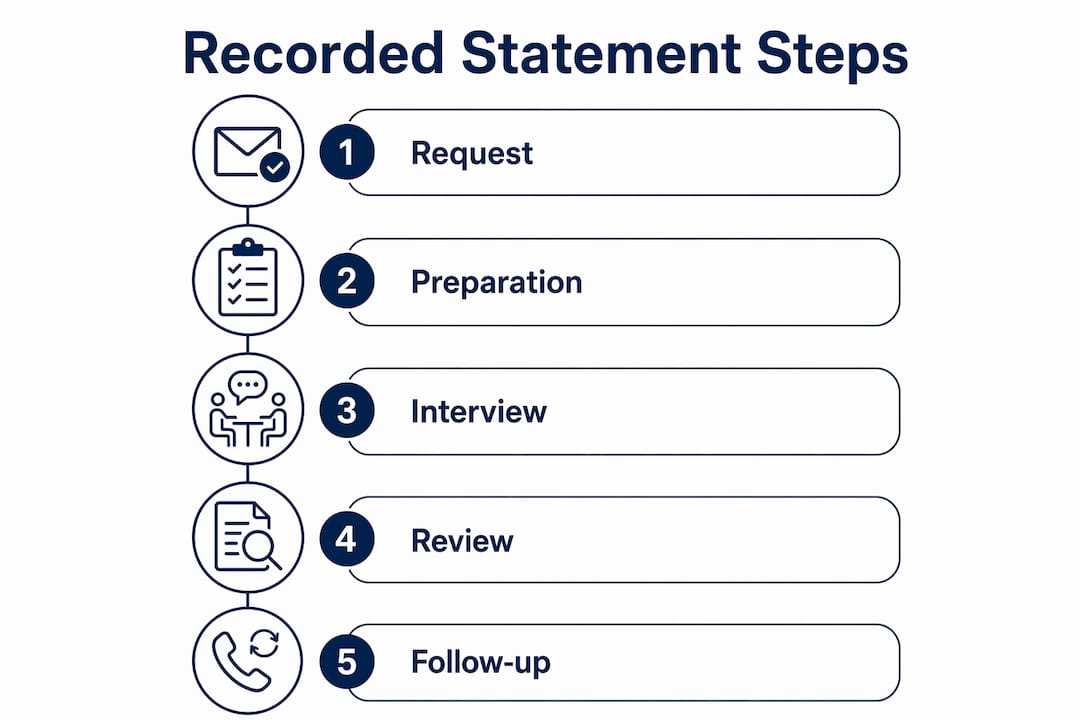
Preparation is the most effective defense against a damaging recorded statement. The steps below apply whether you are dealing with your own insurer or the at-fault party’s company.
-
Consult a personal injury attorney first. This is the single most protective step you can take. An attorney can advise you on whether to give a statement at all, and can be present during the interview if required.
-
Stick to objective facts. Statements should stick to objective facts like dates, times, and street names. Avoid guessing about speed, distances, or medical details you cannot confirm.
-
Use “I don’t recall” when uncertain. Saying “I don’t recall” is always preferable to guessing. A guess that turns out to be wrong gives the insurer grounds to challenge your credibility.
-
Keep answers brief. Answer only what is asked. Do not volunteer additional information or explain your reasoning. Short, factual answers limit the adjuster’s ability to find inconsistencies.
-
Set a time limit. Setting strict time limits of 10–15 minutes can prevent insurer “scope creep” tactics. Inform the adjuster at the start that you have limited time available.
-
Record your own copy. You can record your own conversation with the adjuster in many jurisdictions. Check your state’s laws first. If recording is not permitted, take detailed written notes immediately after the call.
-
Verify identity and purpose. Confirm the adjuster’s name, company, and the specific claim number before the interview begins. This protects you from providing information to the wrong party.
Pro Tip: Ask the adjuster to send you a written list of questions in advance. Many will decline, but the request itself signals that you are informed and prepared, which can change the tone of the entire interaction.
Proper documentation supports your statement. Learning how to document injuries after a crash gives your account a factual foundation that is much harder for insurers to challenge.
Common misconceptions about recorded statements in injury cases
Many claimants walk into recorded statements believing they are routine, neutral conversations. Recorded statements are defensive tactics that help insurers reduce claim payments, not neutral investigations. Treating them as casual conversations is one of the most costly mistakes an injured person can make.
Common myths that put claimants at risk:
- “I have to give a statement or my claim will be denied.” The at-fault driver’s insurer cannot deny your claim solely because you refused a recorded statement. They have independent legal duties to investigate.
- “The adjuster is just gathering facts.” Adjusters are trained to find information that reduces payouts. Adjusters start with routine questions then escalate to complex ones designed to surface damaging admissions.
- “I can correct the record later if I say something wrong.” Once a statement is recorded, any correction looks like inconsistency. The original version carries significant weight in claim evaluations.
- “Being cooperative will help my claim.” Cooperation with your own insurer is a policy requirement. Cooperation with the opposing insurer is a choice, and it rarely benefits the claimant.
Understanding the recorded statement injury definition clearly means recognizing that these interviews serve the insurer’s interests first. Your medical records, properly requested and organized, carry far more objective weight than a verbal account given under stress. Knowing how to request your medical records after an accident gives you a stronger factual foundation for your claim.
Key Takeaways
A recorded statement in a personal injury claim is a permanent, admissible document that insurers use to limit compensation, and giving one without legal guidance is one of the most avoidable risks in the claims process.
| Point | Details |
|---|---|
| Recorded statements are permanent | Any inconsistency between your statement and later evidence can be used to deny or reduce your claim. |
| No legal duty to the opposing insurer | You are not required to give a recorded statement to the at-fault party’s insurance company. |
| Timing works against claimants | Adrenaline and shock mask injury severity, making early statements unreliable and potentially harmful. |
| Preparation protects your claim | Consulting an attorney, keeping answers brief, and setting time limits reduces the risk of a damaging statement. |
| Recorded statements favor insurers | These interviews are strategic tools designed to reduce payouts, not neutral fact-finding exercises. |
What I have seen happen when claimants speak too soon
After years of working with injured people across Indiana, Michigan, and New Mexico, the pattern I see most often is this: a well-meaning person picks up the phone, answers an adjuster’s questions honestly, and unknowingly hands the insurer exactly what it needs to minimize the claim.
The psychological reality of trauma is underappreciated in these conversations. Memory is not a recording. In the hours and days after a serious accident, the brain is managing shock, fear, and physical pain simultaneously. Statements made in that state are not reliable representations of what happened. Yet they become the official record.
What concerns me most is the asymmetry. The adjuster has done this thousands of times. The claimant is doing it once, often while still in pain, often without knowing their rights. That imbalance is not accidental. It is the design of the process.
My strong recommendation is to treat any request for a recorded statement as a legal proceeding, not a conversation. You would not testify in court without preparation. This is no different. Slow down, get counsel, and protect the value of your claim before you say a single word on record.
— Adam
How 2keller helps when insurers request a recorded statement
Facing a recorded statement request after an injury is stressful, and the stakes are real. 2keller works with injured people in Indiana, Michigan, and New Mexico to protect their rights at every stage of the claims process, including before, during, and after recorded statement requests.

Our team helps clients understand whether to give a statement, how to prepare if they must, and how to push back against aggressive adjuster tactics. If you have already given a statement that concerns you, we can assess the impact and build a strategy to protect your claim. Reach out to 2keller’s personal injury team to speak with an attorney who understands exactly what insurers are looking for and how to counter it.
FAQ
What is a recorded statement in a personal injury claim?
A recorded statement is a formal audio or video interview conducted by an insurance adjuster to collect your account of an accident and your injuries. It becomes a permanent part of your claim file and can be used as evidence to limit your settlement.
Should I give a recorded statement to the other driver’s insurer?
No. You are under no legal obligation to give a recorded statement to the at-fault party’s insurance company, and refusing cannot legally justify a claim denial. Consult a personal injury attorney before agreeing to any interview.
How can a recorded statement hurt my injury claim?
A recorded statement locks in your version of events before you have complete medical information. If your injuries worsen or your account changes as evidence develops, the insurer will use the original statement to challenge your credibility and reduce your settlement.
Can I record my own copy of the statement?
In many states, you have the right to record your own conversation with the adjuster. Check your state’s recording consent laws first, and if recording is not permitted, take detailed written notes immediately after the call ends.
What should I say if I am not sure about a detail during a recorded statement?
Say “I don’t recall” rather than guessing. A guess that later proves inaccurate gives the insurer grounds to dispute your account. Stick to facts you can confirm, such as dates, times, and locations, and avoid any medical self-assessment.