
A wrongful death claim compensates surviving family members for the losses the death caused them: lost income, lost companionship, funeral costs. A survival action does something different. It carries forward the harm the decedent personally suffered before dying, from the moment of injury until death, and that recovery flows to the estate rather than directly to family members. Many cases involve both.
TL;DR:
- Filing both wrongful death and survival claims ensures recovery of all available damages, including pre-death pain, suffering, and future family support losses.
- Wrongful death proceeds typically go directly to beneficiaries, while survival damages are part of the estate and subject to creditor claims.
- Damages for wrongful death include lost income, companionship, and funeral costs, with caps varying significantly across states, especially for non-economic losses.
- Survival damages cover medical bills, lost wages, and pain endured before death, with some states allowing punitive damages for the decedent’s suffering.
- Statutes of limitations differ for each claim and often run from the date of injury or death, making prompt legal action essential to preserve claims.
Table of Contents
- Wrongful Death vs. Survival Claims: What Sets Them Apart
- What a Survival Action Actually Recovers
- Wrongful Death and Survival Claims Side by Side
- Who Can File, and Who Actually Gets Paid
- Damages Compared: What’s on the Table and What’s Capped
- How Long You Have to File in Each State
- What to Do Right Now to Protect Both Claims
- Firm Credentials and State-Specific Resources
- A Final Word on Timing and What Comes Next
- How 2keller Can Help After a Wrongful Death
- Sources
- FAQ
Wrongful Death vs. Survival Claims: What Sets Them Apart
The core distinction comes down to whose injury the lawsuit is compensating. A wrongful death claim is a civil cause of action that belongs to survivors, not the person who died. State statutes typically authorize specific relatives, usually a spouse, children, or other dependents, to sue for the financial and emotional fallout of losing that person. According to Cornell Law School’s Legal Information Institute, damages typically cover lost financial support, loss of companionship, and funeral expenses.
Who qualifies as a beneficiary varies significantly from state to state, and that variation matters more than most families realize until they’re already in the process.
Typical wrongful death damages include:
- Loss of the income and benefits the decedent would have provided
- Loss of companionship, guidance, and household services
- Funeral and burial expenses
- Loss of consortium for a surviving spouse
Some states cap non-economic damages like companionship and grief, particularly in medical malpractice deaths, while others impose no cap at all. That single difference can swing a settlement by hundreds of thousands of dollars depending on where the death occurred.
What a Survival Action Actually Recovers
A survival action isn’t a new claim. It’s the injury claim the decedent would have filed themselves, had they lived, kept alive by law so the estate can pursue it. Justia’s overview of wrongful death law describes survival actions as preserving the decedent’s personal injury claim so the estate can recover damages the decedent suffered before death, including medical bills, lost earnings, and pain and suffering.
The personal representative of the estate, usually named in a will or appointed by a probate court, brings this claim on the estate’s behalf.
Damages commonly recovered through a survival action include:
- Medical and hospital bills incurred between the injury and death
- Lost wages for the period the decedent survived but couldn’t work
- Conscious pain and suffering endured before death
- Punitive damages, in states that allow them to survive the decedent
Money recovered through a survival action doesn’t go straight to grieving family members. It enters the estate, where it’s distributed according to the will or, absent one, state intestacy law. That means creditors of the estate may have a claim on those funds before heirs see a dime.
Wrongful Death and Survival Claims Side by Side
The cleanest way to separate these claims is to ask three questions: who sues, what they’re compensated for, and where the money lands.
- Who files. Wrongful death suits are brought by beneficiaries or someone acting on their behalf under the state’s wrongful death statute. Survival actions are filed by the estate’s personal representative.
- What’s recovered. Wrongful death damages compensate the family’s own losses, going forward. Survival damages compensate the decedent’s own suffering, looking backward, from injury to death.
- Where proceeds go. Wrongful death money typically goes directly to named beneficiaries. Survival money goes into the estate and gets distributed under probate rules, which means it can be reached by creditors.
Consider two scenarios. A construction worker falls, is hospitalized for three weeks with significant pain and mounting medical bills, and then dies. The family has a strong survival claim for those three weeks of suffering and expense, plus a wrongful death claim for the income and companionship lost going forward. Now compare that to a driver killed instantly in a highway collision. There’s little to no conscious pain and suffering to claim, so the survival action may be minimal or nonexistent, while the wrongful death claim carries the weight of the case, since a survival action’s recoverable pain and suffering depends on evidence the decedent was conscious of the injury before death.
Families who plead only one of these claims often leave real money on the table. Most states permit both actions for the same incident, but skipping one means forfeiting an entire category of recoverable damages.
Who Can File, and Who Actually Gets Paid
State statutes set a priority order for wrongful death beneficiaries, and that order is not something families get to negotiate around. A surviving spouse usually stands first in line, followed by children, then parents or other dependents, though the exact sequence and eligibility rules shift from state to state.
A survival action works differently at the filing stage. Only the estate’s personal representative, executor, or court-appointed administrator, can bring it, since the claim legally belongs to the estate rather than to any individual relative.
- Wrongful death proceeds often bypass the estate entirely and go straight to statutory beneficiaries.
- Survival proceeds enter the estate and are distributed under the will or intestacy law, which can expose them to creditor claims.
- This estate-versus-beneficiary split is one of the most consequential practical distinctions between the two claim types, and it shapes how attorneys structure a case from day one.
Damages Compared: What’s on the Table and What’s Capped
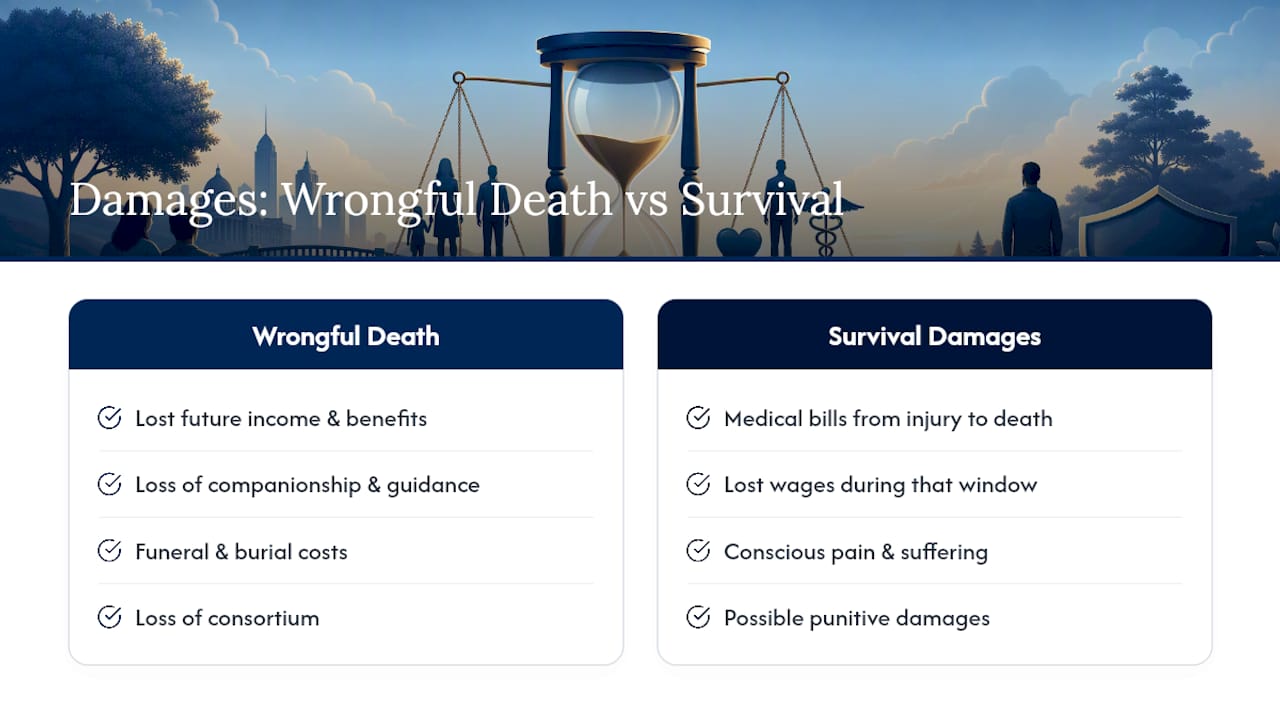
Line them up side by side and the contrast becomes obvious. Wrongful death damages: lost future income and benefits, loss of companionship and guidance, funeral and burial costs, loss of consortium. Survival damages: medical bills from injury to death, lost wages during that window, conscious pain and suffering, and in some states, punitive damages.
Pro Tip: Grief and emotional anguish are treated inconsistently across states. Some allow a beneficiary to recover for mental anguish as part of wrongful death damages; others limit recovery strictly to financial losses. Ask an attorney licensed in the state where the death occurred before assuming either way.
Settlement outcomes vary enormously depending on the facts, the state’s damage caps, and how much conscious suffering can be documented. There’s no reliable single figure that represents a “typical” payout, and any source claiming otherwise is oversimplifying a process that turns heavily on jurisdiction and evidence. What’s consistent is this: cases that plead both claims and document both timelines tend to preserve more of the available compensation than cases that only pursue one.
How Long You Have to File in Each State
Deadlines differ by claim type and by state, and missing one can end a case before it starts. Many states set a two-year statute of limitations for wrongful death, measured from the date of death rather than the date of the injury. Survival action deadlines sometimes run from the date of injury instead, which can create two different clocks ticking on the same underlying incident.
- Indiana generally requires wrongful death claims within two years, with distinct nuances depending on the cause of death, according to the firm’s Indiana wrongful death statute overview.
- California carves out exceptions and extended windows in certain circumstances, illustrating how much variation exists even between two large states.
- Medical malpractice deaths often carry separate, shorter windows, and some states apply tolling rules that pause the clock under specific conditions.
Statute-of-limitations nuances are commonly overlooked and frequently fatal to otherwise valid claims. Local counsel who knows the state’s specific rules isn’t optional here.
What to Do Right Now to Protect Both Claims
- Request the death certificate, all medical records, and any police or accident report tied to the incident.
- Collect witness names and contact information while memories are still fresh.
- Gather income records, tax returns, and evidence of household contributions to support wrongful death damages.
- Preserve hospital charting and physician notes that document the decedent’s condition and consciousness, which support survival damages.
- Bring everything you’ve collected to a free consultation, where an attorney can evaluate both claims at once.
Pro Tip: Contingency-fee representation means you pay nothing upfront, and the firm only collects a fee if your case settles or wins. That structure lets families focus on grieving instead of worrying about legal bills while the case develops.
Firm Credentials and State-Specific Resources
Attorneys at a multi-state law firm work wrongful death and survival claims through all stages, from initial evidence collection through settlement or trial. This article is written by Adam, covering both claim types with attention to state-by-state variation.
Families in Indiana can review the firm’s overview of wrongful death lawsuits or its Indiana wrongful death statute page, while Michigan families can consult the firm’s Michigan wrongful death guide. Typical documents requested at intake:
- Death certificate and autopsy report, if one exists
- Medical records from the incident through the date of death
- Police, OSHA, or accident investigation reports
- Proof of income and financial dependency
A Final Word on Timing and What Comes Next
Grief doesn’t run on a legal calendar, but evidence does. Witnesses forget details, records get purged, and statutes of limitations don’t pause for mourning. Acting within weeks, not months, gives an attorney the best chance to document consciousness, dependency, and fault before that evidence degrades.
Expect a realistic case to take months to build and potentially longer to resolve. Lean on both legal counsel and grief support. You shouldn’t have to carry either burden alone.
— Adam
How 2keller Can Help After a Wrongful Death
A multi-state firm works wrongful death and survival claims together from day one, helping families seek all recoverable damages by filing both claims. That matters because, as this article has shown, skipping one claim type can mean forfeiting an entire category of compensation, whether that’s the decedent’s pre-death pain and suffering or the family’s own future losses.

Some firms offer free case evaluations and operate on a contingency fee basis, collecting fees only if a case settles or wins. Bring the death certificate, medical records, and any accident or police reports you’ve gathered, and an attorney can walk through which claims apply to your situation. If the death arose from a truck accident, the firm’s experience with truck accident cargo liability cases may also be relevant. Start with a free case evaluation to find out what your family may be owed.
Sources
Consult your state’s specific wrongful death and survival statutes, along with the Cornell LII overview and Nolo’s guide to wrongful death settlements, for deeper detail.
This article is general information, not a substitute for advice from a qualified lawyer. Consult a qualified legal professional about your own circumstances before acting on anything here.
- Wrongful death — Cornell Law School, Legal Information Institute
- Wrongful Death — Justia
- How wrongful death lawsuits and settlements work — Nolo
- Wrongful death vs survival action — LawyerDamages
FAQ
What’s the Average Wrongful Death Payout?
There’s no reliable universal average. Settlement amounts depend heavily on the state’s damage caps, the strength of the evidence, and whether a survival claim is pursued alongside the wrongful death claim.
What Percentage of Wrongful Death Cases Are Won?
No dependable national win-rate figure exists, since outcomes vary by state, evidence quality, and whether the case settles before trial. Cases that document both survival and wrongful death damages typically preserve more recoverable value than those pursuing only one theory.
How Hard Is It to Win a Wrongful Death Lawsuit?
Wrongful death cases only require a preponderance of the evidence, a lower bar than the beyond-a-reasonable-doubt standard used in criminal prosecutions, which makes a civil claim achievable even when no criminal charges are filed.
Do I Have to Pay Taxes on a Wrongful Death Settlement?
Tax treatment depends on how the settlement is allocated between physical injury damages, punitive damages, and other categories, so ask your attorney or a tax professional to review the specific breakdown of your award.
Can I File a Survival Action and a Wrongful Death Claim at the Same Time?
Yes. Most states allow both claims to proceed from the same incident, and pursuing both is often the only way to recover the full range of damages available to the estate and to surviving family members.