
If you were hurt in a scaffold collapse or fall, you likely have two possible paths to compensation: a workers’ compensation claim through your employer, and, if someone other than your employer caused or contributed to the accident, a third-party personal injury or wrongful death lawsuit. Workers’ comp is typically the faster, no-fault route, covering medical care and partial wages. A third-party claim, filed against a property owner, contractor, manufacturer, or rental company, can recover far more, including pain and suffering and full lost income. Get medical treatment, put your account in writing, preserve evidence, and talk to an attorney before you sign anything.
TL;DR:
- Workers’ compensation provides quick, no-fault medical and partial wage coverage but excludes pain and suffering, disfigurement, or punitive damages.
- Third-party claims can recover full wages, medical expenses, pain, suffering, and damages from responsible parties like property owners, manufacturers, or rental companies.
- OSHA’s federal standards and New York’s Scaffold Law directly influence liability, with the latter imposing strict liability for gravity-related injuries when fall protection was required but not provided.
- The statute of limitations varies: 30 days to report the injury, two years for workers’ comp claims, and three years for most personal injury suits, with shorter deadlines for government defendants.
- Preserving evidence, timely reporting, and consulting an attorney early can significantly impact case value, especially for catastrophic injuries that may warrant third-party lawsuits.
Table of Contents
- Workers’ Compensation vs. Third-Party Scaffold Injury Compensation
- Who Gets Sued: Liable Parties and the Legal Theories Behind Scaffold Claims
- OSHA Scaffold Standards and Why New York’s Scaffold Law Changes Everything
- Statute of Limitations: Deadlines That Can End a Scaffold Claim Before It Starts
- The First 72 Hours: Protecting Your Health and Your Scaffold Accident Claim
- What a Scaffold Injury Claim Is Actually Worth
- Workers’ Comp Liens: Protecting Your Net Recovery in a Third-Party Suit
- How 2keller Approaches Scaffold Accident Cases
- When Workers’ Comp Is Enough, and When It Is Not
- Get a Free Case Evaluation for Your Scaffold Accident Claim
- Where These Rules Actually Come From
- Sources
- FAQ
Workers’ Compensation vs. Third-Party Scaffold Injury Compensation
Workers’ compensation exists to get injured employees medical care and partial income replacement quickly, without anyone having to prove fault. According to U.S. Department of Labor guidance, benefits typically cover medical treatment and a partial portion of lost wages. What comp does not cover matters just as much: there is no payment for pain and suffering, disfigurement, or punitive damages, no matter how careless the conditions on the scaffold were.
This is where the exclusive remedy doctrine comes in. Most states, including the ones 2keller serves, bars injured employees from suing their direct employer for a workplace injury. Workers’ comp is the trade-off. That protection does not extend to other parties, though. If someone outside the employment relationship caused the fall, a separate lawsuit is often available.
Common scenarios that open the door to a third-party scaffold accident lawsuit include:
- A property owner who failed to provide required fall protection or guardrails
- A general contractor who allowed a scaffold to be erected without proper bracing or planking
- A scaffold rental company that supplied damaged or improperly maintained equipment
- A manufacturer whose defective component caused a collapse
- A subcontractor from another trade whose negligence created the hazard
Filing for workers’ comp immediately protects your medical care and wages while an attorney investigates whether a third-party claim also applies. The two tracks are not mutually exclusive, and pursuing one does not waive your right to the other.
Who Gets Sued: Liable Parties and the Legal Theories Behind Scaffold Claims
Scaffold accident lawsuits rarely name a single defendant. Construction sites involve layers of owners, contractors, and equipment suppliers, and each one carries a distinct legal duty that can support a separate claim.
- Property owners and general contractors carry a duty to keep the site reasonably safe and to supervise subcontractors. When they skip inspections or ignore known hazards, premises liability and general negligence claims follow.
- Subcontractors and site supervisors can be liable when they erect scaffolding incorrectly, skip required tie-ins, or fail to enforce basic safety rules like guardrails and toe boards.
- Scaffold manufacturers face strict product liability claims when a design flaw or manufacturing defect, such as a cracked coupling pin or a weak plank, causes a failure regardless of how carefully the scaffold was assembled.
- Rental and leasing companies can be liable for renting out equipment with known defects or skipping required maintenance and inspection between jobs.
Because these duties overlap, a single accident can generate several viable defendants at once. Plaintiffs’ attorneys typically plead negligence, premises liability, and product liability together, which increases the odds that at least one theory survives early motions and reaches a jury or settlement table.
OSHA Scaffold Standards and Why New York’s Scaffold Law Changes Everything
Federal safety rules set the baseline every scaffold accident claim gets measured against. OSHA’s scaffold standards, codified at 29 CFR 1926 Subpart L, require guardrails above certain heights, proper planking and bracing, competent-person inspections, and specific load capacities. When an employer or contractor violates these rules, that violation becomes powerful evidence, though how powerful depends entirely on the state.
By the numbers: OSHA data points to roughly 4,500 scaffolding-related injuries reported annually in the United States, with falls, planking or support failures, and missing fall protection among the most frequently cited causes.
Courts do not treat OSHA citations uniformly. Some jurisdictions allow a proven violation to establish negligence per se, essentially proving fault automatically. Others treat it only as evidence of the industry standard, and some limit its use because inspection reports can qualify as hearsay in case law addressing this variation.
New York breaks from this pattern entirely. Under Labor Law Section 240(1), the state’s Scaffold Law, owners and general contractors face strict liability for gravity-related injuries when required fall protection was not provided, regardless of how careful the worker was. That single statute can turn a contested negligence case into a far stronger claim, which is why identifying the applicable state law early changes how a case gets built from day one.

Statute of Limitations: Deadlines That Can End a Scaffold Claim Before It Starts
Missing a filing deadline can end a valid claim before an attorney ever gets to argue the facts. The clock starts the day of the accident, and it does not pause for recovery time.
- Report the accident to your employer immediately. In New York, written notice of a work injury is due within 30 days, and a formal claim must reach the Workers’ Compensation Board within two years of the incident.
- Track your state’s personal injury statute of limitations. New York allows three years for most personal injury claims, but wrongful death claims often carry shorter windows, and every state sets its own limit.
- Watch for government defendants. If a public agency owned or managed the site, a Notice of Claim is often due within as little as 90 days, far shorter than standard injury deadlines and easy to miss without counsel.
- **Calendar every deadline the week of the accident, not after treatment ends, since evidence and witness memory fade fast and some clocks run in parallel.
The First 72 Hours: Protecting Your Health and Your Scaffold Accident Claim
What happens in the days right after a fall often decides whether a later claim succeeds. Follow these steps in order:
- Get emergency medical care first, then follow every treatment recommendation. Gaps in care get used against injured workers later, so keep every bill and record.
- File a written incident report with your employer and keep a dated copy for yourself. If you cannot do this from a hospital bed, ask a family member or coworker to submit it on your behalf.
- Photograph everything before conditions change, including the scaffold itself, missing guardrails, damaged planking, and your own injuries. Scaffolds get dismantled fast on active job sites, and once that happens, key evidence is gone.
- Collect witness names and phone numbers while people are still on-site. Coworkers move between projects, and contact information gets harder to track down within weeks.
- Decline recorded statements and do not sign anything from an insurance adjuster. Politely refer any insurer call to your attorney once you have one.
Pro Tip: Ask your employer, in writing, to preserve the scaffold and any broken components for inspection. If a claim later hinges on a defective coupling pin or cracked plank, that physical evidence often matters more than any witness statement.
What a Scaffold Injury Claim Is Actually Worth
The financial gap between workers’ comp and a successful third-party lawsuit is often the difference between covering bills and rebuilding a life.
- Economic damages in a third-party suit can include past and future medical expenses, full lost wages (not the partial percentage comp pays), diminished future earning capacity, rehabilitation costs, and home modifications for permanent injuries.
- Non-economic damages cover pain and suffering, emotional distress, and loss of enjoyment of life, none of which workers’ comp pays under any circumstance. Punitive damages exist but are rare and reserved for particularly reckless conduct.
- Workers’ comp stays capped at medical bills and a partial portion of lost wages, regardless of how catastrophic the injury.
Case outcomes vary widely by state, injury severity, and how clearly liability can be proven. Catastrophic injuries, like spinal damage or traumatic brain injury from a multi-story fall, tend to produce the highest verdicts and settlements, while fractures with lengthy but full recovery periods typically settle in a more moderate range. The strength of the liability evidence, not just the injury itself, usually drives where a case lands.
Workers’ Comp Liens: Protecting Your Net Recovery in a Third-Party Suit
Winning a third-party lawsuit does not mean you keep the entire settlement. Workers’ compensation carriers generally hold a legal right to reimbursement from any third-party recovery tied to the same injury, a claim known as a lien, and the Workers’ Compensation Board’s claim process rules spell out how that reimbursement works.
- The lien typically covers medical expenses and wage benefits the carrier already paid on your behalf.
- Attorneys routinely negotiate lien reductions, arguing that certain costs (like attorney fees and litigation expenses) should reduce the carrier’s share.
- Early attorney involvement matters because signing a settlement without addressing the lien first can trigger repayment demands that eat into money you thought was final. A firm resource explaining how liens affect injury settlements walks through the mechanics in more depth.
Coordinating both claims from the start, rather than settling workers’ comp first and figuring out the lien later, generally protects more of the final payout.
How 2keller Approaches Scaffold Accident Cases
Scaffold cases hinge on details that disappear fast: a missing guardrail, a rental company’s maintenance log, a supervisor’s verbal shortcut on a safety rule. Construction accident work focuses on locking down that evidence early, subpoenaing site records before they get lost in normal business turnover, and bringing in safety experts to reconstruct exactly how a fall or collapse happened.
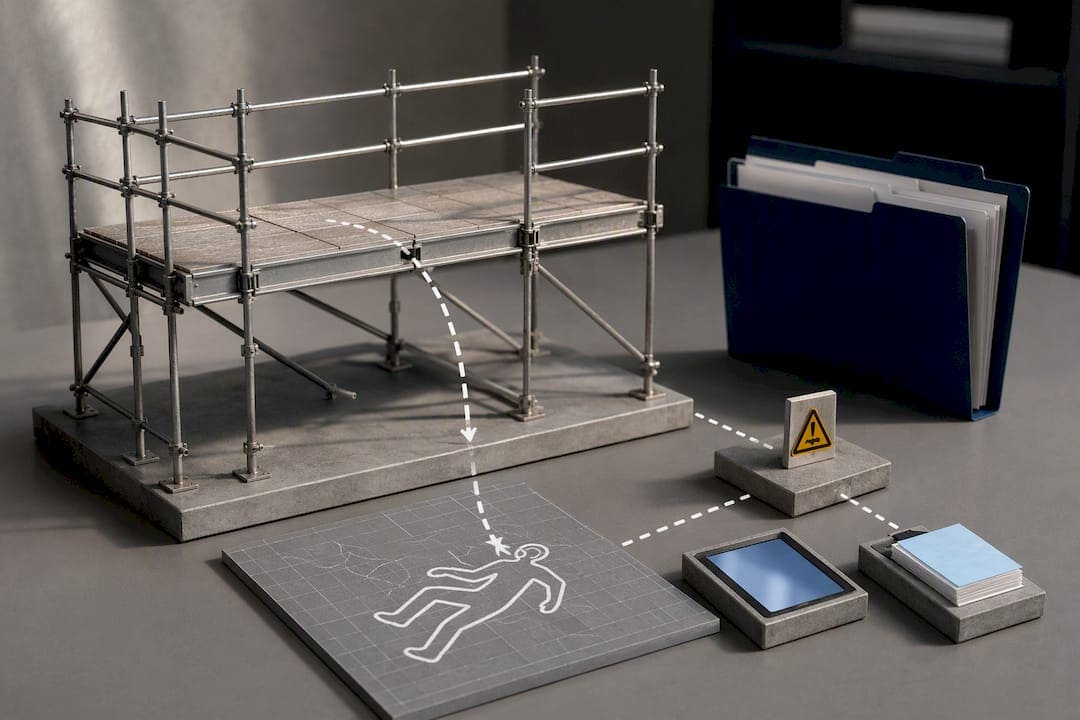
A free case evaluation typically starts with the basics: medical records, your written incident report, photos of the scene, and contact information for any coworkers who witnessed the accident. From there, the firm works to determine whether workers’ comp alone applies or whether a third-party scaffold accident claim against an owner, contractor, or manufacturer is also on the table, all on a contingency-fee basis, meaning no fee unless the case results in a settlement or award.
When Workers’ Comp Is Enough, and When It Is Not
If your injuries heal fully and you return to the same job within a reasonable time, workers’ comp benefits may genuinely cover what you need. Serious, permanent, or career-ending injuries almost always call for a closer look at third-party liability, because comp’s wage cap and lack of pain-and-suffering recovery simply do not match the real financial loss.
Weigh your medical prognosis, whether you can return to your trade, and how strong the evidence of a third party’s fault looks before agreeing to any settlement. Talk to an attorney before you sign a release. Once it’s signed, it’s final.
— Adam
Get a Free Case Evaluation for Your Scaffold Accident Claim
Scaffold and construction accident claims are handled across Indiana, Michigan, and New Mexico with a straightforward promise: no fee unless the case is won. That matters most in scaffold cases, where workers’ comp alone often leaves serious injuries badly undercompensated and figuring out who else can be held liable requires fast evidence work most injured workers cannot do alone while recovering.

A free case evaluation starts with the essentials: your medical records, a copy of the incident report, photos of the accident scene, and names of any coworkers who saw what happened. From there, the firm works to preserve evidence, negotiate workers’ comp liens so they do not eat into a third-party settlement, and bring in the right experts to rebuild exactly how the scaffold failed. If you were hurt on a scaffold and are not sure whether workers’ comp is your only option, start your free case evaluation with 2keller today.
Where These Rules Actually Come From
The claims and deadlines above trace back to primary sources worth bookmarking. OSHA’s scaffold standards set the federal safety floor every employer must meet. The Department of Labor’s workers’ compensation overview explains what comp benefits actually cover. New York claimants should also review the Workers’ Compensation Board’s notice and filing rules directly, since deadlines there are unforgiving.
This article is general information, not a substitute for advice from a qualified lawyer. Consult a qualified legal professional about your own circumstances before acting on anything here.
Sources
FAQ
What Are the Statistics on Scaffolding Accidents in the United States?
Scaffold accidents cause an estimated 4,500 injuries annually in the United States, with falls, plank or support failures, and missing fall protection cited as leading causes. Deaths occur every year as well, most tied to workers falling from height without proper guardrails or harnesses.
What Is the 4 to 1 Rule in Scaffolding?
The 4 to 1 rule refers to the height-to-base-width ratio scaffolds must generally maintain for stability: for every four feet of height, the base needs at least one foot of width, or the scaffold must be secured to prevent tipping. This principle sits within OSHA’s broader scaffold safety standards, which also cover guardrails, planking, and load limits.
What Is the Major Reason for Scaffold Accidents?
Falls from height remain the leading cause of scaffold accidents, frequently tied to missing guardrails, unsecured planking, or scaffolds that were not properly braced or tied to the structure. Improper assembly and skipped inspections consistently show up as contributing factors in accident investigations.
How Do I Know if I Should File a Workers’ Comp Claim or a Lawsuit?
Nearly every injured worker should file for workers’ compensation first, since it provides immediate, no-fault medical and wage benefits. Whether a third-party lawsuit also applies depends on whether a property owner, contractor, manufacturer, or rental company contributed to the accident, which is exactly what a scaffold accident claim evaluation is designed to determine.
What Should I Do Immediately After a Scaffold Fall?
Get medical care first, then file a written incident report and photograph the scene before conditions change. Avoid giving recorded statements to any insurance adjuster and speak with an attorney before signing any settlement release.