
If a car hits you while you’re on foot, you can usually seek compensation from the at-fault driver’s liability insurance, and sometimes from your own PIP, MedPay, or uninsured motorist coverage too. Your state’s fault rule and filing deadline both shape what you recover, so call 911, get medical care, and start documenting the scene before anything else.
TL;DR:
- Pedestrians can seek compensation through driver liability insurance, PIP, MedPay, or uninsured motorist coverage, depending on fault rules and filing deadlines.
- Evidence such as police reports, medical records, scene photos, witness contacts, and technical data are crucial to building a strong claim and defending against insurer tactics.
- State fault rules, especially comparative or contributory negligence, significantly influence how much you can recover, with most states applying some form of comparative negligence.
- Deadlines for filing claims vary by state, often around two years for personal injury, but shorter for claims against government entities, requiring early legal consultation.
- An experienced lawyer can improve settlement outcomes by managing evidence, negotiating liens, and resisting fault-shifting tactics, with many working on contingency fees.
Table of Contents
- What Are Your Legal Rights as a Pedestrian Hit by a Car?
- What Should You Do Immediately After Being Hit by a Car?
- How Does Compensation Get Paid After a Pedestrian Accident?
- How Does Fault Affect What You Can Recover?
- How Long Do You Have to File a Pedestrian Accident Claim?
- What Evidence Do You Need to Build a Strong Claim?
- What Happens If the Driver Flees the Scene?
- How Does an Injury Lawyer Improve Your Outcome?
- What Should You Expect After Hiring a Lawyer?
- Get a Free Case Evaluation From Keller & Keller
- Where to Verify State-Specific Details
- Sources
- FAQ
What Are Your Legal Rights as a Pedestrian Hit by a Car?
A pedestrian hit by a car has the legal right to pursue compensation under ordinary negligence principles, the same framework that governs almost every car accident case. Drivers owe everyone on the road, including people on foot, a duty to exercise reasonable care. When a driver breaches that duty by speeding, running a light, or failing to yield at a crosswalk, and that breach causes your injuries, negligence law gives you a claim against them.
Recoverable damages fall into two buckets. Economic damages cover the bills you can put a number on:
- Emergency room and hospital costs
- Ongoing rehabilitation and future medical care
- Lost wages and diminished future earning capacity
- Property damage, such as a destroyed phone or bicycle
Non-economic damages compensate for harm that doesn’t come with a receipt, including pain and suffering, disfigurement, and loss of consortium claims filed by family members in fatal cases. The driver isn’t always the only party on the hook, either. A vehicle owner, an employer if the driver was on the clock, or even a city that left a crosswalk signal broken can share liability.
What Should You Do Immediately After Being Hit by a Car?
What you do in the first hours after a crash often decides what your claim is worth months later. Follow these steps in order:
- Call 911 right away. This gets you medical attention and creates an official police report, which becomes one of the most persuasive pieces of evidence in your file.
- Get checked out even if you feel fine. Adrenaline masks pain, and conditions like concussions or internal bleeding can take hours or days to surface.
- Gather driver and vehicle information if it’s safe to do so, including the license plate, insurance card, and the driver’s contact details.
- Photograph everything: vehicle position, skid marks, the crosswalk or intersection, your visible injuries, and the surrounding road signs.
- Collect witness names and phone numbers before they leave the scene. Memories fade fast, and people move on.
- Say nothing that resembles an admission of fault, and avoid giving a recorded statement to the driver’s insurance company until you’ve talked to someone representing your interests.
- Notify your own insurer promptly. This step protects your PIP or uninsured motorist rights even if the other driver was clearly at fault.
How Does Compensation Get Paid After a Pedestrian Accident?
Recovering damages after an accident usually starts with the at-fault driver’s liability insurance, which pays out up to the policy limits once fault is established. That’s the primary source in most pedestrian accident claims, but it isn’t the only one, and the order in which sources pay matters.
- Driver’s liability insurance: Primary payer when the driver is identified and clearly at fault, capped at their policy limit.
- PIP or MedPay: In no-fault states and several others, your own auto policy’s Personal Injury Protection or Medical Payments coverage pays initial medical bills regardless of who caused the crash.
- Uninsured/underinsured motorist (UM/UIM) coverage: Steps in when the driver has no insurance, not enough insurance, or fled the scene. Check resident household policies, since coverage sometimes extends to family members living with you even if they weren’t in a car.
- Health insurance, Medicare, or Medicaid: These often pay medical bills up front, but they can later assert a lien against your settlement to recoup what they paid.
- State victim compensation programs: A limited, capped safety net for qualifying hit-and-run injuries when no insurance applies.
The stakes here are higher than most people realize. Pedestrian crashes caused 7,314 deaths in 2023 and injured more than 68,000 people nationwide, and a meaningful share of those injuries involve long recoveries that outlast an insurer’s first offer.
Health insurers, Medicare, Medicaid, and hospitals frequently assert liens against a settlement once it comes through, and ERISA-governed employer plans can be especially difficult to negotiate down. This is one of the quieter ways a settlement shrinks between the number an insurer offers and the check you actually deposit.
How Does Fault Affect What You Can Recover?
Whether you crossed mid-block, jaywalked, or were fully within your rights at a marked crosswalk, your state’s fault rule decides how much that matters to your payout.
- Pure comparative negligence: Your recovery is reduced by your percentage of fault, but you can still collect even if you’re found 90% responsible.
- Modified comparative negligence: You can recover only if your fault stays below a threshold, commonly 50% or 51%, depending on the state. Cross that line and you get nothing.
- Contributory negligence: A small number of states still use this harsh rule, where any fault on your part, even 1%, bars recovery entirely.
Most states now use some version of comparative negligence rather than the older contributory standard, but the exact threshold and calculation method vary enough that the same accident can produce very different outcomes depending on where it happened. Insurance adjusters know this, and they routinely lean on any hint of pedestrian fault to knock down a payout. Detailed scene photos and witness statements are your best defense against that tactic, because they pin down the timeline before the insurer has a chance to rewrite it.
How Long Do You Have to File a Pedestrian Accident Claim?
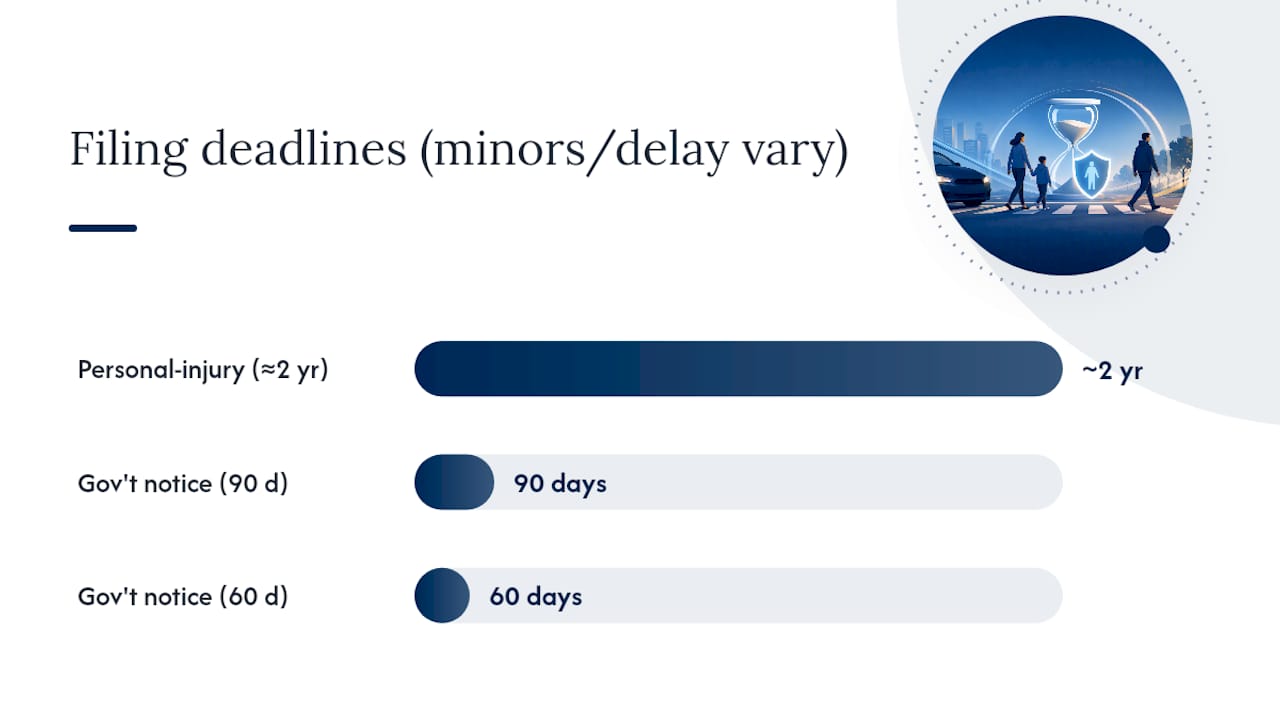
Deadlines vary sharply by state, and missing one permanently kills your claim, no matter how strong the evidence is. Most states set a personal injury statute of limitations typically around two years, but the actual deadline varies by state and claim type.
Claims against a government entity, such as a city bus, a police vehicle, or a pothole-related crash on public property, often carry a much shorter notice requirement, sometimes as little as 60 or 90 days to file formal notice before you can sue at all. Rules also shift for minors and in cases where an injury wasn’t discovered right away. Given how much these windows vary, talking to a lawyer early costs you nothing and protects deadlines you might not know exist.
What Evidence Do You Need to Build a Strong Claim?
A claim lives or dies on documentation, and the strongest files combine four categories of proof.
- Official records: the police report, complete medical records and itemized bills, and employer wage statements showing lost income.
- Visual evidence: scene photos, vehicle damage shots, and video from traffic cameras or nearby storefronts.
- Witness information: names and phone numbers collected at the scene, before people scatter.
- Technical evidence: cell phone location data or, in serious cases, an accident reconstruction expert who can recreate speed and impact angles.
Consistency matters as much as quantity. Insurers and juries both give more weight to a claimant who sought treatment right away and followed through on every recommended visit than to someone with gaps in care, even when the underlying injury is identical.
Pro Tip: Keep a simple daily log of pain levels, missed activities, and medication starting the day of the crash. Adjusters discount vague pain complaints, but a dated, specific record is hard to argue with.
What Happens If the Driver Flees the Scene?
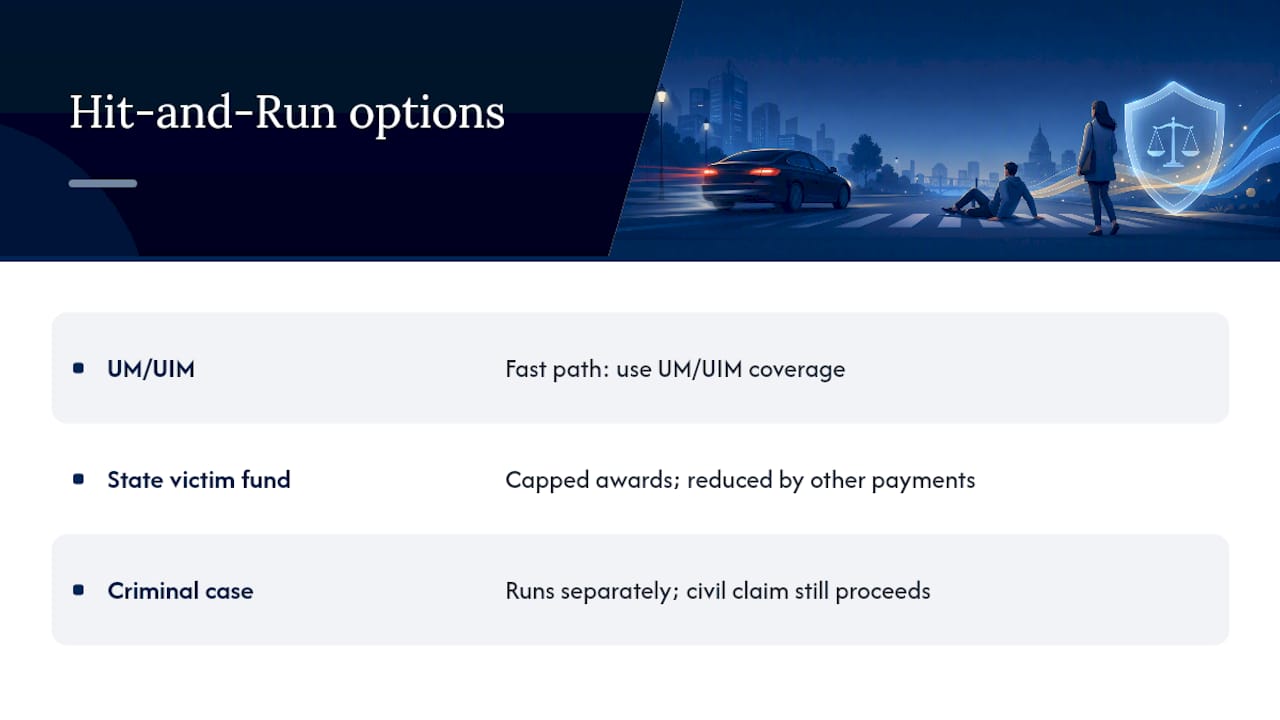
A hit-and-run doesn’t end your options, but it does change which door you knock on first. Treat the fleeing driver as effectively uninsured and lean on your UM/UIM coverage, which is often the fastest path to compensation when no one is left to sue directly.
State victim compensation programs offer another layer of help, though awards are capped and get reduced by any other payments you receive. These programs require a prompt police report and strict eligibility documentation, so speed matters. Leaving the scene of a crash involving an injury is a criminal offense in nearly every state, and depending on injury severity, it can trigger felony charges. That criminal case runs on its own track. Your civil claim for compensation moves forward regardless of whether police catch the driver or a prosecutor wins a conviction.
How Does an Injury Lawyer Improve Your Outcome?
An experienced personal injury lawyer works on a contingency fee, meaning you pay nothing upfront and the fee comes out of the recovery only if the case succeeds. That structure lets injured pedestrians hire serious legal help without touching savings they need for rent or medical copays.
Beyond the fee arrangement, a lawyer’s real value shows up in the parts of a claim most people never see: tracking down surveillance footage before it’s overwritten, negotiating medical liens down so more of the settlement reaches you, and pushing back when an adjuster tries to shift blame onto the person who got hit. Firms handling pedestrian and hit-and-run cases regularly see how much a properly documented file changes the negotiation.
What Should You Expect After Hiring a Lawyer?
Case timelines vary, but a straightforward claim often resolves in several months once treatment ends, while cases involving surgery, disputed fault, or litigation can stretch well past a year. The biggest mistakes I see are accepting a fast, low settlement offer before the full medical picture is clear, skipping follow-up care because symptoms seem to fade, and letting evidence like witness contacts or scene photos disappear. Contacting a lawyer early, even before you’ve decided whether to hire one, tends to prevent all three.
— Adam
Get a Free Case Evaluation From Keller & Keller
Some law firms work on a contingency basis, meaning no fee is charged unless they win your case, which allows injured individuals to obtain legal representation for pedestrian accidents, hit-and-run claims, or wrongful death cases without paying anything out of pocket up front. Some law firms emphasize direct access to attorneys and paralegals rather than relying on call centers, to facilitate communication and case updates for clients.

If you’ve been struck by a vehicle in Indiana, Michigan, or New Mexico, a free case evaluation is the fastest way to find out where you stand. Bring what you have, even if it’s incomplete: the police report, medical records so far, photos from the scene, and any insurance correspondence. We’ll tell you plainly whether you have a claim worth pursuing and what it would take to build it. Readers in Michigan can also review our state-specific pedestrian accident guidance for local context before reaching out.
Where to Verify State-Specific Details
For statutes and safety data beyond this guide, check the Legal Information Institute on negligence and comparative fault, your state Department of Transportation’s crash statistics, and your state’s victim compensation program page for hit-and-run eligibility rules.
This article is general information, not a substitute for advice from a qualified lawyer. Consult a qualified legal professional about your own circumstances before acting on anything here.
Sources
- Nolo — Pedestrian hit-by-car legal options
- NHTSA — Pedestrian safety countermeasures
- LegalClarity — What to do after a car hits a pedestrian
FAQ
Who Is at Fault if a Pedestrian Gets Hit by a Car?
Fault depends on who breached their duty of care, but drivers are found at fault in most pedestrian crashes because they failed to yield, were speeding, or were distracted. Shared fault is possible if the pedestrian was jaywalking or crossing against a signal, and your state’s comparative or contributory negligence rule determines how that affects your payout.
How Much Compensation Can You Get if a Pedestrian Is Hit by a Car?
There’s no fixed average, because settlement value depends on medical costs, lost wages, injury severity, and available insurance limits rather than a flat formula. A claim with capped policy limits and shared fault typically settles for far less than one with clear liability, full coverage, and documented long-term care needs.
What Charges Can a Driver Face for Hitting a Pedestrian?
Charges vary by state and circumstances, ranging from a traffic citation for a minor, non-injury incident to felony charges for hit-and-run, DUI, or vehicular manslaughter when injuries or death result. Criminal charges are handled separately from a civil injury claim, so a driver being charged, or not, doesn’t determine whether you can recover compensation.
Do I Need a Lawyer to File a Pedestrian Accident Claim?
You aren’t required to hire one, but claims involving serious injury, disputed fault, or multiple insurance sources usually turn out better with legal help, especially since lawyers work on contingency and cost nothing upfront. 2keller offers a free case evaluation to help you understand your options before deciding how to proceed.
What if the Driver Who Hit Me Doesn’t Have Insurance?
Uninsured and underinsured motorist coverage on your own auto policy, or a household member’s policy, is usually your main recovery path when the at-fault driver has no insurance. State victim compensation programs can offer limited, capped assistance as well, particularly in hit-and-run cases where the driver was never identified.