
Typical car accident settlement amounts in the United States land between $23,900 and $31,000, depending on which dataset you’re reading, but that median figure tells you almost nothing about your case. Injury severity, insurance policy limits, and who caused the crash swing outcomes from a few thousand dollars to seven figures. The number that actually matters is your net recovery after attorney fees, medical liens, and case expenses come out.
TL;DR:
- Settlement amounts vary greatly depending on injury severity, with catastrophic injuries like brain or spinal cord damage often exceeding one million dollars.
- Evidence strength, documentation quality, and policy limits critically influence the final payout, especially in soft-tissue versus severe injury cases.
- Insurance coverage limits are a key factor, with commercial trucks typically offering higher liability limits than passenger vehicles, impacting potential recovery.
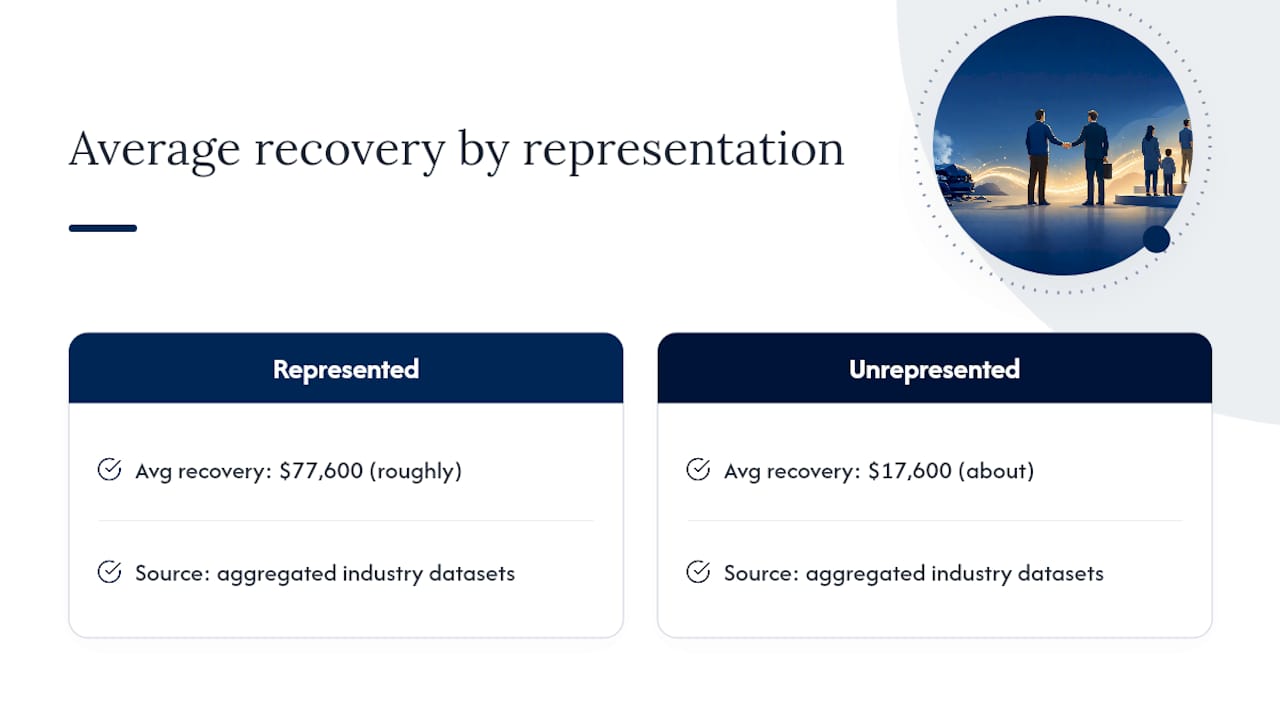
- Legal representation significantly increases chances of higher settlement recovery, with insured claimants averaging around four times more than unrepresented individuals.
- The claim process can take from a few months for mild injuries to over two years for complex or disputed cases, emphasizing the importance of early documentation and legal advice.
Table of Contents
- Car Accident Settlement Amounts by Injury Type
- What Actually Moves the Number Up or Down
- From Gross Settlement to Net Recovery: The Real Math
- How Your State’s Fault Rules Change What You Recover
- Why Legal Representation Changes the Outcome
- The Claim Timeline: Negotiation vs. Litigation
- Your Next Steps After a Crash
- What Clients Get Wrong About Settlement Timing
- Get a Free Case Evaluation From 2keller
- Where These Figures Come From
- Sources
Car Accident Settlement Amounts by Injury Type
Insurers value claims in tiers, and knowing where your injury falls tells you more than any single average ever could. A crash with no injuries, just vehicle damage, typically settles in the low thousands, driven entirely by repair estimates and a rental car bill. Add a diagnosed injury, and the math changes fast.
Soft-tissue injuries, primarily whiplash, make up the bulk of claims filed every year, and they’re also why national averages skew low. A whiplash settlement amount often ranges from $2,500 to $10,000 when treatment wraps up in a few weeks with a chiropractor or physical therapist. Insurers push back hard on these claims because soft-tissue injuries don’t show up on an X-ray, and adjusters know it.
Move up to fractures or a herniated disc, and the range shifts substantially:
- Simple fractures (wrist, ankle, non-displaced) typically settle for amounts varying based on healing time and missed work.
- Herniated discs requiring injections or physical therapy generally result in substantially higher settlements.
- Fractures or disc injuries requiring surgery usually command settlements significantly above those without surgery, reflecting added costs and permanent injury considerations.
Severe and catastrophic injuries occupy an entirely different bracket. Traumatic brain injuries and spinal cord damage routinely produce settlements from $150,000 into the millions, because these cases carry lifetime care costs, lost earning capacity, and permanent disability. Wrongful death claims follow a similar logic. Compensation accounts for the family’s lost financial support, funeral costs, and loss of companionship, and settlements frequently reach six or seven figures when a breadwinner is killed.
One detail that surprises a lot of claimants: commercial truck accidents almost always settle higher than passenger-vehicle crashes with comparable injuries, because trucking companies carry $750,000 to $1,000,000 or more in liability coverage under federal requirements. Passenger vehicle policies, by contrast, often cap out at state minimums, sometimes as low as $25,000. The injury can be identical. The available money is not.
What Actually Moves the Number Up or Down
Two people can suffer the same broken arm in similar crashes and walk away with wildly different settlements. The gap almost always traces back to a handful of factors that insurers weigh in every file they open.
- Liability strength. Clear evidence, a police report assigning fault, dashcam footage, witness statements, or an at-fault driver’s admission, removes the insurer’s biggest bargaining chip. Weak liability evidence invites a lowball offer regardless of injury severity.
- Medical documentation and continuity of care. Gaps in treatment or delayed doctor visits give adjusters an opening to argue the injury wasn’t serious, or wasn’t caused by the crash at all. Objective findings, MRI results, nerve conduction studies, surgical records, carry far more weight than subjective pain complaints alone.
- Economic damages. Medical bills, lost wages, and the projected cost of future treatment form the foundation of every settlement calculation. These figures are documentable, which makes them the least-contested part of a claim.
- Non-economic damages. Pain and suffering doesn’t come with a receipt, so insurers and attorneys estimate it using multipliers, typically 1.5 to 5 times economic damages, scaled to injury severity and permanence. This is where negotiation skill matters most, and where represented claimants tend to see the biggest gains.
- Insurance policy limits. A claim can be worth $300,000 on paper and settle for $50,000 because that’s the ceiling on the at-fault driver’s policy. When limits fall short, underinsured motorist coverage or a claim against a second liable party (a trucking company, a municipality with a dangerous intersection) becomes the only path to full recovery.
- Pre-existing conditions. A prior back injury doesn’t disqualify a claim, but it does invite an insurer to argue the crash only “aggravated” an existing problem rather than caused new damage. Clear medical records distinguishing old injuries from new ones become critical here.
From Gross Settlement to Net Recovery: The Real Math
The settlement number in a demand letter and the check that lands in your bank account are two different figures, and the gap between them catches a lot of claimants off guard.
Most personal injury attorneys work on contingency, typically collecting about one-third of the settlement if the case resolves before filing suit, with higher percentages possible if litigation becomes necessary. On top of that fee, case expenses, filing fees, expert witness costs, medical record retrieval, come out of the settlement before anything reaches the client. Medical providers who treated you on a lien also get paid from the proceeds, and if Medicare, Medicaid, or a health insurer covered any treatment, they have a legal right to reimbursement through subrogation.
Worked Example A: $50,000 pre-litigation settlement
- Attorney fee (33%): $16,500
- Case expenses: $1,500
- Medical liens and provider balances: $12,000
- Net to client: roughly $20,000
Worked Example B: $200,000 settlement involving surgery
- Attorney fee (35%, case involved pre-suit negotiation with some litigation prep): $70,000
- Case expenses (expert witness, records, filing costs): $6,000
- Medical liens, including a hospital lien and a health insurer subrogation claim: $60,000
- Net to client: roughly $64,000
Notice how the second example’s liens grow disproportionately. Surgery generates larger bills, and larger bills mean larger reimbursement claims. Pro Tip: Ask your attorney early whether they negotiate medical liens down before disbursement. A skilled negotiator can often shave 10% to 40% off a hospital lien, and that difference goes straight into your pocket.
One piece of good news: compensation for physical injuries is generally excluded from taxable income under Internal Revenue Code Section 104(a)(2), so the net figure above is typically what you keep, without a tax bill attached.
How Your State’s Fault Rules Change What You Recover
Where the crash happened can matter as much as how badly you were hurt, because states don’t apply the same rules for shared fault.
Most states use modified comparative negligence, which bars recovery once your share of fault crosses 50% or 51%, depending on the state. A handful of states apply pure comparative negligence, letting you recover even if you’re 99% at fault, just reduced by your percentage. A small group, including Alabama, Maryland, North Carolina, and Virginia, still follows contributory negligence, where being even 1% at fault can bar recovery entirely.
The practical effect is significant:
- A $100,000 claim with 20% assigned fault nets $80,000 under comparative negligence.
- That same claim, in a contributory negligence state, can be reduced to zero if the insurer proves any fault on your part.
- Rear-end collision liability usually favors the rear driver’s fault, but sudden stops, brake-light failures, or a chain-reaction crash can shift a meaningful percentage of blame onto the front driver.
Insurance structure adds another layer. No-fault states route initial medical costs through your own PIP coverage regardless of fault, which limits lawsuits unless injuries cross a severity threshold. When the at-fault driver’s liability limits fall short of your damages, whether due to a state’s low minimums or a policy that simply wasn’t enough, underinsured motorist coverage or claims against additional defendants often become the only route to a full recovery. Indiana’s own comparative fault framework, detailed here, illustrates how these percentage reductions play out in practice for residents navigating a claim.
Why Legal Representation Changes the Outcome
The data on this is stark: represented claimants recover roughly $77,600 on average compared to about $17,600 for unrepresented claimants in aggregated industry datasets. That gap doesn’t come from luck. It comes from leverage, documentation, and the credible threat of litigation that insurers take seriously only when a lawyer is on the letterhead.
Attorneys handle the parts of a claim that are easy to get wrong: collecting police reports and crash reconstruction evidence, coordinating with treating physicians and medical experts to document injury causation, negotiating medical liens down before disbursement, and filing suit when an insurer refuses a fair offer. Each of these tasks compounds the others; strong documentation supports a higher demand, and a credible litigation threat backs that demand up.
At a free consultation, ask direct questions: how many similar cases has the attorney handled, what’s the fee split if the case goes to litigation, who covers upfront expenses, and can they point to comparable case outcomes? Our case evaluation guidance walks through exactly what factors we weigh when estimating a claim’s worth.
The Claim Timeline: Negotiation vs. Litigation
Most car accident claims move through predictable phases: investigation and evidence-gathering, a demand letter, negotiation with the insurer, and, if that stalls, filing suit followed by discovery, mediation, and, rarely, trial.
- Straightforward soft-tissue claims with clear liability often settle in two to six months once treatment concludes.
- Moderate injury claims involving surgery or extended treatment typically take six to twelve months.
- Contested or catastrophic cases that proceed to litigation commonly run twelve to twenty-four months or longer, especially when expert testimony is required.
Filing a lawsuit usually gets triggered by one of three things: the insurer’s offer sits well below the policy limit with no room to negotiate further, liability remains genuinely disputed, or the damages are severe enough that a jury verdict is the only way to secure fair value. Most cases still resolve before trial. Filing suit is frequently the move that finally gets an insurer to negotiate seriously.
Your Next Steps After a Crash
Start with three things: gather every medical record and bill connected to the crash, calculate your lost wages with pay stubs or employer documentation, and get a free case evaluation before accepting any offer. National averages are a starting point, not a prediction, and the damages breakdown that applies to your specific injuries and lost income is what actually determines your number.
What Clients Get Wrong About Settlement Timing
Clients almost always underestimate how long fair treatment takes and overestimate what a quick offer is worth. Our job is documenting the full picture and negotiating liens down before a dollar changes hands.
— Adam
Get a Free Case Evaluation From 2keller
2keller works on contingency, so you pay nothing upfront and owe a fee only if we recover money for you, unlike hourly-rate representation that can eat into a settlement before it’s even reached. If you’re weighing whether your injury clears the bar for serious legal action, our guide on what qualifies as a serious injury claim breaks down the criteria plainly.

We serve injured claimants across Indiana, Michigan, and New Mexico, and every consultation starts with a straightforward conversation about your medical documentation, your insurance coverage, and what a realistic outcome looks like for your specific case. There’s no fee unless we win. Start with a free injury claim case evaluation and find out what your case is actually worth before you sign anything an insurance adjuster hands you.
Where These Figures Come From
Settlement averages cited here draw from Insurance Research Council closed-claim data, the Insurance Information Institute, NHTSA crash statistics, and American Bar Association consumer guidance. For a broader look at claims processes outside the U.S., see this personal injury claims guide.

This article is general information, not a substitute for advice from a qualified lawyer. Consult a qualified legal professional about your own circumstances before acting on anything here.
Sources
- Fairsettlement
- Injury settlement guide — American Bar Association
- Facts + statistics: auto insurance — Insurance Information Institute (III)
- Traffic crash death estimates — NHTSA