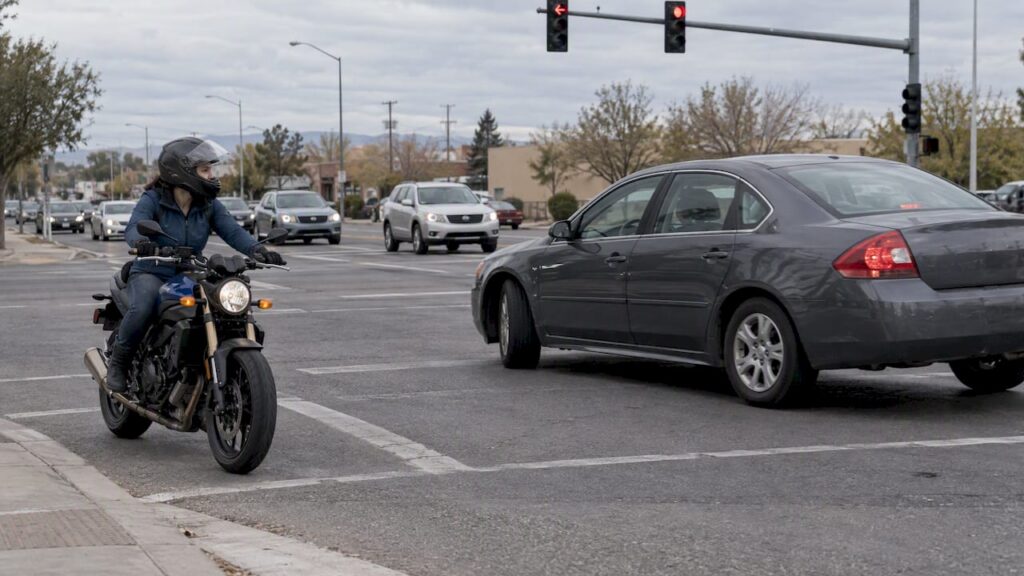
In most left-turn motorcycle crashes, the driver turning left failed to yield, and these crashes are often severe. Left-turn crashes make up 26% of fatal two-vehicle motorcycle crashes nationwide, and the IIHS found that passenger vehicles turning left cause 36% of fatal two-vehicle motorcycle crashes. If you or a family member were hurt in one, prompt medical care, careful documentation, and early legal advice matter.
TL;DR:
- IIHS attributed 36% of fatal two vehicle motorcycle crashes, 21% of injury crashes, and 19% of police reported crashes to passenger vehicles turning left.
- Helmets reduce rider deaths by about 37% and head injury risk by roughly 69%; universal helmet laws are linked to higher use and fewer severe head injuries.
- Even when a turning driver bears primary responsibility, comparative negligence can reduce compensation; a rider found 20% at fault typically loses that share of recovery.
- Call 911, seek same day medical care, photograph the scene before vehicles move, and collect witness contact details before they leave.
- Intersection braking systems could avoid 18% to 84% of left turn across path crashes, depending on design and sightlines, but most vehicles lack them.
Table of Contents
- How left-turn motorcycle crashes happen: common scenarios and contributing factors
- Why left-turn collisions are often severe: injuries, outcomes, and helmet context
- Who is at fault and how fault is determined in left-turn motorcycle crashes
- Statistics and prevention: crash frequency and the promise of left-turn-assist technology
- What to do after a left-turn motorcycle accident: a prioritized checklist for injured riders
- What handling left-turn claims has taught our team
- Get a free case evaluation after a left-turn motorcycle accident
- FAQ
- Sources
How left-turn motorcycle crashes happen: common scenarios and contributing factors
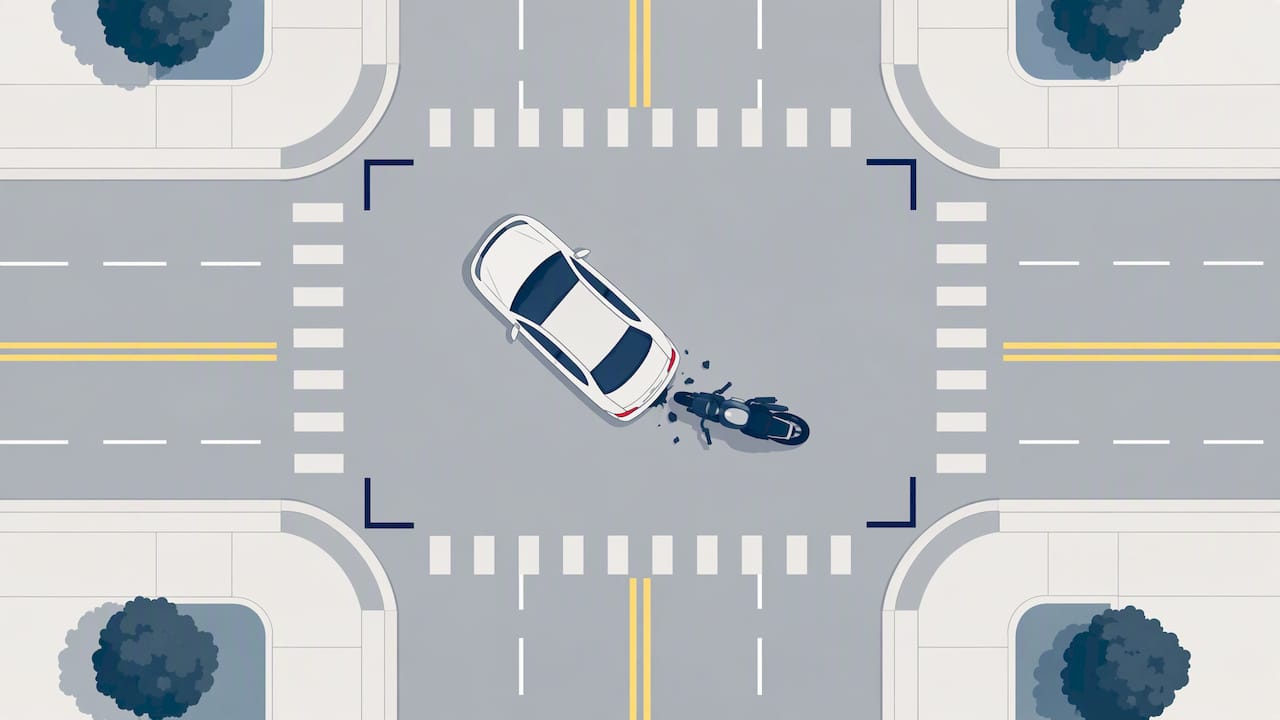
Left-turn crashes follow a familiar pattern. A driver waiting to turn left sees a gap, assumes it is clear, and pulls across the oncoming lane directly into a motorcycle’s path. The driver often never saw the rider at all, or misjudged how fast the motorcycle was closing the distance.
Several factors make this mistake so common:
- A motorcycle’s narrow profile is easy to lose against a cluttered background, especially at dusk, at night, or with the sun low on the horizon.
- On multi-lane roads, a rider can be completely hidden behind vehicles stopped in an adjacent lane until the moment they emerge into the turning driver’s path.
- Distraction and a simple failure to look twice account for many cases where drivers misjudge a motorcycle’s speed relative to a car.
- Intersection design plays a role too. Two-stage left turns, wide medians, and offset lanes all add complexity that increases the chance a driver turns at the wrong moment.
Weather and roadway conditions compound these problems. Wet pavement extends stopping distance for both vehicles, and poorly timed signals can tempt a driver to rush a turn before oncoming traffic, including a motorcycle, has fully cleared the intersection. Urban intersection research links intersection geometry, traffic control type, time of day, and weather to the likelihood of a left-turn collision.
Pro Tip: If you ride through an intersection with a history of left-turn conflicts, cover your brake and make eye contact with waiting drivers before you commit to passing through.
Why left-turn collisions are often severe: injuries, outcomes, and helmet context
A motorcycle offers no crumple zone, no airbags, and no steel cage. When a car turns directly into a rider’s path, the impact transfers force straight to the rider’s body, often at a closing speed neither driver accounted for.
Left-turn-in-front crashes account for about 26% of fatal two-vehicle motorcycle collisions, a reflection of how often this specific scenario turns deadly rather than merely damaging property.
Injuries from these crashes tend to follow a consistent pattern:
- Traumatic brain injury from head impact with a vehicle, the pavement, or roadside fixtures.
- Spinal injuries ranging from fractures to permanent nerve damage.
- Broken bones in the legs, pelvis, and arms, often requiring surgical repair.
- Severe road rash and internal trauma from being thrown across pavement.
Helmets measurably change these outcomes. CDC research shows helmets reduce rider deaths by about 37% and cut the risk of head injury by roughly 69%, and states with universal helmet laws see higher helmet use and fewer fatal and severe head injuries. Riders hurt in a left-turn crash frequently need emergency imaging, orthopedic surgery, and months of physical rehabilitation, all of which become part of the medical record that supports a personal injury claim.
Who is at fault and how fault is determined in left-turn motorcycle crashes
Traffic law in nearly every state starts from the same baseline: a driver turning left must yield to oncoming traffic, including motorcycles, before completing the turn. When a driver turns into a rider’s path, that rule usually places primary fault on the turning driver, not the motorcyclist.
Investigators and insurance adjusters build the fault picture from several sources:
- The police crash report, which documents officer observations, citations issued, and initial statements from both drivers.
- Photographs of vehicle damage, final rest positions, skid marks, and the intersection layout.
- Witness statements from bystanders or other drivers who saw the turn develop.
- Traffic signal timing records and any available surveillance or dashcam video.
- Vehicle event data, when available, showing speed and braking just before impact.
Fault is rarely all or nothing. Most states apply some form of comparative negligence, where a rider’s own actions, such as speeding or lane filtering, can reduce the compensation available even when the driver bears most of the responsibility. A rider found 20% at fault, for example, typically sees their recovery reduced by that same percentage.
Practical choices at the scene affect this calculation. Photograph the intersection, the vehicles, and your injuries before anything moves. Get names and phone numbers from witnesses while they are still there. When you speak with any insurance company, including your own, avoid broad statements like “I didn’t see the light” that can be read as an admission of fault later. We cover related scene-preservation guidance for riders facing dangerous surfaces on a motorcycle that applies just as directly here.
Statistics and prevention: crash frequency and the promise of left-turn-assist technology
Left-turn crashes are not a minor subset of motorcycle collisions. They are one of the most common fatal scenarios on the road, and researchers are actively studying technology that could cut that number substantially.
| Source | Finding |
|---|---|
| Peer-reviewed analysis | Left-turn crashes accounted for 26% of fatal two-vehicle motorcycle crashes |
| IIHS | Passenger vehicles turning left caused 36% of fatal two-vehicle motorcycle crashes, 21% of nonfatal injury crashes, and 19% of police-reported crashes |
| ITS DOT simulation study | Intersection I-ADAS systems with automated braking could avoid an estimated 18% to 84% of left-turn across path crashes, depending on system design and sightline |
That wide 18% to 84% range in the I-ADAS research is not a weakness in the data. It reflects how much outcomes depend on sensor placement, how early a system detects an oncoming motorcycle, and whether sightlines at a given intersection allow the system enough time to act. For riders today, the practical takeaway is simpler: this technology is not yet standard on most vehicles, so the burden of defensive riding and intersection awareness still falls on you.
What to do after a left-turn motorcycle accident: a prioritized checklist for injured riders
The minutes and days after a left-turn collision shape both your recovery and your ability to recover compensation. A clear sequence helps when adrenaline and shock make it hard to think clearly.
- Call 911 for medical help and to get an officer to the scene, even if injuries seem minor at first.
- Photograph both vehicles, the intersection, skid marks, and your visible injuries before anything is moved or repaired.
- Collect names, phone numbers, and addresses from any witnesses before they leave.
- Seek emergency care the same day, even without obvious trauma. Imaging can catch internal injuries that symptoms alone will not reveal.
- Notify your own insurer of the accident, but keep statements factual and avoid speculating about fault.
- Keep every medical bill, prescription record, and note about missed work in one place.
- Contact a motorcycle accident attorney before giving the other driver’s insurer a recorded statement.
Pro Tip: Ask the responding officer for the crash report number before you leave the scene. It speeds up getting the full report later and gives your attorney a head start on the investigation.
A free case evaluation typically starts with the police report, your medical records, and any photos or witness information you gathered, so holding onto those documents from day one makes that first conversation far more productive.
What handling left-turn claims has taught our team
Left-turn claims often hinge on details that fade fast: a witness who moves out of town, a traffic camera that overwrites its footage, a damaged helmet that gets thrown away before anyone thinks to examine it. The riders who recover the most fully are usually the ones who got medical care immediately and preserved evidence before it disappeared.
We use a contingency fee structure, where no fee is charged unless we win, reflecting the reality that injured riders often face urgent financial pressures. If your injuries are serious or you are not sure what evidence still matters, talk to us before the trail goes cold.
— Adam
Get a free case evaluation after a left-turn motorcycle accident
We represent injured motorcyclists and families pursuing motorcycle accident claims across Indiana, Michigan, and New Mexico, along with wrongful death, product liability, and related personal injury cases. A left-turn crash often comes down to a careful read of police reports, photos, and witness accounts, and we handle that work directly with insurers so you can focus on recovery.

We offer free case evaluations with no obligation: we review what happened, explain your options under your state’s comparative negligence rules, and provide honest guidance on whether we can help. Reach out today to start that conversation, and remember, our fee comes only from a settlement or award, never upfront.
This article is general information, not a substitute for advice from a qualified lawyer. Consult a qualified legal professional about your own circumstances before acting on anything here.
FAQ
How many people died from motorcycle crashes?
Motorcyclists accounted for 14% of all traffic fatalities in 2019, a disproportionate share given how few miles motorcycles travel compared with cars. That overrepresentation holds across most recent years tracked by federal safety data.
What are 90% of accidents caused by?
What the data does show is that left-turn crashes, where another vehicle turns left in front of an oncoming motorcycle, represent 26% of fatal two-vehicle motorcycle crashes, making them one of the most common fatal scenarios identified.
What is the 12 second rule for motorcycles?
This article’s sources do not define a “12 second rule.” Riders generally benefit from scanning well ahead of their position and watching for vehicles waiting to turn left, since that intersection-specific hazard accounts for a large share of fatal motorcycle collisions.
Can a motorcycle pass on the left?
Passing rules vary by state and by road configuration, so this is a question for your state’s vehicle code or a traffic safety professional rather than a blanket yes or no. What matters more for left-turn crash risk is visibility: a motorcycle positioned where a turning driver cannot see it, whether passing or riding straight through, faces the same hazard described throughout this article.
Who is usually at fault in a left-turn motorcycle accident?
The driver turning left is usually at fault because traffic law requires drivers turning left to yield to oncoming traffic, including motorcycles. Fault can still be shared under comparative negligence rules if the rider’s own actions, such as excessive speed, contributed to the crash.
Sources
- Left-turn crashes and motorcycle safety (peer-reviewed analysis)
- Helping vehicles ‘see’ motorcyclists could cut crashes — IIHS
- Study estimating crash avoidance potential for I-ADAS in left-turn crashes (ITS Deployment Evaluation)
- Motorcycle injury prevention and helmet effectiveness — CDC