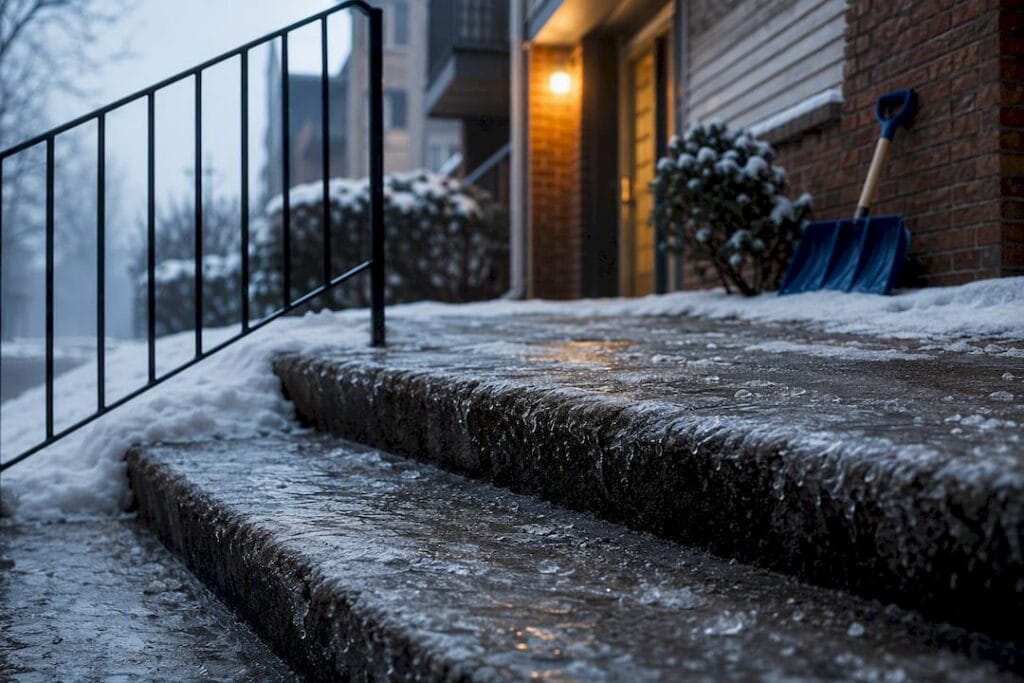
Under current Michigan law, a property owner owes ordinary reasonable care to protect visitors from unreasonable risks of harm, and an “open-and-obvious” hazard no longer automatically defeats a claim. The Michigan Supreme Court’s 2023 decision in Kandil-Elsayed moved that doctrine from a duty question to a breach and comparative-fault question. If you were hurt on someone else’s property, get medical treatment, preserve evidence immediately, and note that most claims carry a three-year filing deadline under MCL 600.5805.
TL;DR:
- Evidence of owner inspection and maintenance logs, surveillance footage, and witness statements heavily influence breach and notice decisions under the new doctrine.
- The owner’s knowledge of the hazard, rather than its visibility, now primarily determines liability, shifting focus to documentation of inspections and witness testimony.
- Filing deadlines are strict: most claims must be filed within three years, with a 120-day notice requirement for cases against government entities, risking claim dismissal if missed.
- The legal shift means a visible hazard no longer automatically bars a claim; juries now assess whether the owner exercised reasonable care based on notice and inspection records.
- Preserving evidence quickly after the incident, including photographs and surveillance footage, is vital since it is often overwritten or deleted within days.
Table of Contents
- What Michigan Premises Liability Law Requires You to Prove
- Invitee, Licensee, or Trespasser: Why Your Status Changes Everything
- Proving Notice: What the Owner Knew, and When
- How Kandil-Elsayed and Pinsky Rewrote the Rules
- Deadlines That Can End Your Case Before It Starts
- The Defenses You’ll Face, and How Comparative Fault Cuts Your Recovery
- Landlord Duties and Common Areas: A Different Set of Rules
- Your Step-by-Step Checklist After a Fall in Michigan
- Michigan Premises Cases Demand Michigan-Specific Experience
- Why the Old Advice on Open-and-Obvious Hazards Is Outdated
- Getting Help With Your Michigan Premises Liability Claim
- Sources
What Michigan Premises Liability Law Requires You to Prove
Every premises liability case in Michigan rests on four elements, and the 2023 ruling changed how courts weigh one of them without touching the basic framework. You still have to establish duty, breach, causation, and damages, in that order, and each one does different work in front of a judge or jury.
Duty is a legal question decided by the court, not the jury. Michigan law asks whether the property owner owed you a duty of care at all, and for most visitors on commercial or residential property, the answer is yes. The Michigan benchbook on landlord liability confirms that a plaintiff must show duty, breach, causation, and damages, and that a visitor’s status shapes exactly what duty applies.
Breach is where cases now live or die, and it’s almost always a factual question for the jury. Did the property owner act the way a reasonably careful owner would have acted under the same circumstances? Before 2023, an obvious hazard could end the case before a jury ever heard it, because “open and obvious” was treated as erasing the duty itself. That’s gone. Now a jury weighs whether the condition’s visibility made the owner’s conduct reasonable, alongside everything else.
Causation requires you to connect the hazard directly to your injury, not just to an unsafe condition that happened to exist nearby. Damages covers what you actually lost, medically and financially.
The kind of evidence that satisfies these elements has shifted along with the doctrine. Courts and defense attorneys now care intensely about:
- Inspection and maintenance logs showing when an area was last checked
- Surveillance footage capturing the hazard’s presence and duration
- Employee witness statements about cleaning schedules or prior complaints
- Photos and measurements documenting the condition at the time of the fall
- Weather records for snow and ice cases, tied to the timeline of the incident
Breach analysis is fact-heavy, and that’s precisely why the evidence you gather in the first days after an injury tends to decide the outcome months later.
Invitee, Licensee, or Trespasser: Why Your Status Changes Everything
Michigan sorts visitors into three categories, and the category you fall into determines how much protection the law gives you before you ever get to breach or notice. Michigan’s model civil jury instructions on invitee, licensee, and trespasser definitions are the framework judges hand to juries at trial, and they matter more than most injured people realize.
- Invitee: You’re on the property for a purpose connected to the owner’s business, such as a customer in a grocery store or a client at a law office. Invitees get the highest level of protection. The owner must inspect for hazards and fix or warn about them.
- Licensee: You’re on the property with permission but not for a commercial purpose, like a social guest at someone’s house. The owner’s duty is narrower: warn you of known dangers, but no obligation to actively inspect for hidden ones.
- Trespasser: You’re on the property without permission or legal right. Owners owe almost no duty here, with narrow exceptions for willful or wanton conduct and specific statutory carve-outs.
Status can shift mid-visit. A social guest who wanders into a “Employees Only” storage room may move from licensee to something closer to a trespasser for that portion of the property. Implied permission also matters. A delivery driver walking up a driveway with no “No Trespassing” sign typically has implied permission to be there, which usually makes them an invitee or licensee depending on the purpose of the visit. These distinctions sound technical, but they decide which duty standard applies before a court even reaches whether the owner behaved reasonably.
Proving Notice: What the Owner Knew, and When
Notice is now the battleground in most Michigan premises liability cases, more so than before 2023. Because open-and-obvious hazards no longer end a case at the duty stage, defense lawyers have shifted their focus toward arguing the owner never knew, or couldn’t reasonably have known, about the danger. Practitioner commentary on the Kandil-Elsayed aftermath describes notice becoming the dispositive issue in far more cases than before.
Michigan law recognizes two kinds of notice:
- Actual notice means an employee created the hazard, someone reported it, or there’s footage showing staff walked past it. This is the easiest kind to prove when it exists, because it usually comes with a paper trail or a timestamp.
- Constructive notice means the hazard existed long enough that a reasonable inspection routine would have caught it. A puddle that formed thirty seconds before you slipped is a hard case. A puddle that sat near a leaking cooler for six hours is a very different one.
Courts weigh maintenance logs, snow-removal schedules, inspection checklists, surveillance recordings, and employee shift schedules heavily when constructive notice is contested. These records either show a business had a system and followed it, or they show gaps a jury can hold against the owner.
Pro Tip: Send a written evidence-preservation letter to the property owner or manager within days of the incident, specifically requesting surveillance footage and maintenance logs. Many businesses overwrite security footage on a rolling cycle of just a few days, and once it’s gone, it’s gone.
Practical steps for preserving your own proof of notice:
- Photograph the hazard before anyone cleans it up or fixes it, including a wide shot and a close-up with something for scale.
- Get names and contact information for any employees or witnesses who saw the condition or the fall itself.
- Ask management directly whether they were aware of the hazard, and note who you spoke to and when.
- Request, in writing, that surveillance footage and maintenance records be preserved before routine deletion cycles run.
- Keep your own timeline: what time you arrived, what the weather was doing, and what changed between your arrival and the fall.
How Kandil-Elsayed and Pinsky Rewrote the Rules
For roughly three decades, Michigan followed a rule that let property owners escape liability almost automatically if a hazard was “open and obvious.” A cracked sidewalk, a wet floor with a visible puddle, an icy patch you could plainly see. If it was obvious, the case often ended on a motion for summary disposition before a jury ever heard the facts.
That changed in 2023. In Kandil-Elsayed v. F & E Oil, Inc., consolidated with Pinsky v. Kroger, the Michigan Supreme Court held that a land possessor owes a duty to exercise reasonable care to protect invitees from unreasonable risks of harm, and that whether a hazard was open and obvious is relevant to breach and comparative fault, not to whether a duty existed in the first place.
That’s a structural shift, not a wording tweak. Duty is decided by a judge, often early in a case. Breach and comparative fault are decided by a jury, later, after both sides have built a factual record. Moving open-and-obvious into that second category means:
- Fewer cases get thrown out at the summary-disposition stage on the strength of “you should have seen it”
- Discovery now focuses heavily on maintenance and inspection records, because those documents shape the breach analysis
- Comparative fault becomes the mechanism for reducing an award when a hazard really was obvious, rather than eliminating the claim outright
- Snow and ice cases, long governed by a near-automatic “natural accumulation” defense, now get evaluated under ordinary reasonable care
Legal commentary following the ruling anticipated exactly this outcome, predicting Kandil-Elsayed would reduce early dispositive motions and push more weight onto discovery of maintenance and inspection records. For snow and ice specifically, Michigan now evaluates natural accumulation under a reasonable-care standard rather than shielding owners automatically, a return to a fact-intensive approach reminiscent of the older Quinlivan line of cases before decades of open-and-obvious precedent pushed it aside.
Practically, this means a slip on a visibly icy parking lot is no longer a guaranteed loss for the injured person. A jury might now hear evidence about whether the property owner salted, plowed, or posted warnings, and weigh that against how obvious the ice actually was.

Deadlines That Can End Your Case Before It Starts
Missing a filing deadline can bar an otherwise strong premises liability claim entirely, regardless of how clear the owner’s negligence was. Michigan’s rules here are unforgiving, and they don’t bend for sympathy.
The general rule is straightforward: most Michigan premises liability lawsuits must be filed within three years of the injury under MCL 600.5805. Certain circumstances can toll or extend that window, such as claims involving minors, but you should never plan around an exception applying to your situation unless a lawyer has confirmed it does.
Government-owned property changes the calculation entirely. If you were injured on a sidewalk owned by a city, in a state building, or on other government property, Michigan generally requires written notice within 120 days under MCL 691.1404 and MCL 691.1406, separate from and far shorter than the three-year lawsuit deadline. Claims against the state itself often route through the Michigan Court of Claims, which carries its own procedural requirements on top of the notice rule.
These notice requirements get enforced strictly. A missed 120-day notice window can bar a claim even when the underlying facts clearly favor the injured person, and courts rarely grant leniency for a late filing against a government entity.
- Three-year general deadline: applies to most private property claims (MCL 600.5805)
- 120-day notice requirement: applies to many claims against government defendants (MCL 691.1404, MCL 691.1406)
- Court of Claims procedures: apply separately when the State of Michigan itself is a defendant
- Minors and certain incapacity situations: may toll deadlines, but confirm this with counsel rather than assuming
If your fall happened on a sidewalk you’re not sure is publicly or privately owned, treat it as a 120-day situation until you know for certain. That single mistake in timing has ended more otherwise-viable claims than almost any other factor. For related timing issues in Michigan injury law, see how Michigan’s malpractice statute handles filing deadlines in a comparable context.
The Defenses You’ll Face, and How Comparative Fault Cuts Your Recovery
Property owners and their insurers rarely concede liability outright, and Kandil-Elsayed gave them a new set of tools even as it took away their old automatic shield. Understanding the standard defenses helps you anticipate what’s coming.
- Lack of notice: The most common defense now. The owner argues they neither knew nor should have known about the hazard.
- Government immunity: Applies to many claims against municipalities, subject to specific statutory exceptions and the notice deadlines above.
- Contractor liability disputes: The property owner may argue a maintenance contractor, not the owner, was responsible for the hazardous condition.
- Comparative fault based on the hazard’s visibility: Since open-and-obvious no longer defeats a claim, owners now argue it should reduce your damages instead.
- Intoxication or reckless conduct: Used to shift blame onto the injured person’s own behavior at the time of the fall.
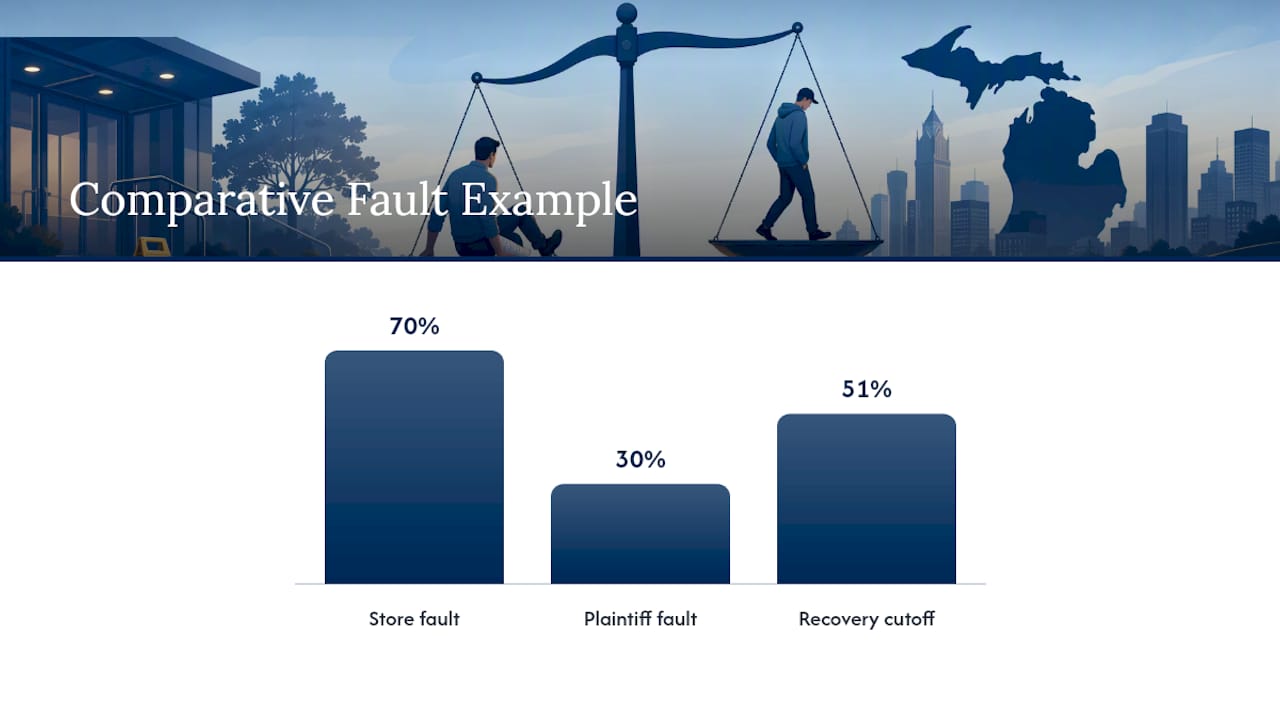
Michigan follows a modified comparative negligence rule. If you’re found partly at fault for your own injury, your damages get reduced by your percentage of fault, and if a jury finds you 51% or more at fault, you recover nothing at all. Say a jury finds a store 70% responsible for an unmarked wet floor and you 30% responsible for not watching where you were walking. A $100,000 award drops to $70,000. Cross the 51% line, however, and the recovery disappears entirely.
Pro Tip: Never assume a hazard being “obvious” means you have no case. Under current law, obviousness is a factor a jury weighs against the owner’s conduct, not an automatic bar. Let a lawyer evaluate the notice evidence before you write off a claim.
Plaintiffs counter these defenses with the same evidence that proves breach: inspection logs showing gaps in a maintenance routine, employee testimony about known problem spots, and surveillance footage showing how long a hazard sat unaddressed. That evidence is exactly what defeats a summary judgment motion built on lack of notice.
Landlord Duties and Common Areas: A Different Set of Rules
Michigan imposes specific statutory obligations on landlords that go beyond ordinary premises liability principles. Under MCL 554.139, landlords must keep the premises fit for their intended use and keep common areas in reasonable repair. That statute covers hallways, stairwells, parking lots, and other shared spaces the landlord, not the tenant, controls.
Control is the key question courts ask. A tenant’s apartment interior is usually the tenant’s own responsibility to maintain day to day, but the exterior stairway leading to it is almost always the landlord’s obligation. Snow and ice on a shared walkway falls squarely on the landlord’s side of that line, and inadequate winter maintenance there is one of the most common landlord-liability claims in Michigan.
Housing code violations can sometimes support a negligence per se theory, meaning the violation itself serves as evidence of breach rather than requiring a separate showing of unreasonable conduct. This has limits: the code provision has to actually apply to the condition that caused your injury, and not every housing code violation automatically translates into liability for a specific fall.
A tenant’s overnight guest injured on a broken exterior staircase typically has the same claim against the landlord that the tenant would, because the landlord’s statutory duty under MCL 554.139 runs to tenants and, in most circumstances, their invitees as well.
Your Step-by-Step Checklist After a Fall in Michigan
What you do in the first hours and days after a premises injury shapes the strength of your claim more than almost anything that happens afterward. Follow these steps in order.
- Get medical care first. Call 911 if the injury is serious, or see a doctor promptly even if it feels minor. Medical records create a timestamped, credible link between the incident and your injury.
- Report the incident to management on-site. Ask for an incident report and get a copy or the report number before you leave.
- Photograph everything. The hazard itself, the surrounding area, your footwear, the weather conditions, and any visible injury. Timestamp your photos if your phone supports it.
- Collect witness information. Names and phone numbers of anyone who saw the fall or the hazardous condition, written down before people scatter.
- Measure or describe the hazard specifically. A puddle’s approximate size, a step’s height, a crack’s depth. Vague memories fade fast.
- Send a written request to preserve evidence. Ask the property owner or manager, in writing, to preserve surveillance footage and maintenance logs before they’re routinely deleted.
- Keep every medical bill and record. These document your damages and support your claim’s value later.
- Contact a lawyer before disposing of anything. Torn clothing, damaged shoes, or broken items connected to the fall can serve as physical evidence. Don’t throw them away.
Pro Tip: If you slipped on ice or snow, photograph the exact spot within the same day if possible. Conditions change fast in Michigan weather, and a hazard that’s obvious at 8 a.m. can be gone by noon.
For dog bite incidents, which fall under a related but distinct area of premises law, similar evidence-preservation principles apply. You can review specific guidance on Michigan dog bite claims for that scenario, and general witness-collection tactics carry over from pedestrian accident evidence guidance as well.
Michigan Premises Cases Demand Michigan-Specific Experience
Michigan premises liability law changed in a real, structural way in 2023, and a lot of legal content online still describes the old open-and-obvious rule as though it’s still controlling law. It isn’t. Keller & Keller has tracked this shift closely, including commentary on legislative attempts to reverse course regarding the open-and-obvious doctrine after the Michigan Supreme Court’s ruling.
This article was written by Adam, drawing on the Michigan Supreme Court’s published opinions, official benchbook guidance, and current statutory text to reflect the law as it stands today rather than as it stood before Kandil-Elsayed.
If you’re weighing whether to pursue a claim, a consultation with counsel typically starts with reviewing what documentation you already have: incident reports, photographs, medical records, and any correspondence with the property owner or their insurer. Bringing what you have, even if it feels incomplete, gives a lawyer the fastest read on whether notice and breach can be proven.
Why the Old Advice on Open-and-Obvious Hazards Is Outdated
A lot of what gets repeated about Michigan premises law online still treats “open and obvious” as a case-killer, and that advice is now wrong. The research here supports a clearer judgment: the Kandil-Elsayed shift didn’t just tweak procedure, it restored the kind of fact-intensive inquiry that juries are actually built to handle.
Where conventional advice falls short is in underselling how much notice now matters. Injured people fixate on whether a hazard was visible, when the real fight has moved to whether the owner knew, or should have known, and documented their inspection routine accordingly. That’s a paperwork and timeline battle, not a visibility argument.
If you take one thing from this shift, prioritize evidence preservation over anything else in the first week. Photographs fade in memory, surveillance footage gets overwritten, and maintenance logs get updated. The window to lock down proof of notice is short, and it closes faster than most people expect.
— Adam
Getting Help With Your Michigan Premises Liability Claim
Legal firms often represent injured Michigan residents on a contingency-fee basis, meaning clients owe nothing unless a settlement or award is secured on their behalf. That structure matters here specifically because premises cases now hinge on discovery and evidence gathering, the exact work that takes resources most injured people don’t have on their own after a fall.

A free case evaluation walks through what happened, what evidence already exists, and what still needs to be preserved before it disappears. You can learn more about what to expect during a case evaluation before you ever pick up the phone. Bring whatever you have: incident reports, photographs, medical records, and any correspondence with the property owner or an insurance adjuster. If an insurer has already denied or downplayed your claim, understanding why insurers deny injury claims helps you see what to expect next. Reach out to 2keller for a free consultation and find out where your claim stands.
This article is general information, not a substitute for advice from a qualified lawyer. Consult a qualified legal professional about your own circumstances before acting on anything here.
Sources
- Liability of landlord for injury to tenant, invitees of tenant, or tenant’s property — Michigan benchbook
- Michigan slip and fall laws: proving premises liability after Kandil-Elsayed — Recording Law