Indiana caps total damages in medical malpractice cases at a statutory ceiling for acts of malpractice occurring after June 30, 2019. A single qualified provider’s personal liability is capped, with the Patient’s Compensation Fund covering the remainder, up to the statutory ceiling. Whether that cap actually applies to your case, though, depends on the provider’s qualification status and whether the mandatory filing steps were followed correctly.
TL;DR:
- The current statutory damage cap for medical malpractice after June 30, 2019, is $1.8 million, but it depends on whether the provider is qualified and filing steps are followed correctly.
- Only qualified providers with malpractice insurance and PCF surcharge are protected by the cap, and their personal liability is limited to $500,000 for acts after June 30, 2019.
- If damages exceed $1.8 million, documenting all economic losses and exploring responsible parties outside the cap are crucial for maximizing recovery.
- Filing deadlines are strict, with a two-year statute of limitations from the malpractice date, so prompt pre-suit filing and early qualification checks are essential.
- Attorney fees are generally capped at about one-third of the recovery, making early case evaluation important to understand net achievable damages.
Table of Contents
- What Is Indiana’s Current Medical Malpractice Cap?
- How Is a Malpractice Payment Split Between the Provider and the Fund?
- Who Counts as a Qualified Provider Under Indiana Law?
- What Are the Filing Deadlines and Required Steps?
- What If Your Damages Exceed the Statutory Cap?
- How Do Attorney Fees Affect What You Actually Take Home?
- Why Real Case Outcomes Matter for Understanding These Limits
- What Should You Do Right Now If You Suspect Malpractice?
- How Keller & Keller Injury Lawyers Can Help With Your Malpractice Claim
- Where to Verify Indiana’s Malpractice Laws Yourself
- Sources
What Is Indiana’s Current Medical Malpractice Cap?
Indiana has raised its damage ceiling several times since the Medical Malpractice Act took effect, and the date of the alleged malpractice determines which statutory cap applies to your claim. Under Ind. Code §34-18-14-3, the caps break down like this:
- Acts occurring before June 30, 1999: lower legacy caps that rarely apply to active claims today.
- Acts occurring between July 1, 1999, and June 30, 2017: a statutory cap applies.
- Acts occurring between July 1, 2017, and June 30, 2019: a higher statutory cap applies.
- Acts occurring after June 30, 2019: the current statutory cap applies, which is the most relevant figure for anyone filing a claim now.
Critically, “total damages” in Indiana means both economic losses (medical bills, lost income, future care costs) and noneconomic losses (pain, suffering, loss of enjoyment of life) combined under one number. Most states cap only noneconomic damages and let economic losses run uncapped. Indiana’s approach is stricter, and it hits catastrophic injury cases especially hard, according to LegalClarity’s analysis of how the total-damages structure limits recovery even when medical bills alone exceed the cap. Always verify the exact statutory text against your injury date before assuming a number applies.
How Is a Malpractice Payment Split Between the Provider and the Fund?
Indiana doesn’t ask one insurer to write the whole check. The statute splits liability into two buckets, and understanding the split matters because it affects negotiation leverage and how many parties need to sign off on a settlement.
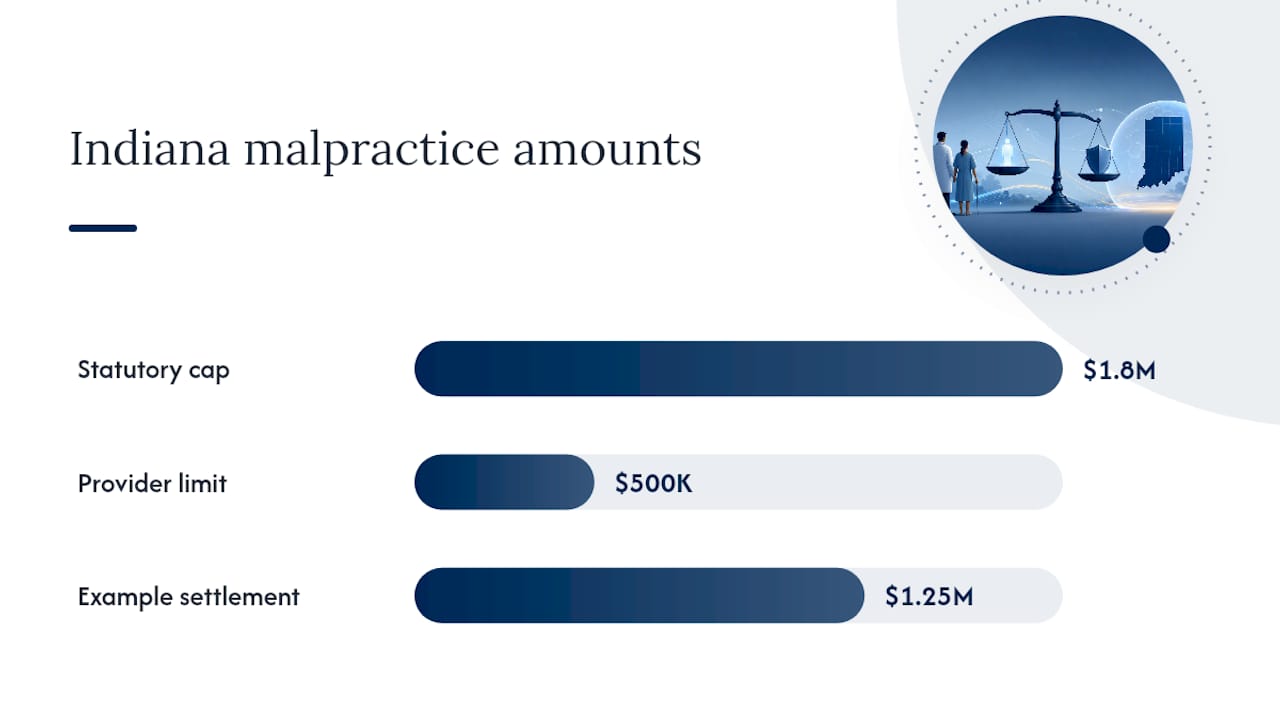
- Provider liability comes first. A single qualified health care provider’s personal exposure is capped at $500,000 for acts after June 30, 2019, regardless of how large the jury verdict or settlement figure is.
- The Patient’s Compensation Fund pays the difference. Once the provider’s $500,000 is accounted for, the PCF pays the remainder up to the total statutory cap of $1,800,000.
- Multiple providers change the math. If more than one qualified provider is found liable, or if a provider is held responsible solely for an employee’s conduct, the aggregate payment rules under the statute still cap the combined exposure, with the PCF absorbing the excess.
- Only qualified providers unlock this system. A provider who never bought into the fund doesn’t get the cap’s protection, and the case proceeds more like a standard negligence claim.
That last point is why checking qualification status early in a case is not a formality. It’s a strategic decision that can change how a claim is valued from day one.
Who Counts as a Qualified Provider Under Indiana Law?
A “qualified” health care provider is one who carries the required malpractice insurance and pays a surcharge into the Patient’s Compensation Fund, as defined under the Medical Malpractice Act. This status is what triggers both the damage cap and the requirement for a pre-suit medical review panel.
You can verify a provider’s qualification through the Indiana Department of Insurance, which maintains the PCF database. When checking, look for:
- Active enrollment status at the time of the alleged malpractice, not just at the time you file.
- The specific entity name, since hospitals, physician groups, and individual doctors often qualify separately.
- Coverage dates, because a lapse in surcharge payments can affect qualification.
Pro Tip: Don’t assume a large hospital system is automatically qualified just because it sounds established. Some affiliated clinics or contracted physicians qualify independently, and a gap in one entity’s status can change your entire legal strategy.
If a provider turns out to be non-qualified, the cap and the medical review panel requirement disappear entirely. That can mean a larger potential recovery, but also a different procedural path.
What Are the Filing Deadlines and Required Steps?
Before you can sue a qualified provider in Indiana, you generally must file a proposed complaint with the Indiana Department of Insurance and go through a medical review panel. The panel issues a written opinion on whether the provider met the standard of care. That opinion is admissible at trial, but it doesn’t bind the judge or jury.
Indiana’s statute of limitations sets a hard boundary: two years from the date of the alleged malpractice for adults, with an extension for children under six, who have until their eighth birthday to file, according to Nolo’s summary of the state’s malpractice statutes. The review panel process itself can toll portions of that clock while the case sits with the panel.
Practical filing tips that matter more than they should:
- Send your proposed complaint by trackable mail to lock in your filing date and avoid processing disputes.
- IDOI charges a modest filing fee, roughly $5 for the first defendant and $2 for each additional one.
- Contact IDOI directly for procedural questions, but remember the department cannot give legal advice.
Pro Tip: Missing the two-year window by even a few days can end a claim permanently, so start the proposed complaint process well before the deadline, not the week of.
What If Your Damages Exceed the Statutory Cap?
A $1.8 million ceiling sounds generous until you’re staring at a lifetime of nursing care, lost future income, and ongoing medical treatment for a catastrophic injury. When projected losses exceed the cap, a few strategies still matter.
- Document every economic loss with precision, including future care needs backed by medical and vocational experts, so the full scope of damages is preserved even if the final award is capped.
- Investigate whether other responsible parties exist outside the Act’s protection, such as a non-qualified provider, a product manufacturer, or a separate corporate entity not enrolled in the PCF.
- Approach settlement negotiations with realistic framing. Once total damages clearly exceed $1,800,000, the negotiation shifts toward how quickly and reliably the fund will pay, not whether the cap applies.
None of these options erase the ceiling, but they can widen who pays and how much of your actual loss gets recognized in the process.
How Do Attorney Fees Affect What You Actually Take Home?

Attorney fees in claims governed by Indiana’s Medical Malpractice Act are subject to statutory limits, with the effective cap reaching up to about one-third of the recovery for many claims filed under current rules, per Recording Law’s summary of Indiana’s fee structure.
Before signing with any firm, ask these questions:
- Is the fee percentage fixed, or does it scale down for larger recoveries?
- Are case costs deducted before or after the fee is calculated?
- Who covers filing fees and expert witness costs if the case doesn’t settle favorably?
Modeling net recovery, not just the headline award, is the only way to know what a settlement actually means for your family.
Why Real Case Outcomes Matter for Understanding These Limits
Statutory numbers only tell part of the story. How the cap and PCF process actually play out in a real Indiana case shows what claimants can expect. Keller & Keller is a multi-state personal injury firm handling malpractice and negligence claims across Indiana, Michigan, and New Mexico, and its case history includes claims shaped directly by these statutory limits.
One example: a Lake Station woman secured a $1.25 million settlement in an Indiana medical malpractice case, illustrating how provider liability, PCF involvement, and negotiation strategy come together under the Act.
- Real settlements show how the $500,000 provider limit and PCF backstop interact in practice.
- Case outcomes below the $1.8 million cap often reflect negotiated resolutions, not a lack of damages.
- Reviewing past case results can help set realistic expectations before filing.
What Should You Do Right Now If You Suspect Malpractice?
The biggest mistake I see is delay. Preserve every medical record, bill, and communication before memories fade or files get harder to obtain. Check the provider’s PCF qualification early. It changes everything about how the case gets built.
File the proposed complaint well before the two-year mark. Never rely on a hospital’s informal apology or a verbal promise to “make it right.” Those aren’t legal commitments. If your losses look substantial, talk to a firm that handles these claims regularly before the review panel process locks in your position.
Adam
How Keller & Keller Injury Lawyers Can Help With Your Malpractice Claim
Some law firms work on a contingency-fee basis for Indiana malpractice claims, where clients pay nothing upfront and only if a settlement or verdict is secured. That structure matters most in malpractice cases, where the statutory cap, the Patient’s Compensation Fund, and the mandatory review panel make the process more complicated than a typical injury claim.

Legal representation for these cases can include claim evaluation, filing the proposed complaint with the Indiana Department of Insurance, preparation for the medical review panel, negotiation with the Patient’s Compensation Fund when a settlement is possible, and litigation if a fair resolution is not reached. If you’re unsure whether your provider is qualified, whether your filing deadline is approaching, or what your case might realistically be worth, a free case evaluation is the fastest way to get clear answers before the two-year clock runs out.
Where to Verify Indiana’s Malpractice Laws Yourself
For readers who want to confirm any figure directly:
- The controlling statute: Ind. Code §34-18-14-3 on FindLaw.
- Official filing guidance: IDOI’s malpractice complaint page.
- Plain-language explainers: LegalClarity and Nolo both break down the cap and deadlines in accessible terms.
This article is general information, not a substitute for advice from a qualified lawyer. Consult a qualified legal professional about your own circumstances before acting on anything here.
Sources
- Indiana Code Title 34. Civil Law and Procedure § 34-18-14-3 | FindLaw
- IDOI: Filing a Medical Malpractice Complaint
- Indiana Medical Malpractice Cap: Damages and Limits – LegalClarity
- Indiana medical malpractice laws and procedures | Nolo