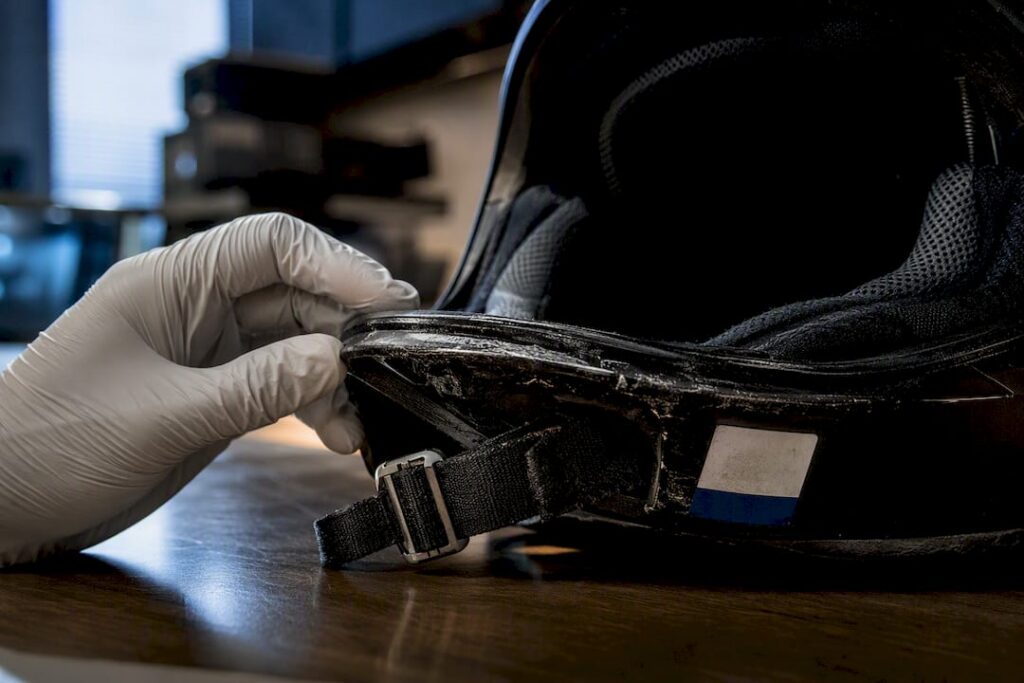
Indiana law requires helmets for anyone under 18 operating or riding a motorcycle, and for any rider of any age who holds a motorcycle learner’s permit. Adult riders age 18 and older with a full endorsement are not required to wear one. The statutory basis sits in Indiana Code IC 9-19-7-1, reinforced by Indiana BMV permit guidance and the federal DOT standard, FMVSS 218.
TL;DR:
- Only riders under 18 and permit holders of any age are legally required to wear DOT-certified helmets on Indiana roads.
- Helmets must meet FMVSS 218 standards, identifiable by a DOT sticker, and should be in good condition to provide proper protection.
- Adult riders with full endorsements are not mandated to wear helmets, but failure to do so can still harm injury claims or insurance settlements.
- Permitted riders must wear helmets regardless of age, limit rides to daylight hours, and cannot carry passengers until fully endorsed.
- The helmet law extends to children on off-road vehicles on private property, requiring DOT-compliant helmets to avoid infractions.
Table of Contents
- Who Has to Wear a Helmet Under Indiana Motorcycle Helmet Law
- What Makes a Helmet Legal in Indiana: DOT Certification Explained
- Learner’s Permit Riders Face a Stricter Helmet Rule
- Indiana’s Off-Road Vehicle Child Helmet Law
- How Skipping a Helmet Can Hurt Your Injury Claim
- Preserving Evidence After a Crash: What Actually Protects Your Claim
- Where to Verify Indiana’s Helmet and Permit Rules
- Why Indiana’s Narrow Helmet Law Creates Bigger Problems Than It Solves
- Sources
Who Has to Wear a Helmet Under Indiana Motorcycle Helmet Law
Indiana’s helmet mandate is narrower than many riders assume, and that narrowness is exactly why it trips people up. The core rule comes from IC 9-19-7-1, which requires anyone under 18 to wear a helmet while operating or riding on a motorcycle or motor-driven cycle on a public street or highway. A companion provision, IC 9-21-10-9, ties into the broader vehicle equipment code that governs how motorcycles must be operated safely on Indiana roads.
The statute covers motorcycles and motor-driven cycles specifically. Autocycles, the enclosed three-wheeled vehicles that look more like a small car than a bike, are excluded from this helmet requirement because Indiana law classifies them separately from traditional motorcycles.
A few points matter for anyone trying to figure out where they stand:
- Riders and operators under 18 must wear a helmet on any public street or highway, no exceptions for short trips or low speeds.
- The law pairs the helmet rule with an eye-protection requirement for minors, since wind and debris pose a real hazard on an open bike.
- Adults 18 and older with a valid motorcycle endorsement can legally ride helmet-free under state law, a fact confirmed by national tracking from IIHS’s state-by-state helmet law summary.
- Indiana BMV materials echo the statute directly, so riders checking official guidance will see the same under-18 threshold repeated there.
That “18 with an endorsement” carve-out is where most confusion starts, because it does not apply to everyone who is 18 or older. Anyone still riding on a learner’s permit, regardless of age, falls under a different and stricter rule, covered below.
What Makes a Helmet Legal in Indiana: DOT Certification Explained
When Indiana law requires a helmet, not just any helmet satisfies it. The helmet must meet the federal performance standard known as FMVSS 218, the U.S. Department of Transportation’s baseline for impact protection, penetration resistance, and retention system strength. This standard is codified in 49 CFR §571.218 and applies nationwide, not just in Indiana.
Verifying compliance takes about thirty seconds. Here’s the checklist:
- Look for the DOT sticker on the outside back of the helmet, usually a small oval or rectangular label.
- Confirm the label reads “DOT FMVSS No. 218 Certified” rather than an unofficial or novelty sticker.
- Check the shell for cracks, deep scratches, or signs of prior impact damage.
- Confirm the chin strap and D-ring hardware are intact and the fit is snug, not loose at the temples or jaw.
- Consider a Snell-certified helmet as an added layer beyond DOT’s minimum, since Snell testing includes more rigorous impact scenarios.
NHTSA’s consumer guidance on choosing the right motorcycle helmet notes that DOT-compliant helmets are built around real crash data, and Ride Safe Indiana’s operator manual reinforces that fit and condition matter as much as certification itself. A helmet that is DOT-labeled but cracked from a prior drop offers far less protection than the sticker implies.
Pro Tip: If you’re ever in a crash, photograph the DOT sticker and the helmet’s condition before anyone moves or discards it, and keep the helmet itself. That single habit can become important evidence later if an insurer questions what protection you were wearing.
Learner’s Permit Riders Face a Stricter Helmet Rule
Here’s where Indiana motorcycle riding rules diverge sharply from what most adult riders expect. If you’re operating on a motorcycle learner’s permit, you must wear a helmet no matter your age, according to Indiana BMV’s motorcycle licensing guidance. A 45-year-old first-time rider on a learner’s permit has the same helmet obligation as a 16-year-old.
Permit status also brings operational limits that go beyond headgear:
- Riding is restricted to daylight hours only, as defined in the Indiana Driver’s Manual, Chapter 2.
- Permit holders cannot carry passengers under any circumstance.
- The permit is a temporary credential meant to bridge the gap until a rider passes the knowledge and skills tests required for a full endorsement.
These restrictions exist because new riders are statistically the most vulnerable group on two wheels, and the state treats the permit period as training with guardrails, not a shortcut to the road. Plan practice rides around daylight windows and double-check your helmet before every session. Skipping either one during the permit period isn’t just a legal violation; it also weakens your position if you’re ever hurt and need to prove you were riding within the rules.
Indiana’s Off-Road Vehicle Child Helmet Law
Indiana’s helmet requirements don’t stop at public roads. A 2017 law extended helmet protection to children under 18 riding off-road vehicles, and this rule applies on private property just as much as public land, according to Indiana DNR’s off-road vehicle child helmet law.
That private-property reach surprises a lot of parents and landowners who assume backyard trails or family farmland fall outside state oversight. They don’t. Key details:
- The requirement applies to any child under 18 operating or riding an ORV, on private or public property alike.
- Owners or the adults who permit a child to ride unhelmeted can face a Class C infraction, a real penalty even for a first offense.
- A DOT-compliant helmet, the same FMVSS 218 standard covered above, satisfies the ORV law’s requirement.
- Parents and property owners should verify the DOT sticker and confirm proper fit rather than assuming any helmet in the garage will do.
Retaining proof of a helmet’s purchase and its size fitting is worth doing, since it can help rebut later claims that a helmet was defective or improperly sized if an incident ever leads to a dispute.
How Skipping a Helmet Can Hurt Your Injury Claim
Beyond the citation itself, riding without a required helmet creates a second, more expensive problem: it hands an insurance adjuster a ready-made argument. Indiana follows a modified comparative fault framework, and insurers routinely raise helmet nonuse to argue that a rider’s own choices contributed to the severity of their injuries, even when the crash itself was someone else’s fault.
Typical consequences and considerations include:
- A citation or infraction for the underlying violation, separate from anything tied to the crash itself.
- Insurers citing lack of helmet use to argue for a reduced settlement, particularly on head or facial injury claims.
- Defense attorneys sometimes framing helmet nonuse as evidence of comparative negligence, even in cases where the helmet had nothing to do with causing the collision.
If you’re in a crash, the immediate steps you take matter more than most riders realize:
- Get medical care right away, even if injuries seem minor at first.
- Photograph your injuries and your helmet’s condition before cleanup or repairs happen.
- Preserve the actual helmet rather than discarding a damaged one.
- Collect contact information from any witnesses at the scene.
- Report the crash to police when required and notify your insurer promptly.
- Talk to an attorney before accepting an early settlement offer, especially if the insurer mentions helmet use at all.
Keller & Keller Injury Lawyers’ guide to helmet safety and Indiana injury claims walks through how these documentation steps play out in real claim disputes, and Determining the Value of an Indiana Motorcycle Crash Claim breaks down how injury severity and helmet status factor into settlement value.
Preserving Evidence After a Crash: What Actually Protects Your Claim
Insurers don’t need much to raise a helmet defense. A vague note in a police report or an adjuster’s assumption can be enough to open the argument. What shuts it down is documentation created close to the moment of impact, not reconstructed weeks later from memory.
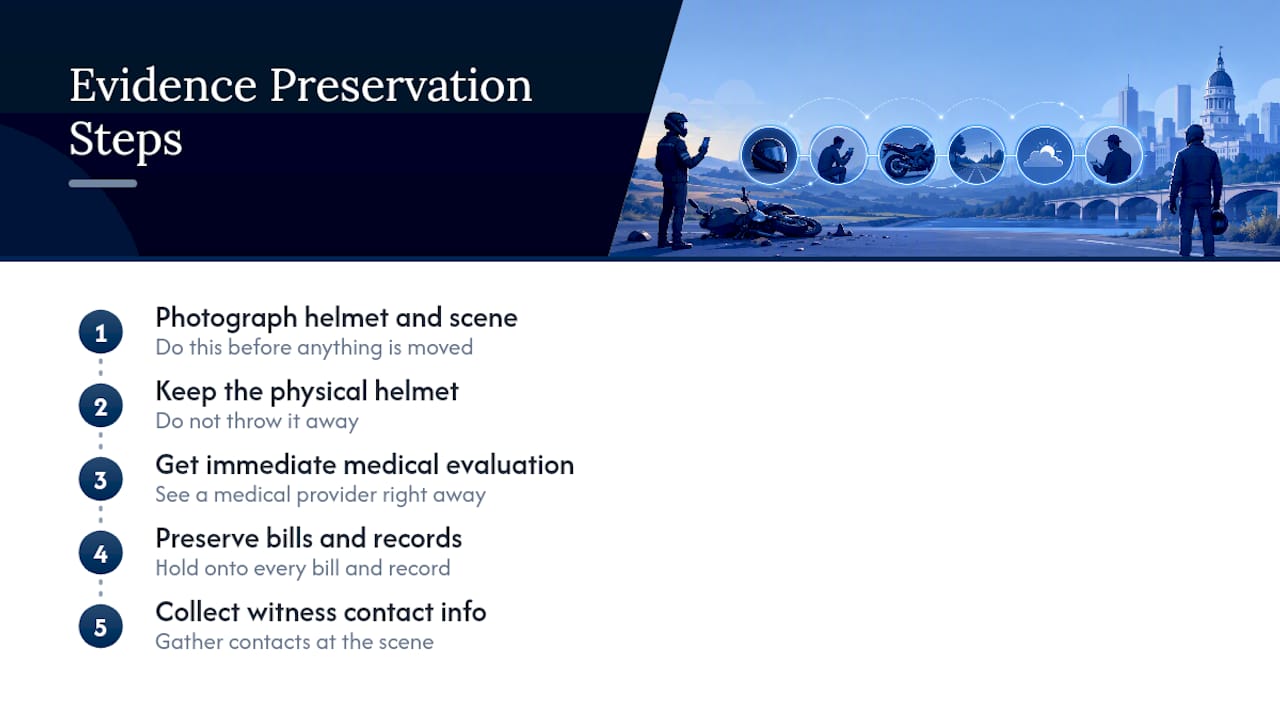
The sequence that protects a claim looks like this: photograph the helmet and the crash scene before anything is moved, keep the physical helmet rather than throwing it away, get evaluated by a medical provider immediately, and hold onto every bill and record that follows. Witness contact information gathered at the scene often becomes irreplaceable once time passes.
Legal help becomes worth pursuing when injuries are serious, when fault is disputed, or when an insurer starts slow-walking or denying a claim outright. An attorney evaluating a motorcycle injury case will typically ask for the police report, medical records, photos of the helmet and scene, and any correspondence already exchanged with the insurance company.
Pro Tip: Don’t wait for the insurer to ask about your helmet. If it was DOT-compliant and in good condition, get that documented and into your file before the question ever comes up.
Riders navigating a contested claim can review Benefits of Hiring an Accident Attorney for a clearer picture of what representation actually changes in these disputes, and Indiana Motorcycle Laws for broader context on the statutes governing Indiana riders.
Where to Verify Indiana’s Helmet and Permit Rules
For readers who want the primary sources rather than a summary, these are the documents that actually govern Indiana motorcycle helmet law:
- Indiana Code IC 9-19-7-1, the statute setting the under-18 helmet requirement.
- Indiana BMV’s motorcycle licensing page, covering permit and endorsement rules.
- The Indiana Driver’s Manual, Chapter 2, detailing learner-permit restrictions.
- Indiana DNR’s off-road vehicle child helmet law page, governing ORV use by minors.
- NHTSA’s helmet selection guidance, explaining the federal FMVSS 218 standard.
Riders wanting deeper background on state-specific rules can also consult What Are The Motorcycle Laws And Regulations In Indiana? and Indiana Motorcycle Injury Prevention: What You Can Wear While Riding.
If you’re already dealing with an insurer after a crash, Why Insurers Deny Injury Claims, What Policyholders Must Do explains the tactics adjusters use and how to respond before a helmet argument derails a fair settlement.
Why Indiana’s Narrow Helmet Law Creates Bigger Problems Than It Solves
The conventional advice on Indiana’s helmet law stops at “adults don’t have to wear one.” That’s technically accurate and practically incomplete. What the statute doesn’t do is protect adult riders from the consequences of skipping a helmet, even when the law permits it.
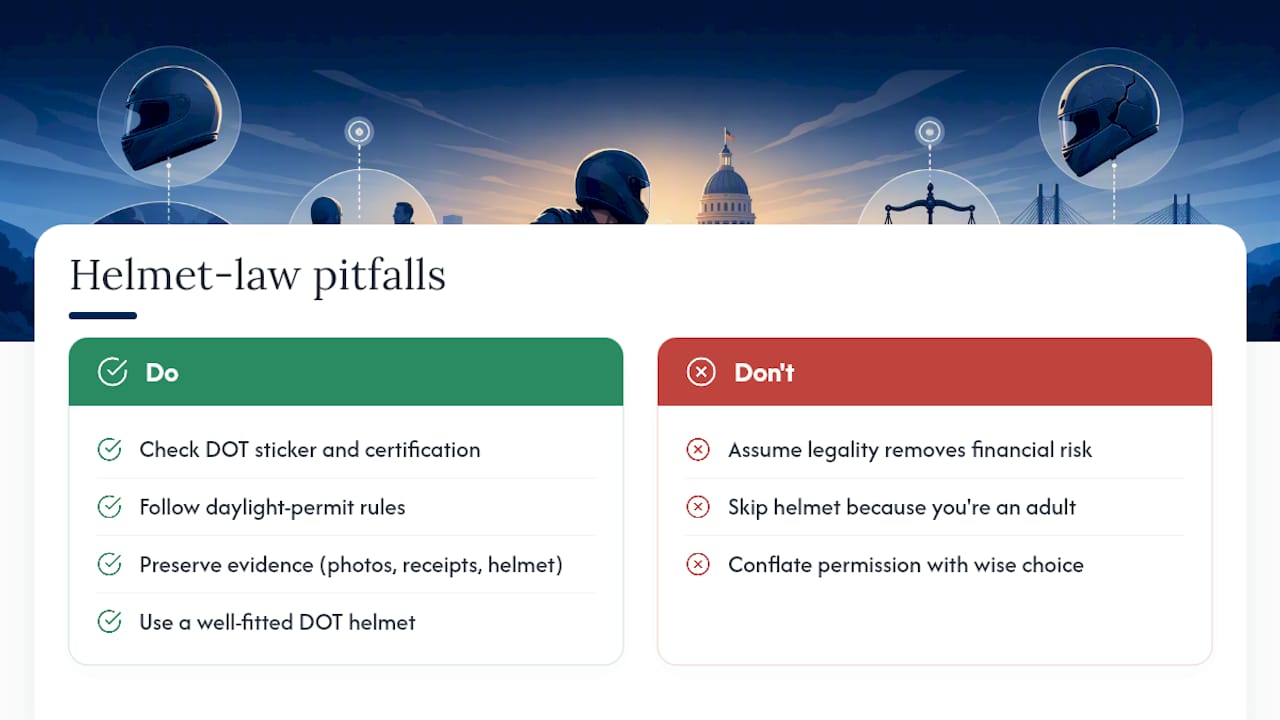
I’d argue the age-18 threshold gives riders a false sense that helmet use is a personal preference with no downside beyond a possible head injury. It isn’t. It’s a documented factor insurers reach for whenever a claim gets contested, regardless of who caused the crash. The legal permission to ride bare-headed and the practical wisdom of doing so are two entirely different questions, and conflating them is where riders get hurt twice: physically, then financially.
My honest read is that the real gap isn’t in the statute, it’s in rider awareness of what happens after a crash. Prioritize the DOT sticker check and the daylight-permit rules covered here, but prioritize evidence preservation just as highly. A helmet that’s DOT-certified, well-fitted, and documented in photos does more for a claim than most riders assume, whether the law required them to wear it or not.
Adam
This article is general information, not a substitute for advice from a qualified lawyer. Consult a qualified legal professional about your own circumstances before acting on anything here.
Sources
- Justia, Indiana Code (IC 9-19-7-1)
- Indiana BMV, Motorcycle licenses and permits
- Indiana Driver’s Manual, Chapter 2
- Indiana DNR, Off-road vehicle child helmet law
- NHTSA, Choose the right motorcycle helmet