
A lien in a personal injury settlement is a legal claim that healthcare providers, insurers, or government programs place on your settlement proceeds to recoup medical expenses before you receive any funds. The role of liens in injury settlement outcomes is direct: they reduce the net amount you actually take home after a case resolves. Medical liens account for 20% to 40% of the gross settlement in many cases. That figure means a $100,000 settlement can shrink to $37,000 or less after attorney fees, case costs, and lien payments are satisfied. Understanding how liens work, and how to negotiate them, is the difference between a fair recovery and a disappointing check.
What is the role of liens in injury settlement cases?
A lien is a legal tool that secures repayment for medical care provided on credit while your case is pending. Hospitals, doctors, insurers, and government programs all use liens to protect their right to reimbursement from your eventual settlement. Liens are standard tools that allow injured people to receive necessary treatment without paying out of pocket while they wait for their case to settle. Without liens, many providers would refuse to treat injury victims on credit at all.
The legal term for the broader process is “subrogation,” which refers to a third party’s right to step into your shoes and recover costs from the at-fault party’s insurance. Liens are the mechanism that enforces subrogation rights against your settlement funds. Every dollar paid to a lienholder is a dollar that does not reach you, which is why lien negotiation matters as much as the initial settlement negotiation itself.

What types of liens commonly affect personal injury settlements?
Several distinct lien types can attach to your settlement, and each carries different rules about priority and negotiability.
- Medical provider liens: Hospitals, surgery centers, and treating physicians file these liens directly against your settlement. They are common when you receive care without health insurance or when your insurer refuses to cover accident-related treatment.
- Health insurance subrogation liens: Your own health insurer pays your medical bills and then asserts a right to reimbursement from your settlement. The right to recover these costs is governed by your policy terms and, in some cases, federal law under ERISA.
- Medicare and Medicaid liens: The federal government holds priority lien rights under the Medicare Secondary Payer Act, which means Medicare must be repaid before you receive funds. Medicaid liens follow similar rules at the state level.
- VA liens: Veterans who receive treatment through the Department of Veterans Affairs may face federal liens tied to that care.
- Attorney liens: Your own attorney holds a lien on the settlement to secure payment of fees and any costs advanced during the case.
Government liens, especially Medicare, are the least flexible. Failure to resolve Medicare liens properly can expose both you and your attorney to personal liability. Private provider and insurance liens, by contrast, are often negotiable with the right approach.
Pro Tip: Ask your attorney early in the case to identify every potential lienholder. Waiting until settlement to discover a government lien can delay your funds by weeks or months.
Whether you must repay your health insurance after a car accident depends on your policy and applicable law. Understanding health insurance repayment rights before your case settles helps you plan for the actual net amount you will receive.
How do liens impact the calculation and distribution of your settlement?
The path from a gross settlement figure to the check in your hand follows a specific sequence, and liens sit squarely in the middle of that process.
- Settlement funds deposit into trust. Your attorney receives the settlement check and deposits it into a client trust account. You do not have immediate access to those funds.
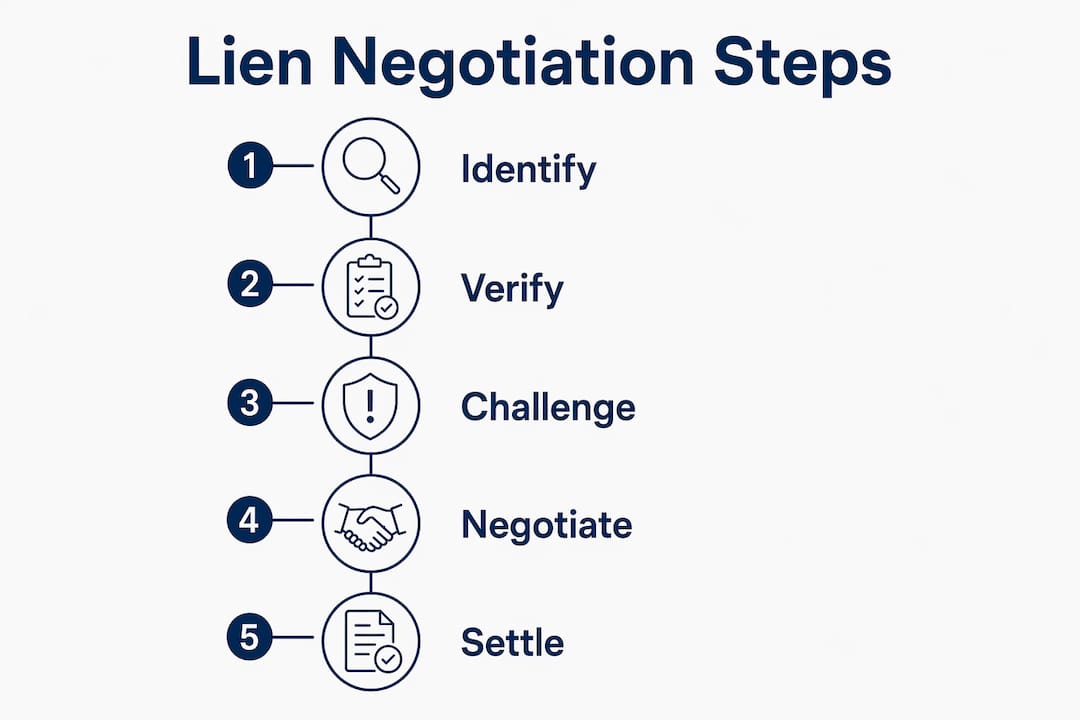
- Lien identification and verification. Your attorney contacts every known lienholder, requests itemized billing, and verifies that each lien is valid and accurate.
- Lien negotiation. Your attorney negotiates with each lienholder to reduce the amount owed where possible.
- Payment to lienholders. Once amounts are agreed upon, the attorney pays each lienholder directly from the trust account.
- Fee and cost deduction. Attorney fees and case costs are deducted from the remaining balance.
- Net funds disbursed to you. You receive what remains after all obligations are satisfied.
Settlement checks deposit into trust first, and lien verification plus negotiation can take weeks or months before funds reach the client. Government liens, particularly Medicare conditional payments, require formal correspondence with federal agencies and add significant time to the process.
The math is sobering. Consider a concrete example: on a $100,000 settlement, after $33,000 in attorney fees, $5,000 in case costs, and $25,000 in liens, the net recovery is $37,000. That is 37 cents on every dollar of the gross award. The gap between the gross settlement and the net check is the most common source of client confusion and frustration in personal injury cases.
Ignoring or improperly resolving liens risks legal penalties, collection actions, and delays in receiving your funds. A lienholder who is not paid can pursue you personally, even after your case is closed.
Pro Tip: Request a written lien resolution summary from your attorney before signing any settlement release. This document should list every lien, the original amount, the negotiated amount, and the final payment.
What negotiation strategies exist to reduce liens and maximize your settlement?
Lien amounts are not fixed. Experienced attorneys can negotiate liens down by 30% to 50%, which translates directly into thousands or tens of thousands of additional dollars for you. That reduction is not automatic. It requires deliberate strategy and knowledge of the applicable legal framework.
Common grounds for lien reduction include:
- Proportionality arguments: If your settlement does not fully compensate you for your injuries, a lienholder should not receive 100 cents on the dollar. Attorneys argue that the lienholder should share in the shortfall proportionally.
- Billing errors: Medical bills frequently contain duplicate charges, unbundled codes, or services not related to the accident. Identifying and challenging these errors reduces the valid lien amount.
- Financial hardship: Some providers will accept a reduced payment when the client demonstrates genuine financial need.
- Statutory fee reductions: Proportionate reduction of liens for attorney fees and costs exists in some jurisdictions, effectively lowering lien amounts and increasing your net recovery.
- Challenging lien validity: Not every asserted lien is legally enforceable. Liens filed outside statutory deadlines or without proper notice may be invalid entirely.
Negotiating with private providers is generally more flexible than negotiating with government programs. Medicare conditional payments have federal priority and must be satisfied precisely to avoid personal liability. However, even Medicare allows a proportionate reduction when the settlement does not fully cover all damages.
Lien negotiation is not a courtesy that providers extend. It is a right that a skilled attorney asserts on your behalf, backed by legal arguments about proportionality, billing accuracy, and statutory compliance. The difference between an attorney who negotiates aggressively and one who simply pays lien demands can be tens of thousands of dollars in your pocket.
Many private liens can be challenged or negotiated depending on compliance with statutory procedures. Choosing an attorney with specific experience in lien negotiation is not a luxury. It is a financial necessity.
Pro Tip: Never assume a lien amount is final. Always ask your attorney what grounds exist to reduce or challenge each lien before any payment is made.
What practical steps can injury claimants take to manage liens effectively?
You play an active role in lien management, even if your attorney handles the legal work. The steps you take during your case directly affect how smoothly liens are resolved at the end.
- Keep detailed records of all medical treatment. Document every provider, every visit, and every bill. Your attorney needs a complete picture to identify all potential lienholders.
- Notify your attorney about every provider and insurer immediately. Surprises at settlement time create delays. Disclose all treatment sources, including workers’ compensation, VA care, and any government program that paid for your care.
- Do not skip medical treatment because of lien concerns. Avoiding medical care out of lien fears weakens your claim more than the cost of treatment itself. Documented, consistent treatment strengthens your case and supports a larger gross settlement.
- Use lien-based treatment strategically. When providers treat you on a lien basis, they create a detailed medical record that documents the full extent of your injuries. That documentation supports a stronger demand to the at-fault party’s insurer.
- Ask your attorney for regular updates on lien negotiation progress. Lien resolution can take time, and staying informed helps you set realistic expectations for when you will receive your funds.
- Understand that delays are normal with government liens. Medicare and Medicaid require formal correspondence and agency review. Build that timeline into your expectations from the start.
Attorney diligence in lien resolution is as important as the initial settlement negotiation for your final recovery. Your active cooperation makes that diligence more effective.
Pro Tip: Create a simple spreadsheet listing every medical provider, the dates of treatment, and whether that provider has asserted a lien. Share it with your attorney at your first meeting and update it throughout the case.
Key Takeaways
Liens are legal claims that reduce your net settlement, but skilled negotiation and active case management can significantly limit their impact.
| Point | Details |
|---|---|
| Liens reduce net recovery | Medical liens alone can consume 20% to 40% of your gross settlement amount. |
| Government liens carry federal priority | Medicare liens under the Medicare Secondary Payer Act must be resolved precisely to avoid personal liability. |
| Negotiation cuts lien amounts | Experienced attorneys can reduce lien amounts by 30% to 50%, adding thousands to your net check. |
| Settlement follows a set payment order | Funds go to trust first, then lienholders, then attorney fees, and finally to you. |
| Skipping treatment hurts your claim | Avoiding care due to lien concerns weakens your case more than the lien cost itself. |
Why lien negotiation deserves as much attention as the settlement itself
After years of watching clients react to their net settlement checks, I can say with confidence that lien negotiation is where cases are won or lost financially. A client who settles for $150,000 but receives $45,000 after liens and fees does not feel like a winner, regardless of what the gross number says.
The uncomfortable truth is that many claimants focus entirely on the gross settlement figure and treat lien resolution as an afterthought. That mindset costs real money. I have seen cases where aggressive lien negotiation added $20,000 or more to a client’s net recovery, simply because the attorney challenged billing errors and argued proportionality. That work happens quietly, after the settlement agreement is signed, and clients rarely see it unless they ask.
My strongest advice is this: before you hire a personal injury attorney, ask them directly how they handle lien negotiation. Ask for examples. Ask whether they challenge government liens or simply pay them on demand. The answer tells you more about the attorney’s value than any marketing claim. Liens are manageable. They are not insurmountable. But they require an attorney who treats lien resolution as a core part of the job, not a clerical task at the end of the file.
— Adam
How 2keller helps you keep more of your settlement
Liens are complex, but they do not have to cost you more than necessary. 2keller represents personal injury claimants across Indiana, Michigan, and New Mexico, with a focus on maximizing the net recovery each client actually receives.

Our attorneys identify every lien from the start of your case, verify each claim for accuracy, and negotiate aggressively to reduce what you owe before any funds are distributed. We challenge billing errors, assert proportionality arguments, and navigate federal Medicare requirements so you are not left exposed to personal liability. If you are dealing with a personal injury claim and want to understand what your settlement could actually look like after liens, contact the personal injury attorneys at 2keller for a free consultation.
FAQ
What is a lien in a personal injury case?
A lien is a legal claim that a healthcare provider, insurer, or government program places on your settlement proceeds to recover medical expenses paid on your behalf. It must be satisfied before you receive your net funds.
How much can liens reduce my settlement?
Medical liens typically reduce net recovery by 20% to 40% of the gross settlement amount. On a $100,000 settlement, combined liens, attorney fees, and costs can leave you with as little as $37,000.
Can my attorney negotiate my liens down?
Yes. Experienced personal injury attorneys can reduce lien amounts by 30% to 50% through proportionality arguments, billing error challenges, and statutory reduction claims, adding significant dollars to your net recovery.
Are Medicare liens negotiable?
Medicare liens are less flexible than private liens because federal law under the Medicare Secondary Payer Act gives them priority status. However, proportionate reductions are available when the settlement does not fully compensate all damages.
What happens if liens are not resolved before settlement funds are distributed?
Unresolved liens expose you and your attorney to personal liability, collection actions, and legal penalties. Lienholders can pursue you directly even after your case is closed, making proper resolution a legal and financial necessity.