
A physiatrist is a board-certified medical doctor who specializes in physical medicine and rehabilitation, and their role in injury claims is to provide expert clinical assessments that establish prognosis, functional limitations, and future care needs. The formal term for this specialty is Physical Medicine and Rehabilitation, often abbreviated as PM&R. Physiatrists complete 12–14 years of post-secondary training, including four years of medical school and a four-year PM&R residency. That depth of training gives them a level of clinical authority that few other specialists can match when it comes to projecting long-term disability and recovery. When you are recovering from a serious accident, a physiatrist’s evaluation can directly shape the strength and value of your injury claim.
What qualifications make physiatrists suited for injury claim assessments?
Physiatrists hold one of the most specialized training profiles in medicine for injury-related cases. Their education covers brain injuries, spinal cord injuries, and musculoskeletal conditions, giving them a broad clinical foundation that directly applies to accident claims. After completing a PM&R residency, many physiatrists pursue additional subspecialty board certification in areas such as Spinal Cord Injury Medicine, Brain Injury Medicine, or Pain Medicine. That subspecialty training translates into clinical judgment that courts and insurance adjusters recognize as authoritative.
What separates physiatrists from other specialists in injury claims is their focus on long-term functional outcomes. A surgeon may fix a structural problem, but a physiatrist evaluates how that injury will affect your daily life, your ability to work, and your need for ongoing care over years or decades. This long-range clinical perspective is exactly what life care plans and damages calculations require. Other specialists often lack the training to project care needs five or ten years into the future with the same clinical rigor.
Key qualifications that strengthen a physiatrist’s role in injury claims include:
- Board certification in PM&R from the American Board of Physical Medicine and Rehabilitation
- Subspecialty certification in areas like Spinal Cord Injury Medicine or Brain Injury Medicine
- Residency training in functional assessment, rehabilitation protocols, and prognosis formulation
- Experience with functional outcome measures such as the Functional Independence Measure (FIM) and Disability Rating Scale (DRS)
- Familiarity with peer-reviewed rehabilitation literature used to support evidence-based opinions
Pro Tip: When selecting a physiatrist for expert testimony, confirm board certification and subspecialty credentials. Courts give significantly more weight to opinions from physicians whose training directly matches the injury type at issue in the claim.
How do physiatrists build life care plans and quantify damages?

A Life Care Plan, or LCP, is a clinical document that projects the medical, therapeutic, and support services an injured person will need for the rest of their life. Physiatrists are the most qualified physicians to author these plans because they conduct independent clinical examinations, review all prior medical records, and formulate a prognosis grounded in direct patient contact. A physician-authored life care plan carries stronger legal defensibility than one prepared by a non-physician planner, because the medical necessity of each care item is anchored in clinical judgment rather than records review alone.
The clinical process a physiatrist follows for an LCP typically includes:
- Independent medical examination to assess current functional status and impairment
- Comprehensive records review covering all treating providers, imaging, and therapy notes
- Prognosis formulation based on diagnosis, injury severity, and evidence-based rehabilitation outcomes
- Care category identification covering all projected services and equipment needs
The care categories a physiatrist addresses in an LCP span a wide range of services. The table below outlines the major categories, with examples and typical replacement or service cycles.
| Care category | Examples | Typical cycle |
|---|---|---|
| Rehabilitation therapies | Physical therapy, occupational therapy, speech therapy | Ongoing or episodic, reviewed annually |
| Attendant care | Personal care assistance, home health aides | Daily hours projected over life expectancy |
| Durable medical equipment | Wheelchairs, orthotics, hospital beds | Replacement cycles of 3–5 years |
| Medical follow-up | Physiatrist visits, specialist consultations | Every 6–12 months |
| Care coordination | Nurse case manager or rehabilitation specialist | Budgeted realistic hours, not symbolic allocations |
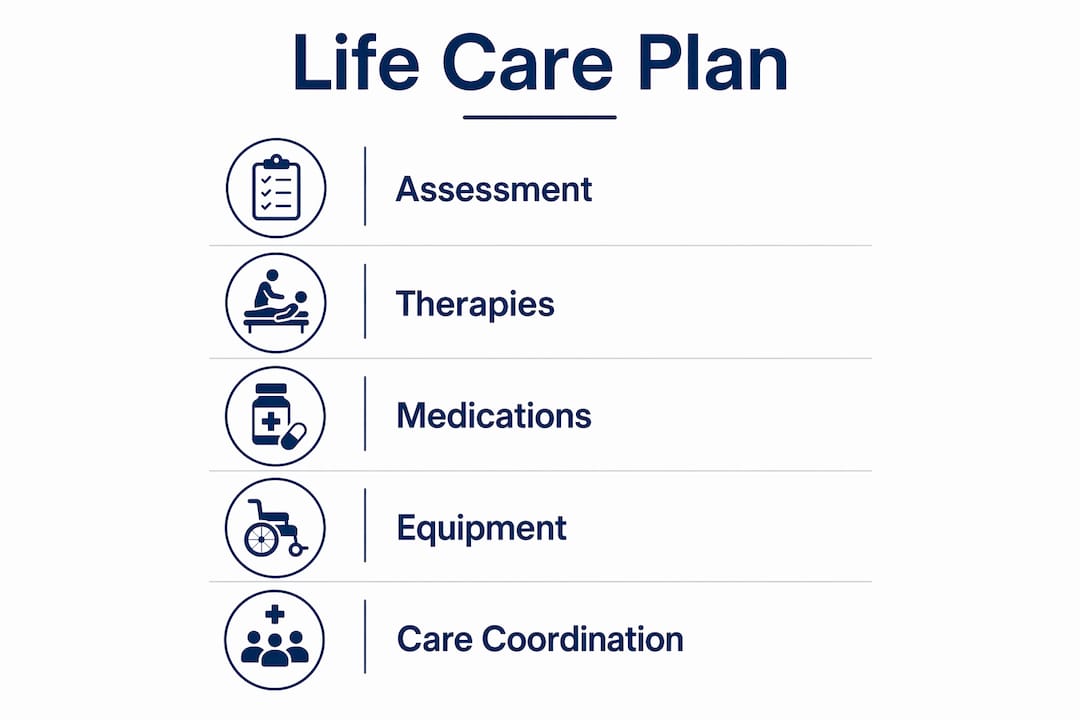
One detail that often gets challenged in litigation is the care coordination line item. Defensible life care plans budget realistic, specific hours for a qualified care coordinator, not arbitrary or token amounts. Defense attorneys routinely attack plans that assign minimal coordination hours, arguing the plan underestimates complexity or is clinically unsupported.
What legal challenges do physiatrists face in injury claim testimony?
Physiatrist expert testimony faces scrutiny under two primary legal standards: the Daubert standard and Federal Rule of Evidence 705 (FRE 705). The Daubert standard requires that expert opinions be based on sufficient facts, reliable methodology, and principles that have been tested and accepted in the relevant scientific community. FRE 705 governs how experts disclose the basis of their opinions during testimony, balancing efficiency with evidentiary transparency.
Common defense challenges to physiatrist testimony include:
- Methodology attacks questioning whether the physician followed a systematic, reproducible process
- Medical necessity disputes arguing that projected care items are excessive or unsupported
- Completeness challenges claiming the physician failed to review all relevant records
- Alternative diagnosis arguments suggesting the injury predates the accident or has another cause
Physiatrists meet these challenges by grounding their opinions in peer-reviewed rehabilitation literature, objective functional outcome measurements, and transparent clinical reasoning. Expert reports that integrate clinical exam findings, published guidelines, and documented functional data are far more likely to survive Daubert challenges than those relying on clinical intuition alone.
“A life care plan is not just a cost projection. It is a clinical record. The physiatrist’s independent examination is what separates a defensible plan from one that collapses under cross-examination. Without that direct patient contact, the medical necessity of every line item is vulnerable.”
Pro Tip: Attorneys working with physiatrist experts should request a draft report early and review it for completeness before disclosure. Identifying gaps in records reviewed or undocumented clinical reasoning before trial is far easier than rehabilitating a report under cross-examination.
You can also review how treating physician rules affect medical expert testimony in Indiana injury cases, which adds important context for how physiatrist opinions are evaluated by courts.
How does physiatrist-led rehabilitation coordination affect injury claims?
Physiatrists function as the coordinator of multidisciplinary rehabilitation teams, directing physical therapists, occupational therapists, speech-language pathologists, neuropsychologists, and other specialists toward a unified recovery plan. The AMA describes this role as the “quarterback” of the rehab team, a description that captures both the leadership function and the need for real-time clinical decision-making. This coordination directly benefits injury claims because it creates a consistent, documented record of functional progress and ongoing medical need.
Without physiatrist leadership, rehabilitation care often becomes fragmented. A patient might see a physical therapist, an orthopedic surgeon, and a neurologist separately, with no single physician synthesizing their findings into a coherent prognosis. That fragmentation creates gaps in documentation that defense attorneys exploit. A physiatrist-led “medical home” model closes those gaps by providing a single clinical authority who monitors functional status over time.
The benefits of physiatrist-led coordination for injury claims include:
- Consistent prognostic documentation updated at regular intervals, supporting claim validity over time
- Integrated therapy planning that reflects the full scope of the patient’s functional deficits
- Timely identification of complications such as spasticity, chronic pain, or secondary conditions that affect care needs
- Stronger life care plan foundation built on longitudinal clinical data rather than a single snapshot evaluation
Regular physiatrist evaluations every 6–12 months produce superior documentation compared to fragmented specialist care. That continuity matters both for the patient’s recovery and for the legal record supporting the claim. Clients with catastrophic injury claims in particular benefit from this model because their care needs evolve over years, and the claim must reflect that evolution accurately.
Key Takeaways
A physiatrist’s clinical examination and expert opinion are the foundation of a legally defensible injury claim, from prognosis to life care plan to courtroom testimony.
| Point | Details |
|---|---|
| Specialized training matters | Board-certified physiatrists complete 12–14 years of training, giving their opinions strong legal authority. |
| Life care plans require direct examination | A physician-authored LCP based on independent examination is far more defensible than one built on records review alone. |
| Legal standards are demanding | Daubert and FRE 705 require physiatrists to use evidence-based methods and document their clinical reasoning transparently. |
| Coordination improves outcomes and claims | Physiatrist-led rehab teams produce consistent documentation that strengthens both recovery and claim validity. |
| Early involvement strengthens prognosis | Engaging a physiatrist early in the claims process produces more complete and defensible prognostic records. |
Why early physiatrist involvement changes everything
I have seen injury claims succeed and fail on the quality of one document: the life care plan. The cases that struggle are almost always the ones where a physiatrist was brought in late, after the claimant had already been discharged from acute care and the medical record had gone cold. By that point, the physician is working from paper rather than from a living patient, and every defense attorney in the room knows it.
The most common misconception I encounter is that a life care plan is primarily a financial document. It is not. It is a clinical record. The numbers only hold up in court when they are anchored to a direct examination, a documented prognosis, and a methodology that a judge can evaluate under Daubert. Generic assessments that list care categories without clinical justification do not survive cross-examination.
My practical advice: if you are recovering from a serious accident, ask your attorney about engaging a board-certified physiatrist early, ideally while you are still in active rehabilitation. The physiatrist can document your functional status in real time, which produces far stronger evidence than a retrospective review months later. For attorneys, the physiatrist you choose should have subspecialty credentials that match the injury type. A brain injury claim needs a physician with Brain Injury Medicine certification, not a general PM&R practitioner. That specificity matters to judges and juries alike.
— Adam
How 2keller supports injury claimants working with physiatrists
Recovering from a serious accident is hard enough without navigating the medical and legal complexity that comes with it. 2keller is a personal injury law firm serving clients in Indiana, Michigan, and New Mexico, with experience handling catastrophic injury claims where physiatrist evaluations and life care plans are central to the case.

If you are building an injury claim and need guidance on medical documentation, our injury documentation guide walks you through the process step by step. Our attorneys work directly with medical experts, including physiatrists, to build claims that hold up under scrutiny. Contact 2keller to speak with a personal injury attorney about your case and how physiatrist involvement can strengthen your claim.
FAQ
What does a physiatrist do in an injury claim?
A physiatrist conducts an independent medical examination, formulates a prognosis, and authors a life care plan that documents future care needs. These findings support economic damages calculations and provide expert testimony in legal proceedings.
How is a physiatrist different from other doctors in injury cases?
Physiatrists specialize in long-term functional outcomes and rehabilitation, making them uniquely qualified to project care needs over a lifetime. Other specialists typically focus on diagnosis or surgical treatment rather than ongoing functional prognosis.
What is a life care plan and why does a physiatrist prepare it?
A life care plan is a clinical document projecting all future medical, therapeutic, and support services an injured person will need. Physiatrists prepare them because their independent examination and prognostic expertise give the plan the medical foundation required for legal defensibility.
Can physiatrist testimony be challenged in court?
Yes. Physiatrist testimony is frequently challenged under the Daubert standard and FRE 705, with defense attorneys targeting methodology, medical necessity, and completeness. Opinions grounded in peer-reviewed literature and objective functional data consistently withstand these challenges.
When should a physiatrist be involved in an injury claim?
A physiatrist should be involved as early as possible, ideally during active rehabilitation. Early involvement produces real-time functional documentation that is far stronger evidence than a retrospective review conducted months after treatment ends.
Recommended
- Indiana Pre-Existing Injuries and Car Accident Claims – Keller & Keller
- Factors That Play a Role in Your Indiana Car Accident Claim – Keller & Keller
- Recorded Statement in Personal Injury: Know Your Rights
- Common Misconceptions About Indiana Personal Injury Claims – How Personal Injury Cases Work in Indiana – Keller & Keller