Indiana law requires insurers to make uninsured and underinsured motorist coverage available on every auto policy, with underinsured motorist coverage offered at no less than $50,000. When the at-fault driver has no insurance or not enough of it, this coverage lets you file a claim against your own policy for medical bills, lost wages, and other losses. A written rejection can waive it, but absent that signature, the protection applies automatically.
TL;DR:
- Rejection of uninsured or underinsured motorist coverage must be written and signed, or the coverage applies automatically with no waiver if omitted.
- Most drivers are offered UM/UIM limits matching their bodily injury liability coverage, with a minimum of $50,000 mandated by law.
- Filing a claim requires prompt medical treatment, police reports, evidence collection, and explicit insurer notification as UM/UIM, not liability.
- If rejected in writing, coverage won’t be offered again unless re-requested in writing, and switching insurers resets the offer opportunity.
- Indiana’s no pay, no play law limits damages for uninsured drivers but not for claimants, emphasizing the importance of UM/UIM coverage.
Table of Contents
- What Does Uninsured Motorist Insurance Require in Indiana?
- What Do UM and UIM Actually Cover?
- How Do You File a UM/UIM Claim in Indiana?
- What Happens if You Reject UM/UIM Coverage?
- How Does Indiana’s “No Pay, No Play” Law Limit Recovery?
- Common UM/UIM Scenarios: Hit-and-Run, Partial Coverage, and Insurer Failure
- What Should You Do After an Accident With an Uninsured Driver?
- When Does a UM/UIM Claim Need a Lawyer?
- What Exclusions Limit UM/UIM Coverage in Indiana?
- Do Medical Payments or Health Insurance Affect a UM/UIM Claim?
- What Disputes Commonly Arise in UM/UIM Claims?
- Does Adding UM/UIM Coverage Raise Your Premium?
- How Have Indiana Courts Interpreted UM/UIM Law?
- The Gap Between the Statute and What Actually Happens
- How 2keller Helps After an Uninsured Driver Accident
- Sources
What Does Uninsured Motorist Insurance Require in Indiana?
Every insurer writing auto liability policies in Indiana must offer uninsured motorist (UM) and underinsured motorist (UIM) coverage. That obligation comes straight from Indiana Code § 27-7-5-2, which also bars insurers from selling UIM coverage below $50,000. Most carriers set your UM/UIM limits to match your chosen bodily injury liability limits, so a driver carrying $100,000 in liability coverage typically gets offered $100,000 in UM/UIM unless they specifically request otherwise.
The Indiana Department of Insurance confirms this isn’t a courtesy insurers extend. It’s baked into how new policies get written:
- Coverage attaches automatically unless you sign a formal rejection.
- Rejection has to be in writing, not a verbal request or a checkbox buried in fine print.
- Once rejected, the insurer generally doesn’t have to offer it again unless you ask in writing.
That last point trips up a lot of drivers who assume they can add coverage back whenever they like.
What Do UM and UIM Actually Cover?
Uninsured motorist coverage kicks in when the at-fault driver carries no insurance at all or flees the scene in a hit-and-run. Underinsured motorist coverage fills the gap when the other driver has insurance, but their limits fall short of your actual losses. Indiana Code § 27-7-5-4 defines both terms and extends protection to accidents where the at-fault driver’s insurer becomes insolvent within two years of the crash.
Coverable losses typically include:
- Medical expenses tied directly to the crash
- Lost wages from time away from work
- Pain and suffering and other noneconomic damages, subject to policy limits
- Property damage, depending on your specific policy terms
Many drivers nationwide do not carry insurance, according to the Insurance Information Institute. That fact is exactly why Indiana lawmakers built UM/UIM into the default policy structure rather than leaving it optional.
How Do You File a UM/UIM Claim in Indiana?
Filing a UM/UIM claim follows a specific sequence, and skipping steps early on can weaken your case later.
- Get medical treatment immediately, even if injuries seem minor. Delayed treatment gives insurers an opening to argue your injuries aren’t crash related.
- File a police report documenting the accident, especially if the other driver fled or admits they’re uninsured.
- Photograph everything: vehicle damage, the accident scene, visible injuries, and license plates if the driver takes off.
- Collect witness contact information before people leave the scene.
- Notify your insurer promptly that you’re filing a UM/UIM claim, not a standard liability claim against the other driver.
- Gather documentation: medical bills, treatment notes, repair estimates, and proof of lost wages.
- Expect an appraisal or negotiation process if your insurer disputes the value of your claim, and be prepared to file suit if negotiations stall.
Pro Tip: Tell your insurer explicitly that you’re pursuing a UM/UIM claim, not just reporting an accident. Some adjusters will process it as a routine liability claim first, which can delay the specific UM/UIM review and documentation requirements.
What Happens if You Reject UM/UIM Coverage?
A valid written rejection is binding, and not just on the person who signs it. Under Indiana’s statutory framework, that signature also binds every other named insured and anyone otherwise entitled to coverage under the policy, a detail many drivers never realize until they need the coverage and discover a family member waived it years earlier.
Once you reject UM/UIM in writing, your insurer isn’t obligated to offer it again on renewal unless you request it in writing yourself. That means:
- Rejecting coverage once doesn’t just skip a single renewal cycle. It can persist indefinitely.
- Switching insurers gives you a fresh chance to elect coverage, since the new carrier must offer it on the new policy.
- Requesting reinstatement mid-term is possible, but you have to initiate it. The Indiana Minimum Car Insurance Requirements guide breaks down how these limits interact with your liability coverage in more detail.
How Does Indiana’s “No Pay, No Play” Law Limit Recovery?
Indiana’s No Pay, No Play statute restricts uninsured drivers from recovering noneconomic damages, like pain and suffering, when they cause or contribute to an accident while uninsured themselves.
Here’s the practical effect:
- If you’re hit by an uninsured driver, this statute doesn’t limit your recovery. It limits what an uninsured driver can recover from someone else.
- It matters most when both drivers share some fault and one is uninsured. That driver may lose access to noneconomic damages entirely.
- For most readers dealing with an uninsured driver who hit them, this reinforces why pursuing your own UM/UIM coverage is often the more reliable path than hoping to collect from an uninsured at-fault driver who may have no assets to pursue anyway.
Common UM/UIM Scenarios: Hit-and-Run, Partial Coverage, and Insurer Failure
Three fact patterns account for most UM/UIM disputes, and each gets handled differently under Indiana law.
Hit-and-run accidents qualify for UM coverage even though the at-fault driver is unidentified. Report the accident to police immediately. That report becomes the backbone of your claim, since your insurer has no other party to verify the crash occurred as described.
- Document the scene and vehicle damage before leaving, since there’s no other driver’s insurance information to collect.
Partially insured drivers trigger UIM coverage when their liability limits don’t cover your full damages. If the at-fault driver carries only $25,000 in liability coverage and your medical bills run $60,000, UIM bridges that $35,000 gap up to your policy limits.
Insurer insolvency is protected for two years after the accident under Indiana Code § 27-7-5-4. If the at-fault driver’s insurer becomes financially unable to pay within that window, you can pursue your UIM coverage as if that driver had no insurance at all.
What Should You Do After an Accident With an Uninsured Driver?
The sequence you follow in the first days after a crash shapes how smoothly your UM/UIM claim moves later.
- Prioritize safety and medical care first. Call 911, get checked out, and don’t downplay symptoms to an EMT.
- File a police report and get the report number before leaving the scene.
- Preserve evidence: photos, witness statements, dashcam footage if you have it.
- Avoid giving a recorded statement to any insurer, including your own, until you understand what’s being asked. Stick to facts; don’t speculate about fault or injury severity.
- Notify your insurer within days, not weeks, and specifically reference UM/UIM coverage.
- Track your treatment and expenses in one place: bills, mileage to appointments, missed work hours.
- Escalate to appraisal or legal counsel if your insurer’s offer doesn’t reflect your actual medical costs and lost income.
Pro Tip: Insurers sometimes ask claimants to sign broad medical authorizations early in the process. Read what you’re signing. A narrowly tailored release protects your privacy without slowing down your claim.
For a deeper look at what strengthens a claim before it reaches this stage, the Elements of a Strong Indiana Car Accident Claim resource covers documentation strategy in more depth.
When Does a UM/UIM Claim Need a Lawyer?
Personal injury attorneys handling UM/UIM claims spend most of their time on three tasks: documenting the full scope of damages, negotiating against an insurer that’s incentivized to minimize payout, and litigating when negotiation stalls.
Insurers use a handful of recurring tactics on UM/UIM claims specifically: undervaluing pain and suffering, disputing whether treatment was reasonable and necessary, or arguing that pre-existing conditions explain your injuries. Attorneys counter these with medical record analysis, expert input when needed, and a documented paper trail showing the injury’s true cost. The Top Indiana Automotive Insurance Company Excuses resource details several of these tactics directly.
A free consultation typically covers your accident timeline, current medical status, and policy details. Bring your police report, medical records, and insurance correspondence. Contingency fee representation means you owe nothing upfront.
What Exclusions Limit UM/UIM Coverage in Indiana?
UM/UIM coverage isn’t unlimited, and Indiana policies carry specific exclusions worth understanding before you assume a loss is covered.
Most policies exclude coverage if you were driving a vehicle you don’t own and that isn’t listed on your policy, unless that vehicle also carries its own UM/UIM coverage you can access. Intentional acts are excluded too. If you deliberately caused the collision, no UM/UIM claim survives that.
Stacking limitations matter for households with multiple vehicles. Some Indiana policies allow you to “stack” UM/UIM coverage across several insured vehicles, multiplying your available limits, while others explicitly prohibit stacking. This detail lives in your policy’s declarations page, and it’s worth confirming before you assume you have more coverage than you actually do.
Family member exclusions can also apply in specific circumstances, particularly around vehicles owned by relatives but not listed on your policy. And coverage disputes sometimes arise over what counts as an “uninsured motor vehicle” in edge cases, like a vehicle owned by a government entity or a vehicle for which liability insurance exists but the insurer denies the claim entirely.
The practical takeaway: read your declarations page, not just your summary of coverage. The specific exclusions and stacking provisions vary by carrier even within Indiana’s statutory floor, and those details determine whether a claim that seems obviously covered actually is.
Do Medical Payments or Health Insurance Affect a UM/UIM Claim?
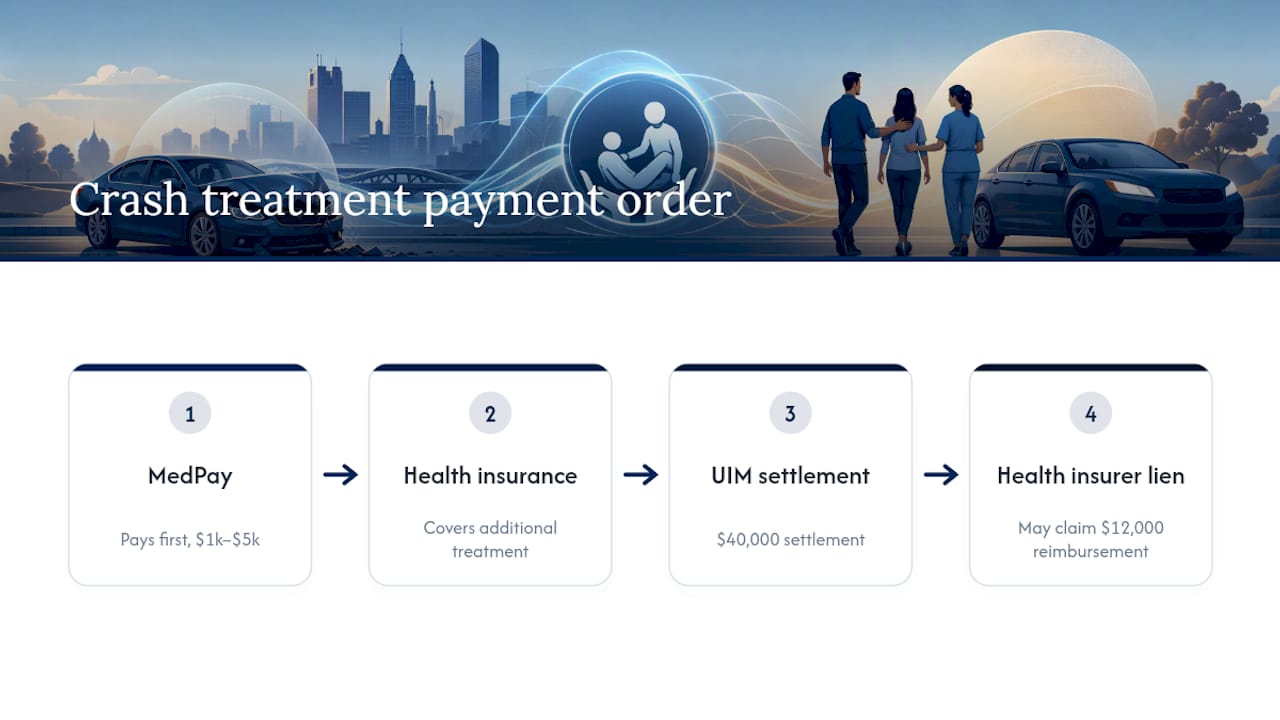
UM/UIM coverage doesn’t exist in isolation from your other coverage. Most Indiana drivers dealing with a crash injury are juggling at least two, sometimes three, sources of payment: medical payments coverage (MedPay) if they carry it, their health insurance, and eventually their UM/UIM claim.
MedPay typically pays first, regardless of fault, and covers medical bills up to your policy’s MedPay limit, often modest amounts like $1,000 to $5,000. Health insurance then covers additional treatment, subject to your deductible and copays. Here’s where it gets complicated: many health insurers assert a subrogation right, meaning if you later recover money through a UM/UIM claim, your health insurer may claim reimbursement for what they already paid toward your treatment.
This interaction affects your net recovery significantly. A $40,000 UIM settlement doesn’t mean $40,000 in your pocket if your health insurer has a valid subrogation lien for $12,000 in prior payments. Understanding this upfront, rather than being surprised by a lien letter after settlement, changes how you negotiate and how you budget for ongoing treatment. Readers navigating this stage often find the Paying Medical Bills After an Indiana Car Accident guide useful for sorting out payment order.
If you lost employer coverage because of missed work, COBRA continuation rules from the U.S. Department of Labor may apply, though that’s a separate track from your UM/UIM claim itself.
What Disputes Commonly Arise in UM/UIM Claims?
Because you’re essentially negotiating against your own insurer, UM/UIM claims generate a specific set of friction points that liability claims against a stranger’s insurer don’t.
Valuation disputes top the list. Insurers frequently argue your medical treatment exceeded what was “reasonable and necessary,” particularly with chiropractic care, physical therapy that extends for months, or treatment from out-of-network providers. Causation disputes follow closely behind: if you had any prior back pain, prior accident history, or a gap between the crash and seeking treatment, expect the insurer to argue your current symptoms aren’t fully attributable to this crash.
Coverage disputes arise when it’s unclear whether a vehicle qualifies as “uninsured,” particularly in cases involving foreign liability policies, government vehicles, or a liability insurer that’s denying coverage but hasn’t been formally declared insolvent.
Bad faith concerns surface when an insurer delays unreasonably, lowballs an obvious claim, or fails to properly investigate. Indiana law provides remedies for genuine bad faith conduct, though proving it requires more than a slow claims process.
Addressing these disputes generally starts with documentation: consistent treatment records, a clear causal narrative from your treating physicians, and prompt reporting that leaves no gaps for an insurer to exploit. When negotiation stalls entirely, appraisal clauses in your policy or formal litigation become the next step.
Does Adding UM/UIM Coverage Raise Your Premium?
UM/UIM coverage adds a modest amount to most Indiana auto premiums, typically far less than drivers expect given the protection it provides. Because UM/UIM claims are less frequent than standard collision or liability claims and the coverage pays out only in specific circumstances, insurers generally price it as a relatively small percentage of your total premium.
The exact increase varies by carrier, your selected limits, and your broader risk profile, but industry guidance consistently frames UM/UIM as one of the more cost-effective coverage additions available. Given that uninsured drivers remain common on the road nationally, many practitioners advise setting UM/UIM limits equal to or above your bodily injury liability limits rather than accepting the state minimum by default, especially given how quickly serious injury costs can outpace a $50,000 floor.
Higher limits cost more, naturally, but the marginal cost of moving from $50,000 to $100,000 in UIM coverage is usually smaller than the jump in bodily injury liability limits would cost, since UIM claims frequency is lower. If you’re shopping for a new policy or renewing an existing one, ask your agent for a side-by-side quote showing the premium difference at multiple UM/UIM tiers before defaulting to the minimum.
How Have Indiana Courts Interpreted UM/UIM Law?
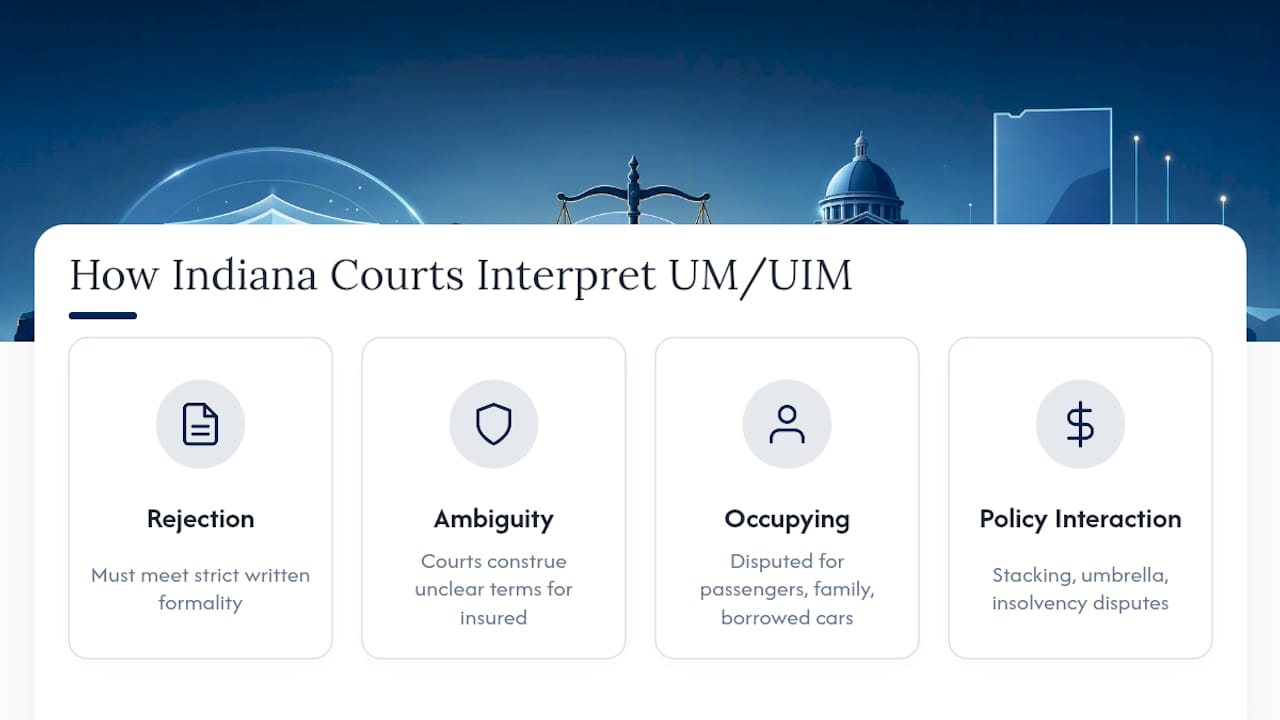
Indiana courts have shaped how UM/UIM statutes apply in practice, particularly around what counts as a valid rejection and how policy exclusions interact with statutory requirements.
Courts have consistently held that a rejection of UM/UIM coverage must meet the written form requirements strictly. Ambiguous language, missing signatures, or rejections that don’t clearly identify which coverage is being waived tend to fail, meaning the coverage remains in force despite the insurer’s paperwork suggesting otherwise. This judicial tendency protects policyholders from technical rejections buried in dense forms.
Interpretation of “occupying” a vehicle and questions about who counts as an “insured” under a given policy have also generated litigation, particularly in cases involving family members, passengers, or people driving borrowed vehicles. Indiana courts generally favor interpretations that extend coverage where policy language is ambiguous, following the broader principle that insurance policies are construed in favor of the insured when terms are unclear.
Disputes over stacking, umbrella policy interaction with UM/UIM, and how the insolvency provision under Indiana Code § 27-7-5-4 applies to specific insurer failures have also reached Indiana courts over the years. The consistent theme across this case law: technical insurer defenses face real scrutiny, and policyholders who understand their rights tend to fare better than those who accept a denial at face value.
The Gap Between the Statute and What Actually Happens
Indiana’s UM/UIM framework reads as protective on paper. Coverage attaches by default, insurers must offer meaningful limits, and rejection requires a deliberate written act. But the conventional advice, “just make sure you have UM/UIM,” undersells how much the fight actually happens after the accident, not before it.
The statute guarantees availability. It doesn’t guarantee a fair valuation of your claim. That’s the part most explainers skip. An insurer processing your UM/UIM claim is still your insurer, financially motivated to minimize what they pay, even though you’ve paid premiums for years expecting them to have your back when it counted.
What I’d prioritize differently than most guidance: don’t just confirm you have UM/UIM. Confirm your limits actually match your bodily injury liability limits, not the $50,000 floor, and revisit that decision every time you renew or switch carriers. The floor exists so insurers can’t refuse to offer coverage. It was never meant to be the ceiling of what you should carry.
The second thing worth saying plainly: if your insurer’s UM/UIM offer feels low relative to your medical bills and lost wages, that instinct is probably correct. This is one of the few claims where you’re negotiating against the company you’ve been loyal to, and that relationship doesn’t buy you goodwill during a payout dispute.
— Adam
How 2keller Helps After an Uninsured Driver Accident
2keller gives Indiana drivers a direct path to a fair UM/UIM recovery instead of navigating your own insurer’s claims process alone. Because UM/UIM claims put you on the opposite side of the table from the company you pay premiums to, having someone who documents damages and pushes back on lowball offers changes the outcome, and it costs nothing upfront under a contingency fee arrangement.

A free consultation with 2keller covers your accident details, current medical treatment, and your policy’s UM/UIM limits. Bring your police report, medical bills, and any correspondence from your insurer so the review moves quickly. If your insurer has already offered a settlement that feels short of your actual losses, the case evaluation process breaks down what to expect before you sign anything. For accidents involving serious or long-term injuries, the guide to serious injury claims explains how those cases differ in scope and strategy. Reach out to start a case review today.
This article is general information, not a substitute for advice from a qualified lawyer. Consult a qualified legal professional about your own circumstances before acting on anything here.
Sources
- Indiana Code § 27-7-5-2. Uninsured and Underinsured Motorist Coverage; Required Coverage; Rejection; Exemptions; Umbrella Policies
- Indiana Department of Insurance: Auto Insurance
- Insurance Information Institute — Facts + Statistics: Uninsured motorists