
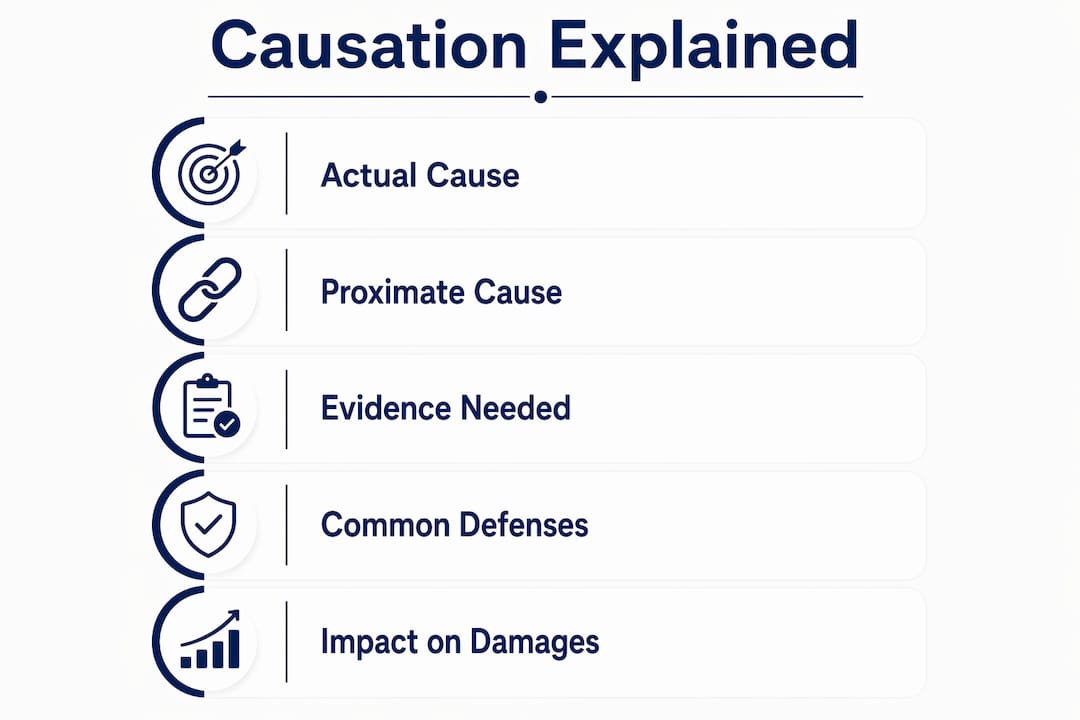
Causation in a personal injury case means the defendant’s conduct actually and legally produced the plaintiff’s harm. Under U.S. tort law, causation has two distinct components: actual cause (cause-in-fact) and proximate cause (legal cause). Without establishing both, even clear-cut negligence will not produce a recovery. The civil standard is preponderance of the evidence, meaning the plaintiff must show it is more likely than not that the defendant’s conduct caused the injury. That threshold sounds manageable, but in disputed claims it is where cases are won or lost.
Table of Contents
- What causation means in a personal injury claim
- How do courts determine actual cause?
- What is proximate cause and why does it limit liability?
- Causation examples in common personal injury scenarios
- What evidence proves causation in a personal injury case?
- Common defenses that attack causation and how to counter them
- How causation affects damages, settlement value, and apportionment
- When causation becomes the central battleground in litigation
- Key Takeaways
- The causation mistakes that cost plaintiffs the most
- How 2keller helps you prove causation from day one
- Authoritative sources for further reading on causation in U.S. personal injury law
What causation means in a personal injury claim
Causation is the legal bridge between what the defendant did wrong and the harm you suffered. Courts and juries do not simply ask whether someone behaved badly. They ask whether that bad behavior produced this specific injury to this specific person. The Restatement (Third) of Torts frames it as a two-part inquiry: first, was the defendant’s conduct a factual cause of the harm? Second, was the harm within the scope of liability that the law recognizes?
Plaintiffs carry the burden of proving both parts by a preponderance of the evidence. Courts separate actual cause from proximate cause for a practical reason: actual cause establishes the factual connection, while proximate cause limits how far liability extends. A defendant who runs a red light is a factual cause of a crash, but the law still asks whether the specific injuries that followed were a foreseeable result of that act.
When adjusters and juries evaluate a claim, they typically look for:
- A clear sequence of events linking the defendant’s act to the injury
- Medical records that document the injury close in time to the incident
- Expert opinions connecting the mechanism of injury to the diagnosed condition
- Absence of a more plausible alternative cause
How do courts determine actual cause?
Actual cause, also called cause-in-fact, is the factual foundation of any causation analysis. The dominant test is the but-for test: would the plaintiff’s injury have occurred but for the defendant’s conduct? If the answer is no, the defendant is a factual cause. If the injury would have happened anyway, the defendant is not.
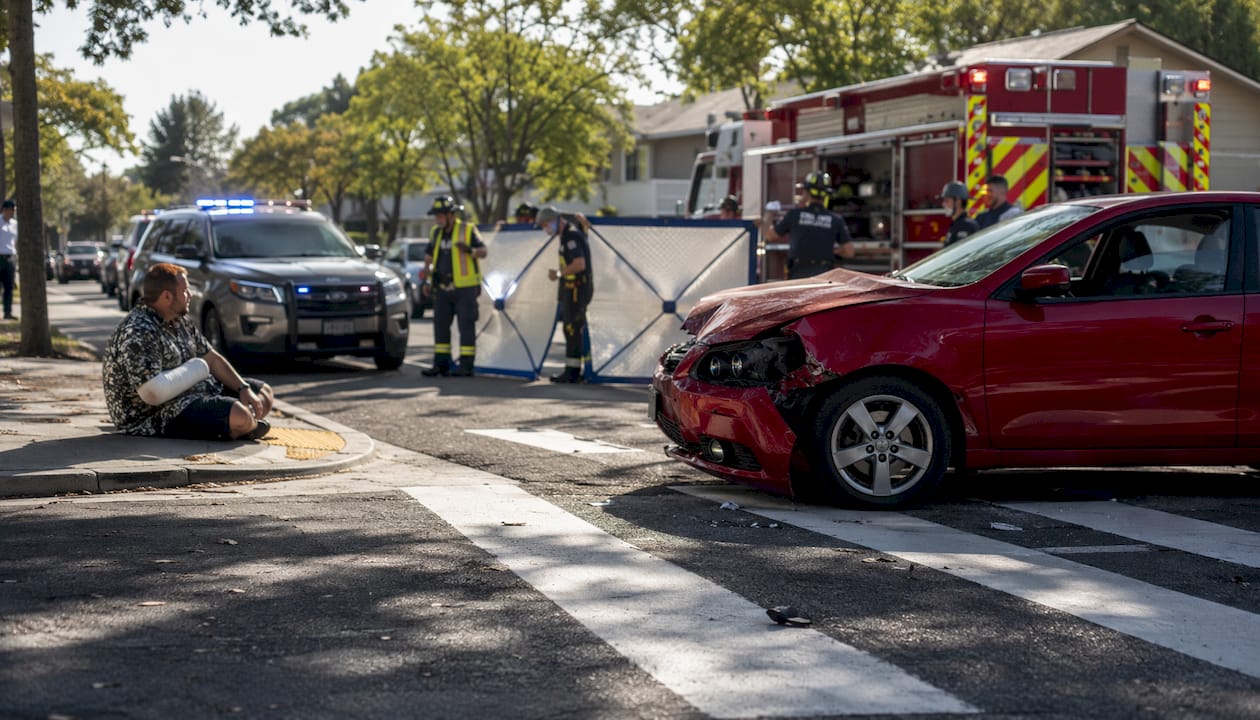
A simple example: a driver runs a stop sign and strikes a pedestrian who suffers a broken leg. But for the driver running the sign, the pedestrian would not have been hit. The but-for test is satisfied.
The test breaks down in multiple-cause scenarios. Courts then turn to the substantial-factor test, which asks whether the defendant’s conduct was a substantial factor in bringing about the harm, even if another cause also could have produced it. The classic illustration is the twin-fires hypothetical: two separate fires, each set negligently by a different person, merge and destroy a home. Either fire alone would have burned the house down, so neither satisfies the but-for test. The substantial-factor approach holds both defendants liable because each contributed meaningfully to the outcome. Some jurisdictions, including Massachusetts under Instruction 4.02, give juries specific guidance on how to handle these multiple-sufficient-cause scenarios.
| Scenario | Test Applied | Outcome |
|---|---|---|
| Single defendant, single cause | But-for test | Defendant liable if injury would not have occurred without their act |
| Multiple causes, each sufficient alone | Substantial-factor test | Each defendant liable if their conduct was a substantial factor |
| Multiple causes, none sufficient alone | Combined but-for / substantial-factor | Liability shared among contributing defendants |
Pro Tip: In any case involving multiple potential causes, build a detailed chronological timeline from day one. Contemporaneous records, timestamped photos, and witness statements gathered early are far harder for a defense team to challenge than reconstructed accounts assembled months later.
What is proximate cause and why does it limit liability?
Proximate cause is the legal boundary on how far a defendant’s responsibility extends. Even when actual cause is established, the law does not hold a defendant liable for every consequence that flows from their act, no matter how distant or improbable. The central question is foreseeability: was this type of harm a reasonably foreseeable result of the defendant’s conduct?
The landmark case Palsgraf v. Long Island Railroad (1928) remains the textbook illustration. A railroad employee helped a passenger board a moving train, dislodging a package of fireworks that exploded and caused scales at the far end of the platform to fall on Mrs. Palsgraf. The court held the railroad was not liable because injury to someone in her position was not a foreseeable result of helping a passenger board. Foreseeability, not mere factual connection, defines the scope of liability.
Intervening vs. superseding causes. An intervening cause is a new act or event that occurs after the defendant’s negligent conduct and contributes to the plaintiff’s harm. Not every intervening act breaks the causal chain. Only a superseding cause does that, and a superseding cause must be both unforeseeable and independent of the original negligence. A foreseeable intervening act, such as a second driver rear-ending a car that was already stopped due to the first defendant’s collision, typically leaves the original defendant’s liability intact. State courts vary in how they define the foreseeability threshold, so jurisdiction-specific analysis matters.

Causation examples in common personal injury scenarios
Car crash. A driver runs a red light and strikes your vehicle. You suffer a herniated disc. The but-for test is straightforward: without the collision, the herniation would not have occurred. Proof rests on the police report, emergency-room records documenting the injury within hours of the crash, and treating-physician notes linking the mechanism of impact to the diagnosis. The causal chain is short and direct.
Medical malpractice. A surgeon operates on the wrong spinal level, causing nerve damage the patient did not have before surgery. Actual cause requires showing that but for the surgical error, the nerve damage would not have occurred. Proximate cause asks whether nerve damage was a foreseeable consequence of operating at the wrong level. Both are typically satisfied, but the plaintiff needs a qualified medical expert to explain the standard of care, the deviation, and the mechanism of injury. Timing is critical: the expert must establish that the damage appeared after the negligent act, not before.
Multiple-causer incident. Two contractors independently dump chemical waste near a water source. Either volume alone would have contaminated the supply. Neither satisfies the but-for test standing alone, so courts apply the substantial-factor approach. Each contractor’s conduct was a substantial factor in the contamination, and both face liability. Justia’s analysis of these multi-defendant scenarios confirms that courts regularly supplement the but-for test when its mechanical application would produce an unjust result.
Outcomes in all three scenarios can shift based on jurisdiction, the timing of medical treatment, and whether any intervening acts occurred between the defendant’s conduct and the plaintiff’s injury.
What evidence proves causation in a personal injury case?
Strong causation proof is built from multiple, mutually reinforcing sources. A single medical record rarely carries a case alone. What persuades adjusters, mediators, and juries is a coherent narrative supported by contemporaneous documentation and credible expert opinion.
Core evidence types include:
- Contemporaneous medical records: Emergency-room reports, urgent-care notes, and treating-provider records created close in time to the incident are the most persuasive causation documents you have.
- Diagnostic imaging: X-rays, MRIs, and CT scans that show a new injury or a worsened condition, compared against any pre-incident imaging, directly address causation.
- Accident and incident reports: Police reports, workplace incident reports, and property-damage assessments establish the mechanism and severity of the event.
- Witness statements: Eyewitness accounts corroborate the sequence of events and the force involved.
- Expert reports: Medical experts provide causal opinions using differential diagnosis; biomechanical engineers explain how the forces involved could produce the documented injuries; accident reconstructionists establish speed, angle, and impact severity.
- Functional and pain documentation: A personal journal tracking pain levels, functional limitations, and missed activities over time gives the jury a human picture of ongoing harm.
Expert testimony deserves special attention. Courts require that a medical expert’s causal opinion be grounded in a reliable methodology, typically differential diagnosis, where the expert rules out alternative explanations and concludes that the incident was the most probable cause of the injury. The role of a physiatrist in this process is often underestimated: physiatrists specialize in functional impairment and can link an injury mechanism directly to documented loss of function, which is exactly what a causation opinion needs.
Pro Tip: Retain a medical expert before the defense schedules its independent medical examination. An early expert opinion sets the causal narrative and makes it far harder for a defense-hired examiner to reframe the injury’s origin.
Common defenses that attack causation and how to counter them
Defense teams rarely concede causation in a disputed claim. Their standard playbook targets the weakest link in the plaintiff’s causal chain.
Alternative-cause attacks. The defense argues that something other than the defendant’s conduct caused the injury, pointing to a prior accident, a pre-existing condition, or an unrelated medical event. The counter is a clear chronological record showing the condition either did not exist before the incident or materially worsened because of it.
Preexisting conditions. This is the most common causation defense in personal injury cases. The eggshell skull rule directly limits this argument: defendants must take their victims as they find them. If a plaintiff had a degenerative disc condition that was asymptomatic before a crash, and the crash made it symptomatic and disabling, the defendant is liable for that aggravation. The preexisting condition does not eliminate causation; it may affect the calculation of damages, but it does not defeat the claim. For Indiana claimants specifically, preexisting injury analysis follows this same principle.
Intervening and superseding causes. The defense may argue that a subsequent event, such as a second accident or a plaintiff’s failure to follow medical advice, broke the causal chain. Whether that argument succeeds depends on foreseeability. A foreseeable complication of an original injury does not sever liability.
Comparative and contributory negligence. In states that apply comparative fault, the defense argues the plaintiff’s own conduct contributed to the harm, reducing the recoverable damages proportionally. This is not a pure causation defense, but it functions similarly by reducing the defendant’s share of liability.
Insurance adjusters routinely use causation disputes to create doubt and reduce settlement offers. Contemporaneous medical records and a clear expert opinion are the most effective counters to each of these strategies.
How causation affects damages, settlement value, and apportionment
Causation does not just determine whether you win. It determines how much you recover. A plaintiff who can trace every element of harm directly to the defendant’s conduct can claim the full range of compensable losses: past and future medical expenses, lost earnings, diminished earning capacity, and pain and suffering. Weak causation narrows that picture considerably.
When multiple parties share responsibility, courts apportion liability based on each party’s causal contribution. In comparative-fault states, a jury might find the defendant 70% responsible and the plaintiff 30% responsible, reducing the award accordingly. In a multi-defendant case, each defendant’s share of the damages tracks their share of the causal contribution.
Settlement strategy follows directly from causation strength:
- A clear, well-documented causal chain with early expert support gives you maximum leverage in negotiation.
- Gaps in treatment, inconsistent statements, or a delayed diagnosis weaken your position and give adjusters grounds to reduce offers.
- An early expert report, obtained before the defense conducts its own examination, anchors the causal narrative and is difficult to dislodge.
- In mediation, being able to explain which percentage of harm each party caused, and why, is more persuasive than a general claim that “the defendant caused everything.”
The practical message is straightforward: the stronger your causation proof, the closer your settlement will track your actual losses.
When causation becomes the central battleground in litigation
Causation is often uncontested in routine, low-complexity claims. In disputed or complex cases, it becomes the primary focus of both sides. Defense counsel and insurance adjusters make the causation link their main target precisely because defeating it eliminates the entire claim, not just a portion of damages.
Plaintiff attorneys triage causation problems early. The first step is a thorough document review: medical records, prior claims history, incident reports, and any available surveillance or imaging. From that review, counsel builds a timeline and identifies gaps that the defense will exploit. Targeted expert retention follows, matching the expert’s specialty to the specific mechanism of injury.
An early preservation checklist for claimants:
- Authorize your attorney to obtain all medical records, including pre-incident records that establish your baseline condition.
- Secure copies of all diagnostic imaging, not just the radiologist’s report.
- Collect contact information for every witness while memories are fresh.
- Send a spoliation prevention letter to any party that may hold relevant evidence, such as surveillance footage or vehicle data.
- Document your symptoms, functional limitations, and daily impact in a written journal starting immediately after the incident.
- Avoid gaps in medical treatment; consistent care creates a continuous causal record.
Signals that a causation fight is likely: a significant gap between the incident and the first medical visit, prior injuries to the same body part, inconsistent witness accounts, or imaging that was not obtained until weeks after the event. When any of these factors are present, retaining experienced counsel and a qualified medical expert early is not optional.
Key Takeaways
Causation in personal injury law requires proving both actual cause and proximate cause by a preponderance of the evidence, and the strength of that proof directly determines what damages you can recover.
| Point | Details |
|---|---|
| Two-part causation test | Every claim requires actual cause (but-for or substantial-factor) and proximate cause (foreseeability). |
| Civil standard of proof | Plaintiff must show causation is more likely than not, a preponderance of the evidence. |
| Eggshell skull rule | Defendants cannot escape liability because a preexisting condition made injuries worse. |
| Evidence builds the case | Medical records, expert opinions, and a clear chronological timeline are the core of any causation argument. |
| Early action protects claims | Prompt treatment, evidence preservation, and early expert retention prevent the gaps defense teams exploit. |
| 2keller’s role | 2keller helps claimants in Indiana, Michigan, and New Mexico build causation proof from day one, including expert retention and evidence preservation. |
The causation mistakes that cost plaintiffs the most
Most people who contact an attorney after an injury assume causation is obvious. After all, they were hurt, and someone else was at fault. What they underestimate is how quickly a defensible claim can develop causation problems, and how hard those problems are to fix once they exist.
The most damaging mistake is delayed treatment. A gap of even two or three weeks between an incident and the first medical visit gives the defense a credible argument that the injury either did not happen as described or was caused by something else entirely. The second most common problem is inconsistent statements, whether to a first responder, an insurance adjuster, or a treating provider. Defense counsel will line those statements up side by side, and any inconsistency becomes an attack on the entire causal narrative.
Failure to preserve evidence is the third major pitfall. Surveillance footage is routinely overwritten within days. Vehicle data from event data recorders can be lost if the car is repaired or totaled before the data is downloaded. Witness memories fade. A preservation letter sent within the first week after an incident can prevent all of that.
The practical do’s are straightforward: seek medical attention the same day or the next day, follow every treatment recommendation, keep a daily journal, and contact an attorney before giving any recorded statement to an insurance company. The don’ts are equally clear: do not post about the incident or your injuries on social media, do not give a recorded statement without counsel, and do not assume the insurance company’s adjuster is working in your interest.
Getting counsel involved early is not about escalating a claim. It is about protecting the evidence and the causal record before the defense has a chance to create doubt.
How 2keller helps you prove causation from day one
Proving causation in a personal injury claim takes more than a medical record and a good story. It takes a coordinated strategy: the right experts retained early, a complete evidence record, and a clear causal narrative that holds up from the first demand letter through trial.

2keller represents injury claimants across Indiana, Michigan, and New Mexico, with a focus on the causation-intensive work that determines whether a claim pays full value or gets reduced to a fraction of actual losses. Our team handles evidence preservation, medical-expert retention, and accident reconstruction coordination from the first case evaluation forward. If your case involves a preexisting condition, a gap in treatment, or a complex multi-party incident, those are exactly the situations where early legal involvement makes the difference between a strong claim and a compromised one. Start with a case evaluation to understand where your causation proof stands and what steps to take now.
Authoritative sources for further reading on causation in U.S. personal injury law
These primary and secondary legal sources provide reliable, jurisdiction-aware guidance on causation doctrine:
- Cornell Law School Legal Information Institute (LII): Free access to Wex legal definitions covering causation, the but-for test, proximate cause, superseding cause, and the eggshell skull rule. The most accessible starting point for understanding U.S. tort doctrine.
- Justia — Personal Injury / Causation: Consumer-facing legal explainer covering both factual and proximate causation, with the Palsgraf illustration and practical notes on how the tests apply in common claim types.
- Nolo — Personal Injury Causation: Plain-language overview of why causation is often taken for granted in simple cases but becomes the claim-killer in disputed ones; useful for claimants who want a non-technical introduction.
- Stanford Encyclopedia of Philosophy — Causation in the Law: Scholarly treatment of why the law draws lines around compensable consequences, including the corrective-justice rationale for proximate cause limits.
- State pattern jury instructions: Most states publish their civil jury instructions online (e.g., Massachusetts Instruction 4.02 on factual causation). These are the actual standards judges give juries and are the most authoritative source for how causation is evaluated in a specific jurisdiction.
- Local counsel: Causation doctrine varies by state in ways that published explainers cannot fully capture. For jurisdiction-specific questions, consult a licensed personal injury attorney in your state.
This article is general legal information, not legal advice. Causation rules vary by jurisdiction and fact pattern. Consult a qualified personal injury attorney in your state to evaluate your specific situation.
Recommended
- Factors That Play a Role in Your Indiana Car Accident Claim – Keller & Keller
- Indiana Pre-Existing Injuries and Car Accident Claims – Keller & Keller
- Common Misconceptions About Indiana Personal Injury Claims – How Personal Injury Cases Work in Indiana – Keller & Keller
- Proving Negligence in an Indiana Car Accident – Keller & Keller