Insurers deny injury claims mainly to protect their financial exposure. Most denials fall into two categories: administrative errors (missing paperwork, wrong codes, late filing) and substantive coverage disputes (liability disagreements, pre-existing conditions, medical necessity challenges). Neither category means the denial is final. Your first moves are to get the denial in writing, note your appeal deadline, preserve all medical records, document every communication, and avoid giving a recorded statement without counsel.
Immediate checklist after a denial:
- Request the denial letter and reason code(s) in writing — insurers are required to provide written reasons in most U.S. jurisdictions
- Calendar your appeal deadline the same day you receive the denial letter
- Preserve all medical records, billing statements, photos, and witness contact information
- Write a short confirmation email after every phone call with the insurer, summarizing what was said
- Do not give a recorded statement to an adjuster until you have spoken with an attorney
Pro Tip: Create a single dated evidence folder — both digital and physical — the day you receive the denial. Write a one-page timeline of events while details are still fresh. That document becomes the spine of your appeal.
Table of Contents
- The most common reasons insurance companies deny injury claims
- How adjusters undervalue or deny claims — and what timeline to expect
- What to do immediately after your injury claim is denied
- How to appeal a denied injury claim: internal, external, ERISA, and bad faith
- Documentation that makes an appeal succeed
- When to hire an attorney for a denied injury claim
- Where to file complaints and find state-level consumer resources
- Key Takeaways
- The cost of waiting after a denial
- 2keller handles denied injury claims in Indiana, Michigan, and New Mexico
- Useful sources
The most common reasons insurance companies deny injury claims
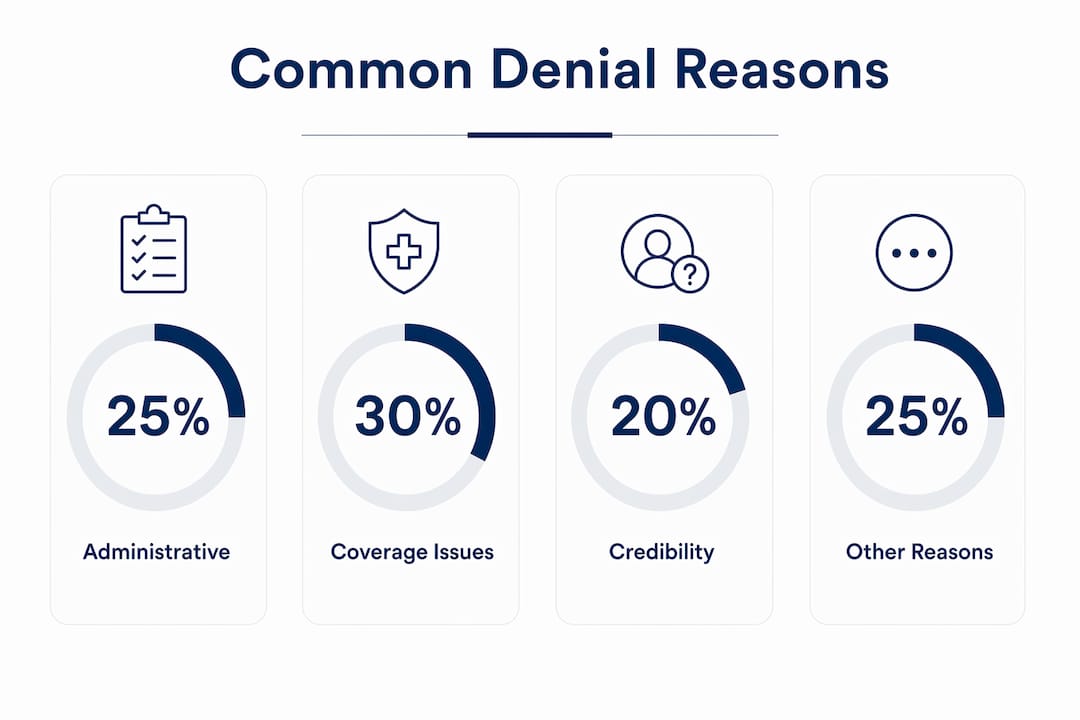
Understanding which denial category applies to your situation is the fastest way to choose the right response. Insurance claim denial reasons break into three broad groups: administrative, substantive, and credibility-based.

Administrative errors
These are often the easiest denials to fix. Common causes include:
- Missing or incorrect paperwork — a claim submitted without required forms, or with the wrong policy number, is often auto-rejected before a human reviews it
- Wrong billing or procedure codes — a provider’s billing office enters an incorrect code; the insurer denies the claim as uncovered, even though the underlying service is covered
- Untimely filing — most policies require claims to be filed within a specific window after the injury; late reporting is a frequent cause of initial denials, especially after car accidents
- Claim sent to the wrong insurer — a simple routing error that a single phone call can often resolve
Example: A claimant’s physical therapy claim is denied because the provider billed under a code for a non-covered service. The billing office corrects the code and resubmits; the claim is paid.
Coverage and substantive disputes
These require more work to counter:
- Lack of medical necessity — the insurer applies internal utilization criteria (such as InterQual or Milliman guidelines) and concludes the treatment was not medically required
- Pre-existing condition arguments — the insurer attributes your injury or condition to a problem that predated the incident, reducing or eliminating its liability
- Causation and liability disputes — the insurer argues that the accident did not cause your injury, or that their insured was not at fault
- Policy exclusions — the specific type of damage or injury is carved out of coverage (e.g., intentional acts, certain vehicle types, or activities excluded by the policy)
- Policy lapse or no active coverage — premiums were not paid, or the policy had expired at the time of the incident
Example: A claimant seeks coverage for back surgery after a slip-and-fall. The insurer denies on pre-existing condition grounds, citing an MRI from three years prior. A treating physician letter documenting the new acute injury reverses the denial on appeal.
Credibility and consistency issues
Insurers also deny claims when they believe the claimant’s account is inconsistent or exaggerated:
- Gaps in treatment — a significant delay between the injury and first medical visit, or between appointments, is used to argue the injury was not serious
- Recorded statement contradictions — early statements taken by adjusters are compared against later accounts to find inconsistencies
- Social media surveillance — photos or posts that appear to show physical activity inconsistent with claimed injuries
- Witness disputes — conflicting accounts from bystanders or other parties involved in the incident
Example: A claimant posts vacation photos two weeks after a knee injury. The insurer cites the photos as evidence the injury is not as severe as claimed.
How adjusters undervalue or deny claims — and what timeline to expect
Adjusters are trained to minimize payouts. Many denials are the insurer’s opening negotiation position, not a final legal conclusion. Recognizing the tactics makes it easier to respond without panic.
The three core tactics
- Deny — reject the claim outright, often citing a technical or administrative reason, to see if the claimant accepts the outcome without appealing
- Delay — slow the investigation through repeated document requests, extended review periods, and unreturned calls; delay creates financial pressure on injured claimants who need money now
- Defend — dispute liability or medical necessity aggressively, using independent medical examinations (IMEs) and utilization-review tools to build a record supporting a reduced or zero payout
Adjuster tactics such as IMEs and lowball settlement offers are negotiation moves, not final determinations. An IME physician is hired and paid by the insurer; their opinion is not independent in the way the name implies.
Utilization review tools

Insurers frequently apply population-based criteria from tools like InterQual or Milliman to deny medical necessity. These criteria are designed for average patient populations and often do not account for your specific clinical circumstances. A targeted physician letter that addresses the insurer’s stated utilization criteria is frequently the most effective rebuttal on appeal.
What timeline to expect
Most state regulations require insurers to acknowledge a claim within 10–15 days of receipt and issue a coverage decision within 30–45 days, though timelines vary by state and policy type. If you are seeing repeated requests for documents you have already provided, or responses that simply restate the denial without engaging your evidence, that pattern can support a bad-faith claim.
Pro Tip: Log every contact with the insurer in a running document: date, time, name of the person you spoke with, and a one-sentence summary of what was said. Set calendar reminders for every statutory or appeal deadline.
What to do immediately after your injury claim is denied
Speed matters. Appeal windows are strict, and evidence degrades. Here is the sequence to follow.
First 48 hours
- Get the denial letter in writing — if you received a verbal denial, request written confirmation immediately; the insurer must provide written reasons in most states
- Identify the reason code(s) — the denial letter will cite specific grounds; note them precisely, because your appeal must address each one
- Calendar your appeal deadline — internal appeal windows are typically 30–180 days depending on the plan type; ERISA plans often have shorter windows
- Avoid recorded statements — do not agree to a recorded interview with the adjuster; recorded statements are used systematically to create contradictions
First two weeks
- Request the insurer’s complete claim file and all internal notes (you are generally entitled to this)
- Gather all medical records, billing statements, and appointment logs
- Collect photos of the injury scene, your injuries, and any property damage
- Obtain contact information for all witnesses
- Review your policy for the exact appeal procedures and deadlines
First 30–60 days
- Decide whether to file an internal appeal immediately or gather additional evidence first; if the denial is administrative, file quickly; if it is a medical necessity dispute, wait until you have a strong physician letter
- Request a letter of medical necessity from your treating physician
- Consider consulting an attorney, especially if the denial involves substantial medical bills, long-term care, or a liability dispute
Statistic callout: KFF analysis of ACA marketplace plans found that insurers upheld a majority of internal appeals — meaning a meaningful share were reversed in the claimant’s favor. Most policyholders never appeal at all, which means the insurer’s first denial is often the last word by default, not by merit.
Review the common car insurance claim mistakes that can undermine your position before you take any further steps.
How to appeal a denied injury claim: internal, external, ERISA, and bad faith
A denial opens a formal process with multiple escalation points. Understanding each one helps you choose the right path.
Step 1: Internal appeal
File a written appeal directly with the insurer. Your appeal letter should:
- State the claim number, date of service, and denial reason code
- Address each denial reason specifically, with evidence attached
- Include a letter of medical necessity from your treating physician
- Attach medical records, billing statements, imaging results, and any relevant specialist opinions
- Request a decision in writing within the insurer’s stated timeframe
The NAIC consumer guidance recommends being as specific as possible about why your claim should be paid and including as much supporting evidence as you can.
Step 2: External or independent review
If the internal appeal is denied, you generally have the right to request an external review by an Independent Review Organization (IRO). The IRO is not affiliated with your insurer. Under the ACA, you must file the external appeal within four months of the internal appeal decision. The IRO’s decision is typically binding on the insurer.
The Washington State Office of the Insurance Commissioner maintains a searchable database of past IRO decisions, which can help you understand how similar cases have been decided.
ERISA plans: different rules apply
If your coverage comes through an employer-sponsored plan, it is likely governed by the Employee Retirement Income Security Act (ERISA). ERISA changes the rules in important ways:
- You must exhaust all internal administrative appeals before you can sue
- Courts review ERISA denials under an “abuse of discretion” standard in many cases, meaning the insurer’s decision is upheld unless it was arbitrary or unreasonable
- The administrative record you build during the appeal is often the only evidence a court will consider; you cannot introduce new evidence in federal court that was not in the appeal file
- Appeal deadlines under ERISA are strict, often 60–180 days
For a deeper look at how judicial review standards affect ERISA cases, the standard of review in long-term disability cases is a useful reference. If your employer plan denied a disability-related claim, the guidance on CIGNA disability claim appeals covers the ERISA-specific procedural requirements in detail.
Step 3: Bad-faith claims and litigation
A bad-faith claim is available when an insurer fails to conduct a reasonable investigation, denies a claim without a legitimate basis, or violates statutory deadlines. Under California Insurance Code § 790.03, for example, failure to investigate or an unreasonable denial can expose an insurer to bad-faith damages beyond the policy limits. Most states have similar consumer protection statutes.
Decision flow:
| Situation | Next Step |
|---|---|
| Administrative error (wrong code, missing form) | Call insurer; resubmit corrected claim |
| Medical necessity denial | Obtain physician letter; file internal appeal |
| Internal appeal denied | Request external/IRO review |
| ERISA employer plan denial | File internal appeal immediately; consult attorney before deadline |
| Repeated delays or unreasonable denial | File state DOI complaint; consult attorney about bad faith |
| Substantial damages or liability dispute | Consult attorney; consider demand letter or lawsuit |
Documentation that makes an appeal succeed
The strength of your appeal depends almost entirely on the quality of your evidence packet. Insurers apply population-based utilization criteria; your job is to show why your specific clinical situation falls outside the average.
Critical evidence to collect
- Treating physician notes — all visit notes from the date of injury forward, showing the clinical progression of your condition
- Letter of medical necessity — a focused letter from your treating physician (see template below)
- Imaging and test results — X-rays, MRIs, CT scans, and lab results that objectively document the injury
- Billing statements and EOBs — itemized bills and Explanation of Benefits documents showing what was billed, what was paid, and what was denied
- Appointment records — a complete log of every medical visit, including dates and providers
- Employer statement for lost wages — a letter from your employer documenting missed work and lost income
- Photos — injury scene, visible injuries, and any property damage
What a strong letter of medical necessity includes
Your treating physician’s letter is often the single most decisive document in a medical necessity appeal. Ask your physician to include:
- Your diagnosis and the objective clinical findings that support it
- The specific treatment requested and why it is appropriate for your diagnosis
- Alternative treatments considered and why they are insufficient or contraindicated
- The expected prognosis with and without the requested treatment
- A direct response to the insurer’s stated denial reason, citing relevant clinical guidelines
The Washington State OIC recommends asking your doctor for written documentation that explains why you meet the insurer’s medical criteria, and suggests getting additional specialist opinions when needed.
Organizing the appeal packet
- Cover letter: state the claim number, denial reason, and a one-paragraph summary of why the denial should be reversed
- Timeline: a chronological list of events from the date of injury through the denial
- Indexed exhibits: label each document (Exhibit A, B, C…) and reference them in the cover letter
- Persuasive statement: one paragraph linking your evidence directly to each denial reason
Pro Tip: When the insurer relies on a narrow utilization guideline, ask your treating physician to obtain a targeted specialist opinion that addresses that specific guideline by name. A specialist’s rebuttal of a population-based criterion is difficult for an insurer to ignore on appeal.
When to hire an attorney for a denied injury claim
Not every denial requires a lawyer. But certain signals make legal representation clearly worth the cost.
Signals that favor hiring an attorney
- Medical bills exceed what you can reasonably negotiate on your own
- The injury involves long-term care, permanent disability, or lost earning capacity
- The insurer disputes liability or comparative fault
- The denial involves an ERISA employer plan, where the administrative record rules are strict
- The insurer has missed statutory deadlines or shown a pattern of bad-faith conduct
- You have received a lowball settlement offer that does not cover your actual losses
What an attorney does for a denied claim
- Files a strong, evidence-supported internal appeal with a complete administrative record
- Obtains treating-physician letters and specialist opinions targeted to the denial reason
- Deposes witnesses and subpoenas records that you cannot access on your own
- Prepares the external review submission and represents you before the IRO
- Litigates bad-faith claims in state court when the insurer’s conduct warrants it
- Negotiates post-denial settlements from a position of documented strength
For a detailed breakdown of how attorneys build appeals and gather evidence, the guide on attorney help with disability appeals covers the process step by step.
Fee arrangements
Most personal injury and denied-claim attorneys work on a contingency basis, meaning they collect a fee only if you recover. Some ERISA cases involve hourly billing or hybrid arrangements. Ask any attorney you interview to explain the fee structure in writing before you engage them.
Questions to ask when interviewing an attorney
- How many denied injury or disability claims have you appealed, and what were the outcomes?
- Have you handled ERISA denials specifically?
- What is your communication process — how often will you update me?
- What does your engagement letter say about fees and scope of representation?
Pro Tip: Always request a written engagement letter before work begins. It should specify the fee arrangement, the scope of services, and what happens if the case does not resolve in your favor. Verbal agreements about fees create disputes later.
Where to file complaints and find state-level consumer resources
A state Department of Insurance (DOI) complaint is not a substitute for an appeal, but it is a powerful tool when the insurer has violated procedural rules or engaged in bad-faith conduct.
How to file a DOI complaint
- Locate your state’s DOI website (e.g., California DOI or Nevada DOI) and find the consumer complaint portal
- Gather the following before you file: denial letter, timeline of communications, key medical records, and your correspondence log
- Submit the complaint with a clear, factual narrative — avoid emotional language and stick to dates, amounts, and specific regulatory violations
- Keep a copy of the complaint confirmation and note the case number
When a DOI complaint helps
- The insurer missed statutory acknowledgment or decision deadlines
- The denial letter did not provide adequate written reasons
- The insurer failed to conduct a reasonable investigation
- You have documented evidence of repeated delays or bad-faith patterns
A DOI complaint is less likely to produce direct payment in a pure coverage dispute that turns on contract interpretation. Those situations typically require litigation or an external review.
Other consumer resources
- NAIC (National Association of Insurance Commissioners) — naic.org provides consumer guides on the appeals process and links to every state DOI
- State consumer protection offices — most states have a separate consumer protection division that handles deceptive trade practice complaints against insurers
- Mediation and ADR programs — several states offer voluntary mediation between claimants and insurers as an alternative to litigation; check your state DOI website for availability
- External review (IRO) — available after an internal appeal denial; your state DOI can explain the process and timelines for your specific plan type
Key Takeaways
Most injury claim denials are reversible, but only if you act quickly, document everything, and file a targeted appeal with strong physician evidence.
| Point | Details |
|---|---|
| Get the denial in writing | Request written reasons immediately; the insurer must provide them in most U.S. states. |
| Calendar your appeal deadline | Internal appeal windows range from 30 to 180 days; ERISA plans often allow only 60–180 days. |
| Administrative errors are fixable | KFF data shows administrative reasons account for about 25% of reported denial categories; many resolve with a corrected submission. |
| Physician letter is decisive | A focused letter of medical necessity that addresses the insurer’s stated criteria is the most effective appeal document. |
| 2keller can help | 2keller handles denied injury claims across Indiana, Michigan, and New Mexico — free case evaluations available. |
The cost of waiting after a denial
The most common mistake I see after a denial is inaction. Claimants assume the insurer’s letter is the final word, accept the outcome, or wait weeks before doing anything. By then, appeal deadlines have narrowed, witnesses have forgotten details, and the insurer has had time to build a stronger file.
The second most common mistake is giving a recorded statement too early. Adjusters are skilled interviewers. A statement taken three days after an accident, when you are still in pain and uncertain about the full extent of your injuries, will be compared word-for-word against everything you say later. Inconsistencies that seem minor to you become significant in the insurer’s hands.
What actually changes outcomes is early file-building. Claimants who gather their medical records, write a detailed timeline, and obtain a physician letter within the first 30 days are in a fundamentally stronger position than those who wait. A well-organized appeal packet signals to the insurer that you are prepared to escalate, which often produces a settlement offer that would never have appeared after a passive response.
The litigation versus appeal tradeoff is real. Filing suit is sometimes necessary, but a strong internal appeal often produces a better result faster and at lower cost. The administrative record you build during the appeal is also the foundation of any subsequent litigation, so the work is never wasted.
One pattern worth noting: when a claimant obtains a focused specialist letter that directly rebuts the insurer’s utilization criterion by name, the denial is frequently reversed at the internal appeal stage. The insurer’s utilization reviewer applied a population-based standard; the specialist demonstrated why that standard did not apply to this patient’s specific clinical picture. That targeted rebuttal, filed on time with a complete exhibit index, is often enough.
2keller handles denied injury claims in Indiana, Michigan, and New Mexico
A denial letter is not the end of your claim. 2keller represents injured individuals whose claims have been denied, undervalued, or delayed across Indiana, Michigan, and New Mexico. The firm handles the full range of post-denial work: internal appeals with complete evidence packets, ERISA employer-plan disputes, bad-faith claims against insurers who have violated statutory obligations, and litigation when the insurer refuses to act in good faith.

A free case evaluation with 2keller starts with your denial letter and timeline. From there, the team identifies which denial category applies, what evidence is missing, and whether the insurer’s conduct rises to the level of bad faith. If 2keller takes your case, you will know exactly what the next steps are and what to expect at each stage. Before you call or submit a form, gather your denial letter, your appeal deadline, and any medical records you have on hand. That preparation makes the first conversation more productive and gets your case moving faster.
If you are looking for alternatives to other firms handling New Mexico injury claims, the 2keller alternatives page outlines what sets the firm apart. You can also review the firm’s legal awards and recognitions for additional context on its track record.
Useful sources
The data and guidance in this article draw from the following primary sources.
Key denial-reason data (KFF, ACA marketplace plans, 2024):
| Denial reason category | Share of reported denials |
|---|---|
| Administrative reasons | 25% |
| Other / unspecified | 36% |
| Prior authorization / referral | 9% |
| Medical necessity | 5% |
| Exclusions and other coverage | Remainder |
Source: KFF, Claims Denials and Appeals in ACA Marketplace Plans in 2024
Primary sources cited in this article:
- KFF — Claims Denials and Appeals in ACA Marketplace Plans in 2024
- NAIC — Health Insurance Claim Denied? How to Appeal
- Washington State Office of the Insurance Commissioner — Common reasons for denial and appeal letter examples
- California Department of Insurance
- Nevada Division of Insurance
- California Insurance Code § 790.03 — Bad faith statutory basis
- healthinsurance.org — Why was your health insurance claim denied?
This article is general information, not legal advice. Appeal deadlines, statutory rules, and coverage obligations vary by state and plan type. Confirm the current rules with your state Department of Insurance or a qualified attorney before making decisions about your specific claim.