
When you’re dealing with the aftermath of an accident, knowing the difference between a first-party and third-party insurance claim determines who you contact, how fast you get paid, and what rights you have throughout the process.
A first-party claim means you file directly with your own insurance company to cover your own losses. Your car is damaged, your home is burglarized, or you’re injured in a crash — you call your insurer, and your policy pays you based on its terms. The relationship is contractual: you paid premiums, and your insurer owes you coverage.
A third-party claim means you file against someone else’s insurance company because you believe that person caused your injuries or property damage. You are the outsider in that contract. The insurer’s primary duty runs to their own policyholder, not to you.
Here’s a quick breakdown of the core distinctions:
- Who files: In a first-party claim, the policyholder files. In a third-party claim, the injured person files against the at-fault party’s insurer.
- Who pays: First-party insurance pays the policyholder directly, while third-party liability insurance pays the victim harmed by the policyholder’s negligence.
- Fault requirement: First-party claims generally don’t require proving fault. Third-party claims do.
- Relationship to insurer: First-party claims are contractual disputes. Third-party claims are adversarial disputes about liability.
- Speed: First-party claims typically resolve faster because no fault determination is needed.
Common examples of first-party and third-party claims
Understanding these claim types becomes much clearer through real scenarios. The same accident can trigger both types depending on your role.
First-party claim examples:
- You hit a guardrail on an icy road. You file a collision claim with your own auto insurer.
- A storm tears shingles off your roof. You file a homeowners claim with your own property insurer.
- You’re injured in a crash and use your own personal injury protection (PIP) or medical payments coverage to pay hospital bills.
- Your car is stolen from your driveway. You file a comprehensive claim with your own insurer.
- You’re in a hit-and-run and activate your uninsured motorist coverage through your own policy.
Third-party claim examples:
- Another driver runs a red light and hits your car. You file a third-party liability claim against their auto insurer for vehicle repairs and medical expenses.
- A contractor damages your fence while working on a neighbor’s property. You file against the contractor’s general liability policy.
- You slip and fall in a grocery store due to a wet floor with no warning sign. You file against the store’s premises liability coverage.
- A delivery driver rear-ends your vehicle. You file against their employer’s commercial auto policy.
Pro Tip: Even when another driver is clearly at fault, notify your own insurer immediately. If the at-fault driver’s coverage turns out to be insufficient, your own policy may provide underinsured motorist protection to fill the gap.
Key differences between first-party and third-party claims
The distinction between these two claim types goes deeper than just who you call. The entire dynamic of the claim changes depending on which type you’re filing.
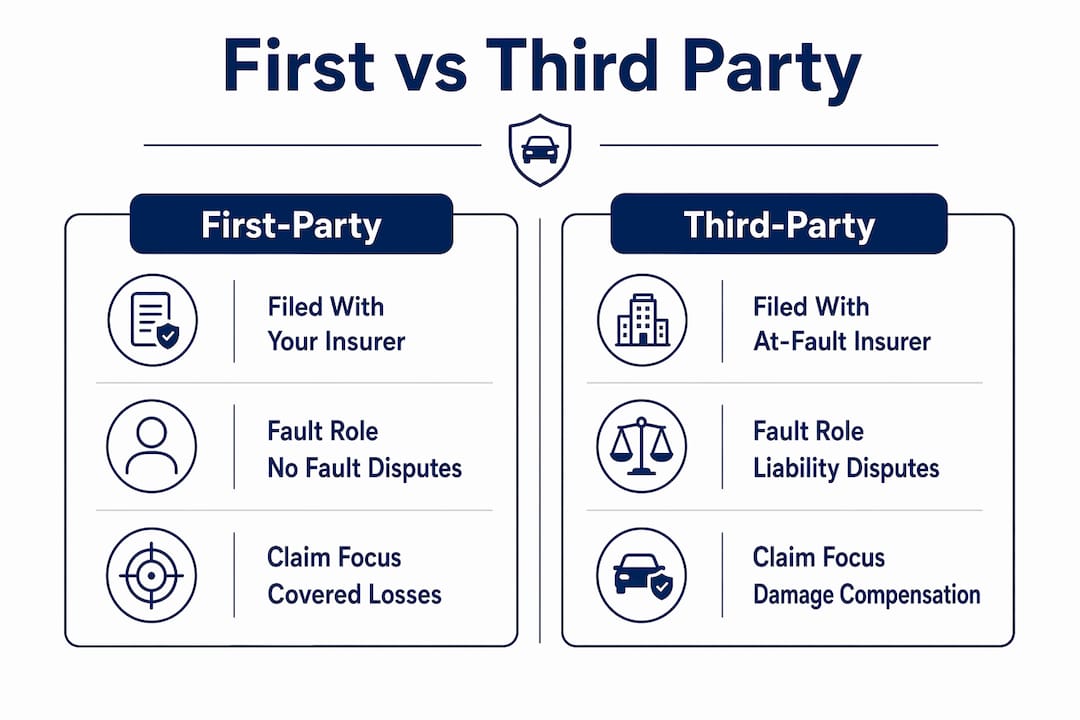
Fault and liability: First-party claims are largely free of fault disputes. You report a covered loss, your adjuster verifies it against your policy, and you get paid. Third-party claims require you to prove the other party was negligent, which means gathering evidence, witness statements, and sometimes accident reconstruction reports. That burden sits entirely on you as the claimant.

Insurer duties: In a first-party claim, your insurer’s duty is to indemnify you for covered losses. In a third-party claim, the insurer’s duty is to defend their own policyholder against negligence allegations. That defense obligation can actually cost more than the settlement itself, which is why third-party insurers often scrutinize claims aggressively before paying.
Coverage limits and gaps: Third-party claims are capped by the at-fault party’s policy limits, which you have no control over. If the at-fault driver carries only state-minimum liability coverage and your damages exceed that amount, you may need to pursue a separate underinsured motorist claim through your own policy for full recovery.
Dispute risk: Because the third-party insurer’s duty runs to their policyholder, not to you, they have less incentive to settle quickly or generously. Denied claims and low settlement offers are more common in third-party situations than in first-party ones.
Pro Tip: Always file with your own insurer after a serious accident, even when you plan to pursue a third-party claim. Your insurer can help manage the process and step in if the other party’s coverage falls short.
How to determine which type of claim to file after an accident
The right claim type depends on who caused the loss and what coverage is available. Most situations point clearly in one direction, but some require filing both simultaneously.
Ask yourself these questions:
- Did I cause the damage to my own property? File a first-party claim.
- Did someone else cause my injuries or property damage? File a third-party claim against their insurer.
- Is fault disputed or unclear? File with your own insurer first to protect your timeline, then pursue the third-party claim as evidence develops.
- Does the at-fault party have inadequate coverage? Activate your own underinsured motorist coverage alongside the third-party claim.
Steps to take immediately after an accident:
- Seek medical attention and document all injuries. Thorough injury documentation after a crash strengthens both claim types.
- Gather evidence at the scene: photos, videos, witness contact information, and the other party’s insurance details.
- Notify your own insurer promptly, even if you intend to file a third-party claim.
- Contact the at-fault party’s insurer to open a third-party claim and obtain a claim number.
- Review your own policy carefully for PIP, medical payments, collision, and underinsured motorist coverage.
- Consult a personal injury attorney if liability is disputed or damages are significant.
Filing both claims simultaneously is sometimes the right move. If you need your car repaired quickly, your own collision coverage can pay immediately while the third-party liability investigation proceeds. If the at-fault driver is later confirmed responsible, your insurer may pursue their own reimbursement through a process called subrogation.
What to expect during the claims process and how long it takes
The procedural path for each claim type differs in complexity, and that gap directly affects how long you wait for compensation.

First-party claims follow a relatively direct path. You report the loss, your insurer assigns an adjuster, the adjuster evaluates the damage against your policy terms, and a settlement offer follows. Because there’s no need to establish fault, the process moves faster. Delays typically stem from documentation gaps, disputed valuations, or high claim volume after major weather events.
Third-party claims involve more steps and more parties. The at-fault party’s insurer must investigate the accident, review all evidence, assess their policyholder’s liability, and then negotiate a settlement. That investigation can include recorded statements, independent medical examinations, and accident reconstruction. Third-party claims require liability investigation, evidence gathering, and negotiation, making them considerably more time-consuming than first-party claims.
Common reasons third-party claims stall:
- The at-fault insurer disputes liability entirely.
- Medical treatment is ongoing and the full extent of injuries is not yet known.
- Policy limits are insufficient and supplementary claims are needed.
- The claimant and insurer disagree on the value of pain and suffering damages.
Practical advice for managing the process:
- Keep a written log of every call, email, and letter with the insurance company.
- Don’t accept a settlement offer before your medical treatment is complete.
- If a third-party insurer denies fault or offers far less than your documented losses, civil litigation may be necessary to recover full compensation.
- Avoid common insurance claim mistakes like giving recorded statements without legal guidance or delaying medical care.
Legal insights on first-party and third-party claims in the United States
The legal framework governing these claims varies by state, and those differences can significantly affect your outcome.
Contractual vs. adversarial nature: First-party claims are contract disputes. Your insurer agreed to specific terms, and if they breach those terms by wrongfully denying or undervaluing your claim, you may have grounds for a bad faith lawsuit. Third-party claims are adversarial by nature — you are attempting to hold a stranger’s insurer accountable for their policyholder’s negligence, without any direct contractual relationship.
State-specific coverage requirements: Every U.S. state sets minimum liability coverage requirements, but those minimums vary widely. Some states require personal injury protection (PIP) as mandatory first-party coverage, while others operate under traditional fault-based systems. Understanding your state’s rules determines which coverages are available to you and in what order you should pursue them.
Bad faith claims: Most states allow policyholders to bring bad faith claims against their own insurer for unreasonable delays, wrongful denials, or failure to conduct a proper investigation. Some states extend bad faith protections to third-party claimants as well, though this is less common. Consulting an attorney is the most reliable way to understand what remedies apply in your state.
When coverage runs out: If the at-fault party’s policy limits are exhausted and your damages exceed those limits, your options include filing a civil lawsuit against the at-fault driver personally or activating your own underinsured motorist coverage. The settlement negotiation process for personal injury claims becomes particularly complex at this stage, and legal representation often makes a measurable difference in outcomes.
At 2keller, our attorneys handle personal injury claims across Indiana, Michigan, and New Mexico, and we regularly see clients who didn’t realize they had underinsured motorist coverage available or who accepted a third-party settlement before understanding the full scope of their injuries. Knowing which type of claim applies to your situation is the first step. Knowing your rights within that process is what protects your recovery.
Key Takeaways
A first-party claim goes to your own insurer for your own losses; a third-party claim goes to the at-fault party’s insurer and requires proving negligence, making it more complex and typically slower to resolve.
| Point | Details |
|---|---|
| Who you file with | First-party claims go to your own insurer; third-party claims go to the at-fault party’s insurer. |
| Fault requirement | First-party claims don’t require proving fault; third-party claims do. |
| Insurer’s duty | Your insurer must indemnify you; the third-party insurer’s duty runs to their own policyholder, not to you. |
| Coverage limits | Third-party payouts are capped by the at-fault party’s policy limits, which you cannot control. |
| Filing both claims | You can file both simultaneously when fault is disputed or the at-fault party’s coverage is insufficient. |
Recommended
- Difference Between an Indiana Insurance Claim and a Lawsuit – Knowing the Differences in Cases in Indianapolis – Keller & Keller
- Factors That Play a Role in Your Indiana Car Accident Claim – Keller & Keller
- Indiana Pre-Existing Injuries and Car Accident Claims – Keller & Keller
- Slip and Fall Frequently Asked Questions (FAQ), Part Two – Keller & Keller