
A case evaluation in a personal injury claim is a professional legal assessment of whether your claim has merit and what it may be worth. Most personal injury attorneys offer this as a free, no-obligation consultation because they work on a contingency fee basis, meaning they only get paid if you recover compensation. Think of it as a diagnostic review: an attorney examines the facts of your accident, your injuries, and the available evidence to give you an honest picture of your legal options.
What a case evaluation covers:
- Whether you have a legally viable claim under applicable state law
- A realistic estimate of potential compensation, expressed as a range
- Identification of key deadlines, including statute of limitations issues
- Guidance on next steps to protect your claim right now
- An explanation of how the attorney gets paid and what representation involves
What documents do you need for a thorough case evaluation?
The quality of your case evaluation depends directly on the evidence you bring. Organized documentation such as medical records, police reports, and scene photographs enables attorneys to conduct a more accurate and productive injury claim assessment. Without these, an attorney can only offer a general impression rather than a grounded estimate.
Bring as much of the following as you have available:
- Medical records and bills: Emergency room reports, treatment notes, imaging results, and projected future care costs
- Police or incident report: Establishes the official account of how the accident occurred
- Photographs and video: Scene photos, vehicle damage, and visible injuries taken close to the time of the accident
- Witness information: Names and contact details of anyone who saw what happened
- Insurance correspondence: Any communications from adjusters or offers already received
- Employment records: Pay stubs or employer letters documenting lost wages
You do not need every document to start the process, but the more complete your file, the more specific and reliable the attorney’s assessment will be.
How are injury claims valued during a case evaluation?
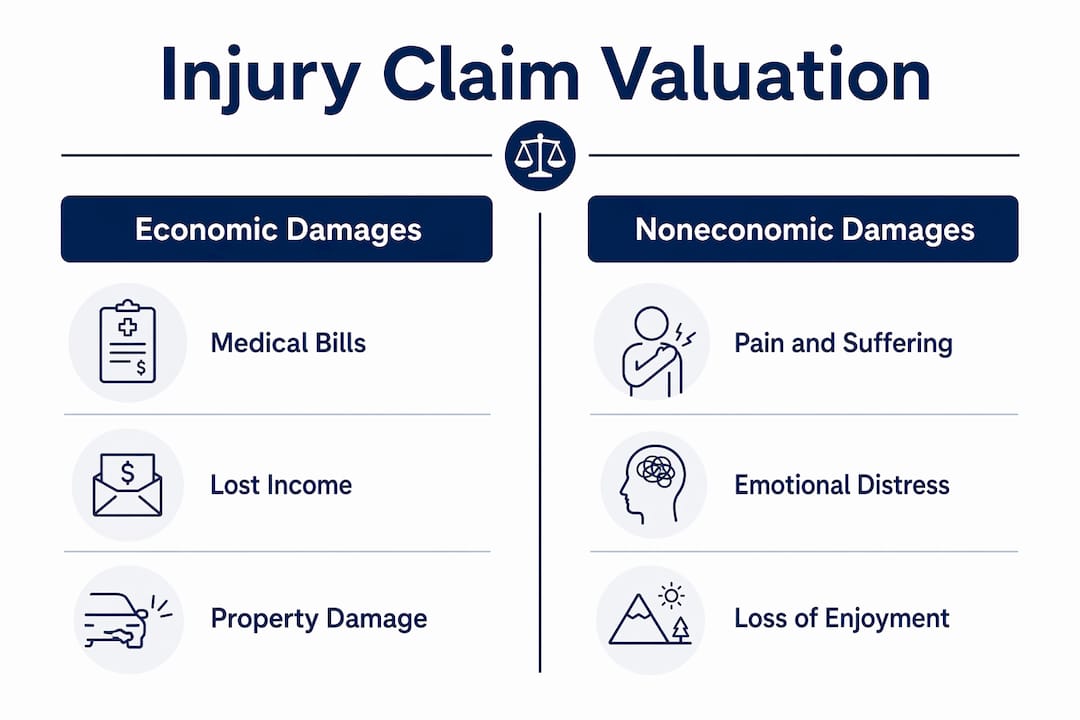
Injury claim valuation covers two distinct categories of damages. Economic damages are the concrete financial losses: medical expenses, lost wages, future treatment costs, and out-of-pocket costs like transportation to appointments. Noneconomic damages cover pain and suffering, emotional distress, disability, and loss of enjoyment of life. These are harder to quantify, which is where valuation methods come in.
Two approaches are widely used for noneconomic damages. The multiplier method takes your total medical expenses and multiplies them by a factor, typically between 1.5 and 5 for moderate injuries, and up to 10 or more for catastrophic cases. The per diem method assigns a daily dollar value to your pain and suffering for each day of recovery. Neither formula produces a fixed answer; both serve as starting points for negotiation.
Insurance adjusters and plaintiff attorneys use similar methodologies but frequently disagree on treatment necessity, recovery timelines, and pain severity. This disagreement creates what practitioners call a “valuation gap,” and it is the primary driver of settlement negotiations after an evaluation.
Pro Tip: If an attorney promises you a specific dollar amount during a free case evaluation, treat that as a warning sign. Ethical attorneys provide realistic value ranges based on comparable cases and legal risk, not guarantees.
What can a case evaluation actually do for your claim?
A case evaluation is a diagnostic tool, not a binding verdict. The evaluator’s opinion is advisory and carries no legal force on its own. You retain full control over whether to settle, continue negotiating, or take your case to trial regardless of what the evaluation concludes.
Two types of evaluation often get confused. The initial free consultation you have with an attorney before hiring anyone is an informal case review focused on viability and value. A formal early case evaluation, sometimes court-ordered during active litigation, is a structured process where a neutral evaluator reviews written summaries and presentations from both sides, then delivers a confidential opinion on likely trial outcomes. The latter typically concludes within a single day and is designed to encourage settlement without going to trial.
Key things a case evaluation influences but does not determine:
- The strength of your opening settlement demand
- Whether your attorney recommends accepting an early offer or waiting
- The litigation strategy if the case proceeds to discovery or trial
- Your realistic understanding of time and cost involved
Early case assessment allows counsel and clients to evaluate litigation risks, available resources, and potential outcomes at multiple stages of a claim, not just at the start.
How 2keller approaches injury claim evaluations
At 2keller, our attorneys handle personal injury claims across Indiana, Michigan, and New Mexico, and we bring state-specific knowledge to every evaluation. Claim values vary by jurisdiction because comparative negligence rules, damage caps, and local jury tendencies all affect what a case is realistically worth in your state.
Our approach to injury claim valuation focuses on building a complete picture of your damages before any number is discussed with an insurer. That means reviewing your medical documentation carefully, understanding the full scope of your future care needs, and assessing liability strength honestly. A thorough evaluation at the outset shapes every negotiation that follows.
We also guide clients through the difference between what an insurer initially offers and what a claim is genuinely worth. Adjusters routinely open below the low end of a reasonable settlement range to create negotiating room. Knowing that going in changes how you respond.
How to prepare for a case evaluation meeting
Preparation takes less than an hour and meaningfully improves the quality of advice you receive. Gather your documents in advance: medical records, the accident report, photos, and any insurance correspondence. Write a brief timeline of events from the accident through your current medical status so you can explain what happened clearly and in order.
Come ready to answer questions about your treatment history, whether you have missed work, and how the injury has affected your daily life. Be honest about any pre-existing conditions; your attorney needs the full picture to give you an accurate assessment. Bring a list of questions you want answered, including how long the process typically takes and what the attorney’s fee structure looks like.

How case evaluation differs from settlement negotiation
A case evaluation and a settlement negotiation are separate stages with different purposes. The evaluation is a private assessment of your claim’s strength and value, conducted before or during representation. Settlement negotiation is the active back-and-forth with the insurance company aimed at reaching a financial agreement.
The evaluation informs the negotiation strategy but does not replace it. An attorney uses the evaluation findings to set a defensible demand, anticipate the insurer’s counterarguments, and decide when an offer is genuinely fair versus when to push back. Settlement can happen at any point after a claim is filed, but the evaluation is what gives your attorney the foundation to negotiate from a position of knowledge rather than guesswork.
What role do insurance companies play in the evaluation process?
Insurance companies conduct their own internal claim evaluations, often using damage calculation software to arrive at a settlement range before you ever speak with an adjuster. The most widely used program historically has been Colossus, designed for lower-value car accident claims and used by many major insurers. Adjusters typically open negotiations at or below the low end of that software-generated range.
This means the insurer already has a number in mind when they contact you. Their evaluation weighs the same factors your attorney does: liability strength, injury severity, treatment consistency, and comparative negligence. The difference is perspective. An insurer’s evaluation is designed to minimize payout; your attorney’s evaluation is designed to maximize your recovery. Understanding that dynamic is one of the most practical reasons to have your own legal assessment before responding to any offer.
Key Takeaways
A thorough injury claim case evaluation, backed by complete documentation and honest legal analysis, is the single most effective way to understand what your claim is worth before negotiating with an insurer.
| Point | Details |
|---|---|
| Evaluation is advisory, not binding | The attorney’s opinion guides strategy but does not lock you into any outcome. |
| Documentation drives accuracy | Medical records, police reports, and photos produce a more reliable value estimate. |
| Two valuation methods apply | Multiplier and per diem approaches both serve as starting points, not final figures. |
| Insurers start below their own range | Adjusters open at or below their software-calculated low end to create negotiating room. |
| Evaluation and negotiation are distinct | The evaluation informs your demand; negotiation is the separate process of reaching agreement. |