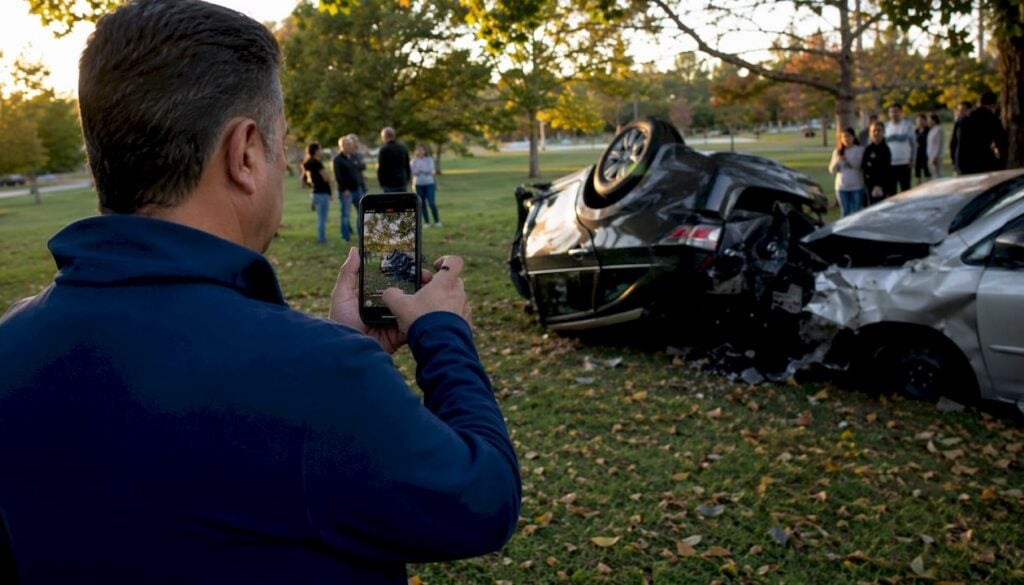
The evidence you collect in the first hours after a crash often determines whether your insurance or legal claim succeeds or fails. Your car accident evidence checklist should cover five core categories: scene photographs and video, contact and insurance information from all parties, a police report, medical documentation, and a written record of all communications. Miss any one of these, and the other side’s insurer will find the gap.
Here is what you need to gather, organized by phase:
At the scene (immediate):
- Photographs and video of all vehicles, damage, skid marks, debris, road signs, and weather conditions
- Names, addresses, phone numbers, driver’s license numbers, and insurance policy numbers from every driver
- License plate numbers and vehicle identification numbers (VINs) for all vehicles involved
- Contact information for every witness present
- The responding officer’s name, badge number, and incident report number
- A voice memo or written note describing how the crash happened, in your own words
Follow-up (within 24–72 hours and beyond):
- A copy of the official police report
- Photographs of visible injuries (bruises, lacerations, seatbelt marks)
- All medical records, bills, imaging results, and treatment notes
- A daily symptom journal tracking pain levels, sleep disruption, and functional limitations
- Receipts for every out-of-pocket expense tied to the accident
- A log of every conversation with your insurance company, including dates, times, and the name of each representative
The window for preserving transient evidence, including traffic camera footage, skid marks, and roadway debris, is 24 to 72 hours after the crash. Acting within that window is not optional if you want a strong claim.
Table of Contents
- What should you do right at the accident scene?
- How do you collect information from everyone involved?
- How should you photograph and video the accident scene?
- Why does the police report matter, and how do you get it?
- How do you document injuries and protect your medical records?
- How should you communicate with your insurance company?
- What does the research say about evidence timing and credibility?
- Which smartphone apps and tools help you collect evidence?
- What should you bring to a legal consultation after an accident?
- Key Takeaways
What should you do right at the accident scene?
Your first obligation at any crash site is safety. Move your vehicle out of active traffic if you can do so without worsening injuries, then call 911. Even if the collision looks minor, a police response creates an official record that insurers and courts rely on. Attempting to handle everything informally, without law enforcement, often backfires when the other driver’s account later contradicts yours.
Once you are in a safe location, begin systematic scene documentation before anything moves. Vehicles get pushed to the shoulder, debris gets swept away, and skid marks fade. The sequence matters: capture the broad context first, then work inward to the details.
Immediate scene actions:
- Call 911 and request police and emergency medical services if anyone is injured
- Turn on hazard lights and, if available, place road flares or warning triangles
- Check on all occupants of every vehicle without moving anyone who may have a spinal injury
- Begin photographing and filming before vehicles are moved, if it is safe to do so
- Note the exact time, date, and location, including the nearest cross street or landmark
- Record weather conditions, road surface, and lighting at the moment of impact
- Avoid discussing fault with the other driver; stick to exchanging required information
Pro Tip: Start with wide-angle shots that show the full scene, including both vehicles, their positions relative to each other, and surrounding road features. Then move to close-ups of specific damage, skid marks, and debris. This sequence, wide context first and then detail, preserves the spatial relationship that investigators and adjusters need to reconstruct what happened.
Documenting the environment is just as important as photographing the vehicles. Note whether traffic signals were functioning, whether sight lines were obstructed by parked cars or vegetation, and whether road conditions were wet, icy, or under construction. These details can shift liability significantly, and they disappear fast.
How do you collect information from everyone involved?
Gathering complete, verified information from every driver, passenger, and witness at the scene is one of the most consequential steps you can take. Incomplete contact details mean you may lose access to a key witness or find yourself unable to reach the other driver’s insurer when you need to file.
Ask to see each driver’s license and vehicle registration rather than relying on what someone tells you verbally. People under stress sometimes give inaccurate information, and verifying on the spot prevents problems later.
Information to collect from each driver:
- Full legal name, home address, and phone number
- Driver’s license number and issuing state
- Insurance company name, policy number, and claims phone number
- Vehicle make, model, year, color, and license plate number
- VIN (usually visible through the windshield on the dashboard)
Information to collect from witnesses:
- Full name, address, and phone number
- A brief description of what they saw, heard, or did, recorded as a voice memo if they consent
- Their availability for follow-up contact
Witness statements carry the most legal weight when they are factual, gathered promptly, and include the witness’s full identity details, including name, address, and occupation. Speculation or opinion weakens a statement; what the witness directly saw or heard is what counts. If a witness leaves before you get a written statement, contact them as soon as possible, because their informal cooperation strengthens your case even before any formal legal process begins.
Do not argue with the other driver or make any statements about fault. Your job at the scene is to collect facts, not to negotiate responsibility.
How should you photograph and video the accident scene?
Thorough visual documentation is the backbone of any accident claim. A well-photographed scene gives adjusters, attorneys, and juries a clear picture of what happened without relying solely on competing accounts from the drivers involved.
Comprehensive photo documentation requires at least 20 images, beginning with wide-angle shots of the entire scene and then progressing to close-ups of specific damage and evidence. This approach preserves the spatial context that close-up photos alone cannot convey.
What to photograph and film:
- Wide-angle views of the full scene showing both vehicles and their positions
- All four sides of every vehicle involved, including underbody damage if visible
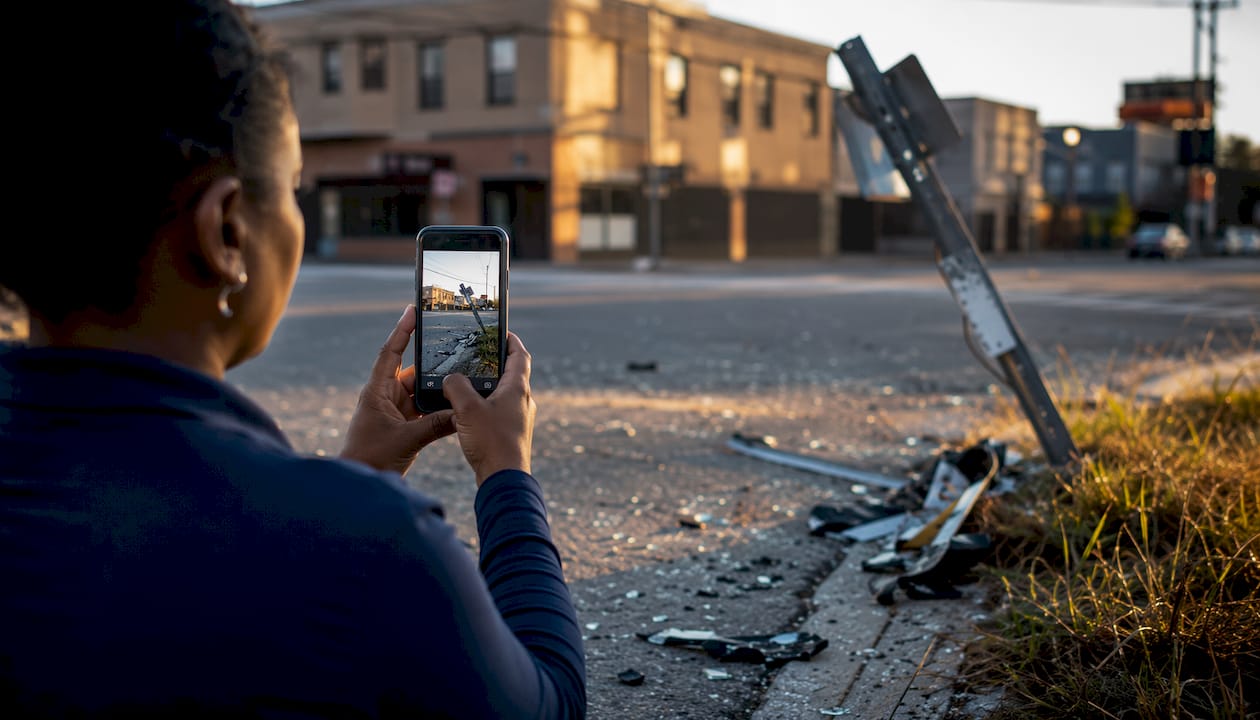
- Close-ups of every point of impact, dents, scratches, and broken glass
- Deployed airbags, which confirm the severity of the collision
- Skid marks, tire tracks, and debris fields, with a reference object for scale
- Traffic signals, stop signs, lane markings, and any obstructions to visibility
- Street signs and intersection layouts
- Weather conditions, including wet pavement, ice, fog, or glare
- License plates and VINs of all vehicles
- Any dashcam footage indicator lights or mounted cameras on other vehicles
- Your own visible injuries, including bruising, cuts, and seatbelt marks
Pro Tip: Use your phone’s timestamp feature or enable location metadata in your camera settings before you shoot. Timestamped photos create an automatic record of when and where each image was taken, which can be critical if the other party later disputes the sequence of events or the scene conditions.
Video walkthroughs add context that still photos cannot. Walk slowly around the entire scene, narrating what you see: vehicle positions, damage, road conditions, and any relevant environmental factors. A 60-second video can communicate the spatial layout of a crash more clearly than a dozen individual photos.
Why does the police report matter, and how do you get it?
A police report is the closest thing to an official, neutral account of what happened at the scene. Insurers use it as a primary reference when assigning liability, and attorneys rely on it to build or defend claims. Without one, your case rests almost entirely on competing driver statements.
Call law enforcement to the scene whenever possible. If officers do not respond, many states allow you to file a self-report directly with the state police or DMV. For example, California requires drivers to report accidents involving injuries or vehicle damage exceeding $750 to the DMV within 10 days, with failure to do so risking license suspension. Requirements vary by state, so check your state’s specific rules promptly.
Steps for securing the police report:
- Record the responding officer’s full name, badge number, and patrol unit
- Ask for the incident or case report number before the officer leaves the scene
- Request a copy of the completed report from the relevant law enforcement agency, typically available within a few days of the incident
- Review the report carefully for factual errors, including incorrect vehicle descriptions, wrong party names, or inaccurate road condition notes
- If you find errors, contact the reporting agency in writing to request a correction or amendment
The police report often includes the officer’s observations about road conditions, damage severity, and any citations issued. That information carries weight precisely because it comes from a neutral third party who was physically present. Insurers are far less likely to dispute a claim that aligns with an official report than one that relies solely on a driver’s account.
How do you document injuries and protect your medical records?
Medical documentation is the financial core of a personal injury claim. Without records that directly link your injuries to the accident, the other party’s insurer has grounds to argue that your condition existed before the crash or resulted from something else entirely.
Seek medical attention immediately after the accident, even if you feel fine. Symptoms from whiplash, concussions, and soft-tissue injuries often appear hours or days after impact. A gap between the crash and your first medical visit gives insurers an opening to dispute causation. Tell every treating provider, from the emergency room physician to your physical therapist, that your injuries resulted from a motor vehicle accident. That context must appear in your records.
Medical records must show a direct link between your injuries and the accident, including the full, unadjusted cost of treatment. Collect and organize every document in this category.
Medical documentation to preserve:
- Emergency room records and discharge summaries
- Diagnostic imaging: X-rays, MRIs, CT scans
- Physician notes from every follow-up visit
- Physical therapy and specialist treatment records
- Prescription records and pharmacy receipts
- Bills for every medical service, including ambulance transport
- Receipts for out-of-pocket costs: over-the-counter medications, medical equipment, travel to appointments
Pro Tip: Start a symptom diary the day of the accident and write in it every day. Record your pain level on a 1–10 scale, which activities you cannot perform, how your sleep is affected, and any emotional changes such as anxiety or depression. A daily symptom log tracking pain, sleep, and functional limitations is a recognized legal tool for substantiating pain and suffering damages beyond what medical bills alone can show.
Photograph visible injuries as soon as possible after the accident and continue photographing them as they evolve. Bruising often deepens and spreads in the days following a crash, and that progression tells a story that a single photo cannot. For guidance on linking injuries to your claim, detailed documentation from day one makes the difference.
How should you communicate with your insurance company?
Notify your insurer as soon as possible after the accident, ideally the same day. Most policies require prompt notification, and delays can complicate or even jeopardize your coverage. When you call, provide factual information: what happened, where, when, and who was involved. Do not speculate about fault, and do not minimize or exaggerate your injuries.
Every conversation with an insurance representative is part of your claim record. Inconsistent statements, even unintentional ones, give adjusters grounds to question your credibility. Prepare before each call by reviewing your notes, and keep a written log of every interaction.
Best practices for insurance communication:
- Report the accident promptly and provide only factual, consistent information
- Prepare a written summary of damages, injuries, lost wages, and expenses before speaking with adjusters
- Avoid giving recorded statements without first consulting an attorney, particularly if your injuries are serious
- Log every call: date, time, representative’s name, and a summary of what was discussed
- Submit all requested forms and documentation by the insurer’s deadlines
- Keep copies of everything you send, including emails and uploaded documents
- Know your policy’s coverage limits, deductibles, and any exclusions that apply to your situation
One of the most common mistakes people make is assuming the other driver’s insurer is working in their interest. That insurer represents the other party, not you. Anything you say to them can be used to reduce your payout. If you are unsure what to say or sign, pause and get legal advice first. Avoiding common post-accident mistakes in your communications with insurers protects the value of your claim.
What does the research say about evidence timing and credibility?
The urgency of evidence collection is not just practical advice. It reflects how quickly physical and digital evidence degrades or disappears after a crash. Traffic camera footage is typically overwritten within 24–72 hours. Skid marks fade with traffic and weather. Witnesses’ memories begin to blur within days, and the details they lose are often the ones that matter most.
Transient evidence such as traffic camera footage, skid marks, and debris can vanish within 24–72 hours of a crash, making early collection the single most time-sensitive task after an accident. This is not a general caution. It is a hard deadline.
Evidence preservation priorities by timeline:
Within 24 hours:
- Photograph the scene, vehicles, and injuries
- Collect all party and witness contact information
- Request traffic or surveillance camera footage from nearby businesses or municipal systems
- Begin your symptom diary
Within 72 hours:
- Obtain the police report number and request a copy
- Follow up with any witnesses who left before giving a statement
- Preserve any dashcam footage from your own vehicle by backing it up immediately
Within the first week:
- Gather all medical records from your initial treatment
- Notify your insurer with a complete, factual account
- Consult an attorney if liability is disputed or injuries are significant
When an attorney is involved early, they can issue a spoliation letter, a formal legal notice that demands the preservation of specific evidence. A spoliation letter from legal counsel prevents the destruction of vital items such as dashcam footage, vehicle repair records, and logbooks, particularly in cases where the injured party cannot gather evidence personally. This tool is especially valuable in commercial vehicle accidents, where trucking companies may otherwise overwrite electronic data quickly.
Witness credibility also depends on timing. Factual, prompt witness statements that include the witness’s name, address, and occupation carry significantly more legal weight than statements gathered weeks later, when memory has faded and details have shifted. If a witness cannot provide a written statement at the scene, contact them within 24 hours while their recollection is still sharp.
Which smartphone apps and tools help you collect evidence?
Your phone is your most accessible evidence collection tool at the scene. Modern smartphones capture high-resolution photos and video, record GPS coordinates, and timestamp every file automatically. Used correctly, a smartphone can document an accident scene as thoroughly as dedicated equipment.
Several apps are designed specifically for post-accident documentation. CARFAX Car Care and State Farm’s Pocket Agent (available to policyholders) include accident reporting features that walk you through information collection step by step. DriveMode and similar apps can help you manage hands-free communication immediately after a crash. For general documentation, the native camera apps on iOS and Android both embed location and timestamp metadata in every photo when location services are enabled.
Practical tools and techniques:
- Enable location metadata in your phone’s camera settings before any trip so every photo is automatically geotagged
- Use your phone’s voice memo app to record a verbal account of the crash immediately while details are fresh
- Back up all photos, videos, and audio files to cloud storage (Google Photos, iCloud, or Dropbox) within hours of the accident to prevent loss if your phone is damaged or seized
- Use a dedicated accident documentation app if your insurer provides one, as these often generate structured reports that match your insurer’s claim format
- If your vehicle has a dashcam, remove the memory card or download the footage immediately. Most dashcams overwrite older footage on a loop, so delay means permanent loss
A few practical cautions: do not use your phone while standing in active traffic lanes, and do not let documentation delay emergency medical care for anyone at the scene. Safety comes first; documentation comes second, but it must come quickly.
What should you bring to a legal consultation after an accident?
Consulting a personal injury attorney after a significant crash is one of the most protective steps you can take, and the quality of that consultation depends almost entirely on what you bring to it. An attorney can only evaluate your claim accurately if they have the full picture.
Most personal injury attorneys offer free initial consultations. Come prepared with organized documentation, and you will get far more useful guidance than if you arrive with a vague account and no records.
Checklist for your legal consultation:
Documentation to bring:
- All photographs and videos from the scene, organized chronologically
- The police report or incident report number
- Contact and insurance information for all parties and witnesses
- All medical records, bills, and treatment notes from every provider
- Your symptom diary, from day one through the consultation date
- Receipts for every out-of-pocket expense related to the accident
- Your insurance policy documents and any correspondence with your insurer
- A written timeline of events: the crash itself, medical visits, insurer contacts, and any communications from the other party
Questions to ask your attorney:
- What is the statute of limitations for my claim in this state?
- Do I have grounds for a personal injury claim beyond my insurance settlement?
- What is my case worth based on the evidence I have?
- Should I accept the insurer’s initial settlement offer?
- What additional evidence should I gather before my claim is filed?
Understanding what qualifies as a serious injury claim under your state’s law can significantly affect your legal options, particularly if your injuries cross a threshold that opens the door to additional damages. An attorney can assess that threshold based on your specific medical documentation.
If you were injured in Indiana, Michigan, or New Mexico, the team at 2keller handles personal injury cases across all three states and can review your evidence at no cost during an initial consultation. Knowing what you have, and what you still need, before you file is the difference between a claim that settles fairly and one that gets disputed at every turn.

The attorneys at 2keller have helped injured drivers in Indiana, Michigan, and New Mexico build strong, well-documented claims. If you are unsure whether your evidence is complete or your injuries qualify for a personal injury claim, contact 2keller for a free consultation.
Key Takeaways
Collecting and preserving the right evidence immediately after a car accident is the single most important factor in determining whether your insurance or legal claim succeeds.
| Point | Details |
|---|---|
| Act within 24–72 hours | Traffic camera footage, skid marks, and debris disappear within this window, making early collection critical. |
| Photograph 20+ images | Start with wide-angle scene shots, then close-ups of damage, skid marks, and injuries, to preserve spatial context. |
| Gather witness details promptly | Factual witness statements with full identity information carry the most legal weight when collected quickly. |
| Document injuries daily | A symptom diary tracking pain, sleep, and functional changes substantiates pain and suffering damages beyond medical bills. |
| Consult an attorney early | Legal counsel can issue a spoliation letter to prevent destruction of dashcam footage, vehicle records, and other key evidence. |