The most important thing to know before your first conversation with an insurance adjuster: their job is to protect the insurance company’s money, not yours. That reality shapes every interaction, every offer, and every deadline they set. You can still reach a fair settlement, but only if you go in prepared, documented, and clear on your rights.
Here is what that preparation looks like in practice.
- Never accept the first settlement offer. It is typically a low opening position designed to test whether you know what your claim is worth.
- Document all damages before the adjuster’s visit with dated photos, videos, and itemized receipts.
- Be present during every inspection and take written notes on what the adjuster examines and what they say.
- Keep records of all communications, including dates, times, and summaries of every phone call.
- Know your policy’s coverage limits and exclusions before any negotiation begins.
- Put agreements in writing. Follow every phone call with an email summary to create a verifiable record.
What does an insurance adjuster actually do?
Insurance adjusters work for the insurance company to evaluate claims and manage costs, not to advocate for you. They investigate damage, verify coverage, and calculate settlement offers based on internal guidelines designed to keep payouts low.
Three types of adjusters operate in the U.S. claims process:
- Staff adjusters are full-time employees of the insurance company.
- Independent adjusters are contractors hired by insurers to handle overflow or specialized claims.
- Public adjusters are the exception. They represent you, the claimant, for a fee typically between 10–15% of the claim payout.
Understanding which type you are dealing with tells you a great deal about their incentives. A staff adjuster’s performance is measured partly by how efficiently they close claims. That efficiency often means starting low. Knowing this, you can approach every offer as a starting point rather than a conclusion.
How to communicate effectively with your adjuster
Preparation before your first substantive contact is what separates claimants who get fair settlements from those who don’t. Gather photos, police reports, repair estimates, and medical records into a single organized file before you pick up the phone.
Maintaining a polite but firm tone throughout every interaction is not just good manners. Hostility can prompt the insurer to involve their own legal counsel, which slows everything down and shifts the dynamic against you. Keep it professional, even when the offer is frustrating.
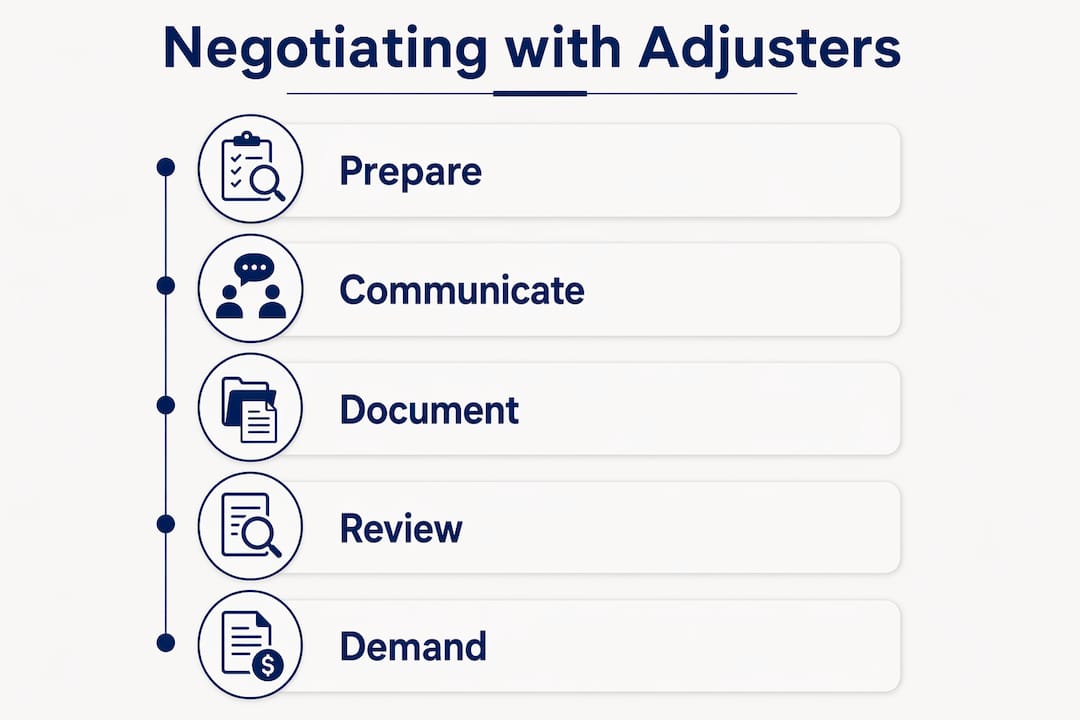
A hybrid communication approach works best: use phone calls to unblock stalled processes quickly, and use email for anything that needs to be on the record. Get the adjuster’s direct contact information and claim number at your first meeting, and attend every inspection in person or send a knowledgeable representative.

Independent insurance agents work for policyholders, not insurers, and can review adjuster reports, interpret policy language, and push back on unfair decisions. They are an underused resource worth contacting early.
Pro Tip: After every phone call with your adjuster, send a brief email summarizing what was discussed and agreed upon. This creates an official, timestamped record that prevents disputes over what was said verbally.
When you are ready to make a formal demand, put it in writing. A demand letter that specifies your claimed amount, itemizes damages, and sets a response deadline creates both leverage and accountability. Set the deadline at roughly 30 days to establish urgency without appearing unreasonable.
What to do if you disagree with the adjuster’s findings
Disagreeing with a settlement offer is normal, and it does not mean the process has failed. It means you are at the negotiation stage.
- Request a written breakdown of how the offer was calculated, including every deduction and the reasoning behind it.
- Submit your counteroffer in writing, not over the phone. Written counteroffers prevent the adjuster from later claiming you agreed to something verbally.
- Back every challenged deduction with documentation. If they undervalued medical expenses, attach the bills they missed.
- Request a reinspection if you believe the adjuster underestimated the scope of damage.
- Ask to speak with the adjuster’s supervisor if the field adjuster lacks authority to move the offer. Supervisors typically have broader settlement discretion.
- Invoke your policy’s appraisal clause if the dispute is about property valuation. Most homeowners and auto policies allow either party to trigger this process, which brings in independent appraisers and, if needed, a neutral umpire.
- Know your state’s complaint process. The Texas Department of Insurance notes that claimants can request a different adjuster if disputes arise. Most state departments of insurance have similar provisions and can be a powerful escalation tool.
- File a complaint with your state’s Department of Insurance if the insurer delays unreasonably or acts in bad faith. United Policyholders, which has more than 30 years of experience in this space, notes that insurers generally respond quickly when a customer complains to a state official.
One caution that many claimants overlook: signing a release form permanently ends your right to seek additional compensation, even if new injuries or hidden damage surface later. Review it carefully before you sign anything.
How personal injury law firms can protect your claim
Personal injury attorneys bring a level of leverage that neither public adjusters nor independent agents can match. They can review adjuster reports and policy language to identify coverage gaps, negotiate directly with insurers, and escalate disputes involving bad faith or outright denial.
- Attorneys interpret complex policy language and identify exclusions or conditions the adjuster may be applying incorrectly.
- They negotiate with a deeper understanding of legal rights, particularly in serious injury claims where the settlement value is genuinely contested.
- Legal counsel can pursue litigation and seek damages beyond the policy’s face value, which public adjusters cannot do.
- Most personal injury attorneys work on a contingency basis, meaning their fee comes from the recovery, not from your pocket upfront. Contingency fees are typically higher than a public adjuster’s percentage, but they open the door to outcomes a public adjuster cannot reach.
Do not wait until negotiations have completely broken down to contact an attorney. If your claim involves serious injuries, a denied coverage decision, or an insurer that is clearly acting in bad faith, involving legal counsel early gives you the strongest possible position. The settlement negotiation process for personal injury claims is something attorneys handle every day, and that experience shows in outcomes.
How to record and document all communications
Documentation is the foundation of every successful insurance claim. Without a written record, verbal promises disappear and timelines become impossible to prove.
Keep a dedicated claim log with the date, time, adjuster’s name, and a summary of every phone call. After each call, send a brief email to the adjuster restating what was discussed. This creates a timestamped record that is difficult to dispute. Save every email, letter, and document you receive from the insurer in a single organized folder, physical or digital.
For formal disputes or escalations, send written complaints to both the adjuster and their supervisor via certified mail. Certified mail gives you proof of delivery and exact dates, which matters if regulators or courts become involved. Most states require insurers to investigate claims within a defined window and provide written explanations for any delays. A thorough paper trail is the only reliable way to prove a missed deadline or a broken promise.
Common traps to avoid when negotiating with an adjuster
Several mistakes consistently cost claimants money, and most of them are avoidable.
Accepting the first offer without review is the most common and costly error. The first offer is a starting position, not a final number. Counteroffers backed by organized evidence frequently result in higher settlements.
Giving a recorded statement without preparation is another trap. If the request comes from the other party’s insurer in a liability claim, you generally have no legal obligation to provide one. Even with your own insurer, review your policy’s cooperation clause before agreeing.
Treating a friendly adjuster as an ally can lead you to share information that weakens your position. Adjusters can be personable and still be working toward a lower payout. Keep every interaction professional and on the record.
Signing a release before fully assessing your damages is irreversible. Most releases include language waiving “known and unknown” claims, which means you give up rights to compensation for problems you have not yet discovered. Review the document carefully, and consult an attorney if the amount is significant or the language is unclear.
Failing to get contractor quotes before accepting a property damage estimate leaves money on the table. Compare the adjuster’s estimate against at least one independent contractor’s assessment before agreeing to any number.
Key Takeaways
Knowing your rights, documenting thoroughly, and communicating in writing are the three factors that most consistently determine whether a claimant reaches a fair settlement.
| Point | Details |
|---|---|
| Never accept the first offer | Initial settlement offers are opening positions; counteroffers backed by evidence regularly produce better outcomes. |
| Document everything in writing | Follow every phone call with an email summary and send formal disputes via certified mail. |
| Know the adjuster’s role | Adjusters work for the insurer, not for you; understanding their incentives shapes how you negotiate. |
| Public adjusters typically charge 10–15% of the claim payout as their fee | Hire one only when they can realistically recover more than their fee beyond the insurer’s initial offer. |
| Involve an attorney early | For serious injuries, denied claims, or bad faith conduct, legal counsel can pursue outcomes beyond what a public adjuster can reach. |
When your claim needs more than negotiation
Some insurance disputes go beyond what any amount of documentation or polite persistence can resolve on your own. If you are dealing with a denied claim, a serious injury, or an insurer that is clearly stalling, the team at 2keller can help. As a multi-state personal injury law firm serving clients in Indiana, Michigan, and New Mexico, we handle insurance disputes every day and know exactly where adjusters cut corners.
If you are unsure whether your situation qualifies as a serious injury claim, that is a good place to start. You can also reach out directly to 2keller for a free case review and find out where you actually stand.
Recommended
- Common Car Insurance Claim Mistakes to Avoid
- Difference Between an Indiana Insurance Claim and a Lawsuit – Knowing the Differences in Cases in Indianapolis – Keller & Keller
- How to Settle a Property Damage Claim With the Insurance Company – Keller & Keller
- 7 Ways Insurance Companies Try To Terminate Your Benefits – Keller & Keller