
If another party caused your traumatic brain injury, you can sue and recover compensation, but do not accept an early settlement before documenting long-term costs and consulting a specialist attorney. That single decision, accepting or refusing an early offer, often determines whether you recover enough to cover a lifetime of care or walk away with a fraction of what you need.
The Brain Injury Association of America warns that settling before reaching a stable medical plateau risks leaving future care costs entirely unpaid. And the CDC’s traumatic brain injury surveillance data confirms that TBI is one of the leading causes of long-term disability in the United States, meaning the lifetime cost projections in these cases are not hypothetical. They are real, they are large, and they must be calculated before you sign anything.
What to do right now:
- Preserve all evidence from the accident scene, including photos, witness contact information, and any physical objects involved.
- Seek a full medical evaluation, including neurology and neuropsychological testing, even if initial imaging looks normal.
- Start a daily symptom log today, recording cognitive lapses, headaches, mood changes, and sleep disruption.
- Contact a specialist brain-injury attorney before speaking further with any insurance adjuster.
On early settlement offers: if an insurer contacts you within days or weeks of your injury, that speed is a signal, not a courtesy. Insurers move fast precisely because your long-term prognosis is still unknown. Refuse or delay any offer until your medical team has assessed your maximum medical improvement and a life-care planner has projected future costs.
Key Takeaways
A traumatic brain injury lawsuit can recover compensation for lifetime care, lost earnings, and pain and suffering, but only if you document thoroughly, avoid early settlements, and act before the statute of limitations closes.
| Point | Details |
|---|---|
| Do not accept early offers | Insurers move fast because your prognosis is unknown; wait until a life-care planner has projected full future costs. |
| Documentation starts on day one | A daily symptom log, caregiver notes, and consistent treatment records are often more valuable than imaging alone. |
| Statute of limitations is strict | Most states allow two to three years, but government defendants may require notice within 60–180 days. |
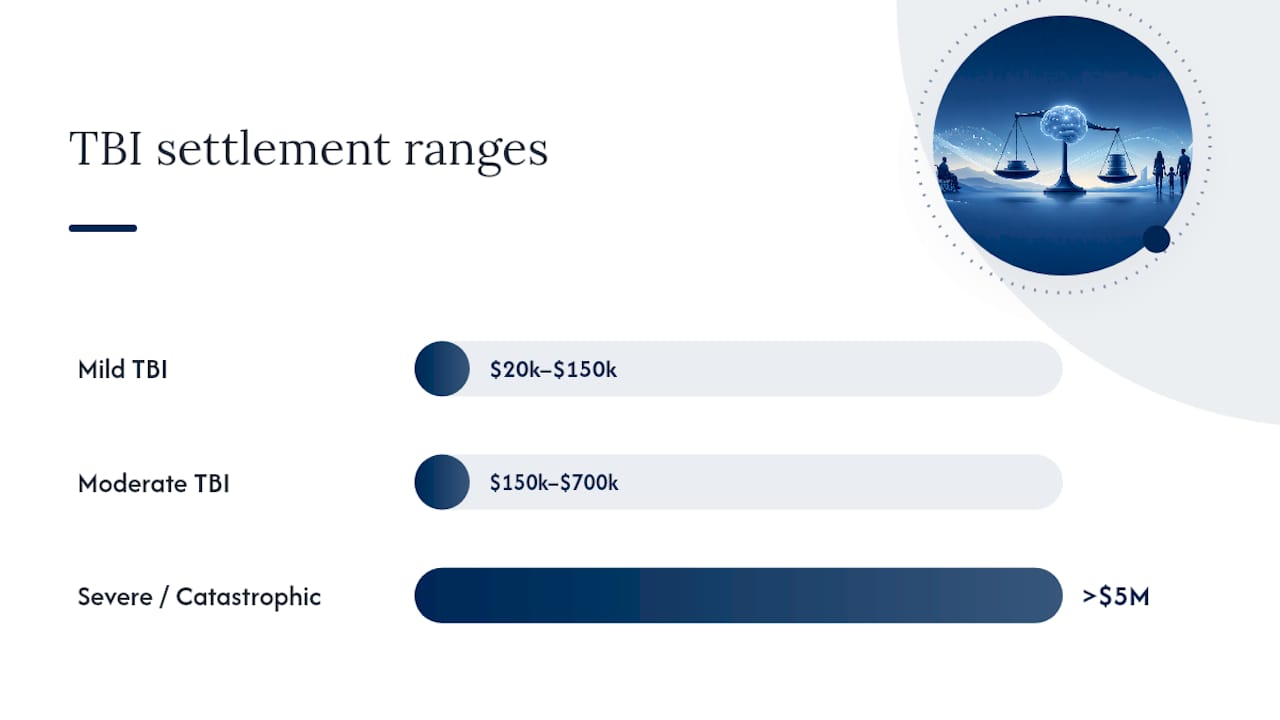
| Severity drives value | Mild TBI claims typically range from $20,000 to $150,000; severe cases can exceed $5 million with strong documentation. |
| 2keller works on contingency | The firm serves Indiana, Michigan, and New Mexico with no fee unless you recover, and advances all case costs. |
Table of Contents
- Why TBI cases are legally different from other injury claims
- When you can file a traumatic brain injury lawsuit
- What drives settlement and verdict value in TBI cases
- Types of compensation you can claim in a TBI lawsuit
- Evidence you need to prove a TBI claim
- How long you have to file and why the deadline matters more than you think
- Should you accept a TBI settlement? How to evaluate any offer
- How a TBI lawsuit actually proceeds, step by step
- When to hire a specialist brain-injury attorney
- Representative verdicts and settlements: what real cases look like
- How to build a durable symptom record that holds up under expert scrutiny
- What I’ve seen clients get wrong, and how to avoid it
- How 2keller handles TBI cases: no fee unless you win
- Sources
Why TBI cases are legally different from other injury claims
A traumatic brain injury is any disruption in normal brain function caused by an external force. That includes concussions (mild TBI), injuries with loss of consciousness lasting minutes to hours (moderate TBI), and severe injuries involving extended unconsciousness, coma, or permanent structural damage.
The legal distinction matters because TBI damages are often invisible, delayed, and lifelong in a way that a broken arm is not. A fracture heals on a predictable schedule. A brain injury can produce cognitive decline, personality changes, and executive-function loss that worsen over years and require continuous, expensive care.
Common causes that produce TBI claims:
- Motor vehicle collisions (cars, trucks, motorcycles)
- Workplace falls and construction-site accidents
- Slip and fall incidents on negligently maintained property
- Surgical errors and anesthesia complications
- Defective helmets, vehicles, or consumer products
- Assaults and criminal violence
Severity tiers and how they shift legal value:
- Mild TBI (concussion): Temporary symptoms, often no visible imaging findings; claims typically range lower but can still be substantial when cognitive impairment persists.
- Moderate TBI: Loss of consciousness, post-traumatic amnesia, measurable cognitive deficits; settlement values rise significantly with documented functional loss.
- Severe TBI: Prolonged unconsciousness, permanent disability, lifetime care needs; these cases routinely reach seven figures when liability is clear.
Courts and insurers treat TBI cases differently because the gap between what imaging shows and what the patient actually experiences can be enormous. Peer-reviewed research confirms that CT and MRI scans are normal in many symptomatic patients, which means the legal record must be built from neuropsychological testing, caregiver observations, and functional assessments rather than radiology reports alone.
When you can file a traumatic brain injury lawsuit
A viable TBI claim rests on four elements of negligence. You must show that another party owed you a duty of care, that they breached it, that the breach directly caused your brain injury, and that you suffered measurable damages as a result. For most people, the hardest element to prove is causation, particularly when symptoms are delayed or imaging is inconclusive.
Common scenarios that produce viable TBI claims:
- A distracted driver rear-ends your vehicle at highway speed, and you develop post-concussion syndrome.
- A property owner fails to repair a wet floor, you fall and strike your head, and you later show cognitive deficits.
- A surgeon operates on the wrong site or fails to manage intracranial pressure, causing permanent brain damage.
- A manufacturer sells a helmet that fails to meet safety standards, and it fractures on impact.
- An employer ignores OSHA fall-protection requirements, and a worker falls from scaffolding.
How comparative fault affects your claim:
Most states use a comparative negligence framework, meaning your compensation can be reduced by your own percentage of fault. In a pure comparative negligence state, you can recover even if you were 90% at fault, though your award is reduced proportionally. In modified comparative negligence states (which include Indiana and Michigan), you are barred from recovery if you are found 51% or more at fault. New Mexico follows a pure comparative negligence rule.
What this means practically:
- Even partial fault does not automatically eliminate your claim.
- Insurers will argue contributory negligence aggressively to reduce payouts.
- A specialist attorney can counter those arguments with accident reconstruction, witness testimony, and medical causation experts.
Justia’s brain injury legal guidance emphasizes that early legal review is critical precisely because comparative fault arguments are built from the same evidence pool as your claim. The sooner you preserve that evidence, the harder it is for the defense to reframe the facts.
What drives settlement and verdict value in TBI cases
Settlement value is not a formula. It is a negotiation anchored by specific, documentable factors. Understanding those factors tells you where to focus your energy before any offer arrives.
Primary drivers of TBI claim value:
- Injury severity and permanence: A mild concussion with full recovery in six weeks carries far less value than a moderate TBI with lasting cognitive deficits. Permanent impairment is the single largest multiplier.
- Lifetime care needs: Projections from a life-care planner covering future neurology visits, cognitive rehabilitation, home modifications, and personal care aides can add hundreds of thousands of dollars to a claim’s floor value.
- Lost earning capacity: A 35-year-old software engineer who can no longer work full-time loses decades of projected income. Economists calculate this figure using pre-injury earnings, career trajectory, and actuarial life tables.
- Strength of liability: Clear, documented negligence (a red-light runner caught on camera) produces higher settlements than disputed-fault scenarios.
- Quality of documentation: Gaps in treatment, inconsistent symptom reporting, and missing records give insurers room to argue the injury is exaggerated or unrelated.
- Policy limits: Even a perfectly documented catastrophic TBI claim cannot exceed the defendant’s insurance coverage without pursuing additional assets or umbrella policies.
Illustrative settlement ranges by severity:
| Severity Level | Typical Range | Key Value Drivers |
|---|---|---|
| Mild TBI (concussion) | a lower range depending on duration of symptoms and recovery factors | Duration of symptoms, return-to-work timeline, neuropsych test results |
| Moderate TBI | a moderate range influenced by cognitive deficits and therapy costs | Cognitive deficits, therapy costs, partial disability, lost wages |
| Severe / Catastrophic TBI | a high range reflecting lifetime care needs and disability | Lifetime care plan, full disability, lost earning capacity, punitive factors |
These ranges come from 2026 settlement guides and reflect how widely outcomes vary based on liability clarity and documentation strength. A severe TBI with a disputed-liability defendant and poor medical records may settle near the bottom of that range. The same injury with clear negligence, a life-care plan, and consistent neuropsychological documentation can push well past the top.
Inpatient acute rehabilitation costs alone are a major driver of lifetime cost projections, and life-care planners typically model these expenses across the claimant’s full actuarial life expectancy.
Types of compensation you can claim in a TBI lawsuit
TBI compensation falls into three broad categories. Knowing them helps you track what to document from day one.
Economic damages (calculable financial losses):
- Past and future medical bills: emergency care, hospitalization, surgery, neurology, neuropsychology, physical and occupational therapy, speech therapy, medications
- Future care costs: in-home aides, assisted living, cognitive rehabilitation programs, durable medical equipment
- Lost wages from the date of injury through recovery
- Lost earning capacity if the injury permanently reduces your ability to work
- Vocational retraining costs if you can work in a different capacity but need new skills
- Home modifications: wheelchair ramps, grab bars, widened doorways, specialized equipment
Non-economic damages (harder to quantify, often larger in severe cases):
- Pain and suffering, both physical and psychological
- Loss of enjoyment of life (activities, hobbies, relationships you can no longer participate in)
- Emotional distress and anxiety
- Loss of consortium (the impact on your spouse or partner’s relationship with you)
- Personality changes and loss of identity, which peer-reviewed research identifies as among the most disabling and least-visible consequences of TBI
Special categories:
Punitive damages are available in cases involving egregious or intentional conduct, such as a drunk driver with prior DUI convictions or a manufacturer who concealed a known safety defect. They are not available in every case and require a higher evidentiary threshold.
Structured settlements pay compensation over time rather than in a lump sum. They offer tax advantages on future payments and can protect against creditor claims, but they also lock in a payment schedule that may not keep pace with inflation or unexpected care costs. A lump sum gives you immediate control and flexibility but requires careful financial management. The right structure depends on the claimant’s age, care needs, and financial situation.
Evidence you need to prove a TBI claim
The quality of your evidence determines whether your attorney can negotiate from strength or has to accept a low offer. Start building your record immediately.

Medical evidence checklist:
| Evidence Type | What to Collect | Why It Matters |
|---|---|---|
| Emergency and hospital records | ER notes, admission records, discharge summaries | Establish injury date, initial severity, and treatment course |
| Imaging studies | CT scans, MRI reports, any follow-up imaging | Document structural damage; note when imaging is normal (see functional testing) |
| Neurology consults | Specialist notes, diagnosis, treatment plans | Confirm TBI diagnosis and ongoing impairment |
| Neuropsychological testing | Full battery results, baseline and follow-up | Quantify cognitive deficits that imaging may miss |
| Therapy records | Physical, occupational, speech, cognitive therapy notes | Show functional limitations and treatment continuity |
| Psychiatric or psychological records | Depression, PTSD, anxiety diagnoses and treatment | Support non-economic damages claims |
Non-medical evidence checklist:
| Evidence Type | What to Collect | Why It Matters |
|---|---|---|
| Accident scene documentation | Photos, video, police or incident reports | Establish liability and mechanism of injury |
| Witness information | Names, contact details, written statements | Corroborate your account of the accident |
| Employer records | Pay stubs, HR absence records, performance reviews | Quantify lost wages and capacity changes |
| Caregiver statements | Written accounts of daily assistance provided | Document functional limitations not captured in medical records |
| Daily symptom log | Your own entries: symptoms, medications, cognitive lapses | Contemporaneous record that experts and juries find credible |
| Financial records | Bills, receipts, insurance EOBs, out-of-pocket costs | Build the economic damages calculation |
Pro Tip: Never let a gap in treatment appear in your medical record without a documented reason. Insurers treat missed appointments as evidence that symptoms resolved. If cost, transportation, or a bad day keeps you from an appointment, note it in your symptom log and tell your attorney immediately.
Clinical literature confirms that CT and MRI are normal in many symptomatic TBI patients. That makes your non-imaging record, including neuropsychological testing, caregiver logs, and therapy notes, the foundation of your case rather than a supplement to it.
How long you have to file and why the deadline matters more than you think
Every state sets a statute of limitations on personal injury claims. Miss it by a single day and even a strong, well-documented TBI case is permanently barred. Justia’s brain injury guidance is direct on this point: filing promptly preserves both your legal rights and time-sensitive evidence like witness memory and surveillance footage.
Default patterns and the discovery rule:
- Most states allow two to three years from the date of injury to file a personal injury lawsuit.
- The discovery rule can extend the clock in cases where the injury was not immediately apparent, starting the limitations period from when you knew or reasonably should have known the injury was caused by another party’s negligence.
- TBI cases sometimes qualify for discovery-rule protection when cognitive symptoms emerged weeks or months after the accident.
Common exceptions that may extend your deadline:
- Minors: In most states, the statute of limitations does not begin running until the injured person turns 18.
- Incapacity: If the TBI left the victim legally incapacitated, tolling provisions may pause the clock until capacity is restored or a guardian is appointed.
- Government defendants: Claims against a city, county, or state agency typically require a notice of claim filed within 60–180 days of the injury, far shorter than the standard limitations period.
- Criminal injury channels: Victims of assault may have access to state crime victim compensation programs with their own separate deadlines.
What to do immediately to protect your right to file:
- Document the date, time, and circumstances of the injury in writing today.
- Photograph all physical evidence before it is cleaned, repaired, or discarded.
- Request and preserve all medical records from every provider you see.
- Contact an attorney well before the deadline, not the week before it expires.
Should you accept a TBI settlement? How to evaluate any offer
The short answer: almost never accept the first offer. Insurers make early offers before your prognosis is stable precisely because they know future care costs are the largest variable in your claim’s value. Once you sign a release, you cannot go back for more money, regardless of how your condition changes.
Acceptance checklist before signing anything:
- Has your treating physician confirmed you have reached maximum medical improvement?
- Has a life-care planner projected your full future care costs?
- Have you confirmed the defendant’s policy limits and whether umbrella coverage applies?
- Has your attorney reviewed the release language for scope (does it release all claims, including unknown future conditions)?
- Do you understand whether the settlement is subject to health insurance or Medicare/Medicaid liens?
Structured settlement vs. lump sum:
| Factor | Structured Settlement | Lump Sum |
|---|---|---|
| Tax treatment | Future payments generally income-tax-free | Compensatory damages generally tax-free; investment gains taxed |
| Inflation risk | Fixed payments may lose purchasing power | You control investment and can hedge inflation |
| Creditor protection | Payments often protected from creditors | Lump sum may be accessible to creditors |
| Flexibility | Limited; schedule is fixed at signing | Full flexibility for unexpected care costs |
| Conservatorship | May be required for incapacitated claimants | Requires careful financial management or guardianship |
Common insurer tactics to watch for:
- Offering a fast settlement before your diagnosis is complete
- Requesting a recorded statement before you have legal representation
- Arguing that pre-existing conditions caused your symptoms
- Sending an independent medical examiner whose report consistently favors the insurer
Pro Tip: Read every release before signing, and have your attorney parse the scope language. Some releases are written to extinguish not just the current claim but any future claim arising from the same incident, including complications that have not yet appeared. A specialist attorney can negotiate carve-outs for future medical contingencies in appropriate cases.
The Brain Injury Association of America specifically advises claimants to assess long-term care needs before signing any release. For a deeper look at settlement vs. trial trade-offs, the 2keller resource on that decision covers the full framework.
How a TBI lawsuit actually proceeds, step by step
Most people picture a courtroom when they hear “lawsuit.” The reality is that the overwhelming majority of TBI cases resolve before trial, often during mediation or late-stage negotiation. Understanding the process helps you set realistic expectations and stay engaged at each phase.
The typical phases of a TBI lawsuit:
- Initial investigation and intake: Your attorney reviews medical records, accident reports, and insurance information to assess liability and damages. This phase often includes a demand letter to the insurer.
- Medical stabilization and life-care planning: Your legal team waits, when possible, until you reach maximum medical improvement before finalizing the damages calculation. A life-care planner and economist may be retained at this stage.
- Demand and negotiation: Your attorney sends a formal demand package to the insurer with supporting documentation. Negotiation follows, often over weeks or months.
- Mediation: Many cases go to a neutral mediator before formal litigation. A skilled mediator can bridge gaps between the parties and produce a resolution without trial.
- Filing the lawsuit: If negotiation fails, your attorney files a complaint in the appropriate court, formally beginning litigation.
- Discovery: Both sides exchange documents, take depositions, and retain expert witnesses. This is the most time-intensive phase and often the one that determines settlement value.
- Expert reports and depositions: Neurologists, neuropsychologists, life-care planners, and vocational economists submit written reports and are deposed by opposing counsel.
- Trial or final settlement: Most cases settle during or just before trial. If the case goes to verdict, the jury determines liability and damages.
Who does what on your team:
- Neurologist: Diagnoses and documents the TBI, testifies to causation and prognosis.
- Neuropsychologist: Administers cognitive testing, quantifies deficits, and explains functional limitations to the jury.
- Life-care planner: Projects future medical and support costs across the claimant’s life expectancy.
- Vocational economist: Calculates lost earning capacity based on pre-injury earnings and career trajectory.
- Your attorney: Coordinates all experts, manages discovery, negotiates with insurers, and tries the case if needed.
On fees: virtually all TBI attorneys work on a contingency basis, meaning you pay no attorney fee unless and until you recover compensation. The fee is typically a percentage of the recovery, agreed in writing at the start of representation. Case costs (expert fees, filing fees, deposition costs) are usually advanced by the firm and reimbursed from the settlement.
When to hire a specialist brain-injury attorney
Not every personal injury attorney has the depth of experience that a catastrophic TBI case demands. The difference between a generalist and a specialist often shows up in the expert network, the life-care planning process, and the willingness to take a case to trial if the insurer undervalues it.
Hire a specialist immediately if:
- Your injury is severe or has produced permanent cognitive, physical, or behavioral changes.
- Liability is disputed or involves multiple defendants (a trucking company, a vehicle manufacturer, a property owner).
- An insurer has already contacted you with an offer or a request for a recorded statement.
- You are unsure whether your symptoms are related to the accident (delayed onset is common in TBI).
- Your employer, a government entity, or a large corporation is the defendant.
Questions to ask at your first consultation:
- How many TBI cases have you handled, and what were the outcomes?
- Do you have neuropsychologists, life-care planners, and economists in your expert network?
- What is your trial record in brain-injury cases specifically?
- How is your contingency fee structured, and what costs are advanced by the firm?
- What is a realistic timeline for my case given the facts?
- What is the biggest challenge you see in my claim right now?
What to bring to your first meeting:
- All medical records and imaging reports you have received
- The accident or incident report
- Insurance information for all parties involved
- Your daily symptom log, if you have started one
- Any correspondence from insurers or opposing parties
- Pay stubs or employer records documenting missed work
2keller’s brain injury FAQ resource covers many of the questions clients bring to a first consultation and can help you prepare.
Representative verdicts and settlements: what real cases look like
No two TBI cases produce the same outcome. Severity, liability clarity, defendant resources, and documentation quality all interact to produce a range that can span hundreds of thousands of dollars even within the same injury tier. These examples illustrate how those factors play out.
| Case Type | Injury Severity | Key Facts | Reported Value |
|---|---|---|---|
| Motor vehicle collision | Severe TBI | Clear liability, permanent disability, life-care plan presented | $5M range |
| Workplace fall | Moderate TBI | OSHA violations documented, partial disability, lost earning capacity | $1.5M range |
| Slip and fall | Mild-to-moderate TBI | Disputed liability, persistent cognitive symptoms, neuropsych testing | $150,000–$300,000 range |
| Stadium / public venue | Severe TBI | Corporate negligence, high-profile liability | $10M claimed |
| Product liability | Moderate TBI | Defective safety equipment, clear manufacturing defect | $2M range |
The stadium example references a real $10 million lawsuit filed after a spectator was struck by a bat at a Yankees game, alleging traumatic brain injury. It illustrates how clear corporate negligence and catastrophic impact can anchor a large claim, though filed amounts and final outcomes often differ.
Important caveats:
- Verdicts can be reduced on appeal or overturned entirely; most cases settle before a jury decides.
- A high verdict in one jurisdiction does not predict an outcome in another; local jury pools, judges, and damages caps vary significantly.
- Policy limits often cap recovery regardless of verdict size; a $5 million verdict against a defendant with $1 million in coverage requires additional collection strategies.
Settlement guides for 2026 confirm that severity, liability clarity, and policy limits remain the three primary determinants of where a case lands within any given range.
How to build a durable symptom record that holds up under expert scrutiny
The most compelling evidence for non-visible TBI deficits is a contemporaneous narrative collected by the injured person and their family. Medical records capture what happens in a clinical setting. A daily log captures what life actually looks like, and that distinction matters enormously to neuropsychologists, life-care planners, and juries.
Daily symptom log: what to record and how often:
- Date and time of each entry.
- Cognitive symptoms: memory lapses, word-finding difficulty, confusion, inability to concentrate.
- Physical symptoms: headaches (location, intensity, duration), dizziness, light or noise sensitivity, fatigue.
- Emotional and behavioral changes: irritability, anxiety, depression, personality shifts noted by others.
- Sleep: hours slept, quality, nightmares, difficulty falling or staying asleep.
- Medications taken and any side effects observed.
- Activities you could not complete that you could before the injury (driving, cooking, reading, working).
- Caregiver assistance received that day and what it involved.
Aim for a daily entry, or at minimum every two to three days. Consistency is what makes the log credible. A log with entries every few weeks looks constructed rather than contemporaneous.
Caregiver and family documentation checklist:
- Written entries describing what assistance they provided and why (bathing, medication management, transportation, supervision).
- Notes on behavioral changes they observed, with specific examples and dates.
- Short video recordings (with the injured person’s consent) showing functional limitations in daily tasks, taken periodically over months.
- Witness memory prompts: write down specific incidents while they are fresh, including the date, what happened, and who was present.
When to use expert witnesses and what they need:
- Order neuropsychological testing as early as your treating physician recommends it, and repeat it at intervals to document change over time.
- Retain a life-care planner once your prognosis is reasonably stable; they need your medical records, therapy notes, and caregiver logs to build a credible projection.
- Vocational economists need pre-injury employment records, tax returns, and your physician’s functional capacity assessment.
Pro Tip: Share your daily log with your attorney and treating neuropsychologist regularly, not just before trial. Experts who have reviewed contemporaneous logs throughout the case can testify to the log’s authenticity and use specific entries to illustrate functional decline. A log produced only at the end of litigation looks like litigation strategy.
Justia’s guidance reinforces that the single biggest difference between a low offer and a full-value settlement is the quality and continuity of documentation from day one.
What I’ve seen clients get wrong, and how to avoid it
The most painful cases are not the ones with weak liability. They are the ones where the injury was real, the negligence was clear, and the client still left money on the table because of decisions made in the first few weeks after the accident.
Accepting an early offer is the most common mistake, and it is almost always driven by financial pressure. Medical bills are mounting, income has stopped, and an insurer is offering a number that feels significant. But that number is almost never calculated with your lifetime care costs in mind. It is calculated to close the file before your prognosis is established.
The second mistake is stopping treatment. Clients sometimes feel better for a few weeks and stop attending therapy or neurology appointments. Insurers treat that gap as evidence of recovery. Then symptoms return, often worse, and the medical record now has a break that the defense will exploit.
A third pattern: clients who wait too long to call an attorney because they are not sure their injury is “serious enough.” TBI severity is not always apparent in the first weeks. Cognitive symptoms, mood changes, and executive-function decline can emerge gradually. By the time those symptoms are undeniable, critical evidence may be gone and the statute of limitations may be closing.
The firm’s role is to get ahead of all three of these problems. That means a free consultation early, before any offers are signed, before treatment gaps develop, and while evidence is still fresh. If you or a family member has suffered a brain injury and another party may be responsible, the time to call is now, not after the insurer’s deadline passes.
How 2keller handles TBI cases: no fee unless you win
TBI cases require a law firm that invests in the right experts, fights for full lifetime value, and does not pressure clients into early settlements to close files quickly. 2keller represents injured individuals and families in Indiana, Michigan, and New Mexico on a pure contingency basis: you pay no attorney fee unless and until the firm recovers compensation for you.

The firm handles TBI claims arising from car and truck accidents, workplace injuries, slip and fall incidents, medical malpractice, defective products, and other negligence-based scenarios across all three states. Every case includes a free initial consultation, and the firm advances case costs (expert fees, filing costs, deposition expenses) so clients are never asked to fund their own litigation out of pocket.
If you are weighing your options after a brain injury, request a free consultation with 2keller to get a direct assessment of your claim’s strength, likely value range, and next steps, with no obligation and no upfront cost.
Sources
The following sources support the claims in this article and offer additional depth for readers who want to research further.
- Centers for Disease Control and Prevention, traumatic brain injury report
- NCBI PMC article (peer-reviewed study on TBI outcomes)
- NCBI PMC article (imaging vs. functional deficits in brain injury)
- Justia, Brain injury resources and legal guidance
- Brain Injury Association of America, Should I accept a TBI settlement?
- Brain Injury Calculator, Brain injury settlement guide 2026
FAQ
What is the average settlement for a traumatic brain injury lawsuit?
There is no single average that applies across cases. Mild TBI settlements typically fall in the $20,000–$150,000 range; moderate TBI cases often settle between $150,000 and $700,000; severe and catastrophic cases can exceed $5 million when lifetime care needs are fully documented and liability is clear. Policy limits, jurisdiction, and documentation quality all affect where a specific case lands.
How long does a TBI lawsuit take to resolve?
Most TBI cases take one to three years from the date of filing to resolution, though cases that go to trial can take longer. Cases that settle during mediation or pre-litigation negotiation may resolve faster, sometimes within six to twelve months of the injury, though settling that quickly often means accepting less than full value.
Can I file a TBI lawsuit if I was partly at fault?
Yes, in most states. Under comparative negligence rules, your compensation is reduced by your percentage of fault. New Mexico uses pure comparative negligence, allowing recovery regardless of fault percentage, though your award is reduced proportionally.
What if my brain injury does not show up on imaging?
Normal CT and MRI results do not mean you have no claim. Clinical research confirms that imaging is normal in many symptomatic TBI patients. Neuropsychological testing, functional assessments, caregiver logs, and consistent treatment records can establish the injury and its impact even without visible imaging findings.
How soon do I need to contact an attorney after a TBI?
As soon as possible. Statutes of limitations typically run two to three years from the date of injury, but government defendants may require notice within 60–180 days. Evidence degrades, witnesses forget details, and surveillance footage is overwritten. Early legal involvement preserves all of it.
What does a contingency fee mean for my TBI case?
A contingency fee means your attorney collects a percentage of your recovery only if and when you win or settle. You pay no upfront legal fees. Case costs (expert fees, filing costs, depositions) are typically advanced by the firm and reimbursed from the settlement. If there is no recovery, you owe no attorney fee.
Should I give a recorded statement to the insurance company?
No, not without your attorney present. Recorded statements are used to lock in your account of the injury before your full diagnosis is known, and adjusters are trained to ask questions that can minimize your claim. Decline politely and refer the insurer to your attorney.
This article is general information, not a substitute for advice from a qualified lawyer. Consult a qualified legal professional about your own circumstances before acting on anything here.