
For most injured people, settling a personal injury case is the faster, lower-risk path to compensation. Most personal injury cases resolve before trial, and the reasons are straightforward: settlement delivers guaranteed money in months, not years, while trial carries the real possibility of walking away with nothing after years of litigation and tens of thousands in costs. That said, trial is the right call when an insurer’s offer is far below fair value and your evidence is strong.
Here is the core trade-off at a glance:
Settlement advantages:
- Guaranteed compensation, no risk of $0
- Resolved in roughly 9–18 months
- Lower legal costs ($2,000–$5,000 vs. $20,000–$60,000+ for trial)
- Less emotional strain, no courtroom testimony
- Privacy: terms stay confidential
Trial advantages:
- Potential for significantly higher awards, especially with severe injuries
- Jury can award punitive damages for egregious conduct
- Holds defendants publicly accountable
- Correct path when insurer offers far below fair value
Trial risks:
- Defense verdict means $0 recovery
- Total trial costs can reach $20,000–$60,000 or more, deducted from any verdict
- Timelines of 2–4 years, longer if appealed
- Emotional toll of depositions, cross-examination, and waiting
Pro Tip: Preparing your case as if it will go to trial almost always produces a better settlement offer. Insurers negotiate harder when they know your attorney is genuinely ready for the courtroom.
Table of Contents
- What does settling a personal injury case actually involve?
- How a personal injury trial actually works
- How do settlement and trial compare on the factors that matter most?
- What factors should drive your decision to settle or go to trial?
- Are there alternatives between settling and going to trial?
- Why do most personal injury cases settle, and what are your payout options?
- How can you protect your injury claim and make the best decision?
- Key Takeaways
- Serious about your injury case? Here is what 2keller brings to the table
What does settling a personal injury case actually involve?
A settlement is a negotiated financial agreement that resolves your claim without a court verdict. You and the opposing party, usually an insurance company, agree on a dollar amount, and in exchange you sign a release of liability, permanently giving up the right to sue over that injury again. That finality is worth understanding before you sign anything.
Settlements can happen at several points in the process:
- Before filing a lawsuit: Your attorney sends a demand letter; the insurer responds with an offer; negotiations proceed.
- During discovery: After a lawsuit is filed, both sides exchange evidence. Many insurers settle during this phase once they see the strength of your documentation.
- On the courthouse steps: A significant number of cases settle days or even hours before trial begins.
A settlement offer typically covers medical bills (past and future), lost wages, reduced earning capacity, and pain and suffering. How you receive that money matters as much as the amount itself.
Payout structures include:
- Lump sum: Full payment at once. You have immediate access to all funds, which suits people with pressing medical or financial needs.
- Structured settlement: Tax-free periodic payments spread over months or years. Useful for long-term care needs, but once established, changing the payment schedule is difficult and costly.
- Hybrid arrangement: An upfront lump sum combined with ongoing structured payments, balancing immediate needs with long-term security.
One detail many people overlook: if you receive government benefits like Medicaid or SSI, a large lump-sum settlement can disqualify you. A special needs trust can protect that eligibility while still giving you access to settlement funds for care and daily expenses.
How a personal injury trial actually works
Going to trial means entering a formal legal process that moves on the court’s schedule, not yours. After your attorney files a lawsuit, the case enters discovery, a phase where both sides gather evidence through document requests, interrogatories, and depositions. This phase alone commonly takes 12–18 months.
The trial process, step by step:
- Filing the lawsuit triggers the litigation timeline and often pressures the insurer to negotiate more seriously.
- Discovery involves depositions, expert witness retention, and evidence exchange.
- Pre-trial motions can narrow the issues or, in some cases, end the case before it reaches a jury.
- Trial itself: opening statements, witness testimony, cross-examination, closing arguments, and jury deliberation.
- Verdict: The jury (or judge in a bench trial) determines both liability and damages.
- Post-trial motions and appeals can extend the process by another 12–24 months.
The financial exposure at trial is real. Expert witness fees alone run $5,000–$15,000 per expert, and total trial costs frequently reach $20,000–$60,000 or more. Those costs come out of your verdict, so a $150,000 jury award can shrink to $90,000–$130,000 after fees and expenses. A defense verdict means you receive nothing and may owe the defendant’s court costs under certain state rules.
The emotional weight is also considerable. Testifying about your injuries, facing cross-examination, and waiting years for resolution takes a toll that no dollar figure fully captures. For many people, that reality alone tips the decision toward settlement.

How do settlement and trial compare on the factors that matter most?
The right choice depends on your specific circumstances, but this comparison covers the dimensions that matter most to injured individuals.
| Factor | Settlement | Trial |
|---|---|---|
| Speed of resolution | 9–18 months | 2–4 years (up to 6 with appeal) |
| Certainty of outcome | Guaranteed payment | Risk of $0 |
| Legal expenses | $2,000–$5,000 | $20,000–$60,000+ |
| Attorney fee | Approximately one-third of recovery | Approximately 40% of recovery |
| Potential payout | Moderate, predictable | Higher if you win; $0 if you lose |
| Emotional impact | Moderate stress | Extremely high stress |
| Risk of $0 recovery | None | Real and significant |
| Confidentiality | Terms typically private | Public court record |
| Ability to appeal | None (final agreement) | Available to either party |
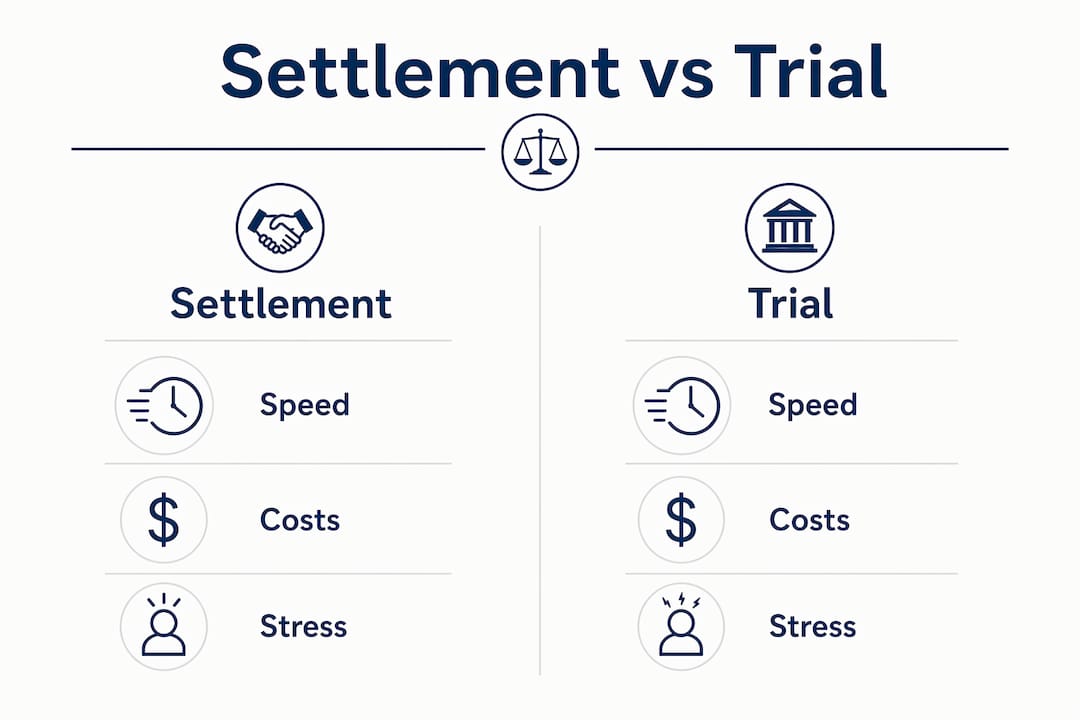
Key pros and cons at a glance:
Settlement pros: Certainty, speed, lower costs, privacy, no courtroom stress.
Settlement cons: May leave money on the table; release of liability is permanent.
Trial pros: Higher potential award, punitive damages possible, public accountability.
Trial cons: Risk of $0, high costs, long timeline, emotional burden, public record.
The settlement negotiation process is also shaped heavily by how prepared your attorney appears. Insurers track which attorneys actually try cases and which ones settle everything. When a defense team believes your attorney will take the case to verdict, offers tend to improve.
Pro Tip: Filing a lawsuit does not mean you are committed to trial. It is often a strategic move that signals seriousness and pushes insurers toward meaningful negotiation. Many cases settle after filing but well before a trial date.
What factors should drive your decision to settle or go to trial?
No single formula fits every case. The right path depends on a combination of financial need, evidence strength, injury severity, and your personal tolerance for risk and delay.
Situations that favor settlement:
- You need funds soon to cover medical bills, lost income, or living expenses.
- Liability is disputed and a jury could reasonably find against you.
- Your injuries are moderate and fully resolved or nearly so.
- The offer represents 75–80% or more of your calculated case value.
- Your evidence has gaps: no witnesses, inconsistent medical records, or treatment delays.
- You want to move forward emotionally and close this chapter.
Situations that favor going to trial:
- The insurer’s offer is below 60% of your case’s fair value.
- Liability is clear: police report, dashcam footage, and witnesses all support your account.
- Your injuries are severe and permanent, creating substantial future medical costs and lost earning capacity.
- The defendant acted egregiously (driving under the influence, reckless conduct), making punitive damages possible.
- The insurer has acted in bad faith: denying valid claims, stalling unreasonably, or making lowball offers without justification.
Common pitfalls that hurt plaintiffs:
- Accepting the first offer without understanding the full value of future medical care.
- Settling before reaching maximum medical improvement, which locks in a number before the full extent of injuries is known.
- Underestimating how liens from health insurers or Medicare can reduce your net recovery. Understanding how liens affect your settlement is critical before signing anything.
- Letting emotional exhaustion or financial pressure push you into a premature decision.
- Assuming a high gross verdict automatically means a high net recovery, without accounting for fees, costs, and liens.
Are there alternatives between settling and going to trial?
Mediation and arbitration sit between direct negotiation and full trial, and both are worth understanding before you decide your path.
Mediation involves a neutral third party, a trained mediator, who facilitates discussion between you and the insurer. The mediator does not decide the case; they help both sides find common ground. Mediation in personal injury cases is typically non-binding, meaning you are free to reject any proposed resolution and proceed to trial. It tends to be faster and far less expensive than litigation, and roughly 70% of cases that reach mediation resolve there.
Arbitration is more formal. An arbitrator (or panel) hears evidence and issues a decision. Binding arbitration produces a final ruling that replaces a trial verdict. Non-binding arbitration gives both sides a preview of how a neutral evaluator sees the case, which often prompts settlement.
Benefits of alternative dispute resolution:
- Significantly lower costs than full trial preparation and courtroom proceedings.
- Faster resolution, often within weeks of the session.
- Private proceedings, unlike public court records.
- Less emotionally taxing than live testimony and cross-examination.
- Preserves the option to settle on terms both parties can accept.
Limitations to keep in mind:
- Binding arbitration removes your right to appeal, even if the outcome seems unfair.
- Mediation only works if the insurer participates in good faith.
- Some arbitration clauses in contracts favor the defendant’s preferred arbitrators.
When an insurer refuses to negotiate reasonably but trial feels too risky, mediation is often the most productive next step.
Why do most personal injury cases settle, and what are your payout options?
Most personal injury cases settle before trial, which reflects a rational calculation on both sides. Insurers want to avoid the unpredictability of juries. Plaintiffs want guaranteed money without years of waiting. The math usually favors settlement for both parties.
95–97% of personal injury cases settle before reaching trial. That near-universal rate reflects the combined weight of cost, risk, and timeline on both sides of the negotiation.
Once you reach a settlement, how you receive the funds shapes your financial future as much as the amount itself.
Payout options and their trade-offs:
- Lump sum: Immediate, full access to all funds. Best for people with urgent needs or who want control over investing and spending. Requires discipline to manage, particularly for large amounts.
- Structured settlement: Periodic tax-free payments over a defined period. Provides long-term income stability and protects against spending the entire amount quickly. The drawback: once structured payments are established, selling them later requires court approval and typically results in a significant discount on their full value.
- Hybrid: An upfront lump sum covers immediate costs while structured payments handle ongoing care or income replacement. This approach suits people with both pressing short-term needs and predictable long-term expenses.
Choosing between these structures is not just a financial preference. If you receive Medicaid, SSI, or other means-tested benefits, a large lump sum can affect your eligibility. A special needs trust, as noted earlier, can preserve those benefits while still making funds available for your care.
How can you protect your injury claim and make the best decision?
The single most important step is working with an attorney who genuinely prepares every case for trial, even when settlement is the likely outcome. Trial preparation strengthens settlement leverage because insurers respond to evidence, not demands. An attorney who builds a complete case file, retains the right experts, and demonstrates willingness to try the case extracts better offers than one who signals eagerness to settle quickly.
Steps to protect your claim:
- Document everything from day one: medical records, bills, photos of injuries and the scene, witness contact information, and a personal journal of how your injuries affect daily life.
- Reach maximum medical improvement before accepting any offer. Settling before your treatment is complete means you may not know the full cost of your recovery.
- Get a clear accounting of all liens (health insurance, Medicare, Medicaid) that will reduce your net recovery before evaluating any offer.
- Understand the typical settlement timeline for your type of case so financial pressure does not force a premature decision.
- Ask your attorney to calculate the present value of a trial verdict against the certainty of the current offer, accounting for fees, costs, and the probability of winning.
Pro Tip: Never accept a settlement offer under financial pressure without first consulting your attorney about whether the offer reflects your case’s actual value, including future medical costs and long-term income loss.
The benefits of experienced legal counsel extend well beyond negotiation. An attorney who knows local courts, judges, and jury tendencies can give you a realistic picture of what trial actually looks like in your jurisdiction, which is information no online guide can fully replace.
Key Takeaways
Settling a personal injury case provides guaranteed compensation faster and at lower cost, while trial offers higher potential awards but carries real risk of $0 recovery, significant expenses, and years of delay.
| Point | Details |
|---|---|
| Settlement rate | Over 95% of personal injury cases settle before trial, reflecting the rational weight of cost and risk. |
| Timeline difference | Settlement resolves in roughly 9–18 months; trial takes 2–4 years, up to 6 with appeals. |
| Cost exposure at trial | Total trial costs commonly reach $20,000–$60,000+, deducted directly from any verdict. |
| Trial preparation pays off | Attorneys who prepare every case for trial consistently extract stronger settlement offers from insurers. |
| 2keller’s approach | 2keller prepares personal injury cases for trial from day one, across Indiana, Michigan, and New Mexico, to maximize your recovery whether you settle or go to court. |
Serious about your injury case? Here is what 2keller brings to the table
When you are weighing a settlement offer against the uncertainty of trial, the quality of your legal representation is the variable that changes the outcome most. 2keller is a multi-state personal injury law firm serving clients in Indiana, Michigan, and New Mexico, and the firm’s approach is built on a straightforward principle: every case gets prepared as if it will go to trial, because that preparation is what produces fair settlement offers in the first place.

If you have a serious injury claim and an insurer offering far less than your case is worth, 2keller’s attorneys have the trial experience and case-building depth to change that dynamic. The firm handles cases on a contingency fee basis, meaning you pay nothing unless you recover. Whether your case resolves through negotiation, mediation, or a courtroom verdict, having attorneys who are genuinely prepared for all three paths puts you in a fundamentally stronger position. Contact 2keller to get a free case evaluation and find out what your claim is actually worth.