
The role of OSHA in injury claims is to enforce federal workplace safety standards and generate independent investigative records that support your compensation case, though OSHA itself does not award damages or file claims on your behalf. The Occupational Safety and Health Administration is a regulatory agency. Its job is to hold employers accountable for unsafe conditions, not to secure your financial recovery. Understanding this distinction protects you from a costly mistake: waiting on OSHA to resolve your situation while your compensation deadlines pass. Workers in Indiana, Michigan, and New Mexico who grasp how OSHA’s enforcement function intersects with workers’ compensation and personal injury law are far better positioned to protect their rights.
What are OSHA’s reporting requirements after a workplace injury?
OSHA places strict reporting obligations on employers, and those obligations create a paper trail that directly affects your claim. Fatalities must be reported within 8 hours of the incident. Hospitalizations, amputations, and eye loss must be reported within 24 hours. These are federal requirements, not suggestions.
The distinction between reportable and recordable injuries matters more than most workers realize.
- Reportable injuries trigger immediate federal notification to OSHA. These are the most severe events: deaths, in-patient hospitalizations, amputations, and loss of an eye.
- Recordable injuries are broader. They include any work-related injury or illness requiring medical treatment beyond first aid, days away from work, restricted duty, or loss of consciousness. Employers have 7 days to log these in their OSHA 300 injury log.
| Injury Type | Reporting Obligation | Deadline |
|---|---|---|
| Work-related fatality | Report to OSHA directly | Within 8 hours |
| Hospitalization, amputation, eye loss | Report to OSHA directly | Within 24 hours |
| Less severe work-related injuries | Record in OSHA 300 log | Within 7 days |
Misclassifying injuries between these two categories causes documentation problems that can complicate insurance coverage and legal proceedings. If your employer logs a reportable injury as merely recordable, that error can surface later as evidence of negligence or bad faith.
Pro Tip: Request a copy of your employer’s OSHA 300 log entry as soon as possible after your injury. You have the legal right to access this record, and it establishes an early timestamp on your case.
OSHA reporting does not replace filing a workers’ compensation claim. Both systems operate on independent timelines and serve different legal purposes. Filing one does not satisfy the requirements of the other.
How does OSHA evidence impact workers’ compensation and personal injury claims?
OSHA evidence is one of the most powerful tools available in a workplace injury case. When OSHA investigates a worksite after an incident, it produces reports containing witness statements, photographic documentation, expert safety assessments, and citations identifying specific violations. Courts routinely admit these reports as evidence, and they carry significant weight because they come from a federal agency with no financial stake in the outcome.
OSHA establishes employer duty of care through its published safety standards. When an employer violates those standards and a worker is injured as a result, the citation becomes direct evidence of a breach of that duty. That is the foundation of a negligence claim.
“OSHA citations are not automatic proof of liability, but courts treat them as critical evidence identifying recognized hazards and employer breaches of legal duty. They shift the conversation from ‘was this dangerous?’ to ‘the employer already knew this was dangerous.’”
Here is how OSHA evidence functions across different claim types:
- Workers’ compensation claims: OSHA citations support the argument that the injury was work-related and caused by employer negligence, which matters in disputed claims.
- Personal injury lawsuits: In states that allow third-party claims, OSHA violations can establish that a contractor, property owner, or equipment manufacturer failed to meet federal safety standards.
- Settlement negotiations: An active OSHA investigation or a recent citation gives your attorney concrete leverage when negotiating with an employer’s insurance carrier.
OSHA inspection reports contain detailed witness accounts and expert assessments that workers cannot easily obtain on their own. Subpoenaing these records early in discovery gives your legal team independent documentation that has not been filtered through your employer’s legal department.
Pro Tip: Do not wait for OSHA to close its investigation before consulting an attorney. An experienced lawyer can subpoena OSHA records during discovery, even while the investigation is still active.

OSHA’s findings do not guarantee compensation. They reinforce your claim. The financial recovery still depends on filing the correct claim through the correct legal channel, on time.
What should injured workers do to use OSHA’s role effectively?
Taking the right steps immediately after a workplace injury determines how much OSHA’s role can actually help your case. Passive workers who rely on their employer or OSHA to handle everything often find their claims weakened or denied.
-
Document the scene yourself. Take photographs of the hazard, your injuries, and the surrounding work area before anything is moved or cleaned up. Note the time, date, location, and names of any witnesses. Your employer’s incident report will reflect their version of events. Yours should reflect yours.
-
Report the injury to your employer in writing. Verbal reports disappear. A written report creates a dated record that your employer received notice of the injury. Keep a copy for yourself.
-
File your workers’ compensation claim promptly. Many workers delay filing workers’ comp claims while waiting for OSHA investigations to conclude. This is a serious mistake. Workers’ compensation has its own filing deadlines, and missing them can forfeit your right to benefits entirely.
-
File an OSHA complaint if your employer has not reported the injury. If you suffered a reportable injury and your employer failed to notify OSHA within the required window, you can file a complaint directly with OSHA. This creates an official record and may trigger an inspection.
-
Know your anti-retaliation rights. Section 11© of the Occupational Safety and Health Act prohibits employers from retaliating against workers who file OSHA complaints or participate in OSHA investigations. If you face demotion, termination, or reduced hours after reporting, that retaliation is itself a federal violation.
-
Request OSHA records for your claim. Once an OSHA investigation concludes, the report becomes a public record in most cases. Your attorney can also subpoena it during litigation. These records often contain independent witness statements that are difficult for employers to dispute.
Legal professionals consistently advise injured workers to document everything beyond what their employer reports. Your own records, combined with OSHA’s independent findings, create a much stronger foundation for any claim.
How do OSHA violation penalties and employer reporting failures affect claims?
OSHA penalties are not just regulatory fines. They are public signals of how seriously an employer violated safety law, and they carry real weight in civil proceedings. Serious violations carry penalties up to $16,550 per violation. Willful or repeated violations carry penalties up to $165,514 per violation as of 2026. A willful violation means the employer knew about the hazard and chose not to fix it.
| Violation Type | Maximum Penalty (2026) |
|---|---|
| Serious violation | $16,550 per violation |
| Willful or repeated violation | $165,514 per violation |
| Failure to report (fatality/severe injury) | $16,550 per violation |
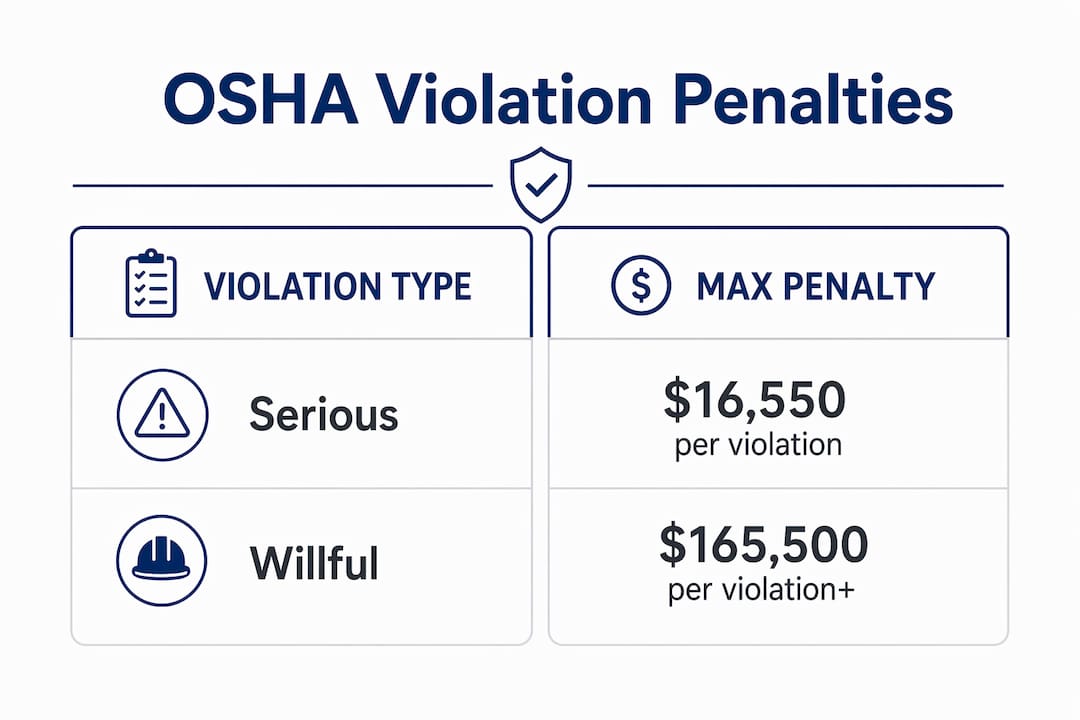
When an employer receives a willful violation citation, that finding tells a court something specific: the employer recognized the danger and failed to act. That is not an accident. That is recklessness, and it can support claims for increased damages in civil litigation.
Employer reporting failures carry their own legal consequences. Missed reporting deadlines can indicate concealment or recklessness, and attorneys use them as leverage in settlements. An employer who failed to report a hospitalization within 24 hours has a harder time arguing the injury was minor or unforeseeable.
“When an employer fails to meet OSHA’s mandatory reporting window, that failure becomes evidence. It suggests the employer either did not take the injury seriously or actively tried to avoid federal scrutiny. Either interpretation damages their credibility in a claim.”
OSHA public reports are also a source of independent evidence that neither party controls. Because OSHA investigators work for the federal government, their findings carry an authority that internal employer reports simply do not. Workers who understand how to access and use these records gain a meaningful advantage in the claims process. An attorney familiar with construction site accidents and OSHA enforcement can identify which citations and reports are most relevant to your specific situation.
Key Takeaways
OSHA enforces safety standards and produces investigative records that strengthen injury claims, but workers must file their own compensation claims independently and on time to secure financial recovery.
| Point | Details |
|---|---|
| OSHA does not award compensation | OSHA enforces safety law; financial recovery requires a separate workers’ comp or civil claim. |
| Reporting deadlines are strict | Fatalities must be reported within 8 hours; hospitalizations, amputations, and eye loss within 24 hours. |
| OSHA citations are powerful evidence | Courts treat citations as proof of recognized hazards and employer breach of duty. |
| File workers’ comp independently | Do not wait for OSHA investigations to conclude before filing your compensation claim. |
| Employer reporting failures matter | Missed OSHA reporting deadlines can serve as bad faith evidence in settlements and litigation. |
Why workers misread OSHA’s role more than any other part of their claim
The most common and damaging mistake I see injured workers make is treating OSHA as their advocate. OSHA is not your advocate. OSHA is a federal enforcement agency that holds employers accountable to safety standards. That is genuinely valuable to your case, but it is not the same as someone fighting for your compensation.
The confusion is understandable. When OSHA shows up after a serious injury, it feels like the system is working on your behalf. Investigators ask questions, document the scene, and issue citations. Workers naturally assume that process will lead to financial recovery. It does not. OSHA’s job ends when the employer corrects the hazard and pays the regulatory fine. Your financial recovery is a separate matter entirely.
What I have found is that workers who understand this distinction act faster and recover more. They file their workers’ comp claims immediately. They hire an attorney who knows how to subpoena OSHA records during discovery. They document the scene themselves rather than relying on their employer’s incident report. These are the workers who do not lose their claims on procedural grounds.
OSHA’s broader function matters too. Every citation issued and every penalty collected pushes employers toward safer workplaces. That benefits every worker who comes after you. But in the immediate aftermath of your injury, OSHA’s value to you is specific: it creates an independent, federally produced record of what went wrong and who was responsible. Use it. Do not wait for it to do more than it can.
If you were hurt at work and you are trying to understand your rights, talking to an attorney who handles workplace accident claims is the most direct path to clarity.
— Adam
How 2keller helps workers navigate OSHA-related injury claims
Workplace injury claims involving OSHA violations require legal knowledge that goes beyond standard workers’ compensation filings. At 2keller, our team works with injured workers in Indiana, Michigan, and New Mexico to build claims that incorporate OSHA citations, investigation reports, and employer reporting failures as supporting evidence.

We help you document your injury correctly from day one, file your workers’ compensation claim on time, and identify whether OSHA violations support a third-party personal injury lawsuit. Our attorneys know how to subpoena OSHA records early in discovery and use them to demonstrate employer negligence. If your employer failed to meet federal reporting requirements, we know how to use that failure in your favor. Contact 2keller to speak with our team about your workplace injury claim.
FAQ
What is OSHA’s role in a workplace injury claim?
OSHA enforces federal safety standards and investigates serious workplace incidents, producing reports and citations that serve as evidence in workers’ compensation and personal injury claims. OSHA does not award compensation or file claims on behalf of injured workers.
Does an OSHA violation prove my employer was negligent?
An OSHA citation is not automatic proof of negligence, but courts treat it as strong evidence that the employer recognized a hazard and failed to correct it, which directly supports a negligence claim.
Should I wait for OSHA’s investigation to finish before filing workers’ comp?
No. Workers’ compensation has independent filing deadlines, and waiting for OSHA to conclude its investigation can cause you to miss those deadlines and forfeit your benefits.
Can my employer retaliate against me for filing an OSHA complaint?
No. Section 11© of the Occupational Safety and Health Act prohibits employer retaliation against workers who file OSHA complaints or participate in OSHA investigations. Retaliation is itself a federal violation.
How do I get OSHA investigation reports for my claim?
Once an OSHA investigation closes, the report is generally a public record accessible through a Freedom of Information Act request. Your attorney can also subpoena OSHA records during the discovery phase of litigation to obtain witness statements and expert findings.