Constructive notice means the law treats a property owner as having known about a hazard because it existed long enough that a reasonably diligent inspection would have caught it. That is the whole concept in one sentence, and it is often the single factor that decides whether a slip-and-fall claim survives.
Here is the honest verdict: without evidence the hazard sat there for a meaningful stretch of time, most courts will not accept a constructive-notice theory. Video, witness accounts, inspection logs, or a hazard’s own visible deterioration all count. Vague assumptions do not.
Constructive notice fits inside a broader legal framework. To win a premises-liability case, you generally need to show:
- A duty of care existed (the owner had a legal obligation to keep the property reasonably safe).
- Notice, actual or constructive, that the hazard existed.
- A breach of that duty (the owner failed to fix or warn about the hazard).
- Damages caused by the resulting fall.
Key Takeaways
Constructive notice requires proof a hazard existed long enough for a reasonably diligent inspection to catch it, and duration evidence is what wins or loses these claims.
| Point | Details |
|---|---|
| Duration is decisive | Courts require evidence the hazard existed long enough to be discovered, not just that it existed. |
| Video can carry a claim | Surveillance footage that brackets the timeline, even without an exact start time, can establish notice. |
| Circumstantial evidence often fails | General maintenance history or unrelated prior incidents cannot substitute for specific time-and-place proof. |
| Documentation must happen fast | Time-stamped photos, witness contacts, and preservation requests protect evidence before it disappears. |
| Legal guidance helps early | Keller & Keller offers free case evaluations and works on contingency, sending preservation letters and gathering evidence from day one. |
Where to Learn More
- Justia’s premises liability overview covers the four negligence elements in depth.
- Cornell Law’s Wex explainer defines actual versus constructive notice.
- These sources offer general information only and are not a substitute for individual legal advice.
Table of Contents
- What Constructive Notice Means in a Slip-and-Fall Claim
- Actual Notice vs. Constructive Notice: What Separates Them
- Everyday Situations Where Courts Recognize Constructive Notice
- Proving Constructive Notice: Evidence and the Duration Problem
- How Constructive Notice Changes the Outcome of Your Claim
- Defenses Property Owners Raise Against Constructive Notice
- What To Do Right After a Slip and Fall
- Get a Free Case Evaluation From Keller & Keller
- Frequently Asked Questions
- Sources
What Constructive Notice Means in a Slip-and-Fall Claim
Constructive notice is a legal presumption. Courts do not require proof that an owner personally saw the spill or the broken tile. They ask whether the hazard existed long enough, and was obvious enough, that a reasonably diligent inspection would have found it. That question is central to any premises liability claim, which typically turns on four negligence elements: duty, notice, breach, and damages.
Notice is the element constructive notice slots into. Common fact patterns that support it include:
- A spill that sat unaddressed through multiple customers walking past it for a period of time.
- Flooring worn smooth from years of foot traffic with no repair record.
- A hazard in a location employees pass regularly during their shifts often supports constructive notice claims.
Actual Notice vs. Constructive Notice: What Separates Them
Actual notice means someone at the business directly knew about the hazard, an employee saw the spill, a manager received a complaint, a maintenance worker reported the leak. Actual notice is knowledge a party actually received, while constructive notice is knowledge the law imputes even without proof anyone saw it.
Actual notice is easier to prove when it exists, but it is rare. Most defendants deny direct knowledge outright. That is why constructive notice carries most slip-and-fall claims:
- Actual notice example: an employee mops a spill, walks away, and a customer falls minutes later on the wet residue.
- Constructive notice example: a leak has pooled near a store entrance for hours with no one checking on it.
Everyday Situations Where Courts Recognize Constructive Notice
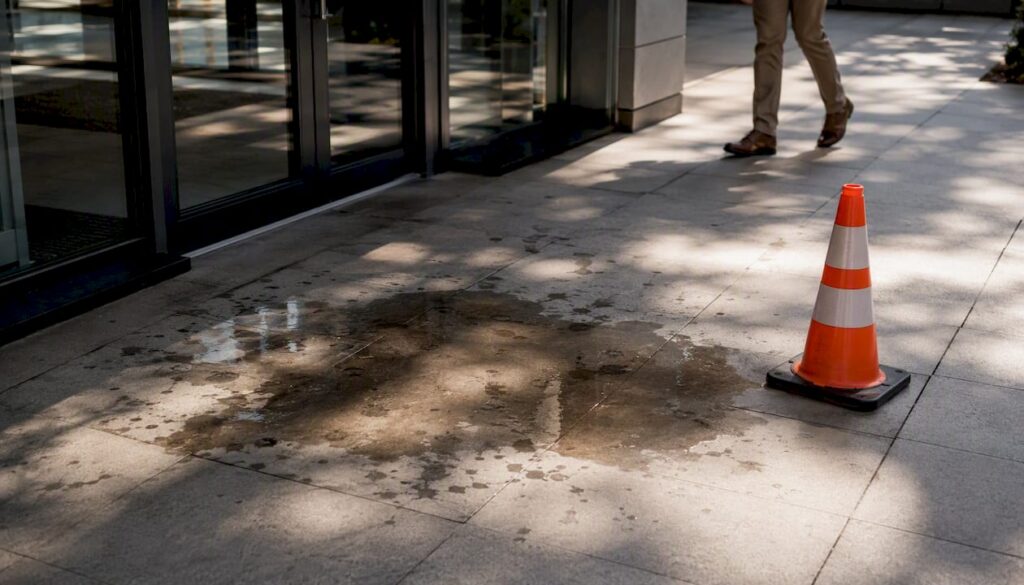
Certain patterns show up again and again in slip-and-fall litigation, and some are far stronger than others. A puddle that visibly darkened the floor tile, gathered dirt tracks, or sat through a documented time gap between inspections tends to support constructive notice claims. A persistent roof leak that management knew caused pooling in the same spot after every rainstorm does too, especially with repair records showing the problem was known and unresolved.
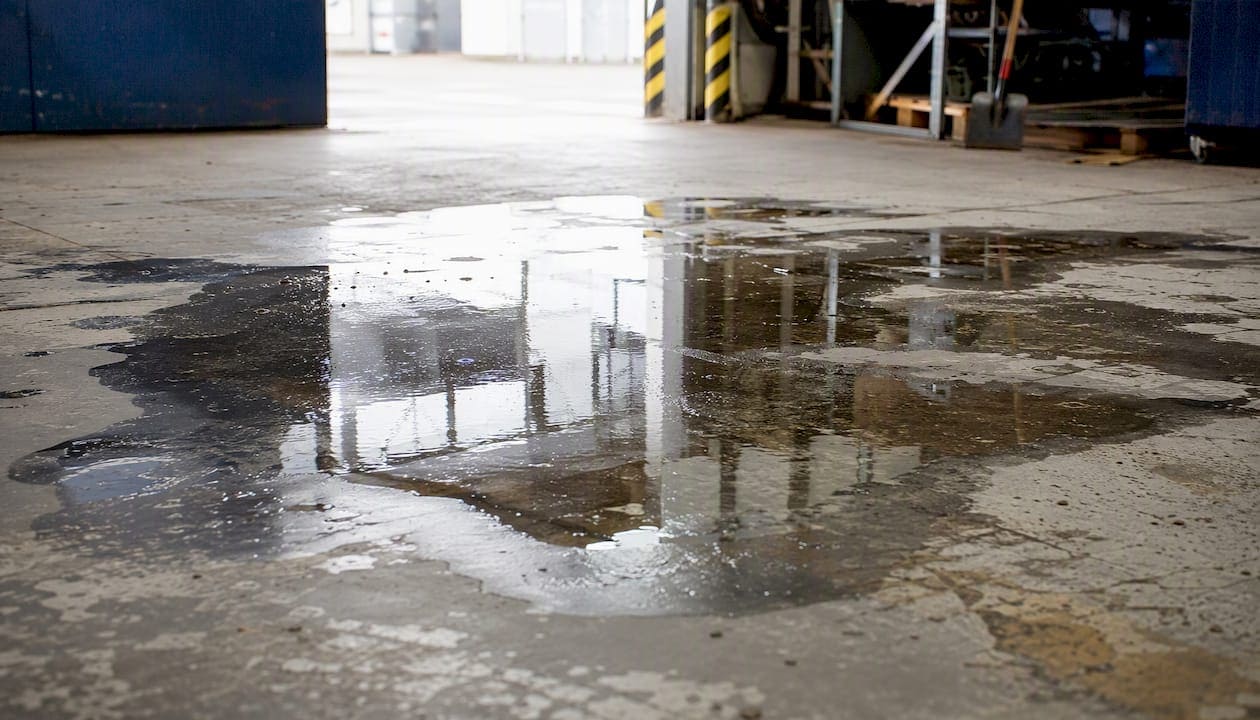
Worn or cracked flooring in high-traffic zones, degraded to the point that deterioration itself signals age, often works in the plaintiff’s favor. Courts weigh factors like how long the hazard was present, foot traffic patterns, and whether the property followed industry-standard inspection procedures.

Where constructive notice usually fails: a spill that appeared moments before the fall, with no camera coverage and no witness who saw it earlier. Without some marker of duration, courts routinely side with the property owner.
Proving Constructive Notice: Evidence and the Duration Problem
Duration is the fight. Courts want proof the hazard existed long enough that a diligent inspection would have caught it, and that single question decides most of these cases. Evidence that typically establishes duration includes:
- Surveillance footage showing the hazard before the fall.
- Employee inspection logs with gaps or missed checks.
- Witness statements describing how long the hazard had been visible.
- Maintenance and incident reports referencing the same location.
- Physical signs like dirt buildup, footprints through a spill, or worn edges on damaged flooring.
You do not need to pinpoint the exact minute the hazard appeared. One Wisconsin court allowed a jury to infer duration from security-camera footage bracketing the time before the injury, even without proof of the precise starting moment. Contrast that with the Texas Supreme Court’s 2026 decision, which rejected circumstantial evidence, like a history of leaks elsewhere in the store, because it did not tie the specific hazard to the specific time and place of the fall. General maintenance problems will not substitute for proof about this hazard, at this location, for this length of time.
Pro Tip: Take time-stamped photos immediately, and send the property a written request asking them to preserve surveillance footage before it gets overwritten. Most retail systems recycle footage within days.
How Constructive Notice Changes the Outcome of Your Claim
Notice is usually the element insurers fight hardest, because it decides whether the case even reaches a jury. If you can show constructive notice with solid evidence, liability risk shifts heavily toward the property owner, and settlement offers tend to reflect that.

If you cannot, the case often ends early. Courts frequently grant summary judgment for the property owner when a plaintiff has no evidence of duration, surveillance footage, inspection gaps, or visible wear, leaving only speculation about how long the hazard existed.
The legal standard boils down to one question: would a reasonably diligent owner have discovered and fixed this hazard in time to prevent the injury? Everything about proving constructive notice, and everything an insurance adjuster will scrutinize, traces back to that single sentence.
Defenses Property Owners Raise Against Constructive Notice
Expect the property owner’s insurer to push back hard. The most common defenses are that they had no notice at all, that the hazard appeared moments before the fall, that the danger was open and obvious, that you share fault for not watching where you walked, or that their inspection routine was reasonable and thorough.
Each defense has a counter:
- “No notice” gets challenged with inspection logs showing missed checks or footage showing the hazard existed earlier.
- “It just happened” gets challenged with witness statements or video establishing a longer timeline.
- “Open and obvious” gets challenged by showing poor lighting, distractions, or a hazard that blended into the flooring.
- Comparative fault claims get countered with evidence you were walking normally and had no reason to expect danger.
Pro Tip: Ask early for the property’s written inspection policy. If their actual practice does not match their policy, that gap alone can undercut a “we followed procedure” defense.
What To Do Right After a Slip and Fall
- Get medical care immediately and keep every record; treatment delays get used against you later.
- Photograph the hazard from multiple angles, including anything that shows time of day or surrounding conditions.
- Collect names and phone numbers from any witnesses before they leave.
- Ask the property for an incident report and request in writing that they preserve surveillance video.
- Note which employees you spoke with and what they said.
- Keep the shoes and clothing you were wearing; they may become evidence.
Contact a lawyer quickly. Footage gets deleted, memories fade, and preservation letters work best sent within days, not weeks.
A Note From Our Team
At Keller & Keller, we have spent years building premises-liability cases where notice was the deciding factor. I have seen firsthand how quickly video evidence disappears and how much a documented timeline changes a claim’s trajectory.
Get a Free Case Evaluation From Keller & Keller
If you are dealing with a slip-and-fall injury, the clock on preserving evidence is already running. Keller & Keller works on a contingency-fee basis, so there is no upfront cost and no fee unless we win or settle your case.

Once you reach out, our team can move quickly to send preservation letters for surveillance footage, track down and interview witnesses while their memory is fresh, and request inspection and incident records directly from the property. We also help you understand how insurance companies evaluate and sometimes deny these claims, which matters because adjusters often try to close weak-notice cases fast, before you have had a chance to build your evidence.
To get started, request a free case evaluation and have ready: the date and location of your fall, photos if you took any, names of witnesses, and any medical records from your treatment so far. Property owners also carry their own maintenance responsibilities, and resources like this property damage prevention guide show just how routine inspection is supposed to be, which is exactly the standard your claim will be measured against.
Frequently Asked Questions
What is the difference between actual notice and constructive notice in a slip-and-fall case?
Actual notice means someone at the business directly knew about the hazard. Constructive notice means the law treats the owner as having known because the hazard existed long enough that a reasonable inspection would have found it.
How long does a hazard need to exist to prove constructive notice?
There is no fixed number of minutes. Courts look at whether the duration, based on video, logs, or witness accounts, was long enough for a reasonably diligent inspection routine to have caught it.
Can I win a slip-and-fall case without surveillance video?
Yes, but it becomes harder. Witness statements, inspection log gaps, and physical signs of wear or neglect can also establish duration when video is unavailable.
What should I do immediately after a slip-and-fall injury?
Get medical care, photograph the scene with time cues, collect witness information, and request the property preserve any surveillance footage in writing.
Does an “open and obvious” hazard defeat my claim automatically?
Not automatically. Poor lighting, distractions, or a hazard that blended into its surroundings can still support a claim even when the property argues the danger was obvious.
Sources
- Premises Liability Slip and Fall: Elements and Defenses – Justia
- Actual notice, Cornell Law School Wex
- Supreme Court of Texas Reaffirms Strict Constructive‑Notice Standard in Slip‑and‑Fall Cases – Cozen O’Connor
- Slip and Fall Laws by State (2026): Premises Liability Guide | Recording Law