
Three actions matter more than anything else once your hearing date lands on the calendar. Request and review your Social Security file immediately. Get updated medical evidence, including a function-based statement from your treating provider, submitted before the 5-business-day deadline. Practice describing your worst days in specific, concrete terms.
Each of these has a hard deadline or a real cost attached to delay. Miss the 5-business-day evidence rule and the judge can exclude records that might have won your case. Ignore the Notice of Ways to Attend and you may end up locked into a hearing format that doesn’t work for your situation.
- Review your file now, request it through the hearing office or your my Social Security account.
- Submit medical evidence early, treating-source statements carry weight, but they take weeks to obtain.
- Rehearse your testimony, vague answers hurt credibility; specific ones build it.
Pro Tip: If you’re unsure whether your evidence will make the cutoff, a consultation with a disability attorney costs nothing and can flag gaps before they become a denial.
Key Takeaways
Winning an SSDI hearing depends on submitting function-specific medical evidence before the 5-business-day deadline and testifying with concrete, measurable details about daily limitations.
| Point | Details |
|---|---|
| Request your file immediately | Pull records through the hearing office or my Social Security account as soon as your notice arrives. |
| Beat the 5-business-day deadline | Submit or notify the hearing office of all written evidence at least 5 business days before your hearing. |
| Get a function-based RFC | Ask your treating provider for concrete limits on standing, lifting, breaks, and absences, not vague descriptions. |
| Respond to your NWtA quickly | Object in writing right away if your assigned hearing format doesn’t fit your medical or technical situation. |
| Consider free representation help | Keller & Keller reviews your file, secures RFCs, and prepares VE strategy on contingency with no upfront cost. |
Table of Contents
- SSDI Hearing Preparation Starts With Understanding the Timeline
- How Do You Request and Review Your Social Security File?
- What Medical Evidence Matters Most, and How Do You Submit It?
- How Do You Prepare Testimony That Actually Helps Your Case?
- Notice of Ways to Attend: What Are Your Hearing Format Options?
- What Do Vocational and Medical Experts Actually Do at Your Hearing?
- SSDI Hearing Documents Needed and Day-Of Logistics
- Should You Hire a Lawyer for Your SSDI Appeal?
- Two-Week SSDI Hearing Checklist: What to Finish and When
- What the Data Actually Tells Claimants to Prioritize
- How Keller & Keller Helps You Prepare for Your SSDI Hearing
- Frequently Asked Questions
- Sources
SSDI Hearing Preparation Starts With Understanding the Timeline
Your hearing sits at the third stage of the appeals process: initial denial, then reconsideration, then a written request for a hearing before an Administrative Law Judge (ALJ) using Form HA-501. Once filed, your case gets assigned to a hearing office, and a Notice of Hearing follows with your date, time, and assigned format. Processing at this stage takes months, and SSA’s own workload data shows just how backed up the hearing queue nationally remains.
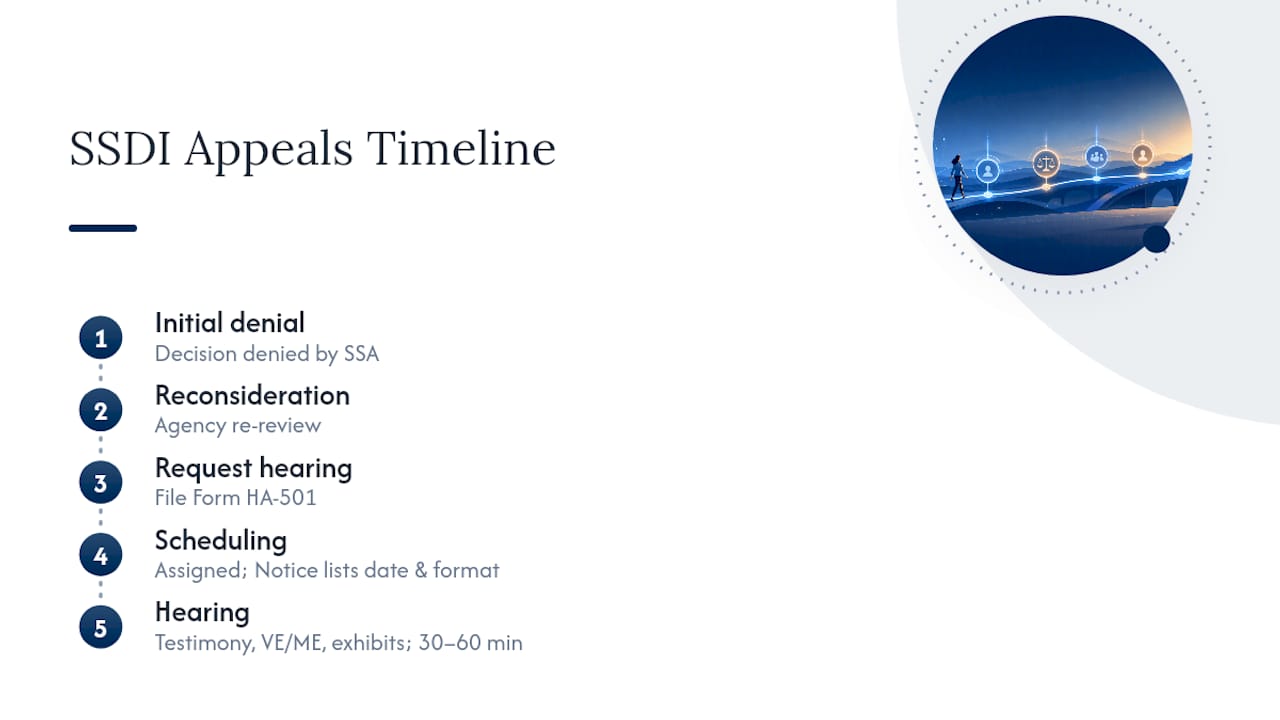
The hearing itself follows a predictable order. The ALJ opens by explaining the process, you testify about your work history and daily limitations, a vocational expert (VE) and sometimes a medical expert (ME) offer testimony, and the judge reviews exhibits before closing statements. Most hearings run between half an hour and an hour. Attendees typically include you, the judge, a VE, and your representative if you have one. Nothing about the hearing revolves around proving you’re sick. It revolves entirely around what you can and cannot physically and mentally do on a sustained, full-time basis.
How Do You Request and Review Your Social Security File?
Request your file the day your hearing notice arrives, not the week before. You can ask the hearing office directly, pull records through your my Social Security account, or request a CD copy of the full file. Waiting even a few weeks can mean you discover a critical gap too late to fix it.
Once you have it, check three things in order:
- Medical records, confirm every treating provider is represented and nothing recent is missing.
- Prior decisions and reconsideration notes, read the stated reasons for denial; these tell you exactly what the judge will focus on.
- Function reports (SSA-3373) and work history, verify the descriptions of your limitations still match your current condition.
If you find gaps, document them immediately: note which provider holds the missing record, when you contacted them, and how. This paper trail matters later.
Pro Tip: Judges deny cases based on what’s in the file, not what you assume is in the file. A twenty-minute review can reveal a missing MRI or an outdated function report that’s quietly working against you.

What Medical Evidence Matters Most, and How Do You Submit It?
ALJs weigh function over diagnosis. A stack of records showing you have a condition matters far less than a statement showing what that condition stops you from doing. Focus your collection efforts on:
- Complete treatment records and diagnostic test results from every active provider.
- A current medication list, including dosages and documented side effects.
- A Medical Source Statement (MSS) or Residual Functional Capacity (RFC) assessment from a treating physician.
A strong RFC does more than check boxes. It states concrete limits: how long you can stand or sit at once, how many pounds you can lift, how often you’d need unscheduled breaks, and how many days per month your condition would likely cause you to miss work. Vague language like “moderate limitations” gives a VE almost nothing to work with. Specific numbers do.
SSA’s evidence rule requires you to submit or notify the hearing office of all written evidence no later than 5 business days before your hearing. Evidence submitted after that window can be excluded unless you show good cause, such as a provider’s delay in releasing records. Keep every email and call log proving you tried.
How Do You Prepare Testimony That Actually Helps Your Case?
Judges are trained to listen for specifics, not adjectives. Saying “I’m in a lot of pain” tells the ALJ nothing usable. Saying “I can stand for about ten minutes before the pain in my lower back forces me to sit down” gives the judge something concrete to weigh against the vocational requirements of full-time work.
- Keep a symptom journal for at least two weeks before the hearing. Note what you attempted, how long you lasted, and what happened afterward.
- Convert journal entries into short, factual statements. “Three to four days a month I can’t get out of bed, and on those days I need help dressing” beats any general description of a bad flare.
- Prepare any witnesses, like a spouse or adult child, to describe what they observe, not what you’ve told them. A witness statement works best when it sticks to firsthand observation.
Pro Tip: Testimony that drifts from what’s already in your medical file raises red flags for judges. If your journal reveals something your doctor hasn’t documented, get that record updated before the hearing, not during it.
Notice of Ways to Attend: What Are Your Hearing Format Options?
Since November 2024, SSA treats four hearing formats as equally valid: in-person, agency video, online video, and phone. The Notice of Ways to Attend (NWtA) tells you which format has been assigned and includes instructions for objecting if that format doesn’t work for you.
Acceptable objection grounds generally include documented medical barriers to travel, lack of reliable internet or video access, or a specific need for in-person interaction with the judge. File your written objection promptly using the process the NWtA outlines.
- Read the NWtA the day it arrives; deadlines to object are short and firm.
- State your reason for objecting clearly and back it with documentation where possible.
- Keep a copy of everything you submit, along with proof of the submission date.
Missing the objection window usually means you’re stuck with the assigned format, even if it genuinely disadvantages your case.
What Do Vocational and Medical Experts Actually Do at Your Hearing?
A vocational expert (VE) testifies about whether jobs exist in the national economy that someone with your specific limitations could perform. The judge poses hypothetical scenarios to the VE, and the VE’s answers to those hypotheticals often decide the outcome.
That’s exactly why the limitations described in your hypothetical need to be complete:
- Include physical limits like standing, lifting, and reaching tolerances.
- Include mental and cognitive limits like concentration lapses and time off-task.
- Include practical limits like unscheduled breaks and medication side effects such as drowsiness.
Medical experts (ME) appear less often, usually in complex cases involving conflicting medical opinions. When one testifies, their opinion gets weighed alongside your treating provider’s records, not automatically above them.
SSDI Hearing Documents Needed and Day-Of Logistics
Bring your photo ID, Hearing Notice, NWtA, a current medication list, your symptom notes, and copies of any evidence you submitted recently, even though the judge should already have them on file.
- Answer questions directly and stop talking once you’ve answered; don’t fill silence with extra detail.
- Avoid exaggeration; consistency with your medical records builds credibility, overstatement undermines it.
- Pause before answering if you need to think; judges expect this and it beats guessing.
- For remote hearings, test your internet connection and camera the day before, and have a phone backup ready in case video fails.
Should You Hire a Lawyer for Your SSDI Appeal?
Representation changes what happens behind the scenes long before the hearing starts. An experienced disability attorney reviews your file for missing evidence, reaches out to treating providers for detailed RFCs, preps your testimony against the judge’s likely questions, and cross-examines the VE when their hypothetical leaves out limitations that belong in it.
- Most disability attorneys work on contingency, meaning you owe nothing unless your claim succeeds.
- A free consultation typically includes a review of your denial letter and a frank assessment of your case’s strengths and gaps.
- Ask any attorney you’re considering how they handle VE cross-examination and whether they’ll request updated RFCs from your providers.
Pro Tip: Since the abolition of the treating-physician-rule presumption, a treating doctor’s opinion no longer automatically outweighs other evidence. That makes a well-documented, function-specific medical opinion more important than ever, not less.
Two-Week SSDI Hearing Checklist: What to Finish and When
- Immediately upon receiving your notice: request your file, review the NWtA, and object if the assigned format doesn’t work.
- 30 to 45 days before: contact treating providers for updated records and a Medical Source Statement or RFC.
- 5 business days before: confirm all evidence has been submitted or the hearing office has been notified in writing.
- Day of: bring your document folder, arrive early or log in early for remote formats, and review your symptom notes one last time.
If any record arrives late, keep proof of every call and email showing you tried to get it sooner. That documentation is what supports a good-cause exception to the deadline.
What the Data Actually Tells Claimants to Prioritize
The conventional advice floating around forums and outdated guides still treats the hearing like a medical exam: gather every test result, describe every diagnosis, hope the paperwork speaks for itself. It doesn’t. Judges decide based on function, and the claimants who prepare well are the ones who translate their medical history into specific, measurable limitations before they ever sit down in front of an ALJ.
The 5-business-day rule and the shift to four equal hearing formats are the two most underappreciated changes reshaping this process right now. Miss the evidence deadline and a perfectly valid piece of evidence never reaches the judge’s desk. Miss the NWtA objection window and you’re stuck testifying through a format that works against you.
What actually moves outcomes isn’t more paperwork. It’s a Residual Functional Capacity statement with real numbers, testimony that matches the medical file word for word, and a VE hypothetical that accounts for every limitation you actually live with. Claimants who handle this alone often don’t know what they don’t know. That’s the gap representation closes.
How Keller & Keller Helps You Prepare for Your SSDI Hearing
You shouldn’t have to learn the 5-business-day rule and the NWtA objection process while also managing a disabling medical condition. Keller & Keller handles SSDI hearing preparation on contingency, meaning there’s no upfront cost and no fee unless your case succeeds.

Our team audits your Social Security file for gaps, works directly with your treating providers to secure a detailed RFC or Medical Source Statement, and builds a vocational expert strategy designed to surface every limitation the hypothetical needs to include. If your hearing notice mentions a format that doesn’t work for your medical situation, we handle the objection and the documentation behind it.
A free consultation starts with your denial letter and hearing notice, whatever medical records you already have, and a short conversation about your daily limitations. From there, we tell you exactly what’s missing and what timeline we’re working against. Visit Keller & Keller to schedule your consultation before your evidence deadline arrives.
Frequently Asked Questions
What should I prioritize first in SSDI hearing preparation?
Request your Social Security file the moment your hearing notice arrives, then confirm your medical evidence, including any RFC or Medical Source Statement, will be submitted before the 5-business-day deadline.
What happens if I miss the 5-business-day evidence deadline?
The judge can exclude evidence submitted after that window unless you show good cause, such as documented delays in obtaining records from a provider.
Can I object to the hearing format SSA assigns me?
Yes. Your Notice of Ways to Attend explains the objection process; you generally need a documented reason, such as a medical barrier to travel or lack of reliable technology, and a prompt written response.
Do I need a lawyer for my SSDI hearing?
Representation isn’t required, but attorneys who work on contingency review your file for gaps, secure detailed RFCs, and question the vocational expert, activities most claimants aren’t equipped to handle alone.
How long does it take to get a decision after the hearing?
Timelines vary by hearing office, and current SSA workload data shows meaningful backlogs nationwide, so expect the wait to be measured in months rather than weeks.
This article is general information, not a substitute for advice from a qualified lawyer. Consult a qualified legal professional about your own circumstances before acting on anything here.
Sources
- Hearings and Appeals, What do I need to know about requesting a hearing before an Administrative Law Judge (ALJ)
- POMS entries on hearing formats / Notice of Ways to Attend