
Only the personal representative of a deceased person’s estate may bring a wrongful death lawsuit in Michigan, under MCL 600.2922. Families generally have three years from the date of death to file, per MCL 600.5805, though a saving rule under MCL 600.5852 can extend that window in narrow situations. Damages fall into several categories:
- Medical and funeral expenses
- Conscious pain and suffering endured before death (paid to the estate)
- Loss of financial support for dependents
- Loss of society and companionship for close family members
Quick fact: Michigan’s three-year clock starts running on the date of death, not the date of the injury that caused it, which matters in cases involving a slow decline after an accident or medical error.
Key Takeaways
Michigan wrongful death claims require a court-appointed personal representative, a filing within three years of death, and careful compliance with notice and distribution rules to secure full compensation.
| Point | Details |
|---|---|
| Only the personal representative files | Family members cannot sue individually; probate appointment must happen first. |
| Three-year deadline applies | MCL 600.5805 sets the general filing window from the date of death. |
| Saving rule offers narrow relief | MCL 600.5852 can extend deadlines when death occurs near the original limitations date. |
| Damages split into two categories | Estate damages (medical, funeral, pain) differ from survivor damages (support, society). |
| 2keller handles the procedural risk | Our Michigan team manages appointment, notices, and distribution on contingency, at no upfront cost. |
Table of Contents
- Understanding Michigan Wrongful Death Law and What Counts as a Claim
- Who Can File and What the Personal Representative Must Do
- What Damages Michigan Families Can Recover, and Who Gets Paid
- Michigan’s Wrongful Death Statute of Limitations and the Saving Rule
- How a Michigan Wrongful Death Lawsuit Moves From Filing to Payout
- Exceptions That Change the Rules: Malpractice, Fetal Death, and the Slayer Rule
- Why Experienced Michigan Counsel Matters in These Cases
- What This Article Gets Right That Most Advice Misses
- How 2keller Helps Michigan Families Move Fast After a Death
- Where to Verify These Michigan Wrongful Death Rules
- Sources
Understanding Michigan Wrongful Death Law and What Counts as a Claim
Michigan wrongful death law rests on a single statutory pillar: MCL 600.2922 authorizes a lawsuit whenever a death results from a “wrongful act, neglect, or fault” that would have supported a personal injury claim had the victim survived. That’s the legal hinge connecting wrongful death claims to ordinary personal injury cases. If the decedent could have sued for their injuries, the estate can generally sue for the resulting death.
This is why wrongful death and survival actions often travel together. A survival action lets the estate recover for losses the decedent suffered between injury and death (medical bills, pain, lost wages). The wrongful death claim then addresses losses the death itself caused to survivors.
Common scenarios include:
- Fatal car, truck, or motorcycle crashes
- Medical errors or delayed diagnoses
- Dangerous property conditions, including negligent security
- Defective products or pharmaceuticals
- Death of a viable fetus caused by wrongful or negligent conduct, addressed separately under MCL 600.2922a
Who Can File and What the Personal Representative Must Do
Michigan law channels every wrongful death claim through one person: the personal representative appointed by the probate court. Family members, no matter how directly affected, cannot sue individually. A spouse or adult child who files on their own behalf risks having the case dismissed or folded into a properly filed action, which wastes time the family may not have.
Getting someone appointed usually follows this path:
- Petition the probate court in the county where the decedent lived (or where the death occurred) for appointment as personal representative.
- Receive Letters of Authority from the court, which formally establish legal standing to act for the estate.
- File the wrongful death complaint in circuit court once appointed.
- Notify every person who may be entitled to damages within 30 days of filing, as required under MCL 600.2922.
- Give those beneficiaries 60 days to respond with their own claims for a share of any recovery.
Pro Tip: If a claim is time-sensitive, ask the probate court about a special or temporary personal representative appointment. Michigan probate courts can often move faster than families expect when a filing deadline is close, but you have to ask early, not after months have passed.
What Damages Michigan Families Can Recover, and Who Gets Paid
Michigan divides wrongful death damages into two buckets, and the distinction determines who actually receives the money. Survival damages belong to the estate itself: medical bills, hospital costs, funeral and burial expenses, and compensation for the conscious pain and suffering the decedent experienced before dying. Those funds pass through the estate’s distribution process rather than going directly to any one relative.
Survivor damages belong to the people left behind. This includes loss of financial support, calculated using the decedent’s income, work-life expectancy, and the dependency of each survivor, along with loss of society and companionship, a non-economic loss courts assess based on the closeness of the relationship.

Key point: Michigan sets no general statewide cap on wrongful death damages. That said, when the death resulted from medical malpractice, separate statutory caps on noneconomic damages apply and can significantly limit what a family recovers, even in a fatal case.
Courts weigh several factors when valuing these claims:
- The decedent’s age, health, and earning capacity
- Number and ages of dependents
- Quality and closeness of family relationships
- Whether the decedent provided caregiving, not just income
There’s no fixed formula. A jury or judge applying MCL 600.2922 has real discretion, which makes documentation of financial dependency and relationship history genuinely important to the outcome.
Michigan’s Wrongful Death Statute of Limitations and the Saving Rule
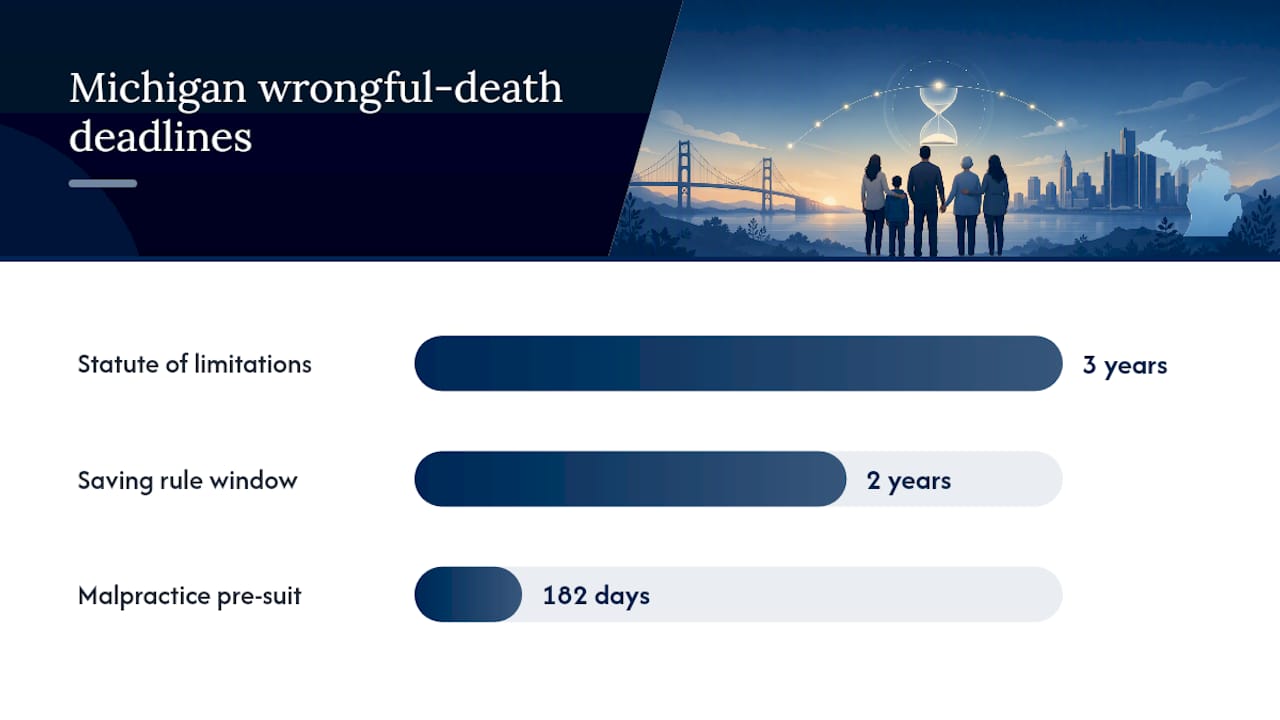
The default deadline is straightforward: three years from the date of death, per MCL 600.5805. Miss it, and the estate typically loses the right to sue entirely, regardless of how strong the underlying case is.
A few exceptions and complications matter:
- The saving rule (MCL 600.5852): If the decedent dies before the original limitations period expires, or within 30 days after it would have expired, the estate can file within two years of a personal representative’s appointment, even if that pushes past the standard three-year mark.
- Government defendants: Claims against municipalities or state agencies often carry shorter notice requirements, sometimes just months, separate from the general filing deadline.
- Medical malpractice deaths: These cases require a 182-day pre-suit notice period before filing, which effectively shortens the practical window for action well below three years.
Given these variables, families should talk to counsel as soon as possible after a death, not after the estate is settled or grief has passed. Waiting to see how things unfold is the single most common way a valid claim gets jeopardized.
How a Michigan Wrongful Death Lawsuit Moves From Filing to Payout
Wrongful death suits are typically filed in circuit court in the county where the death, the injury, or the defendant is located. From there, the case follows a defined sequence.
- The personal representative files the complaint and serves each defendant, filing proof of service with the court.
- Within 30 days of filing, the representative must notify every person who might be entitled to a share of damages, a requirement drawn directly from MCL 600.2922.
- Notified beneficiaries have 60 days to submit their own claims to the personal representative.
- The case proceeds through discovery, negotiation, or trial, often resolving through settlement.
- Once funds are available, the court holds a distribution hearing to approve how proceeds are divided among the estate and survivors.
Pro Tip: Ask your attorney early who qualifies as a “person who may be entitled to damages” in your specific family situation. Blended families, estranged relatives, and adult children from prior relationships can all complicate the notice list, and getting it wrong can delay distribution by months.
Michigan courts and their model civil jury instructions, specifically M Civ JI 45.01, make clear that while the personal representative is the named plaintiff, survivors are the real parties in interest. Their relative losses are what the court or jury actually evaluates when dividing an award.
Exceptions That Change the Rules: Malpractice, Fetal Death, and the Slayer Rule
A handful of special circumstances alter the standard wrongful death playbook in Michigan, and missing one can cost a family real money or time.
- Malpractice caps: When a death stems from medical negligence, statutory noneconomic damage caps apply and adjust annually, capping the pain-and-suffering and loss-of-society portions of a claim even when liability is clear.
- Viable fetus claims: MCL 600.2922a allows a wrongful-death-style claim when negligence causes the death of a viable fetus, though the statute imposes its own limits distinct from standard adult wrongful death claims.
- The slayer rule: Anyone who feloniously and intentionally caused the decedent’s death is barred from receiving any share of the proceeds, regardless of their family relationship.
- Government defendants: Suits against public entities carry different procedural rules and often much shorter notice windows than the standard three-year deadline.
Why Experienced Michigan Counsel Matters in These Cases
Michigan wrongful death law is unforgiving on procedure. A missed 30-day notice, a late probate appointment, or a mishandled malpractice notice period can undo an otherwise strong case before it reaches a courtroom. Firm resources like our overview of Michigan wrongful death claims and our breakdown of Michigan no-fault law’s order of priority walk through how medical and funeral costs get paid while a claim is pending.
Experienced counsel typically helps families by:
- Expediting probate appointment so the filing clock doesn’t lapse
- Preserving evidence, including vehicle black box data in crash cases, before it’s lost or overwritten
- Managing beneficiary notices and the 60-day response process correctly
Michigan courts supervise wrongful death settlement distribution through a formal hearing process, and the model civil jury instructions make clear that survivors, not just the named personal representative, are the parties whose losses ultimately get weighed and compensated.
What This Article Gets Right That Most Advice Misses
Most online explainers treat Michigan wrongful death law as a single deadline: three years, done. That’s technically true and practically misleading. The real risk isn’t the three-year date on a calendar. It’s everything upstream of it: getting a personal representative appointed, sending notices correctly, and recognizing when a shorter clock, malpractice notice, or government claim deadline actually controls.
I’d push back on the common assumption that grieving families have time to sort out probate before contacting an attorney. In malpractice and government-defendant cases especially, the practical filing window is often far shorter than three years once notice requirements are factored in.
If there’s one priority, it’s this: get a personal representative appointed fast, even provisionally, and get beneficiary notices right the first time. Distribution disputes almost always trace back to sloppy early notice work, not disagreements over the merits of the underlying case. The statute rewards families who move early and documents their losses thoroughly. It punishes those who wait to see how things settle.
Adam
How 2keller Helps Michigan Families Move Fast After a Death
2keller is the Michigan resource for families who need a wrongful death claim handled correctly the first time, not months into probate when deadlines are already tightening. Our team works on contingency, so there’s no upfront cost while we secure a personal representative’s appointment, preserve evidence like black box data, and manage the notice and distribution process the statute demands.

If a loved one died because of someone else’s negligence in Michigan, a free consultation costs nothing and starts the clock working in your favor instead of against you. Visit our personal injury law firm page to reach our Michigan team and get a clear read on your deadline and options before more time passes.
Where to Verify These Michigan Wrongful Death Rules
- MCL 600.2922, filing authority and damages
- MCL 700.3924, distribution protections
- Michigan courts resources, jury instructions and settlement checklists
- Nolo’s Michigan wrongful death overview for plain-language summaries
This article is general information, not a substitute for advice from a qualified lawyer. Consult a qualified legal professional about your own circumstances before acting on anything here.
Sources
- MCL – Section 600.2922 – Michigan Legislature
- How Do Wrongful Death Lawsuits Work in Michigan? (Nolo)
- MCL – Section 700.3924 – Michigan Legislature
- Michigan courts, model civil jury instructions and wrongful-death settlement checklist