Yes, you may be able to sue after a drug recall, but a recall alone doesn’t guarantee compensation. Causation, timing, and evidence matter more than the recall notice itself. A recall tells you the drug was pulled from shelves. It does not automatically prove the manufacturer is legally liable for what happened to you.
Three factors decide whether a drug recall lawsuit succeeds:
- Causation — you need both general causation (the drug can cause this type of harm) and specific causation (it caused your harm)
- Timing — when you took the drug relative to the recall date, and how close you are to your state’s filing deadline
- Evidence — medical records, pharmacy receipts, lot numbers, and documentation tying your specific prescription to the recalled batch
Pro Tip: If you still have the pill bottle, don’t throw it away. The lot number printed on the label can be the single piece of evidence that connects your injury to the specific recalled batch.
If you’ve been harmed by a recalled medication, the immediate priorities are getting medical care, preserving every record you can find, filing a report with FDA MedWatch, and talking to a lawyer before evidence disappears.
Key Takeaways
A successful drug recall lawsuit depends less on the recall itself and more on documented causation, timely filing, and preserved evidence connecting your specific harm to the defective batch.
| Point | Details |
|---|---|
| Recall isn’t proof of liability | Courts often limit recall evidence under subsequent remedial measures rules, so causation still has to be proven separately. |
| Recall class signals risk level | Class I means serious harm is likely; Class III means minimal risk, which can shape how a case is prioritized. |
| Deadlines vary by claim type | Individual statutes of limitations differ from MDL or class settlement filing windows, so check both. |
| Preserve evidence immediately | Pill bottles, lot numbers, pharmacy records, and MedWatch reports become harder to recover the longer you wait. |
| 2keller evaluates cases on contingency | The firm reviews defective drug claims across Indiana, Michigan, and New Mexico with no upfront fee. |
Table of Contents
- How FDA Drug Recall Lawsuits Start: Classes and Who Pulls the Drug
- Does a Recall Prove the Drug Company Is Liable?
- What Types of Claims Can You File After a Drug Injury?
- When Do You Need to File? Deadlines That Can Kill a Claim
- What Should You Do If You Took a Recalled Drug?
- What Have Past Drug Recall Settlements Looked Like?
- How Does Hiring a Drug Recall Attorney Actually Work?
- Why Trust This Guidance on Drug Recall Lawsuits?
- The Recall Is Just the Starting Point, Not the Case
- Talk to a Firm That Handles Drug Recall Lawsuits Directly
- Frequently Asked Questions About Drug Recall Lawsuits
- Sources
How FDA Drug Recall Lawsuits Start: Classes and Who Pulls the Drug
Most drug recalls begin with the manufacturer, not the government. A company discovers a defect, a contamination problem, or a labeling error and voluntarily pulls the product before regulators force the issue. The FDA can also request a recall, and in rare cases it has the legal authority to mandate one outright when a manufacturer refuses to act voluntarily.
Once a recall is underway, the FDA assigns it one of three risk classes:
- Class I — reasonable probability the product will cause serious health problems or death. This is the most severe category.
- Class II — the product may cause temporary or reversible health problems, or the risk of serious harm is remote.
- Class III — the product is unlikely to cause any adverse health consequences, often tied to labeling or minor quality issues.
A recall is different from a market withdrawal, which happens when a company removes a product for a minor violation that wouldn’t trigger FDA legal action, such as a tamper-evident seal defect. Public notices for both appear on the FDA’s recall and safety alert page, which is worth bookmarking if you’re tracking a specific drug.
The classification matters for your case. A Class I recall signals the FDA itself viewed the risk as serious, which can shape how aggressively an attorney pursues the claim and how quickly evidence needs to be locked down before it’s lost or destroyed.
Does a Recall Prove the Drug Company Is Liable?
No. A recall is a public-health tool, not a legal admission. Courts frequently exclude evidence of a company’s post-injury safety fixes under what’s called the “subsequent remedial measures” rule, an evidentiary principle meant to encourage manufacturers to correct problems quickly without fear that doing so hands plaintiffs an automatic win. State rules on this vary, and some allow more flexibility than others, according to Nolo’s overview of drug recall litigation.
That doesn’t mean the recall is useless to your case. It just means your lawyer has to build causation from a broader evidence base:
- FDA warning letters and enforcement reports documenting known violations
- Internal company memos showing what the manufacturer knew and when
- cGMP (current Good Manufacturing Practice) violation records from FDA inspections
- Clinical studies or epidemiological data linking the drug to the specific harm you experienced
Timing complicates things further. If you started taking the drug after a recall notice was public, insurers and defense attorneys will argue you assumed a known risk, which can weaken your claim considerably.
Pro Tip: Ask your pharmacist for the exact lot number tied to your prescription fills. Lawyers use batch and lot tracing, paired with expert testimony, to convert a general recall into proof that a specific defective batch caused your specific injury.
Product liability claims lean heavily on expert testimony to establish both general causation (can this drug cause this harm at all) and specific causation (did it cause this harm to this person), a distinction FindLaw’s product liability guide lays out clearly for readers new to the process.
What Types of Claims Can You File After a Drug Injury?
Dangerous drug lawsuits generally fall into a handful of legal theories, and which one applies depends on what actually went wrong with the medication.
- Strict liability — the drug had a design defect or manufacturing flaw that made it unreasonably dangerous, regardless of how careful the manufacturer was
- Negligence — the company failed to exercise reasonable care in testing, manufacturing, or monitoring the drug
- Failure to warn — the label didn’t adequately disclose known risks or side effects
- Breach of warranty / economic-loss claims — you paid for a product that didn’t perform as represented, even without a physical injury
Not every case is a personal injury claim. Some resolve as medical monitoring claims, where plaintiffs recover costs for ongoing screening rather than a specific injury payout, or as economic-loss settlements that refund purchase costs for a compromised product.
When enough people are harmed by the same drug, cases often consolidate into a multidistrict litigation (MDL) or class action, which centralizes discovery and can lead to global settlements. Individual claimants inside an MDL usually retain their own attorney and case value, even though pretrial proceedings are shared. Compensation ultimately hinges on the severity of harm, how many people are affected, and how strong the causation proof is.
When Do You Need to File? Deadlines That Can Kill a Claim
Every state sets its own statute of limitations for personal injury and product liability claims, typically ranging from two to four years. The clock usually starts on the date of injury, but many states apply a “discovery rule” that starts the countdown when you knew or reasonably should have known the drug caused your harm, which can be much later than the date you first took it.
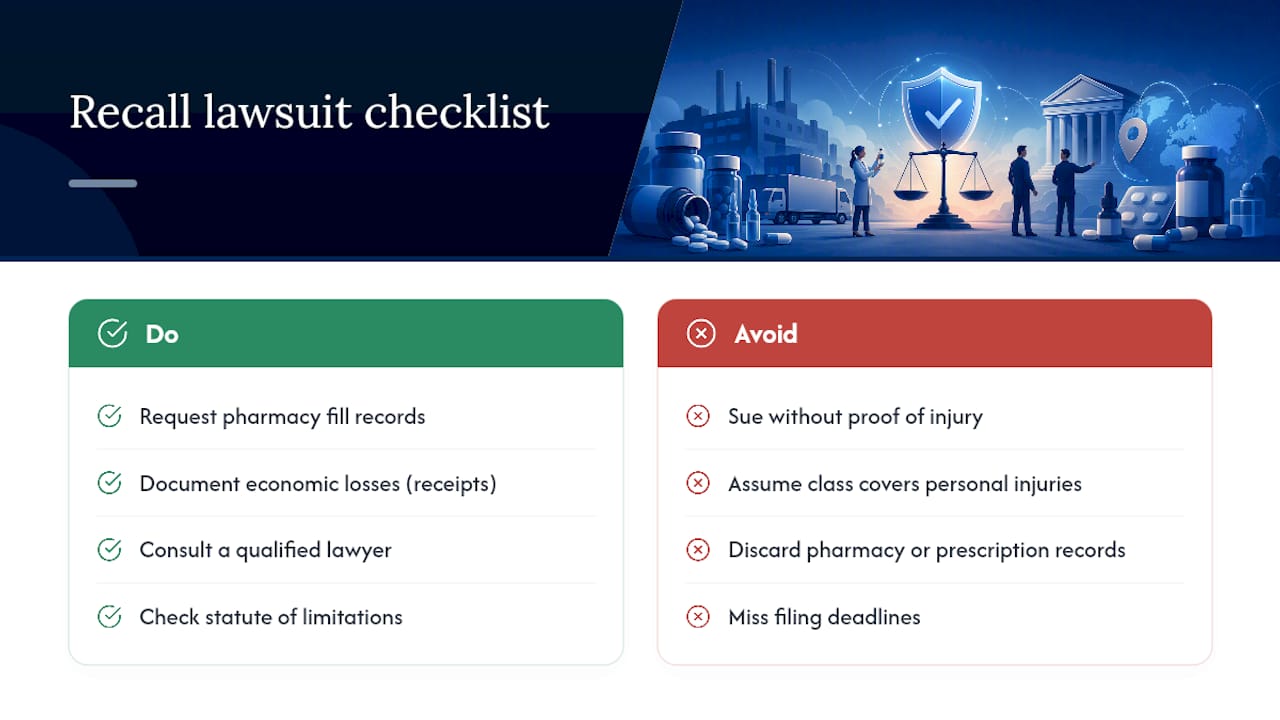
- Confirm your state’s filing deadline and whether the discovery rule applies to your situation.
- Check MDL or class settlement claim windows separately — these often run on their own administrative deadlines, distinct from your state’s general statute of limitations.
- Look into tolling doctrines like fraudulent concealment, which can pause the clock if a manufacturer actively hid known risks.
- Gather documents now: prescription records, pharmacy printouts, medical bills, and the recall notice itself, since delays make evidence harder to recover.
Missing a filing window doesn’t just weaken a case. It usually ends it permanently, regardless of how strong the underlying facts are.
What Should You Do If You Took a Recalled Drug?
If you’ve taken a recalled medication or believe it caused you harm, the sequence you follow in the first few weeks can shape the entire case — consulting civil lawyers Houston TX may help if you need specialized local legal counsel.
- Get medical care immediately and describe the medication and dosage to your provider so it’s documented in your chart.
- Request copies of your medical records and test results rather than assuming your doctor’s office will preserve them indefinitely.
- Preserve physical evidence — pill bottles, packaging, and pharmacy receipts, especially anything showing the lot number.
- Collect your pharmacy fill history going back as far as the records allow.
- Report the adverse event to FDA MedWatch and save the confirmation or report ID number.
- Save the recall notice itself, along with any correspondence from your pharmacy or the manufacturer.
- Contact an experienced defective-drug attorney for a case evaluation before evidence ages or disappears.
Pro Tip: Bring everything to your first consult, even records you think are irrelevant. A detail as small as a refill date can matter more than you realize once an attorney lines it up against the recall timeline. You can find a step-by-step version of this checklist in our post on what to do if a drug you take is recalled.
What Have Past Drug Recall Settlements Looked Like?
Recent cases show how differently these lawsuits can resolve depending on the harm involved.
- Chantix (varenicline): a nitrosamine impurity triggered a recall, and the resulting MDL produced a $44 million consumer and third-party payor economic-loss settlement, preliminarily approved June 1, 2026. The case centered on economic-loss and medical-monitoring theories rather than proving individual physical injury from every dose.
- Talcum powder litigation: one of the largest product liability sagas in recent history, with Johnson & Johnson settlements reported around $5.5 billion, illustrating how personal injury claims involving cancer diagnoses can take years of discovery and trial activity before resolving.
- Generic drug contamination cases like valsartan and ranitidine involved manufacturing and impurity issues across multiple generic manufacturers, producing sprawling MDLs with mixed outcomes depending on which manufacturer supplied a given patient’s pills.
The contrast matters. Economic-loss cases like Chantix compensate for what you paid for a compromised product. Personal-injury cases like the talc litigation compensate for actual physical harm, and they tend to take dramatically longer to resolve.
How Does Hiring a Drug Recall Attorney Actually Work?
Most defective-drug attorneys work on contingency, meaning you pay nothing upfront and the firm only collects a fee if your case settles or wins. That arrangement matters because these cases require significant investigation before anyone knows if a claim is viable.
Early in a case, attorneys typically investigate:
- Medical causation, often through consultation with independent medical experts
- Lot and batch tracing to connect your specific prescription to the recalled product
- Manufacturer records, FDA warning letters, and inspection findings
- Prior similar claims or existing MDL proceedings tied to the same drug
Bring your medical records, pharmacy history, and the recall notice to your first consult, and don’t hesitate to ask direct questions about experience with similar cases and how long resolution typically takes.
A recall doesn’t win your case for you. What wins it is connecting your specific injury to the specific defect through medical evidence, expert testimony, and a documented timeline. That work starts long before a courtroom is involved.
Our past work on cases like Bextra and the Reglan litigation shows how much of this evidence-gathering happens before a claim is even filed.
Why Trust This Guidance on Drug Recall Lawsuits?
This guidance draws on years of hands on experience handling defective drug and product liability claims. 2keller is a multi-state personal injury firm serving Indiana, Michigan, and New Mexico, with a specific track record in defective drug cases.
- Case history includes matters involving oral sodium phosphate and acute kidney injury
- Firm resources include analysis of how FDA approval interacts with liability claims
- Free consultations are available to evaluate whether your specific situation supports a claim
The Recall Is Just the Starting Point, Not the Case
The biggest misconception people bring into a first consultation is that the recall notice itself is the evidence. It’s not. It’s a signal that something was wrong, but the legal work is proving that the something wrong is what hurt you specifically.
Where conventional advice falls short is treating “was the drug recalled” as the threshold question. The better question is whether you can trace your prescription, your dosage, and your symptoms to a documented defect with medical support behind it. Plenty of people took a recalled drug and have no viable claim, because they can’t establish specific causation. Others have a strong claim even though the recall was only Class III, because the harm and the documentation are both solid.
If you take one thing from this, prioritize evidence preservation over speed of decision making. You don’t need to know within a week whether you’ll sue. You do need to make sure the pill bottle, the pharmacy printout, and the MedWatch report exist before they don’t.
Talk to a Firm That Handles Drug Recall Lawsuits Directly
If you’re weighing whether a recalled medication caused your injury, you don’t have to sort through FDA classifications and causation standards on your own. 2keller reviews defective drug cases across Indiana, Michigan, and New Mexico on a contingency basis, meaning there’s no fee unless we win or settle your case.

What sets a dedicated personal injury firm apart from trying to piece this together yourself is the ability to move fast on lot tracing, medical record requests, and expert consultation before evidence gets harder to recover. Our team has handled cases involving contaminated generics, mislabeled medications, and manufacturing defects, and we know how to convert a recall notice into the kind of documented causation chain that actually holds up.
If a recalled drug affected you or a family member, start with a free case evaluation to find out where you stand before any filing deadline gets closer than it already is.
Frequently Asked Questions About Drug Recall Lawsuits
Can I sue if I took a recalled drug but wasn’t injured?
Generally, no, unless you can show economic loss, such as paying for a product that was later deemed unsafe or ineffective. Personal injury claims require actual harm, not just exposure to a recalled product.
Does the recall class affect how much my case is worth?
Not directly, but a Class I recall often reflects more serious documented risk, which can support a stronger causation argument when paired with medical evidence.
What if I can’t find my old pill bottles or lot numbers?
Pharmacy fill records and prescription history often contain the same lot information, so request those directly from your pharmacy even if the physical packaging is gone.
How long do I have to file a drug recall lawsuit?
It depends on your state’s statute of limitations, typically two to four years, and whether the discovery rule applies to extend your filing window based on when you learned of the harm.
Do I need a lawyer if the manufacturer already settled a class action?
Often yes, especially for personal injury claims, since class or MDL settlements for economic loss don’t always cover individual physical injury damages you may be entitled to pursue separately.
This article is general information, not a substitute for advice from a qualified lawyer. Consult a qualified legal professional about your own circumstances before acting on anything here.
Sources
- Understanding drug recalls: what to know and what to do | FDA
- FDA Drug Recalls and Product Liability Lawsuits | Nolo
- Chantix recall lawsuit: Varenicline nitrosamine claims | OpenClassActions
- Johnson & Johnson talcum powder settlements | Drugwatch