
Under Indiana law, most medical malpractice claims must be filed within two years of the alleged act, are subject to a statutory total damages cap, and usually require presentation to a medical review panel before you can sue. That framework comes from the Indiana Medical Malpractice Act, and it controls almost everything about how your claim moves forward.
Here’s the short version:
- Two-year deadline: Ind. Code §34-18-7-1 requires most claims to be filed within two years of the act or omission, with a special rule allows children under six to file until their eighth birthday.
- Damages cap: For malpractice occurring after June 30, 2019, total recoverable damages are capped at $1,800,000, with a qualified provider’s personal liability limited and the Patient’s Compensation Fund covering the rest.
- Panel requirement: Before filing a lawsuit against a qualified provider, you generally must present your case to a medical review panel through the Indiana Department of Insurance.
Miss any one of these three pieces and your case can collapse before it ever reaches a jury.
Key Takeaways
Indiana’s medical malpractice statute gives most claimants two years to file, caps total damages at $1,800,000 for acts after June 30, 2019, and requires panel presentation before most lawsuits can proceed.
| Point | Details |
|---|---|
| Two-year filing deadline | File within two years of the malpractice under Ind. Code §34-18-7-1, or by the child’s eighth birthday if the patient was under six. |
| Total damages cap | Recovery is capped at $1,800,000 for malpractice occurring after June 30, 2019, per Ind. Code §34-18-14-3. |
| Panel is usually mandatory | Present your proposed complaint to an IDOI medical review panel before filing suit, unless the claim is $15,000 or less or both sides waive it in writing. |
| Filing tolls your deadline | The statute pauses while the panel reviews your case and for 90 days after the opinion arrives. |
| Get a free consult early | Keller & Keller reviews Indiana malpractice claims on contingency, with no fee unless you recover compensation. |
Primary Statutes and Official Filing Resources
- Ind. Code Title 34 (2025) for current statutory text.
- IDOI’s malpractice filing page for forms and procedures.
- IC 34-18, Article 18 (Justia) for the full malpractice chapter text.
Always confirm case-specific details with an Indiana attorney, since statutory interpretation can shift with new case law.
This article is general information, not a substitute for advice from a qualified lawyer. Consult a qualified legal professional about your own circumstances before acting on anything here.
Table of Contents
- Understanding the Indiana Medical Malpractice Statute of Limitations
- How Indiana’s Damage Caps and the Patient’s Compensation Fund Work
- The Medical Review Panel Requirement and How It Affects Your Timeline
- Proving Malpractice: Elements and the Role of Expert Witnesses
- Tolling Rules, Minor Exceptions, and Procedural Traps That Can Sink a Claim
- How to Start a Medical Malpractice Claim in Indiana
- Why Trust This Guide
- Statutory Defenses Available to Healthcare Providers
- Appealing a Medical Review Panel Decision
- Attorney Fees and Contingency Arrangements in Malpractice Cases
- Who and What the Medical Malpractice Act Covers
- Sources
Understanding the Indiana Medical Malpractice Statute of Limitations
The core rule sits in Ind. Code §34-18-7-1: you have two years from “the date of the alleged act, omission, or neglect” to act on a malpractice claim. Not two years from when you found out. Not two years from when treatment ended. Two years from the act itself, in most cases.
There’s one built-in exception. A surgical error on a four-year-old, for example, leaves the family until the child turns eight to file.
Indiana’s occurrence-based rule is notably strict compared to states that use a straightforward discovery standard. Courts here have carved out narrow discovery-rule exceptions for cases where the injury wasn’t reasonably knowable at the time it occurred, but these exceptions are fact-specific and hard to win outright. A retained surgical sponge that causes symptoms three years later is the classic example.
- Delayed-diagnosis cancer cases often trigger discovery-rule arguments.
- Foreign objects left in the body after surgery are another common fact pattern.
- Misread imaging that isn’t caught until a later, unrelated scan can also qualify.
Pro Tip: If you’re not sure exactly when your two-year clock started, don’t wait to find out. File a proposed complaint with the Indiana Department of Insurance while you sort out the discovery question. That filing itself tolls the deadline while the issue gets resolved.
How Indiana’s Damage Caps and the Patient’s Compensation Fund Work

Indiana limits how much a malpractice victim can recover, no matter how severe the injury. Ind. Code §34-18-14-3 sets the current ceiling at $1,800,000 in total damages for acts of malpractice occurring after June 30, 2019. Earlier cap tiers apply to older claims, so the date of the alleged malpractice matters just as much as its severity.
The cap works in two layers. A qualified health care provider’s personal liability is capped at a set amount, and the Patient’s Compensation Fund makes up the difference up to the statutory total. The PCF exists specifically so that severely injured patients aren’t left uncompensated just because a provider’s individual exposure is capped lower than the case’s full value.
- The provider (or their insurer) pays their capped share first.
- The PCF pays the remainder, up to the $1,800,000 ceiling.
- “Qualified provider” status matters. Providers who haven’t paid into the fund or met IDOI’s requirements don’t get the cap’s protection, which can actually work in the claimant’s favor.
Statistic Callout: Indiana’s total damages cap of $1,800,000 applies specifically to malpractice occurring after June 30, 2019. Claims tied to earlier dates fall under lower, older cap tiers set out in the same statute.
For families dealing with catastrophic injury or wrongful death, the practical effect is that settlement negotiations often focus heavily on documenting economic losses, since the cap limits what a jury verdict can ultimately deliver regardless of the harm’s true scope.
The Medical Review Panel Requirement and How It Affects Your Timeline
Before you can sue a qualified health care provider in Indiana, your case almost always has to go through a medical review panel first. This isn’t optional paperwork. IC 34-18-8 makes panel presentation a prerequisite to filing a lawsuit, with two narrow exceptions: claims worth $15,000 or less, and cases where both sides sign a written agreement waiving the panel.
Here’s how the process typically unfolds:
- You file a proposed complaint with the Indiana Department of Insurance rather than a court.
- Each side selects one panelist, and those two select a third; an attorney serves as chair and votes only to break a tie.
- The panel reviews medical records and evidence, then issues a written opinion on whether the provider met the standard of care.
- Either side can proceed to court after the opinion is issued, regardless of the panel’s conclusion.
The panel doesn’t decide your case. Its opinion is admissible at trial, and panel members can be called as witnesses, but the opinion isn’t binding on a judge or jury.
- Filing tolls your statute of limitations for the entire time the panel has your case.
- The clock stays paused for a period after you receive the panel’s written opinion.
- This tolling protection is exactly why practitioners often recommend filing the proposed complaint early when discovery timing is uncertain.
Proving Malpractice: Elements and the Role of Expert Witnesses
Every Indiana malpractice claim rests on four elements, and you need evidence for all four, not just one or two:
- Standard of care: what a reasonably competent provider in the same specialty would have done under similar circumstances.
- Breach: proof the provider’s actual conduct fell below that standard.
- Causation: a direct link between the breach and your injury, not just a bad outcome.
- Damages: documented harm, whether economic, physical, or both.
Almost no malpractice case survives without expert testimony. Indiana Evidence Rule 702 requires that scientific or medical testimony come from someone qualified by knowledge, skill, or training, and juries generally can’t be expected to judge whether a surgeon breached the standard of care without hearing from another physician who can explain it.
Pro Tip: Start collecting your full medical record, billing statements, imaging, and a written timeline of your treatment as soon as you suspect something went wrong. Gaps in records are the number one reason experts decline to review a case later.
- Complete treatment records from every provider involved, not just the one you suspect.
- Itemized billing showing the cost of corrective or follow-up care.
- Imaging, lab results, and any second-opinion documentation.
Tolling Rules, Minor Exceptions, and Procedural Traps That Can Sink a Claim
Timing mistakes kill more malpractice claims than weak medical facts do. Filing your proposed complaint with IDOI tolls the statute of limitations under IC 34-18-7-3 for as long as the panel considers your case, plus 90 days after you receive the opinion. Miss that 90-day window and you may lose your right to sue entirely, even after doing everything else correctly.
- Minors under six get an extended deadline until their eighth birthday, a rule distinct from the standard two-year clock.
- IDOI can move to dismiss a proposed complaint for prolonged inactivity, so a filed claim still needs active management.
- Waiving the panel requires a written agreement from both parties; you can’t assume it’s waived just because the other side seems willing.
- Trackable mail is not a formality. IDOI specifically recommends certified or trackable delivery for pleadings, because disputes over filing dates can decide whether a claim survives.
How to Start a Medical Malpractice Claim in Indiana
Filing correctly matters as much as filing on time. Here’s the process:
- Gather your records first. Pull complete medical charts, billing statements, imaging, and a written timeline before you do anything else.
- Prepare the proposed complaint. This document goes to IDOI, not a county court, and should identify the provider, the alleged act, and the damages claimed.
- File and serve it properly. Use trackable delivery, include required attachments, and pay the applicable filing fees IDOI outlines.
- Prepare for the panel process, or discuss a written waiver with the opposing side if both parties agree to skip it.
Pro Tip: Bring every piece of paper you have to your first consultation, even records you think are irrelevant. A medical review panel filing moves faster when your attorney isn’t waiting on records requests three months in.
Retaining counsel before the proposed complaint goes out is generally wise, since the panel process has its own procedural rules and a misstep can cost you time you don’t have left on the clock.
Why Trust This Guide
This guide draws on Keller & Keller’s experience handling Indiana medical malpractice claims as part of a multi-state personal injury practice serving Indiana, Michigan, and New Mexico.
- Adam authors the firm’s malpractice explainers, translating dense statutory language into practical guidance for claimants navigating IDOI’s process.
- The firm’s attorneys have direct experience filing proposed complaints and working through the medical review panel process on behalf of injured patients.
- Content is checked against current Indiana Code sections and IDOI’s own published filing guidance rather than secondhand summaries.
Statutory Defenses Available to Healthcare Providers
Providers facing a malpractice claim in Indiana aren’t without their own tools, and understanding these defenses helps set realistic expectations for how your case might unfold.
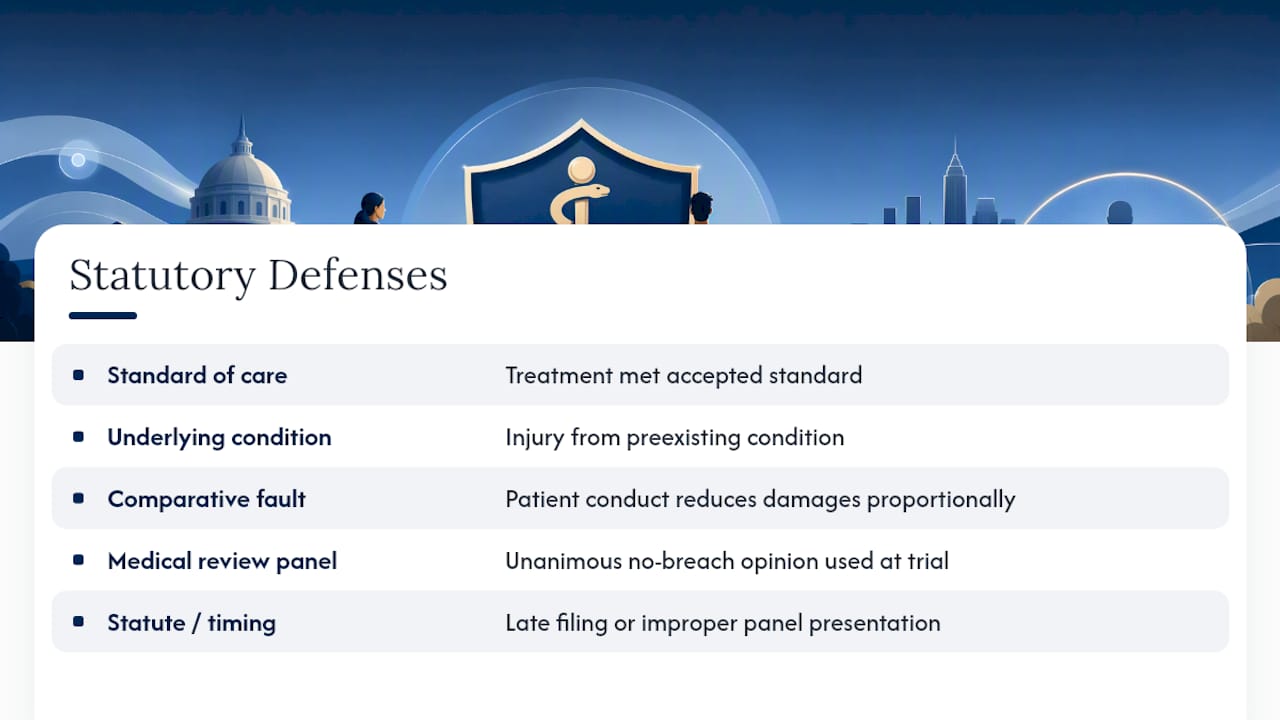
The most common defense challenges one of the four required elements outright. If a provider’s attorney can show the treatment met the accepted standard of care, or that your injury resulted from the underlying condition rather than any breach, the claim fails regardless of how sympathetic your situation is. Causation disputes are especially common in cases involving patients who had serious preexisting conditions, since defense experts will argue the bad outcome was likely regardless of treatment.
Comparative fault also plays a role. If a patient didn’t follow post-treatment instructions, missed follow-up appointments, or withheld relevant medical history, a provider can argue the patient’s own conduct contributed to the outcome. Indiana’s comparative fault framework can reduce a damages award proportionally rather than eliminating it entirely, so this defense rarely wins outright but often shrinks the eventual recovery.
Providers also lean heavily on the medical review panel’s opinion when it favors them. While that opinion isn’t binding, a unanimous panel finding of no breach becomes a powerful piece of evidence at trial, and defense counsel will typically feature it prominently.
Finally, providers can raise a statute of limitations defense if a claim was filed even a few days late, or argue the claimant failed to properly present the case to the panel before filing suit. These procedural defenses succeed often enough that timing and process deserve as much attention as the medical facts themselves.
Appealing a Medical Review Panel Decision
A panel opinion isn’t the end of the road for either side, and it isn’t a formal appeal in the traditional sense either. Because the panel’s conclusion is advisory rather than binding, neither party files an “appeal” the way they would with a court ruling. Instead, once the panel issues its written opinion, either side is free to proceed directly to court and let a judge or jury weigh the same evidence fresh.
That said, timing still governs everything. You have until 90 days after receiving the panel’s opinion to file suit in court, a window built directly into the tolling provisions of IC 34-18-7-3. Miss that 90 days and the claim can be barred permanently, even if the underlying malpractice was clear cut.
If the panel opinion goes against you, your legal options center on building a stronger evidentiary record for trial rather than challenging the panel’s process itself. Panel members can be called as witnesses, and their opinion becomes one piece of evidence among many, not a final verdict. Skilled counsel will often prepare additional expert testimony specifically to counter an unfavorable panel finding, since juries are free to reach a different conclusion than the panel did.
Delays in receiving a panel opinion are common, particularly when panelists have full clinical schedules. If your case has sat with a panel for an extended period without movement, it’s worth confirming filing status directly with IDOI rather than assuming the 90-day clock hasn’t started.
Attorney Fees and Contingency Arrangements in Malpractice Cases
Most Indiana medical malpractice attorneys, including Keller & Keller, work on a contingency basis. That means you pay nothing upfront, and the firm only collects a fee if your case settles or wins a judgment.
Indiana law doesn’t impose a hard statutory cap on contingency percentages in malpractice cases the way some states do, but the practical range typically runs between one third and 40% of the recovery, often scaling based on how far the case proceeds before resolution. A case settled before filing a lawsuit often carries a lower percentage than one that goes all the way through trial and appeal, since trial work requires substantially more attorney time and risk.
The damages cap complicates fee calculations in a way that doesn’t come up in uncapped injury cases. Because total recovery is capped at $1,800,000 for malpractice after June 30, 2019, attorneys and clients both need to think realistically about net recovery after fees and case expenses, particularly in catastrophic injury or wrongful death cases where the true value of the harm may exceed what the cap allows. This is one reason experienced malpractice counsel spends significant time upfront assessing whether a case is worth pursuing given the cap’s ceiling relative to the litigation costs involved.
Ask any attorney you’re considering to explain their fee percentage and how it changes at different stages of the case before you sign a representation agreement. A transparent conversation about fees upfront prevents confusion later when a settlement offer arrives.
Who and What the Medical Malpractice Act Covers
The Indiana Medical Malpractice Act applies broadly across the health care system, but not every provider or facility falls under its protections and procedural requirements. Understanding coverage matters because it determines whether the two-year deadline, the damages cap, and the panel requirement even apply to your case.
Covered practitioners generally include physicians, surgeons, dentists, nurses, physician assistants, nurse practitioners, chiropractors, podiatrists, physical therapists, and psychologists, provided they qualify under the Act. Covered facilities typically include hospitals, ambulatory surgical centers, and other licensed health care institutions.
The critical detail claimants often miss is “qualified provider” status. Not every practitioner or facility has paid into the Patient’s Compensation Fund or met IDOI’s other requirements to be considered qualified under the Act. When a provider isn’t qualified, the case may fall outside the Act’s procedural requirements, meaning no mandatory panel and potentially no damages cap protecting the provider either.
- Hospitals, clinics, and surgical centers licensed in Indiana are typically covered facilities.
- Physicians, nurses, dentists, and various licensed allied health professionals are typically covered practitioners.
- Nursing homes and long-term care facilities may fall under separate liability frameworks depending on the nature of the claim, particularly for neglect or abuse allegations rather than clinical treatment decisions.
- Checking a provider’s qualified status with IDOI early can change how your entire case gets structured procedurally.
This distinction is worth raising with an attorney early, since it affects strategy from the first filing decision onward.
When to Act Immediately, and When an Early Consult Changes Outcomes
Death, permanent injury, pediatric cases, and delayed discovery all demand fast action. Early counsel preserves evidence and keeps you inside the panel’s procedural rules.
Free Consultation and Contingency Representation for Your Malpractice Claim
If you’re dealing with a botched diagnosis, a surgical error, or a loved one’s wrongful death, you have other paths forward, from handling the proposed complaint yourself to hiring a general practice attorney unfamiliar with Indiana’s panel process. Neither gets you the advantage of a firm that has specifically navigated IDOI’s filing requirements and the medical review panel process on repeat.

Keller & Keller offers a free consultation and represents Indiana malpractice clients on a contingency basis, meaning you owe nothing unless your case settles or wins. Our team handles the medical review panel process directly, tracks the tolling deadlines that can quietly expire while a claim sits idle, and structures the proposed complaint correctly the first time.
Bring your medical records, billing statements, and a written timeline of events to your intake meeting. If you’re also facing insurance pushback on a related claim, our page on how insurers deny injury claims explains what policyholders can do. Visit 2keller to schedule your free consultation today.
Sources
- Filing a Medical Malpractice Complaint — Indiana Department of Insurance
- Ind. Code 34 (2024) — Indiana General Assembly
- Indiana Code Title 34 § 34-18-14-3 — FindLaw
- IC 34-18-8 — Commencement of a medical malpractice action (Justia)
- Indiana medical malpractice laws — Nolo