
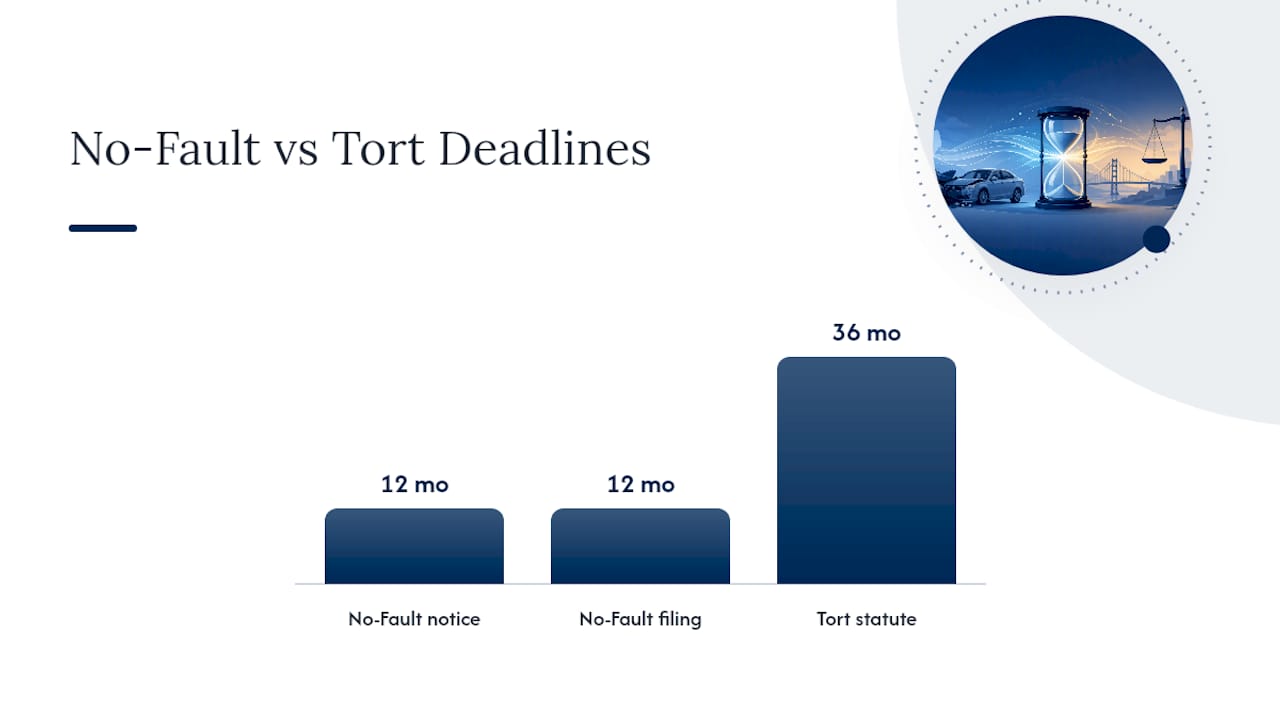
Michigan gives you a period following a crash to file a personal injury, property damage, or wrongful death lawsuit under MCL 600.5805. The typical limitation period is three years from the date of the crash. A separate, much shorter clock also runs: Michigan No-Fault benefit claims require written notice to your insurer within one year, per MCL 500.3145, and missing this requirement can bar medical and wage-loss benefits even if your tort suit deadline remains open. Michigan law requires drivers to stop, exchange information, and render aid at the scene, with criminal penalties applicable for failure to comply.
TL;DR:
- Missing the one-year written notice to your insurer can bar no-fault benefits, even if the three-year tort lawsuit deadline remains open.
- The three-year limitation for most Michigan car accident claims starts on the crash date but can be paused for minors, mental incapacity, or delayed injury discovery.
- Sending written notice within the first year after an accident preserves no-fault benefits and prevents losing coverage due to late reporting.
- Failing to comply with Michigan’s scene duties, such as stopping, exchanging information, or rendering aid, can lead to criminal charges or license suspension.
- Contacting a lawyer early is crucial if you face serious injuries, insurance disputes, or claims involving out-of-state drivers, to protect your rights before deadlines expire.
Table of Contents
- What Does Michigan’s Car Accident Statute Say?
- How Do Michigan No-Fault Notice Deadlines Work?
- What Are Your Duties at the Scene of a Michigan Crash?
- When Does the Clock Start, and What Can Pause It?
- What Should You Do Immediately After a Michigan Car Crash?
- When Should You Contact a Michigan Car Accident Lawyer?
- How Does Michigan’s No-Fault Insurance System Work?
- How Does Fault Affect Compensation in Michigan?
- What Damages Can You Recover After a Michigan Car Accident?
- Can You Still File a Lawsuit After the Deadline Passes?
- Insurer Claims vs. Lawsuits Against the At-Fault Driver: What’s the Difference?
- A Straight Answer on Missed Deadlines
- Get a Free Michigan Case Review Before Any Deadline Closes
- Michigan Statutes and Resources Worth Bookmarking
- Sources
- FAQ
What Does Michigan’s Car Accident Statute Say?
The controlling language in MCL 600.5805 is direct: for injury to a person or property, “the period of limitations is 3 years after the time of the death or injury.” That single sentence governs the overwhelming majority of Michigan car accident lawsuits, whether you are pursuing a driver for pain and suffering, wreckage costs, or a wrongful death claim on behalf of a family member.
The three-year rule is not universal, though. Michigan statute carves out different periods for specific claims, and confusing one for another is a common, costly mistake:
- Assault, battery, or false imprisonment: a shorter limitation period applies.
- Malicious prosecution: limited period applies.
- Medical malpractice: generally a shorter limitation period applies (see our Michigan malpractice statute breakdown for details).
- Certain claims involving minors or criminal sexual conduct: have extended limitation periods beyond the typical term.
These variations exist within the same statutory chapter, which is why FindLaw’s summary of MCL 600.5805 is worth reading in full rather than skimming for the headline number.
“Accrual” is the legal term for when the clock starts. In most car accidents, that is straightforward: the crash date. But if an injury only becomes apparent later, such as a soft-tissue injury or a diagnosis delayed by weeks, accrual questions get more complicated, and that gap is exactly where cases get contested.
How Do Michigan No-Fault Notice Deadlines Work?
Michigan’s No-Fault system runs on its own clock, separate from the tort deadline, and it moves much faster. Under MCL 500.3145, an action to recover personal protection insurance benefits generally cannot proceed unless one of these conditions is met:
- You gave your insurer written notice of the injury within 1 year of the accident.
- The insurer already made a payment for the injury within that year, which itself extends the window.
- You file suit within 1 year of the accident, absent notice or payment.
There is a secondary trap buried in the statute: even when notice is timely, you generally cannot recover benefits for losses incurred more than one year before you file suit. If your insurer pays regularly, though, the filing window resets to one year after the most recent allowable expense or wage-loss payment, which is why tracking payment dates matters as much as tracking the accident date itself.
Here’s the contrast that trips people up. A driver injured in March who sends written notice to their insurer within a few weeks preserves their No-Fault benefits regardless of how the claim later unfolds. A driver who assumes the “three-year rule” applies to everything, and waits 14 months to mention a lingering back injury to their insurer, may find that PIP benefits are barred outright, even though their three-year tort deadline hasn’t moved an inch. The notice requirement and the tort deadline are legally unrelated, and treating them as one clock is the single most common mistake we see in Michigan claims.
What Are Your Duties at the Scene of a Michigan Crash?
Michigan law imposes obligations at the time of a crash. Under MCL 257.617 through 257.622, drivers involved must stop at or near the scene without undue obstruction, exchange identifying and vehicle information, render reasonable assistance to injured persons including arranging medical transport, and report the accident to police when it involves injury, death, or property damage exceeding a statutory threshold.
Leaving the scene of an accident involving injury or death is a felony under Michigan law. Leaving the scene after crashes involving only property damage may lead to misdemeanor charges and license suspension.
Pro Tip: Complying with these duties does double work. It keeps you out of criminal jeopardy, and it creates the contemporaneous record, police report, exchanged information, documented aid, that your later injury claim will lean on.
When Does the Clock Start, and What Can Pause It?
“When a claim first accrued” sounds abstract until you’re the one arguing about it. For most Michigan car accidents, accrual is simply the crash date, full stop. But several recognized exceptions can shift that starting point or pause the clock entirely:
- Delayed discovery: if an injury genuinely couldn’t be known at the time of the crash, courts may look at when it was reasonably discoverable, though this is narrowly applied outside malpractice contexts
- Minors: claims involving injured minors often have extended periods tied to reaching the age of majority
- Mental incapacity: incapacitation can toll (pause) the running of the limitations period
- Insurer payments: as noted above, ongoing No-Fault payments extend the one-year filing window under MCL 500.3145
- Alternate statutory periods: malpractice, criminal sexual conduct, and a handful of other claim types carry their own fixed periods under different subsections of 600.5805
None of these exceptions are automatic. Each requires specific facts, and courts apply them narrowly rather than as a general grace period for anyone who missed a deadline.
What Should You Do Immediately After a Michigan Car Crash?
The steps you take in the first hours and weeks after a crash directly determine whether your claim survives statutory scrutiny later. Handle them roughly in this order:
- Get medical care immediately, even if injuries seem minor. Medical records dated close to the accident are often the strongest evidence tying your injury to the crash.
- Call police and get a report number, especially if damage or injury meets the statutory reporting threshold.
- Exchange information and photograph everything: vehicles, the roadway, visible injuries, and any relevant signage or signals.
- Collect witness contact information before people leave the scene.
- Send written notice to your No-Fault insurer describing the injury, well within the one-year window, even if you’re still assessing the full extent of harm.
- Track every bill, missed workday, and insurer response, including denials, in writing where possible.
- Avoid giving a recorded statement to any insurer (including your own) without talking to an attorney first.
Pro Tip: Send your No-Fault notice in writing, not just a phone call, and keep a copy. If an insurer later disputes whether you gave timely notice, a dated letter or email is far more useful than your memory of a phone conversation.
If your insurer denies benefits or a liability dispute emerges, that’s the point to bring in counsel rather than negotiate alone.
When Should You Contact a Michigan Car Accident Lawyer?
Certain situations call for legal help well before any deadline is close to expiring. Contact a lawyer promptly if you’re dealing with a serious or permanent injury, a liability dispute where the other driver contests fault, symptoms that developed days or weeks after the crash, an insurer denying or delaying No-Fault benefits, or a crash involving an out-of-state driver whose insurance rules may differ from Michigan’s.
An attorney’s first moves in these cases are rarely dramatic, but they’re precise. That includes confirming that written notice was properly given to preserve No-Fault benefits, documenting any facts that support a tolling or discovery-rule argument, calendaring the true filing deadline rather than relying on a rule of thumb, and opening negotiation with insurers from a position backed by evidence rather than guesswork.
Keller & Keller’s Michigan practice, including Adam’s writing on the firm’s blog covering out-of-state drivers in Michigan crashes, focuses specifically on these Michigan-specific procedural traps because they’re where otherwise valid claims get lost.
How Does Michigan’s No-Fault Insurance System Work?
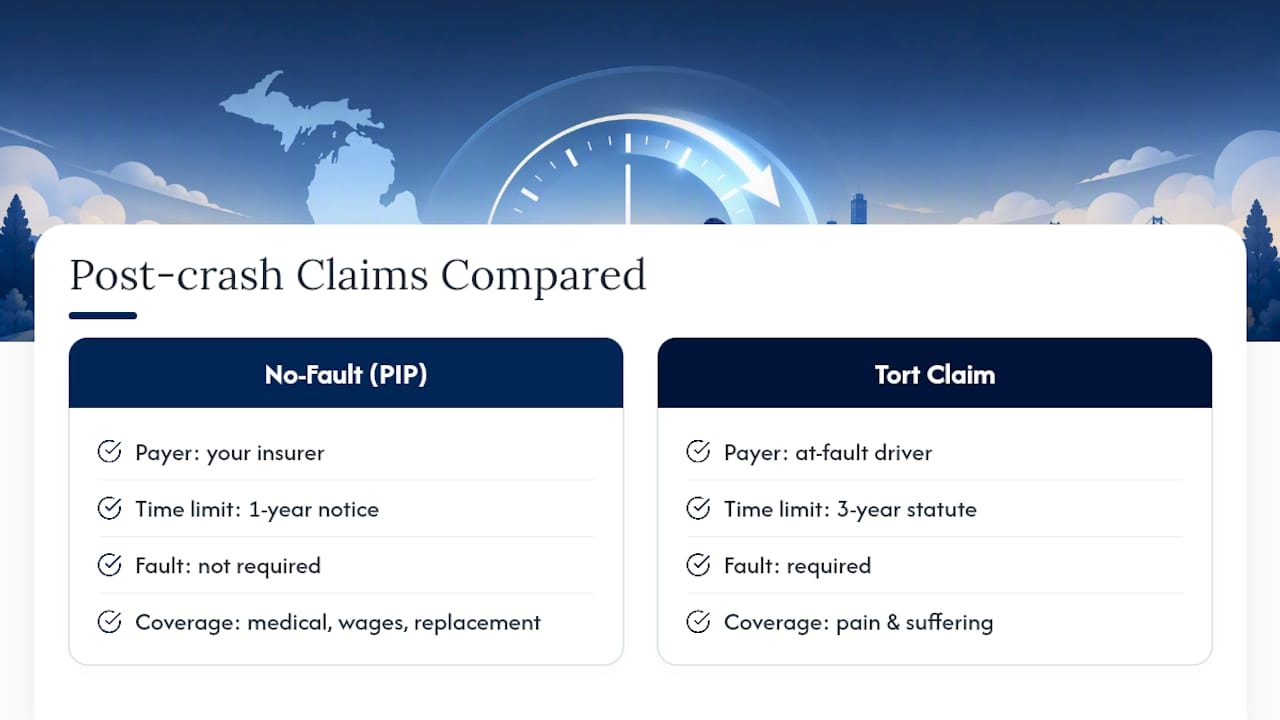
Michigan operates under a No-Fault insurance system, meaning that after a crash, you generally turn to your own auto policy first for medical bills and lost wages, regardless of who caused the accident. This is a fundamentally different structure than the “at-fault pays first” model many other states use, and it changes your entire claims strategy from the outset.
Under this system, Personal Injury Protection (PIP) benefits cover reasonable and necessary medical expenses, a portion of lost wages, and replacement services for tasks you can no longer perform because of your injuries. These benefits flow through your own insurer (or a resident relative’s policy, or the assigned claims plan in some cases) independent of fault. Our breakdown of Michigan’s No-Fault order of priority walks through exactly whose policy pays first when multiple policies could apply.
The tradeoff is that No-Fault limits your ability to sue the at-fault driver for pain and suffering unless your injury meets the threshold defined in MCL 500.3135, a “serious impairment of body function” or comparable severe harm. This means many Michigan crash victims are running two claims in parallel: a No-Fault benefits claim against their own insurer, governed by the one-year notice rule, and potentially a separate tort claim against the at-fault driver, governed by the three-year statute. Understanding which system covers which type of loss is often the first thing that trips up someone handling a claim without guidance. For a fuller walkthrough, see our guide on what injured drivers must do under Michigan No-Fault law.
How Does Fault Affect Compensation in Michigan?
Michigan follows a modified comparative negligence rule, where compensation reduces by your percentage of fault.
Fault determinations rest on evidence gathered close to the time of the crash: police reports, witness statements, traffic camera footage where available, and vehicle damage patterns. This is part of why the on-scene duties discussed earlier matter so much. A police report filed the day of the crash carries far more weight than a reconstructed account built months later from memory.
Insurance adjusters routinely push fault percentages higher than the facts support, particularly in disputed intersection crashes or lane-change collisions where liability isn’t obvious.
What Damages Can You Recover After a Michigan Car Accident?
Michigan car accident victims can pursue two broad categories of compensation, and which one applies depends on whether you’re claiming against your own No-Fault insurer or suing the at-fault driver in tort.
Economic damages cover quantifiable financial losses: medical expenses, lost wages, replacement services (help with household tasks you can no longer perform), and property damage to your vehicle. Under No-Fault, most of these flow through PIP benefits regardless of fault, though wage-loss benefits are capped and time-limited under the statute.
Noneconomic damages, pain and suffering, loss of enjoyment of life, and similar harms, are only available through a tort lawsuit against the at-fault driver, and only if your injury meets the “serious impairment of body function” threshold under MCL 500.3135. This is a meaningful legal hurdle, not a formality; it typically requires documented, objectively verifiable injury affecting your general ability to lead your normal life.
In wrongful death cases, Michigan law allows surviving family members to recover both economic losses (lost financial support, funeral and burial expenses) and noneconomic losses (loss of companionship, mental anguish) through the estate, still subject to the three-year filing window under MCL 600.5805.
Can You Still File a Lawsuit After the Deadline Passes?
Once the applicable statute of limitations expires, whether the three-year tort deadline or the one-year No-Fault notice window, Michigan courts will almost always dismiss the claim if the defendant raises the deadline as a defense. Judges don’t typically raise this issue on their own; the opposing side has to argue it, but they almost always do.
There are narrow paths around a missed deadline, and none of them are simple do-it-yourself fixes. A minor’s claim may extend past their 18th birthday. A claimant who was mentally incapacitated during the relevant period may have grounds for tolling. A discovery-rule argument, showing the injury genuinely could not have been known earlier, sometimes applies outside standard tort claims, though Michigan courts apply it narrowly.
If you believe you have grounds to argue that your deadline should be extended, that argument needs to be raised the right way, supported by medical records, insurer correspondence, and a clear timeline, and ideally before the deadline passes rather than after a court has already dismissed your case. Waiting until after the statute has run to build that argument is a significantly harder position to argue from. This is precisely the kind of procedural fight where legal representation stops being optional and starts being the difference between a viable claim and a dismissed one.
Insurer Claims vs. Lawsuits Against the At-Fault Driver: What’s the Difference?
These are two entirely separate legal processes, and Michigan drivers frequently conflate them, sometimes at real cost to their recovery.
A No-Fault benefits claim goes against your own auto insurer (or the insurer otherwise responsible under Michigan’s priority rules). It covers medical bills, a portion of lost wages, and replacement services, and it doesn’t matter who caused the crash. This claim is governed by MCL 500.3145’s one-year notice and filing rules, and it’s essentially a contract and statutory claim, not a fault-based lawsuit.
A tort lawsuit against the at-fault driver is a different animal entirely. It seeks compensation the No-Fault system doesn’t cover: pain and suffering, and in some cases additional economic losses beyond what PIP pays. This claim requires proving the other driver’s negligence, requires your injury to meet the serious-impairment threshold, and runs on the three-year clock under MCL 600.5805.
Here’s the practical wrinkle: you can pursue both simultaneously, and in many serious-injury cases, you should. Missing one doesn’t disqualify you from the other, but the deadlines don’t sync up, and treating them as a single timeline is how people lose access to benefits they were otherwise entitled to. Our page on how liens affect injury settlements covers another wrinkle worth understanding early: how PIP payments and settlement proceeds interact once both claims resolve.
A Straight Answer on Missed Deadlines
The pattern we see most often isn’t dramatic. It’s a driver who assumed they had three years to handle everything, only to discover months later that their No-Fault notice window had already closed. By the time that mistake surfaces, usually when a bill goes unpaid or a benefit gets denied, there’s often very little room left to fix it.
The fix isn’t complicated: send written notice early, document everything, and get a professional read on your timeline before you assume you have more time than you do. Keller & Keller’s Michigan practice exists largely because these procedural gaps, not the underlying facts of who caused the crash, are what determine whether a claim survives.
— Adam
Get a Free Michigan Case Review Before Any Deadline Closes
Get your Michigan accident timeline reviewed by a personal injury law firm that offers free consultations and contingency-fee representation. A consultation typically covers confirming which deadlines apply to your specific claim, identifying immediate steps to protect your No-Fault benefits and any tort claim, and providing guidance on your case.

If you’re unsure whether your notice was timely, whether your injury meets Michigan’s serious-impairment threshold, or whether you’re even looking at the right deadline, that uncertainty is exactly what a free consultation resolves. Compare your options and see how a contingency-fee firm stacks up against handling a claim alone or through other personal injury law firm alternatives. Reach out today and get your timeline reviewed before a deadline you didn’t know about closes on you.
Michigan Statutes and Resources Worth Bookmarking
- MCL 600.5805: the 3-year tort statute of limitations
- MCL 500.3145: No-Fault notice and filing deadlines
- MCL 257.617-622)/documents/mcl/pdf/mcl-300-1949-VI-ACCIDENTS.pdf): duties at the scene and reporting thresholds
- Michigan’s Complex No-Fault Law: a deeper look at how benefits and deadlines interact
This article is general information, not a substitute for advice from a qualified lawyer. Consult a qualified legal professional about your own circumstances before acting on anything here.
FAQ
How long do I have to sue after a car accident in Michigan?
You generally have three years from the date of the accident or death to file a personal injury, property damage, or wrongful death lawsuit under MCL 600.5805.
What is the deadline for Michigan No-Fault benefits?
You must give written notice of your injury to your insurer within one year of the accident, or file suit within that year, unless the insurer already made a payment, under MCL 500.3145.
Can I lose No-Fault benefits even if I still have time to sue?
Yes. The one-year notice requirement and the three-year tort deadline are separate; missing the notice window can bar PIP benefits even while your lawsuit deadline remains open.
What happens if I leave the scene of a crash in Michigan?
Leaving the scene of an accident involving injury or death is a felony under Michigan law, and even property-damage-only crashes can bring misdemeanor charges and license suspension.
Does 2keller offer a free consultation for Michigan car accident cases?
Yes, Certain personal injury firms provide free consultations and represent Michigan car accident clients on a contingency-fee basis, meaning there’s no fee unless the case is won or settled.