
Yes, a ladder fall can support a lawsuit when a property owner, employer, or manufacturer’s negligence caused or worsened your accident. Your first move is not calling a lawyer. It’s getting medical care and documenting the scene, because that record becomes the backbone of any negligence, premises liability, or product-liability claim you file later. If another party’s carelessness put you on that ladder in the first place, talk to an attorney soon, before evidence disappears and deadlines close in.
TL;DR:
- Most ladder fall claims are strengthened by photographic evidence of the scene, the ladder’s condition, and any hazards present at the time of the fall.
- Prompt medical treatment within 48 hours is crucial to establishing injury severity and preventing insurance disputes over delayed care.
- Liability can rest with property owners, employers, or ladder manufacturers, especially if safety standards or maintenance procedures were neglected.
- Expert testimony and thorough evidence collection significantly influence the success of negligence or product defect lawsuits.
- Statutes of limitations vary by state, so filing within the specified window is essential, with most cases relying on damages such as medical costs, lost wages, and pain and suffering.
Table of Contents
- Immediate Steps After a Ladder Fall Injury
- Who Can Be Held Liable for a Ladder Accident?
- How Ladder Fall Lawsuits Are Proven in Court
- Evidence That Strengthens a Ladder Fall Injury Claim
- Timeline and Compensation for Ladder Fall Cases
- When to Bring in a Ladder Fall Attorney
- What Most People Get Wrong About Ladder Fall Claims
- Get a Free Consultation for Your Ladder Fall Claim
- Sources
- FAQ
Immediate Steps After a Ladder Fall Injury
What you do in the first 48 hours often decides whether a ladder fall claim succeeds. Insurance adjusters look for gaps between the accident and treatment, and they use those gaps to argue the injury wasn’t as serious as claimed.
- Get medical care immediately, even if you feel capable of walking away. A doctor’s exam creates a timestamped medical record connecting your injuries to the fall, and some injuries like concussions or spinal compression don’t show symptoms right away.
- Photograph everything before it changes. Shoot the ladder itself, its base surface, the setup angle, your footwear, and any nearby hazards. Use your phone’s automatic timestamp or a photo app that logs the date.
- Report the incident formally. Notify your employer, the property manager, or building owner in writing, and request a copy of any incident report filed.
- Preserve the ladder. Don’t let anyone repair, discard, or move it until it’s been photographed and, if possible, inspected by an expert.
- Avoid recorded statements to insurance companies until you understand your rights. Adjusters often use early, unguarded comments to shift blame onto you.
Pro Tip: Keep a written log of your symptoms, missed workdays, and follow-up appointments starting the day of the fall. Insurers weigh contemporaneous notes far more heavily than memories reconstructed months later.
Who Can Be Held Liable for a Ladder Accident?
Liability in a ladder fall case usually points to one of three parties, sometimes more than one at once.
Property owners and managers face premises liability claims when they knew, or reasonably should have known, about a hazard like a wobbly balcony ladder or unstable flooring beneath a work ladder and failed to fix or warn about it.
Employers and contractors carry responsibility for workplace ladder falls, particularly when OSHA-compliant setup, inspection, or training protocols weren’t followed. Construction ladders must meet OSHA compliance standards, and a violation of those standards is strong evidence of negligence. Some state labor statutes go further, imposing near-strict liability on site owners when a ladder used as a safety device wasn’t properly secured, as one recent appellate ruling illustrates.
Ladder manufacturers or sellers can be sued under product liability theories when a design flaw, manufacturing defect, or inadequate warning label caused the failure.
Fault is rarely one-sided. Most states apply comparative or contributory negligence rules that reduce, or in a few states bar, your recovery if you share blame for the fall.
How Ladder Fall Lawsuits Are Proven in Court

Winning a negligence claim requires proving four elements: the defendant owed you a duty of care, breached that duty, the breach actually and proximately caused your fall, and you suffered measurable damages as a result. Miss any one link in that chain and the claim collapses, regardless of how badly you were hurt.
Product liability cases run on a different track. You must show the ladder had a design defect, a manufacturing defect, or an inadequate warning, and that the defect (not user error) caused the accident. This is where many ladder fall injury cases get contested hardest.
- Defense attorneys routinely argue user error or improper setup rather than a product flaw.
- Courts have dismissed manufacturing-defect claims when plaintiffs couldn’t produce expert evidence tying a preexisting defect directly to the accident.
- One federal case ended in a defense verdict after the defense offered a plausible alternative explanation, an unstable setup rather than a faulty ladder.
Expert testimony often decides these cases. Accident reconstruction specialists analyze the fall mechanics, metallurgists examine the ladder for material failure, and physicians testify to medical causation. Without that expert layer, a construction ladder lawsuit can stall on causation alone.
Evidence That Strengthens a Ladder Fall Injury Claim
The strength of your case usually tracks the strength of your evidence file, so build it methodically rather than relying on memory.
- Scene photographs and video, capturing the ladder’s setup angle, the condition of its feet, the surface it stood on, and any obstructions or spills nearby. NIOSH data shows roughly 40% of falls involve base slide-out tied directly to incorrect setup angle, so angle documentation matters enormously.
- The physical ladder itself, along with the clothing and shoes you wore, stored untouched and unrepaired.
- Witness information, names, phone numbers, and written statements from anyone who saw the fall or the ladder’s condition beforehand.
- Medical records and bills, imaging results, physical therapy notes, and documentation of missed work.
- Maintenance and purchase records for the ladder, showing its age, inspection history, and any prior repairs.
Sequential photos taken over days or weeks, showing bruising progression or a wound’s healing pattern, also carry real weight with adjusters and juries alike.
Timeline and Compensation for Ladder Fall Cases
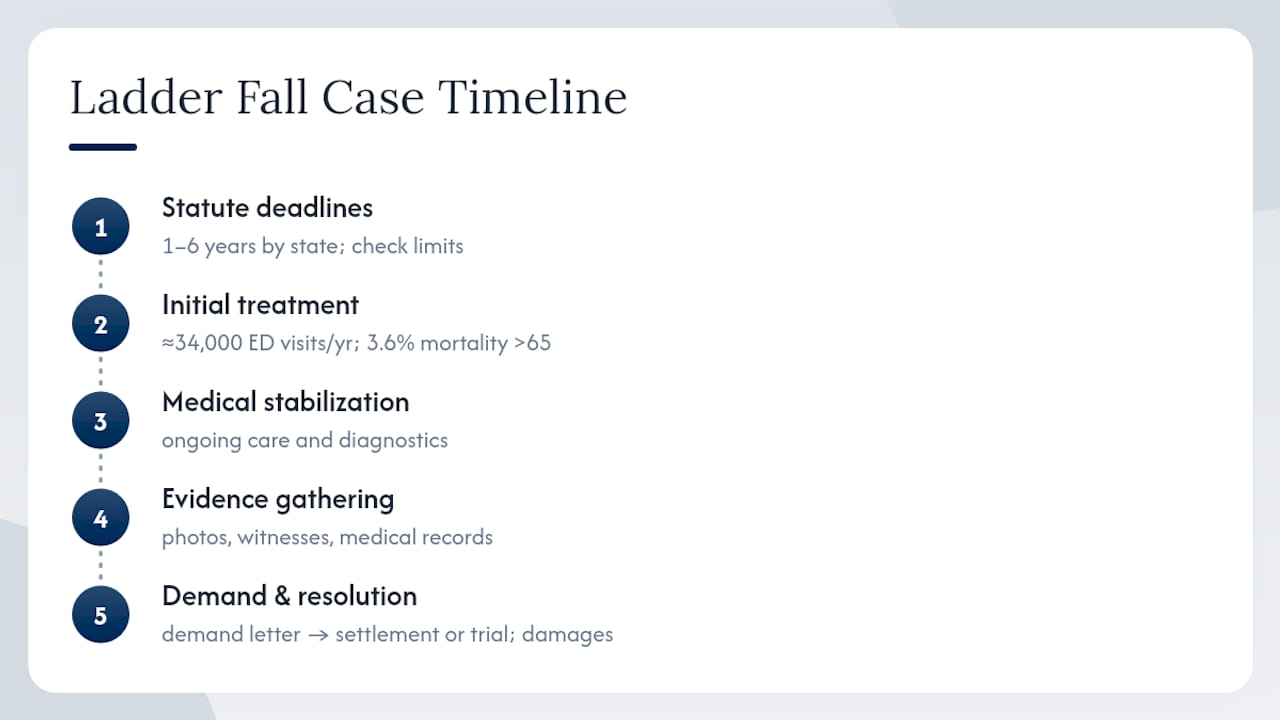
Statutes of limitation for personal injury claims vary widely by state, generally ranging from one to six years from the date of injury, though some states apply shorter windows to claims against government property owners. Check your state’s specific deadline immediately. Missing it typically ends your right to sue, no matter how strong your evidence is.
A typical case moves from initial treatment through medical stabilization, evidence gathering, a demand letter to the insurer, and either a negotiated settlement or trial. Ladder fall injuries carry real severity: about 34,000 people are treated in U.S. emergency departments annually for ladder falls, with in-hospital mortality reaching 3.6% for patients over 65, a figure that shapes how attorneys value future care needs for older claimants.
Recoverable damages typically include medical expenses, lost wages, future care costs, and pain and suffering. When a fall proves fatal, as in one Las Vegas case involving a handyman, families can pursue wrongful-death and loss-of-consortium claims.
When to Bring in a Ladder Fall Attorney
Certain signals mean it’s time to stop handling things alone. A serious injury, a disputed fault determination, an insurer denying or lowballing your claim, a suspected product defect, or an employer deflecting responsibility, any one of these is reason enough to consult a lawyer.
An experienced firm preserves evidence before it disappears, retains the right experts, and manages every conversation with insurance adjusters on your behalf. Keller & Keller handles slip-and-fall and ladder accident claims across Indiana, Michigan, and New Mexico, with working familiarity in OSHA compliance issues that often surface in workplace ladder cases. Before your consultation, gather your photos, medical records, witness contacts, and any ladder purchase or maintenance records. That preparation alone can shorten how long the early evaluation takes.
What Most People Get Wrong About Ladder Fall Claims
Insurers move fast on ladder fall claims precisely because early offers are cheap and injured people are financially stressed. The mistake I see most often is treating that first offer as a starting point for negotiation rather than a number designed to close the file before you understand your injury’s full trajectory.
Serious ladder falls, spine injuries especially, often need months of treatment before anyone can accurately value future care. Contingency-fee representation exists so you can wait that out without paying upfront.
— Adam
Get a Free Consultation for Your Ladder Fall Claim
If a property owner’s neglected railing, an employer’s skipped safety check, or a defective rung put you on the ground, you don’t have to sort out liability alone while medical bills pile up. Some personal injury firms offer free consultations and work on a contingency basis, meaning there’s no fee unless they recover compensation for you.

Bring what you’ve gathered: photographs of the ladder and scene, medical records, witness contact information, and any purchase or maintenance history for the ladder involved. During a case evaluation, the legal team will help determine whether your situation points to premises liability, employer negligence, or a product defect, and what that means for your next steps. If an insurer has already denied your claim or offered a settlement that feels low, review why insurers deny injury claims before you sign anything, then consider reaching out to a personal injury firm for consultation.
Sources
This article draws on peer-reviewed research on ladder fall injury patterns and outcomes, CDC and NIOSH ladder safety guidance including the NIOSH Ladder Safety App, and representative court opinions on causation and product-defect claims cited throughout.
- Falls from ladders: Injury patterns and outcomes
- Ladder safety | Falls | CDC
- Appellate opinion discussing manufacturing-defect claim and causation challenges (2025)
- Law
FAQ
Can I sue if I fell off a ladder at work?
Yes, if the fall resulted from an employer’s OSHA violation, a defective ladder, or unsafe site conditions, though workplace falls may also involve workers’ compensation alongside any third-party lawsuit.
How long do I have to file a ladder fall lawsuit?
Statutes of limitation typically range from one to six years depending on your state, so confirm your state’s specific deadline as soon as possible after the injury.
What if I was partly at fault for my ladder accident?
Most states apply comparative or contributory negligence rules, which can reduce your compensation proportionally or, in a handful of states, bar recovery entirely if you’re found more than 50% at fault.
Do I need an expert witness for a ladder fall injury lawsuit?
Serious or disputed cases often require expert testimony from accident reconstruction specialists, metallurgists, or physicians to prove causation, especially in product liability claims.
What compensation can I get from a ladder fall lawsuit?
Common damages include medical expenses, lost wages, future care costs, and pain and suffering, with wrongful-death and loss-of-consortium claims available when a fall proves fatal.