
Two statutes govern most Indiana car accident claims: Ind. Code § 9-26-1-1.1, which requires drivers to stop and report a crash, and Ind. Code § 34-11-2-4, which gives you two years to file a lawsuit for injury or property damage. Act fast to preserve evidence and never let that two-year clock sneak up on you.
TL;DR:
- Drivers must report accidents within 270 days to avoid losing government claim rights, and filing claims after two years is generally barred unless tolling applies.
- Collecting evidence quickly through photographs, witness contact info, and medical records is crucial to preserve your claim and counter potential defense strategies.
- Courts will reduce your damages proportionally to your fault, and exceeding 50% fault prevents recovery entirely under Indiana’s modified comparative fault rule.
- Filing deadlines can be paused for minors, active military members, or victims under legal disability, but missing these windows can dismiss your case.
- Insurance companies may challenge causation, fault, or damages, making prompt scene documentation, medical treatment, and legal consultation vital to secure fair compensation.
Table of Contents
- What to do immediately after a crash in Indiana
- Reporting duties and penalties under Indiana law (IC 9-26-1-1.1)
- How long do you have to file a car accident claim in Indiana?
- How does Indiana’s comparative fault rule affect your claim?
- Special deadlines: government claims, wrongful death, and tolling
- What should you do next to protect your claim?
- What damages can you recover after an Indiana car accident?
- What insurance requirements apply after an Indiana car accident?
- Does Indiana have a no-fault insurance system?
- Can you still file a lawsuit after Indiana’s deadline has passed?
- What defenses do insurance companies use in Indiana car accident cases?
- A closing thought on common mistakes
- How Keller & Keller can help with your Indiana claim
- Primary statutes and official resources
- Sources
- FAQ
What to do immediately after a crash in Indiana
The minutes right after a collision often determine whether you have a strong claim or a weak one. Indiana law and the Indiana Driver’s Manual both set expectations for how drivers behave at the scene, and getting this part right protects you legally and medically.
- Stop and stay at the scene. Exchange your name, address, and vehicle registration with the other driver.
- Call 911 if anyone is injured, if you can’t locate a vehicle’s owner, or if you’re unsure how serious the damage is.
- Leave vehicles in place if someone is trapped, injured, or if hazardous materials are involved. Otherwise, move to a safe shoulder or lot once it’s clear to do so.
- Photograph vehicle positions, damage, license plates, road conditions, and any skid marks before traffic disturbs the scene.
- Collect witness names and phone numbers, and get the responding officer’s name and the police report number.
- Get medical care promptly, even for injuries that seem minor. Medical records establish both your condition and the accrual date the statute of limitations will later hinge on.
Pro Tip: Take a wide shot of the entire intersection or road segment before you photograph individual vehicles. Insurers and courts often care as much about lane position and sightlines as they do about bumper damage.
Reporting duties and penalties under Indiana law (IC 9-26-1-1.1)
IC 9-26-1-1.1 spells out what every driver involved in a crash must do: stop, provide identifying information, and render reasonable assistance if anyone is injured or killed. If you hit an unattended vehicle or property, you must try to locate the owner or notify law enforcement rather than simply driving off.
Penalties scale with the severity of the outcome and whether you knew someone was hurt:
- Leaving the scene of a property-damage-only crash can be charged as a Class B misdemeanor.
- Leaving the scene when there’s injury can escalate to a Class A misdemeanor or a Level 6 felony.
- Leaving the scene of a fatal crash, particularly with knowledge of the death, can reach a Level 3 felony.
- Repeat violations and aggravating factors, such as intoxication, push penalties higher still.
Staying put and calling for help does double duty. It keeps you out of criminal jeopardy and it builds the documented timeline your civil claim will need later. Drivers who flee, even from minor fender benders, often turn a manageable insurance claim into a hit and run investigation with far higher stakes.
How long do you have to file a car accident claim in Indiana?
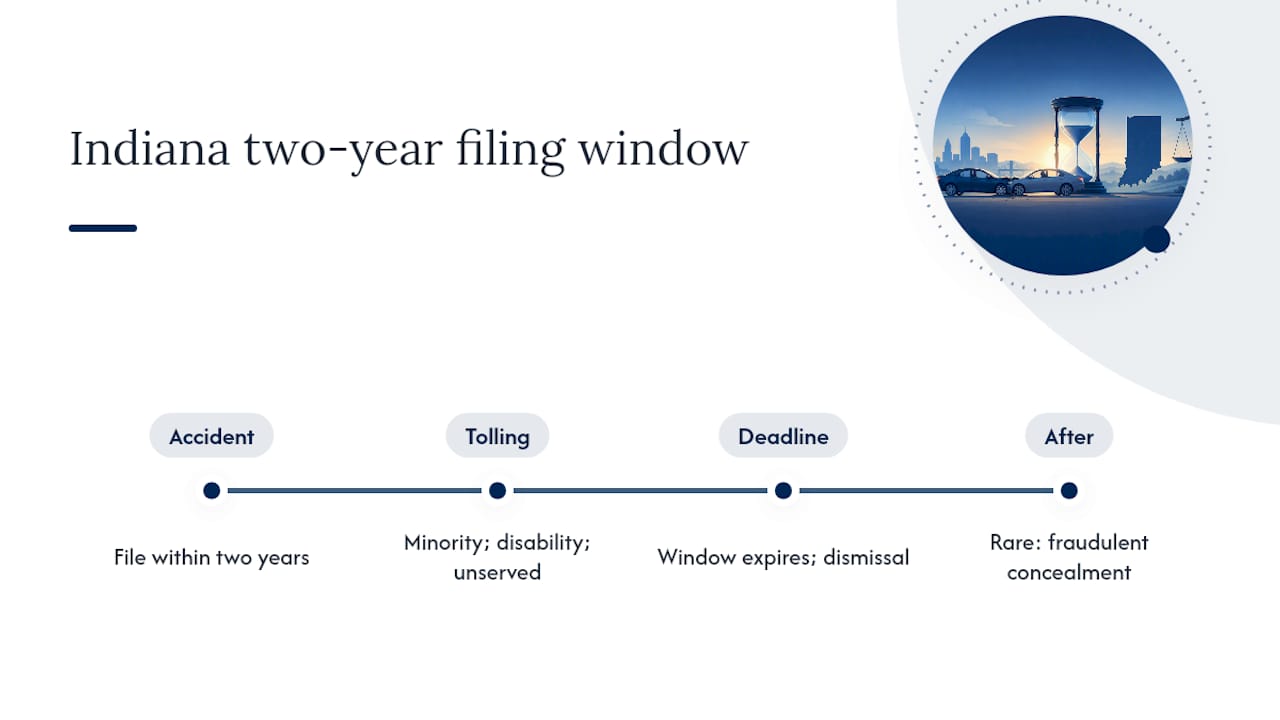
You generally have two years from the date of the crash to file a personal injury or property damage lawsuit under Ind. Code § 34-11-2-4. For a wrongful death claim, the filing period typically runs from the date of death rather than the date of the collision, which matters when a victim survives the crash by weeks or months before passing.
Several situations toll, or pause, that clock:
- Minors injured in a crash often have their two-year window begin closer to their 18th birthday rather than the accident date.
- Legal disability or incapacity at the time of injury can delay when the clock starts running.
- Claims against nonresident defendants and periods of active military service can also affect timing.
- Claims against a government entity follow a much shorter notice requirement of several months, shorter than the two-year rule.
Don’t assume an uninsured or underinsured motorist claim buys you more time. Those claims generally follow the same tort deadline as any other injury case, regardless of what your policy’s contract language implies. Miss the deadline without a valid toll, and the court will almost certainly grant the defense’s motion to dismiss before your case ever reaches a jury.
How does Indiana’s comparative fault rule affect your claim?
Indiana uses modified comparative fault under IC 34-51-2-5 and IC 34-51-2-6. A jury assigns a percentage of fault to each party, including any nonparties whose actions contributed to the crash, and those percentages don’t have to add up to 100% between just the plaintiff and defendant.
- A driver found 30% at fault with $100,000 in damages collects $70,000.
- A driver found 51% at fault collects nothing, regardless of how severe their injuries were.
- Insurance adjusters often assign fault percentages early in a claim, but those numbers aren’t binding legal determinations. Documented evidence, from dashcam footage to witness statements, can shift the percentage a court ultimately relies on.
Fault percentages also affect how medical liens get paid out of a settlement, since providers with liens typically get paid from whatever net recovery survives the comparative fault reduction. Understanding how comparative fault actually works before you accept an insurer’s fault assessment can be the difference between a fair settlement and a lowball one.
Special deadlines: government claims, wrongful death, and tolling
Some crashes come with deadlines shorter and less forgiving than the standard two years. If a government vehicle, like a snowplow, police cruiser, or city bus, was involved, the Indiana Tort Claims Act requires a formal notice of claim within 270 days, well before the two-year lawsuit deadline even becomes relevant.
- Government defendants: 270-day notice requirement, separate from and shorter than the two-year filing deadline.
- Wrongful death: two years from the date of death, which can fall later than the date of the crash itself.
- Minors: the clock often doesn’t fully start until the injured person turns 18.
- Nonresident defendants and active military service: both can pause or extend the standard filing window.
If any of these situations apply to your case, don’t wait to find out how the rules interact. Government notice requirements are strict, and missing that 270-day window can extinguish an otherwise valid claim before it’s ever filed.
What should you do next to protect your claim?
Turning statutes into action means moving quickly on a short list of tasks:
- Obtain your official Indiana police report and confirm the report number matches your records.
- Continue medical treatment and keep every bill, imaging report, and provider note in one file.
- Photograph vehicle damage before repairs and preserve any surveillance or traffic camera footage early, since it’s often overwritten within days.
- Report the crash to your insurer promptly, but hold off on a recorded statement about fault or injuries until you’ve spoken with an attorney if injuries are significant.
- Call a lawyer right away if a government vehicle was involved, someone died, fault is contested, or your statute of limitations deadline is approaching.
Pro Tip: Businesses near the crash site often overwrite security footage within a week or two. A written preservation request sent the same day can be the difference between having video evidence and having none.
What damages can you recover after an Indiana car accident?
Indiana law allows recovery of three categories of damages, though not every case qualifies for all three. Economic damages cover the measurable financial losses: medical bills, lost wages, future earning capacity, property repair costs, and out-of-pocket expenses tied directly to the crash. These are usually the easiest to prove because they come with receipts, pay stubs, and medical billing records attached.
Non-economic damages compensate for harm that doesn’t come with an invoice, things like pain and suffering, loss of enjoyment of life, disfigurement, and emotional distress. Indiana doesn’t cap non-economic damages in standard car accident cases the way some states do, though caps do apply in medical malpractice claims under separate statutes.
Punitive damages are rarer and reserved for cases involving gross negligence or willful misconduct, such as a drunk driver who caused a crash. Courts award punitive damages to punish the defendant’s conduct rather than simply compensate the victim, and the bar for proving that kind of misconduct is considerably higher than for ordinary negligence.
All three categories get filtered through the comparative fault reduction discussed earlier. If a jury finds you 20% at fault, your economic, non-economic, and any punitive award are all reduced by that percentage before you see a dollar.
What insurance requirements apply after an Indiana car accident?
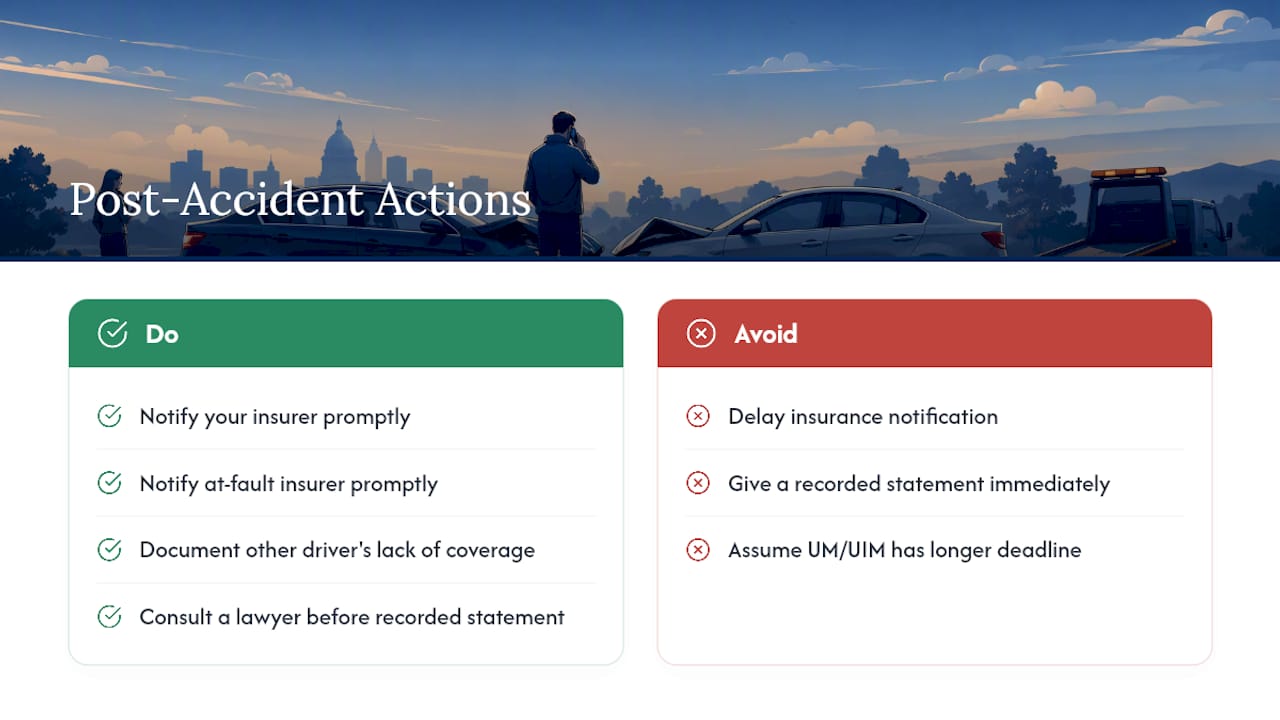
Indiana requires drivers to carry minimum liability coverage, and the claims process typically starts with notifying your own insurer and the at-fault driver’s insurer as soon as possible after the crash. Most policies include a notification clause requiring prompt reporting, so delaying that call, even while you focus on medical care, can create friction later.
Once notified, the at-fault driver’s insurer typically opens a claim file, assigns an adjuster, and begins evaluating fault and damages. Adjusters frequently request a recorded statement early in the process. You’re not obligated to give one immediately, and if your injuries are serious or fault is disputed, it’s often wiser to consult a lawyer first, since early statements can be used to undercut your claim later.
If the at-fault driver is uninsured or underinsured, your own policy’s uninsured/underinsured motorist coverage becomes the relevant source of compensation, assuming you carry that coverage. Notably, claims under UM/UIM coverage generally follow the same two-year tort deadline as a standard injury lawsuit, not a longer contract-based limitations period some policyholders mistakenly assume applies. Reporting the crash to your carrier promptly, documenting the other driver’s lack of coverage, and understanding your policy limits early all shape how much leverage you have during negotiations.
Does Indiana have a no-fault insurance system?
Indiana is a fault-based state, not a no-fault state. That distinction matters because it changes who pays first after a crash. In a no-fault system, each driver’s own insurer covers their medical bills and losses regardless of who caused the accident, usually through required personal injury protection coverage.
Indiana doesn’t work that way. The at-fault driver, or more precisely their liability insurance, is responsible for covering the other party’s damages. That’s why fault determination carries so much weight in Indiana claims. Since there’s no PIP requirement forcing your own insurer to pay your bills upfront, you and your medical providers are often waiting on the outcome of the fault investigation and settlement negotiations before bills get resolved.
The practical effect: Hoosiers involved in a crash need to prove the other driver’s fault, or negotiate around a comparative fault percentage, to get compensated at all. This makes early evidence collection, the photos, witness statements, and police report discussed earlier, more valuable in Indiana than it would be in a no-fault state where your own coverage pays regardless of blame.
Can you still file a lawsuit after Indiana’s deadline has passed?
Once the two-year window under Ind. Code § 34-11-2-4 closes, filing a lawsuit becomes extremely difficult, though not always impossible. Courts treat the statute of limitations as an affirmative defense, meaning the defendant has to raise it, but once raised, judges routinely grant a motion to dismiss unless the plaintiff can point to a specific tolling provision.
Valid arguments for filing late are narrow. They typically involve proving the plaintiff was a minor at the time of the crash, was under a legal disability that prevented earlier filing, or that the defendant was a nonresident who couldn’t be served within the standard window. Fraudulent concealment by the defendant, where they actively hid facts necessary to bring the claim, can also toll the clock in rare cases.
Outside of those exceptions, there’s no general “good cause” extension for simply not knowing about the deadline or being too busy recovering to contact a lawyer. If your deadline is approaching and any complicating factor might apply, whether it’s a possible tolling situation or a government defendant, getting a legal opinion well before the two-year mark gives you options that disappear entirely once the window closes.
What defenses do insurance companies use in Indiana car accident cases?
Defense strategies in Indiana car accident cases usually center on shifting or increasing your share of comparative fault, since doing so directly reduces or eliminates what they owe. Common defenses include:
- Comparative fault allocation. Arguing you contributed to the crash, through speeding, distraction, or failing to yield, to push your fault percentage toward or past the 50% bar.
- Disputing causation. Claiming your injuries stem from a pre-existing condition or a different incident rather than this crash.
- Challenging damages. Arguing medical treatment was excessive, unnecessary, or unrelated to the collision.
- Statute of limitations. Moving to dismiss if the case was filed even slightly outside the two-year window without a valid toll.
- Sudden emergency doctrine. Arguing the driver faced an unforeseeable emergency, such as a sudden mechanical failure, that excuses otherwise negligent conduct.
Every one of these defenses hinges on evidence, which is exactly why the on-scene documentation and prompt medical care covered earlier carry so much weight months later when an adjuster or defense attorney starts building their case.
A closing thought on common mistakes
The clients who struggle most aren’t the ones with weak cases. They’re the ones who waited weeks to see a doctor, never got a witness’s number, or gave a recorded statement before understanding how fault would be calculated. Early action preserves evidence, keeps your claim on the right side of the statute of limitations, and puts you in a stronger negotiating position from day one.
— Adam
How Keller & Keller can help with your Indiana claim
Sorting out fault percentages, government notice deadlines, and a two-year clock that doesn’t pause for recovery time is a lot to manage while you’re also healing. Keller & Keller represents Indiana drivers and families in car accident injury and wrongful death claims, working on a contingency fee basis so you owe nothing unless the firm wins or settles your case.

Consultations are generally offered to help you understand your deadline, comparative fault exposure, and potential claim value before committing to representation. That matters most when a government vehicle was involved, multiple drivers share blame, or your 270-day or two-year window is getting close. If you’re unsure where your case stands, reach out for a free case evaluation before a deadline decides the outcome for you.
Primary statutes and official resources
For readers who want to check the law directly: Ind. Code § 9-26-1-1.1 covers reporting duties, Ind. Code § 34-11-2-4 sets the two-year filing deadline, and IC 34-51-2 governs comparative fault. The Indiana Driver’s Manual, Chapter 8, explains practical scene procedures in plain language.
This article is general information, not a substitute for advice from a qualified lawyer. Consult a qualified legal professional about your own circumstances before acting on anything here.
Sources
- Indiana Code 2026 — Title 34, Article 11, Chapter 2
- Indiana Code Title 9. Motor Vehicles § 9-26-1-1.1 | FindLaw
- Indiana Driver’s Manual: Chapter 8 — Accidents and emergency situations
FAQ
Is Indiana a fault state for car accidents?
Yes. Indiana is a fault-based state, meaning the at-fault driver’s insurance is responsible for covering the other party’s damages, unlike no-fault states where each driver’s own PIP coverage pays first regardless of blame.
What are the main laws governing car accidents in Indiana?
The two central statutes are IC 9-26-1-1.1, which sets duties to stop and report, and IC 34-51-2-5/34-51-2-6, which sets Indiana’s modified comparative fault rule and 50% bar to recovery.
What is the statute of limitations for car accidents in Indiana?
Under Ind. Code § 34-11-2-4, you generally have two years from the date of the accident to file a personal injury or property damage lawsuit, with narrow tolling exceptions for minors, legal disability, and other special circumstances.
What does Indiana Code 9-26-1-1.1 mean?
It requires any driver involved in a crash to stop, exchange identifying information, and, if there’s injury or death, provide reasonable assistance and notify law enforcement or 911. Violating it can result in penalties ranging from a misdemeanor to a felony depending on the severity of harm caused.
Can I still recover damages if I was partly at fault for the crash?
Indiana’s modified comparative fault rule reduces your damages by your percentage of fault but bars recovery entirely once you’re found more than half responsible.