If a prescription or over-the-counter medication injured you in New Mexico, you may be able to bring a defective drug lawsuit against the company that made or sold it. These claims rest on a manufacturing flaw, a dangerous design, or a warning label that failed to describe a known risk. They are technical, they depend on medical and scientific proof, and they have a filing deadline that starts running sooner than most people expect.
This guide explains what makes a drug legally defective, how these cases differ from medication-error claims, what you must prove, what to save, what compensation may cover, and how the New Mexico deadline works.
TL;DR
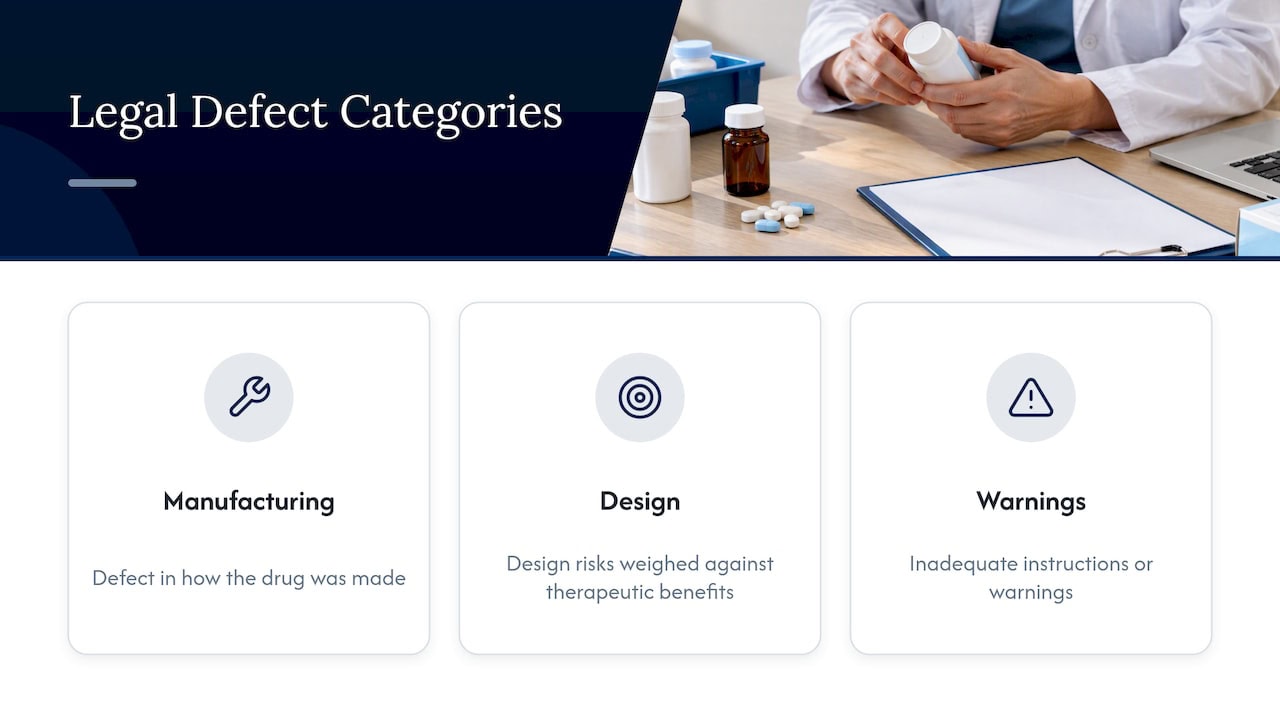
- A drug can be legally defective in three ways: a manufacturing defect, an unsafe design, or inadequate instructions or warnings.
- Failure to warn is the theory most often used against drug makers in the United States.
- You generally must show an injury, a defect or missing warning, causation, and use of the drug as intended or reasonably expected.
- A reference chart reports a three-year limitations period for New Mexico, but accrual and exceptions vary, so confirm your deadline early.
- Keep the pills, packaging, pharmacy records and medical records. Do not discard anything.
Table of Contents
- What makes a drug legally defective
- Defective drug claim or medication error?
- Who can be held responsible
- What you must prove
- Evidence to preserve right now
- The New Mexico filing deadline
- Compensation in a defective drug case
- Our perspective
- How we can help
- Related claims you may be dealing with
- FAQ
- Sources
What makes a drug legally defective
A medication does not become defective simply because it has side effects. Every effective drug carries some risk. The legal question is whether the product was unreasonably dangerous for the way it was made, designed or labeled.
Under the Restatement framework, a prescription drug is defective if it has a manufacturing defect, is not reasonably safe because of its design, or is not reasonably safe because of inadequate instructions or warnings. A law review analysis of manufacturer liability explains that the design inquiry weighs foreseeable risks against therapeutic benefits, which is why a drug with serious but justified risks is not automatically a defective one.
Manufacturing defects
This is the most intuitive category: the drug that reached you was not made the way it was supposed to be. Contamination, wrong strength, or mislabeling all fit here. Two FDA recall notices show how this looks in practice. In one, a lot of cyclobenzaprine bottles was recalled because the labels were inadvertently placed on bottles that held meloxicam tablets. In another, a worldwide ranitidine recall was initiated over possible contamination with the nitrosamine impurity NDMA.
A recall is not a lawsuit, and it does not by itself prove your injury came from the product. It can, however, be important evidence that a problem existed with the lot you took.
Design defects
A design defect means every unit of the drug carries the problem because of how the product was formulated. These cases usually turn on expert testimony about whether a safer alternative design or formulation was feasible and whether the benefits justified the risk.
Failure to warn
This is the theory most often used. Robinette and Green explain in their review of pharmaceutical product liability in the United States that failure to warn is the primary theory against drug manufacturers, and that it may be brought under strict product liability or negligence. In a typical case, the claim is that the company knew or should have known about a serious risk and did not tell prescribers or patients clearly enough. Medical-legal reporting in The Hospitalist points to Vioxx cardiovascular deaths, Actos bladder-cancer allegations and Baycol rhabdomyolysis as well-known examples of warning-based allegations.
Defective drug claim or medication error?
People often start with the wrong label for their case, and the label decides who you sue.
| Defective drug claim | Medication error claim | |
|---|---|---|
| Core allegation | The drug itself was defective or its warning was inadequate | A professional made a mistake with the drug |
| Typical defendants | Manufacturer and other product-liability defendants | Physician, pharmacy or other healthcare provider |
| Example | Contaminated lot, unsafe formulation, missing risk warning | Wrong drug dispensed, wrong dose prescribed, missed interaction |
| Legal framework | Product liability | Negligence, often medical malpractice |
The distinction is drawn in the same pharmaceutical product liability review: defective-drug suits generally target the manufacturer, while medication-error litigation concerns a healthcare professional’s or pharmacy’s negligent prescribing, dispensing, administration, monitoring or counseling. A medicolegal study of physician and pharmacist liability presents real cases of inappropriate prescribing and dispensing.
Some injuries involve both. A patient might receive a drug with an undisclosed risk and also be prescribed it despite a documented contraindication. If your situation touches a doctor or pharmacy, our New Mexico medical malpractice articles explain how those claims work, and they follow different timing rules.
Who can be held responsible
Depending on the facts, responsibility may extend beyond the company whose name is on the bottle:
- The manufacturer that designed, tested, produced or labeled the drug.
- Other companies in the chain, such as a contract manufacturer or distributor, when the defect arose in their stage.
- A prescriber or pharmacy, when the problem was how the drug was prescribed or dispensed rather than the product itself.
- A government actor, in unusual cases.
That last point matters more than it seems. The Congressional Research Service explains in its overview of the Federal Tort Claims Act that the Act allows compensation claims against the United States for torts of federal employees, but statutory exceptions can bar recovery. If your medication came through a federal facility, the claim may require a separate pathway with its own procedures, so tell your attorney where you received the drug. For state and local public bodies, our guide to the New Mexico Tort Claims Act covers the notice rules that can apply.
What you must prove
Winning a defective drug case takes more than showing you took a medication and got hurt. A product liability FAQ summarizes the general elements a plaintiff must establish:
- Injury or damage. Documented harm, usually through medical records.
- A defect or missing warning. The drug was flawed in manufacture or design, or the label left out a risk.
- Causation. The defect or missing warning, rather than your underlying condition or another factor, caused the injury.
- Intended or reasonably expected use. You used the drug as directed or in a way the maker could foresee.
Showing that a drug has risks is not enough. You must connect the alleged defect to your specific injury.
The American Association for Justice notes that pharmaceutical products liability cases repeatedly raise the same issues: FDA approval and post-market surveillance, adverse-event reporting, pharmacology and epidemiology, expert qualification, discovery of electronically maintained information, and federal preemption. In plain terms, these cases are expert-driven. They require physicians, pharmacologists and epidemiologists, and they require access to company documents. That is a large part of why people do not handle them alone.
Evidence to preserve right now
What you save in the first weeks can shape the case years later.
- The medication itself, including remaining pills, injectors or patches, in the original container.
- Packaging, labels, lot numbers and inserts. The lot number is how a recall or contamination problem is tied to your supply.
- Pharmacy records showing the drug, dosage, fill dates and pharmacy.
- Medical records and bills from before and after the injury, including diagnoses and test results.
- A symptom journal with dates, severity and how daily life changed.
- Recall notices and warning letters you received or found.
- Proof of lost income, such as pay stubs and employer letters.
Do not return unused medication to a pharmacy for disposal if you think it may be defective. Do not post details of your injury online, and be cautious about speaking with the manufacturer’s insurer before you have advice. If the drug came from a hospital or clinic, ask a lawyer how to request records so nothing is lost.
The New Mexico filing deadline
Time limits are the most unforgiving part of any injury claim. A missed deadline can end a case regardless of how strong the facts are.
The International Association of Defense Counsel’s 50-state drug and device chart reports a three-year limitations period for New Mexico for the relevant personal-injury or product-liability entry. That chart was published in 2013, and it is subject to its own cited authorities and exceptions. A 2011 legislative bill quotes the existing personal-injury limitation as three years under NMSA §37-1-8, which is consistent with that figure.
Three years is a starting point, not a promise. Several issues can change the real deadline:
- When the claim accrues. Drug injuries often appear slowly. A condition may develop months or years after you began taking a medication, and the question of when you knew or should have known about the cause can be contested.
- Medical malpractice claims. If a healthcare provider is a defendant, different rules apply. The New Mexico Court of Appeals discussed the three-year Medical Malpractice Act period in Richter, and explained that limitations issues can affect whether allegedly negligent physicians remain parties to a case.
- Government defendants. Public bodies and federal employees bring notice requirements and exceptions of their own.
- Wrongful death. When a drug injury ends in death, a separate claim may exist for the family.
Because the statute and court decisions can change, do not rely on a chart or a blog post, including this one, to fix your deadline. Have an attorney check the current statute and controlling New Mexico authority against your dates. For a sense of how deadlines work in another kind of New Mexico case, see our article on the motorcycle accident statute of limitations.
Compensation in a defective drug case
What you may recover depends on the evidence and on how your injuries have affected your life. The product liability FAQ lists the usual categories of compensatory damages:
- Medical expenses, past and future
- Lost wages or lost profits
- Property damage
- Pain and suffering and other non-economic losses
Punitive damages may be awarded if a judge or jury finds the defendant acted particularly badly, to punish the conduct and deter others. They are the exception, not the expectation.
Taxes and liens
Two practical points surprise many clients. First, the IRS states in Publication 4345 that compensatory damages received on account of personal physical injury or physical sickness are generally excluded from income, except to the extent they reimburse medical expenses previously deducted for a tax benefit, while punitive damages are generally taxable. The IRS also explains that what the payment was intended to replace is the key question. A tax professional should review your settlement terms.
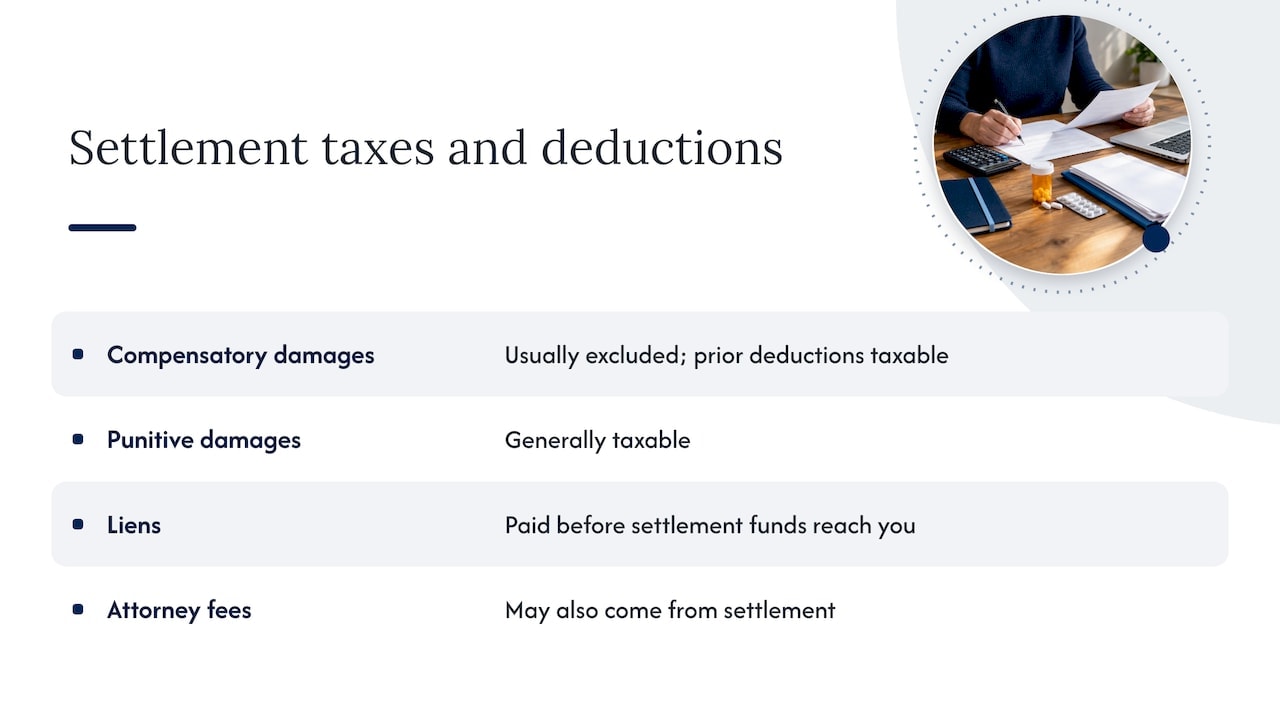
Second, money does not go straight to you. Before settlement funds are turned over, a lawyer typically pays liens, which may include medical and government liens, and insurers may be entitled to reimbursement, according to a legal FAQ on drug lawsuits. Attorney fees may also come from the settlement. Knowing about these items early lets your attorney negotiate them down and gives you a realistic picture of what you will net.
Our perspective
Drug cases are the ones where people most often blame themselves. A client will say, “My doctor prescribed it and I took it as told, so maybe this is just bad luck.” Sometimes it is not. A label that left out a known risk or a contaminated lot is a failure by a company with far more resources than you have.
We built our practice around the idea that injured families should not face those companies alone. That means direct access to your attorney and paralegal, plain explanations of what is happening in your case, and a team with experience taking on large insurance companies and corporate defendants. It also means we cover the cost of getting started: you pay no fee unless we win.
If you are unsure whether what happened to you is a defective drug case, a medication error, or neither, that is the right thing to bring to a free evaluation. We would rather sort that out with you early than have you lose time you cannot get back.
Adam
How we can help
Our firm handles defective drug and device cases for injured people in New Mexico, as well as car and truck crashes, wrongful death, product liability, medical malpractice and more. The free case evaluation costs nothing, and we work on a contingency fee, so there is no fee unless we win your case.

To see how we approach these claims, read about our New Mexico defective drug and device lawyers, or if the harm came from another kind of dangerous item, our New Mexico product liability practice. When you are ready to talk, you can request your free case evaluation and we will review the medication, the injury and the timeline with you.
Related claims you may be dealing with
Drug injuries rarely arrive alone. A patient harmed by a medication may also be dealing with a hospital stay, a long-term care facility or an overdose. Our page on fentanyl lawsuits addresses one of the most serious situations, and our overview of bed sore lawyers in New Mexico is relevant when injuries occur in care settings. Each type of claim has its own defendants and proof, so tell your attorney everything about your treatment history.
FAQ
Can I sue if the FDA approved the drug?
Yes, FDA approval does not automatically protect a manufacturer from every claim. The role of FDA approval and post-market surveillance, along with federal preemption, are recurring issues in these cases, which is why the specific allegation (manufacturing flaw, design or warning) matters so much. An attorney can tell you which defenses are likely in your situation.
How long do I have to file a defective drug lawsuit in New Mexico?
A 50-state reference chart reports three years for New Mexico, but when the clock starts and whether an exception applies depend on your facts. Medical malpractice and government defendants can follow different rules. Contact an attorney as soon as you suspect a drug caused your injury so the deadline can be confirmed against current law.
What if my doctor prescribed the drug?
That does not end your claim. A defective drug claim usually targets the manufacturer for a defect or inadequate warning, while a claim against the prescriber would be about negligent prescribing or monitoring. Your case may involve one, the other or both.
How much does it cost to hire a lawyer?
Our case evaluation is free, and we work on a contingency fee. We are paid a percentage of a settlement or award only if we win or settle your case. We will explain the fee terms and any case costs in writing before you sign anything.
Sources
- Manufacturers’ Liability for Drugs and Medical Devices (Seton Hall Law Review)
- Pharmaceutical product liability in the United States
- Unichem cyclobenzaprine recall notice, FDA
- Perrigo ranitidine recall notice, FDA
- Labeling of medication warnings, The Hospitalist
- Physician and Pharmacist Liability: Medicolegal Cases
- The Federal Tort Claims Act: A Legal Overview, Congressional Research Service
- Product Liability FAQ
- Pharmaceutical Products Liability Cases and the FDA, AAJ
- 50 State Drug and Device Quick Reference Guide, IADC
- New Mexico SB0390 (2011)
- Richter, New Mexico Court of Appeals
- IRS Publication 4345
- Tax implications of settlements and judgments, IRS
- Legal FAQs about lawsuits, Drugwatch