Indiana’s initial SSDI approval rate sits close to the national average. One tracker reports 38.6 percent of initial claims approved by Indiana’s disability agency in fiscal year 2024, against 39.8 percent nationwide. The rate climbs sharply once a claim reaches an administrative law judge. Below, we explain where those figures come from, why different websites report different numbers, and how to use the data when you decide what to do next.
TL;DR
- Indiana’s initial approval rate for fiscal year 2024 was about 38.6 percent, roughly 1.2 points under the national 39.8 percent, according to AISSDI’s state data.
- Counted by the share of applicants who are ultimately awarded benefits at the first level, the national figure is lower: 18 to 21 percent for claims filed from 2014 through 2023.
- Indiana reconsideration approvals are low, about 11 percent, while hearings before a judge approve about 53 percent, per Disability Exchange.
- A statewide rate says nothing about your own claim. Medical evidence, work history and age drive the outcome.
- Most denied applicants can still win on appeal, so a denial letter is a deadline, not a verdict.
Table of Contents
- Indiana’s initial SSDI approval rate
- How Indiana compares with the national rate
- Reconsideration and hearing approval rates in Indiana
- What the SSA actually decides
- Why Indiana claims are denied
- What SSDI pays in Indiana
- What to do with these numbers
- Our perspective
- Talk to us about your claim
- FAQ
- Sources
Indiana’s initial SSDI approval rate
When people search for the “approval rate,” they usually mean the share of first-time applications that the state’s Disability Determination Services (DDS) office approves. In Indiana, that office decides the medical side of your claim on behalf of the Social Security Administration (SSA).
For fiscal year 2024, AISSDI reports an Indiana initial DDS approval rate of 38.6 percent. Disability Exchange reports roughly 35 percent for the initial stage in 2024 and says about 65 percent of initial applications in Indiana are denied. Those two numbers do not match, and neither is wrong. They come from different counting methods, which we explain below.
The practical reading is the same either way: between roughly one in three and two in five Indiana applicants are approved on the first try, and the majority are told no.
Why you will see different numbers online
The SSA publishes its state workload data by federal fiscal year, covering receipts, determinations and allowances for initial claims sent to state disability agencies. A fiscal year runs from October through September, so a figure labeled “2024” is not the same as calendar 2024.
The method matters just as much. The SSA’s own Annual Statistical Report defines an allowance rate as medical allowances, including those later denied on technical grounds, divided by medical decisions. It defines an award rate as allowances minus later technical denials, divided by applications minus pending claims. The award rate is always the lower figure, because it counts only people who actually end up with benefits.
So a page quoting 40 percent and a page quoting 20 percent can both be accurate. One counts medical approvals at the state office. The other counts everyone who filed and was ultimately awarded.
How Indiana compares with the national rate
Using the same fiscal year and method, Indiana’s 38.6 percent initial rate is 1.2 percentage points below the national average of 39.8 percent. That is a small gap. It is far too small to justify the idea that Indiana is an unusually hard or easy state.
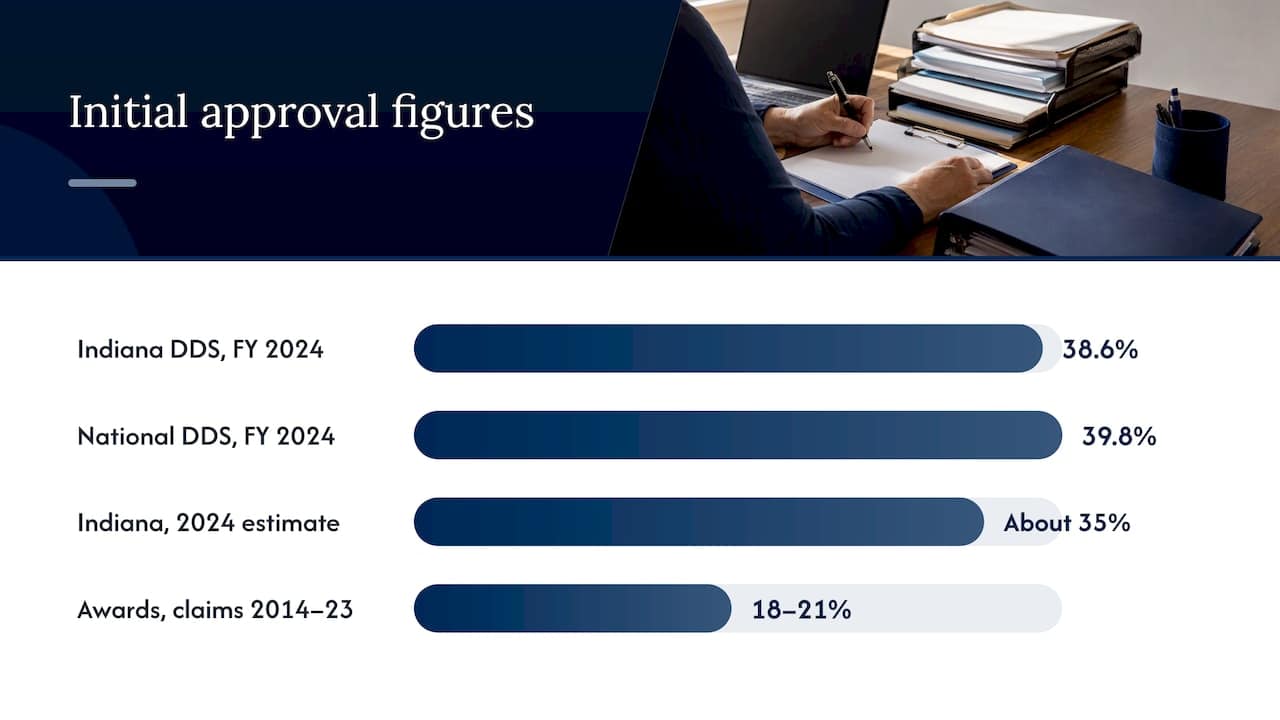
The national award figures are more sobering. According to the SSA’s 2024 Annual Statistical Report, the share of disabled-worker applicants awarded benefits at the initial level ranged from 18 to 21 percent for claims filed from 2014 through 2023. That is the number to keep in mind if you read a headline claiming that most people are approved the first time. They are not.
Here is how the figures line up:
| Measure | Figure | Scope |
|---|---|---|
| Indiana initial DDS approval rate, FY 2024 | 38.6% | Indiana, AISSDI |
| National initial DDS approval rate, FY 2024 | 39.8% | United States, AISSDI |
| Indiana initial approval, 2024 | About 35% | Indiana, Disability Exchange |
| Initial award share, claims filed 2014 to 2023 | 18% to 21% | United States, SSA |
Reconsideration and hearing approval rates in Indiana
If the first decision is a denial, the appeal path in Indiana starts with reconsideration, then a hearing before an administrative law judge (ALJ). The two stages perform very differently.
Disability Exchange reports that about 11 percent of Indiana reconsiderations and 53 percent of ALJ hearings end in approval, compared with national averages of about 14 percent and 56 percent. Reconsideration is largely a second look by the same type of state reviewer, so it rarely changes the outcome. A hearing is different: you appear before a judge, can explain your daily limitations in person, and your representative can question a vocational expert.
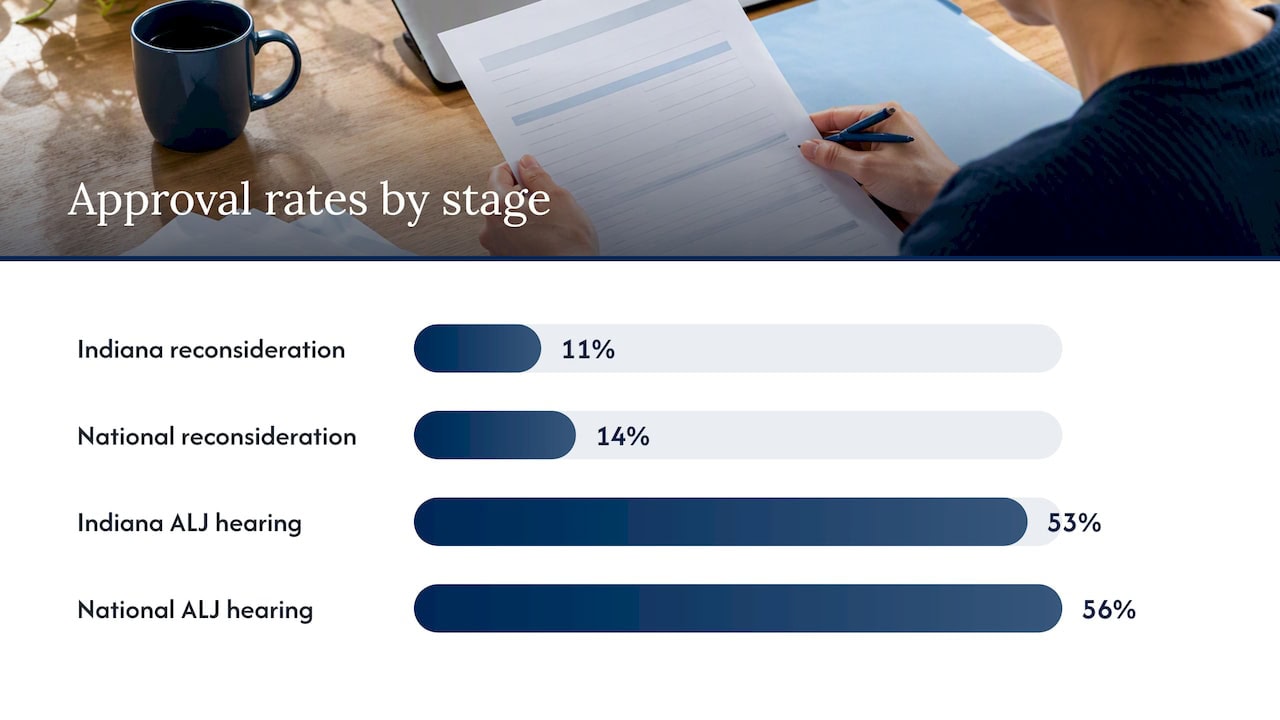
The lesson is not that reconsideration is pointless. It is a required step, and skipping it forfeits the right to a hearing. The lesson is that many strong claims are won at the third stage, so giving up after a second denial is the costliest mistake a claimant can make.
To see how each step works in practice, read our guides on the SSDI reconsideration stage in Indiana and how the SSDI appeals process works. Our overview of the Indiana levels of appeal lays out the full sequence.
Wait times
Time is part of the picture. The SSA’s 2024 statistical report shows the average wait for an initial determination in Indiana was 237 days, against a national average of 227 days. Plan for months, not weeks, and keep your medical treatment documented the whole time.
What the SSA actually decides
A statewide percentage is an average of thousands of very different files. The SSA decides each file by a five-step sequential evaluation. Reviewers look at work activity, the severity of the medical condition, whether it meets or equals a listed impairment, and whether you can do your past work or any other work in the national economy.
The steps matter in order:
- Are you working above the substantial gainful activity (SGA) level? For 2026, SGA means earnings averaging more than $1,690 per month for non-blind individuals, or $2,830 for blind individuals. If you earn above that, the SSA does not move on to the medical evaluation.
- Is your impairment severe? It must significantly limit basic work activities.
- Does it meet or equal a listing? The SSA keeps a list of conditions severe enough to qualify on their own.
- Can you do your past relevant work?
- Can you do any other work, given your age, education and experience?
DDS examiners work with medical or psychological consultants who weigh all of the medical and vocational evidence in the file. That is why the quality of your records decides more than any state average does.
What statewide rates do not tell you
An SSA working paper on state variation found that differences in allowance rates are partly tied to economic and demographic factors, and that states with high filing rates tend to have lower allowance rates. In other words, a state’s rate reflects who applies as much as how strictly claims are judged.
Your age, your work history, the condition itself and the completeness of your records all shift your own odds well away from the state figure. A 58-year-old former warehouse worker with documented back and heart problems is in a different position from a 32-year-old with a recently diagnosed condition and no treatment notes.
Why Indiana claims are denied
In Indiana, common reasons for an initial denial include insufficient medical evidence and a failure to show that the condition prevents substantial gainful activity. Both are problems you can often fix.
The patterns we see most often when reviewing denials:
- Gaps in treatment. Months without seeing a doctor read as improvement, even when the real cause was cost or transportation.
- Records without function. Diagnoses and test results are in the file, but no doctor has written down how long you can sit, stand, lift or concentrate.
- Missed requests. The SSA sends forms and appointment notices, and a missed deadline can end a claim.
- Understated symptoms. Applicants describe their worst day as an average day, or the reverse.
We cover these in more detail in why SSDI applications are denied in Indiana. If your claim involves anxiety, depression or another mental health condition, see applying for disability with a mental illness.
What SSDI pays in Indiana
SSDI benefits are set by your lifetime earnings record, not by your state, so there is no separate Indiana SSDI rate. Nationally, the SSA’s monthly statistical snapshot for September 2026 shows about 6.96 million disabled workers receiving benefits, with an average monthly benefit of $1,636.47.
Supplemental Security Income (SSI) is a different, needs-based program with its own payment levels. In August 2024, the average SSI payment in Indiana was $690.41, compared with $698.51 nationally. Some people qualify for both programs, which is why the two get confused.
What to do with these numbers
The data points to a few decisions that are in your hands:
- File as soon as you cannot work. Initial decisions take months, and the clock on your medical evidence starts when you apply.
- Keep treating. Regular visits with the same doctors create the record the examiner needs.
- Ask your doctors for functional statements. Work-related limits carry more weight than a diagnosis alone.
- Appeal every denial on time. The deadline is stated in your denial letter. Our guide to the SSDI appeals process walks through each stage.
- Prepare for the hearing. If a judge denies you, there are still options, which we describe in what to do after a denial at a hearing.
For a plain walkthrough of the whole system from application to payment, see how the Social Security benefits process works.
Our perspective
A state approval rate is a starting point for a conversation, never a prediction. We have handled thousands of cases against large insurance companies and government agencies, and the claims that succeed are rarely the ones with the best statistics behind them. They are the ones with the best-organized evidence.
That is why we work the way we do. Our family-run firm keeps communication transparent and consistent, and you have direct access to attorneys and paralegals throughout the process. You should never have to guess where your claim stands.
The low reconsideration numbers worry us most, because they discourage people. We tell clients to expect the process to be long and to treat each denial as the next step toward a hearing, where the evidence can be heard in full.
Adam
Talk to us about your claim
We represent Social Security Disability claimants in Indiana, and the consultation is free. Our fee is contingent: we collect a fee only if you win. If you have been denied, or you are about to apply and want your records reviewed first, we can look at where your claim stands and which appeal deadline applies.
Start with a free case evaluation and bring your denial letter if you have one. We also handle car accident, truck accident, wrongful death and other injury claims, so if your disability followed a crash or another person’s negligence, we can look at both claims together.
FAQ
What is the SSDI approval rate in Indiana?
For fiscal year 2024, one tracker reports an initial approval rate of 38.6 percent for Indiana, against 39.8 percent nationally. Another source puts the 2024 initial rate near 35 percent. The difference comes from counting methods and data periods.
What percentage of people get approved for disability on the first try?
Nationwide, the SSA reports that 18 to 21 percent of disabled-worker applicants were awarded benefits at the initial level for claims filed from 2014 through 2023. State-office approval rates look higher, around 40 percent, because they count medical decisions rather than final awards.
Is it easier to win SSDI at a hearing in Indiana?
Yes, on the available data. About 53 percent of Indiana ALJ hearings end in approval, versus about 11 percent at reconsideration, according to Disability Exchange. Hearings let you testify, and your representative can question the vocational expert.
What is the average SSDI payment?
The SSA’s September 2026 snapshot lists an average monthly benefit of $1,636.47 for disabled workers nationally. Your own amount depends on your earnings history, not on whether you live in Indiana.
Does a high state approval rate improve my chances?
Not meaningfully. Your medical evidence, age, education and work history decide your claim. State averages shift mostly with who applies, as an SSA study of state variation found.
Sources
- Indiana SSDI Data, 38.6% DDS Approval Rate (AISSDI)
- Social Security Disability in Indiana: Statistics, Rates (Disability Exchange)
- SSA Annual Statistical Report on the Social Security Disability Insurance Program, 2024
- SSA Fiscal Year Disability Claim Data
- SSA testimony on the five-step evaluation process
- SSA: If You Are Disabled or Blind
- SSA testimony on DDS examiners and medical consultants
- SSA working paper on state allowance rate variation
- SSDI in Indiana: Offices, Processing Times, and How to Apply
- SSA Monthly Statistical Snapshot
- SSA SSI Monthly Statistics, August 2024