A third-party claim is a personal injury lawsuit or insurance claim against someone other than your employer or a co-worker who helped cause your construction-site injury. It can be filed alongside a workers’ compensation claim, and in many cases it is the only route to compensation for pain, suffering and the full value of lost earnings. This guide explains how these claims work in New Mexico, who can be responsible, what evidence matters and when the clock runs out.
TL;DR
- A third-party claim targets a party other than your employer or co-workers, such as a property owner, a different contractor, an equipment maker or a negligent driver.
- Workers’ compensation and a third-party claim can usually run side by side. New Mexico courts have recognized that a worker’s right to pursue a third-party action is preserved.
- Personal injury claims in New Mexico generally carry a three-year filing deadline, and wrongful death claims are commonly listed at three years as well. Confirm your exact date with an attorney as soon as possible.
- Evidence disappears quickly on a job site. Photographs, witness names, contracts and equipment records should be secured early.
- Lawyers at Keller & Keller handle these cases on contingency: no fee unless we recover compensation for you.
Table of Contents
- What a third-party claim is, and how it differs from workers’ compensation
- Can you claim workers’ compensation and sue a third party?
- Who can be a third party on a construction site
- Construction zones: when the injured person is not a worker
- How fault and insurance shape the claim
- Evidence that builds a third-party claim
- Deadlines for New Mexico construction injury claims
- What our team believes about these cases
- How Keller & Keller helps
- Frequently asked questions
- Sources
What a third-party claim is, and how it differs from workers’ compensation
Workers’ compensation is a no-fault system run through your employer’s insurance. If you are hurt on the job, it generally pays medical care and a portion of lost wages without requiring you to prove anyone was careless. The trade-off is that it usually prevents you from suing your own employer for negligence, and it does not pay for pain, suffering or loss of enjoyment of life.
A third-party claim works differently. It is an ordinary negligence case against a person or company that is not your employer. You must show that the party owed you a duty of care, breached it, and that the breach caused your injuries. If you do, the damages are measured the way they are in any personal injury case, which generally includes:
- Medical expenses, past and future
- Lost wages and reduced earning capacity
- Pain and suffering
- Loss of enjoyment of life
- In fatal cases, the losses described in wrongful death law
The difference in value can be large. A workers’ compensation check replaces only part of your wages. A third-party recovery can address the parts of your life that the compensation system never counts.
Can you claim workers’ compensation and sue a third party?
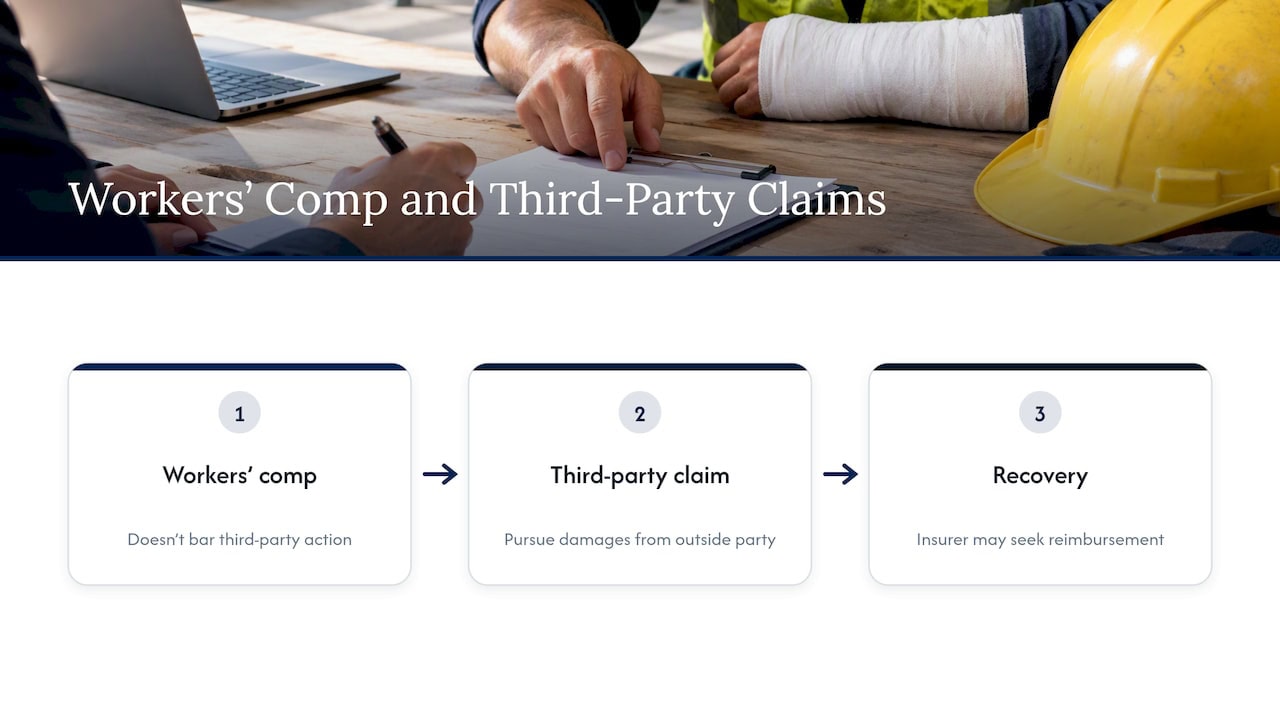
Yes, in most situations. Filing for workers’ compensation does not usually give up your right to pursue another party who caused the injury. In New Mexico, an appellate decision examining the state’s workers’ compensation statute explained that the statute preserved a worker’s third-party action for damages, in a case that arose from a construction dispute. That court was reading an older version of the statute, so the details of how the law works today are worth confirming with a lawyer, but the principle that an injured worker is not locked out of a claim against outsiders has long been part of how these cases are handled.
There is one practical wrinkle. When a workers’ compensation insurer has paid your medical bills and wage benefits, it may have a right to be reimbursed from what you recover from the third party. How that reimbursement is calculated, and whether it can be reduced, depends on the facts and on New Mexico law. This is why it matters to coordinate both claims. A settlement signed without understanding the reimbursement claim can leave you with far less than expected.
Who can be a third party on a construction site
A construction project is rarely run by one company. A typical commercial or residential job in Albuquerque, Rio Rancho or Santa Fe involves an owner, a general contractor, several subcontractors, equipment suppliers, engineers and delivery drivers, all working in the same space. Any one of them may owe a duty of care to workers they do not employ.
Property owners and developers
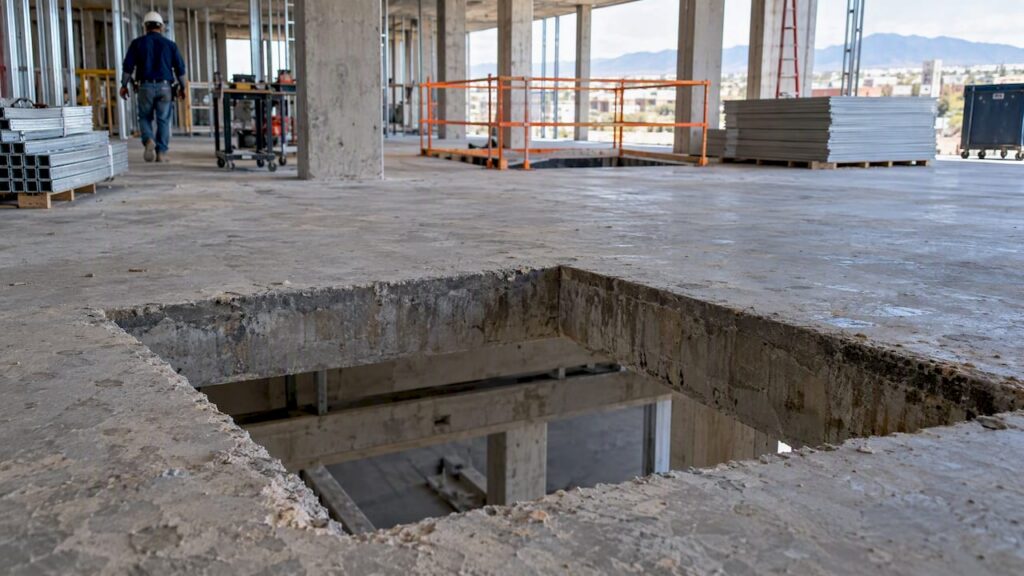
An owner who controls the site, or who knows about a hazard and does nothing, can be responsible for injuries that result. Unprotected openings, unstable ground, poor lighting and missing barricades are common examples.
General contractors and other subcontractors
If you work for a subcontractor, the general contractor or a different trade may be a third party. A framing crew that leaves debris on a walkway, an electrical contractor that leaves live wiring exposed, or a general contractor that ignores a known fall hazard can all create liability for workers on other crews. Which parties are protected by workers’ compensation immunity and which are not can turn on the contracts between them, so those documents deserve a careful review.
Manufacturers and equipment suppliers
Scaffolding, lifts, nail guns, cranes, harnesses and heavy equipment can fail because of design flaws, manufacturing defects or inadequate warnings. A product liability claim against the maker or distributor is a classic third-party claim. If a part failed, keep it. The physical item is often the most important piece of evidence in the case. You can read more about this type of claim on our product liability page.
Engineers, architects and inspectors
Professionals who design a structure, approve a plan or certify safety may be responsible if their work was negligent and led to a collapse or other hazard.
Drivers and trucking companies
Construction sites depend on trucks: concrete mixers, dump trucks, flatbeds and delivery vehicles. Workers are also exposed to traffic when a job is in or beside a roadway. If a driver is distracted, speeding or fatigued, or a trucking company fails to maintain its vehicles or screen its drivers, that driver and company may be liable, even though the injured person was at work when the crash happened. This is also true for motorists who strike workers in a highway work zone.
Construction zones: when the injured person is not a worker
Third-party thinking also applies to people who are not employees at all. Drivers, passengers, pedestrians and cyclists can be hurt in or near a work zone because of poor signage, missing barriers, abrupt lane shifts or unmarked drop-offs. In those cases the contractor responsible for traffic control, or the agency that approved the plan, may be one of the parties examined. We have written about this in why New Mexico construction zones are dangerous for drivers and in a case review of a fatal construction-zone accident on U.S. 550.
How fault and insurance shape the claim
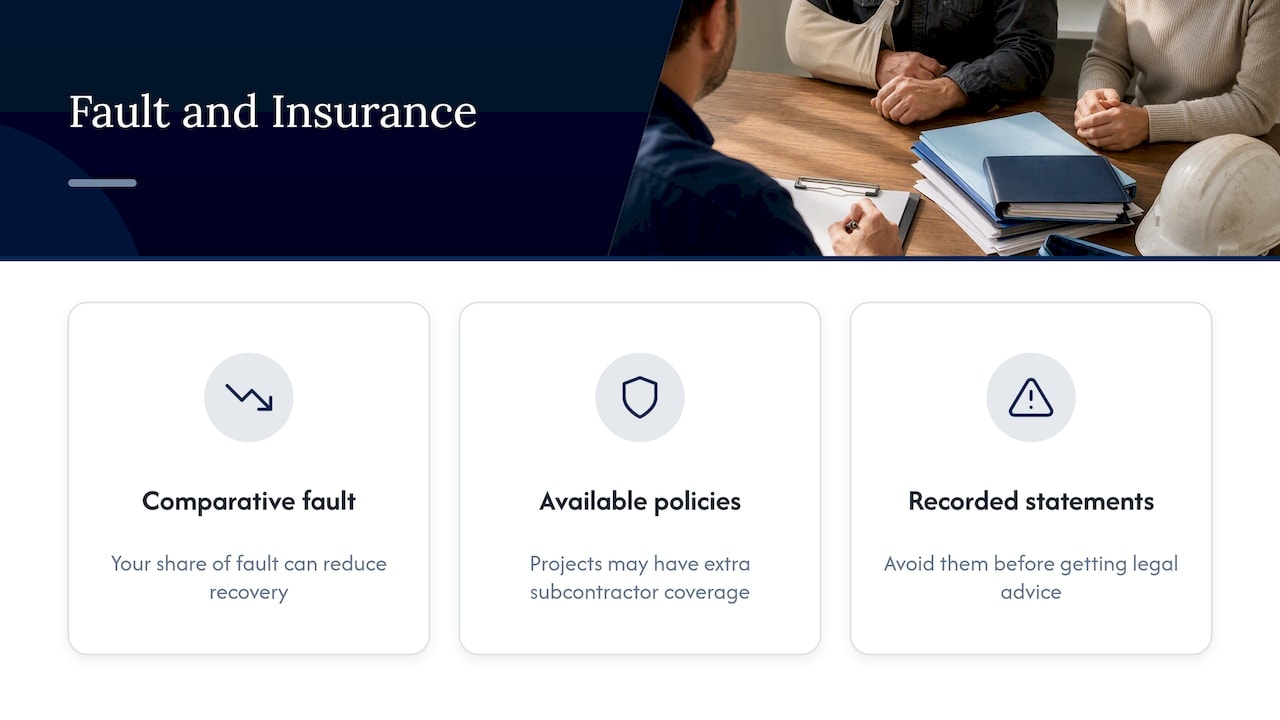
Fault is rarely simple on a construction site, and a third party will often try to blame the injured worker, the employer or someone else. Expect to hear that you ignored a safety rule, that you were not wearing protective equipment, or that another company is responsible instead. New Mexico follows a comparative fault approach, so a claim is not automatically defeated because more than one party contributed, but your own share of fault, if a court assigns one, can reduce what you recover. Our article on New Mexico auto accident claim restrictions and limitations explains how comparative fault reasoning works in practice. The same principles carry over to other negligence cases.
Insurance matters just as much. Contractors and owners typically carry commercial general liability coverage, and a project may have additional policies that cover subcontractors or name other companies as insureds. Identifying every available policy early tells you how much can realistically be recovered and which insurer will be handling the dispute. Insurers have adjusters and defense counsel whose job is to limit what they pay, which is one reason to avoid giving recorded statements before you have legal advice.
Evidence that builds a third-party claim
The strongest cases are built in the first days, before the site is cleaned up, repaired or restarted. Useful evidence includes:
- Photographs and video of the scene, the equipment involved, and any hazard you can identify, taken from several angles.
- Names and contact details of witnesses, including workers from other companies.
- Contracts and site documents, such as the agreements between the owner, general contractor and subcontractors, safety plans, schedules and daily logs.
- Equipment and maintenance records, along with the equipment itself where possible.
- Incident reports and communications, including emails or texts about the hazard before the accident.
- Medical records, starting with your first treatment, which link your injuries to the event.
- Vehicle data, when a truck or car was involved. Event data recorders and driver logs can be overwritten if no one sends a preservation demand.
Law enforcement and safety agencies have their own rules about protecting a scene. For example, the federal rule for accident investigations in federal workplaces says that after a fatality or hospitalization of three or more employees, evidence at the scene should be left untouched until inspectors can examine it, except where it must be moved to protect people. That rule governs federal employees, so it is not the standard for every private job site, but it illustrates the same principle we apply in every case: do not let the scene be altered without a record of what it looked like.
If you are physically able, report the injury to your supervisor and get medical care right away. If you cannot gather evidence yourself, a family member or an attorney’s investigator can do it for you.
Deadlines for New Mexico construction injury claims
A claim filed after the statute of limitations expires can be dismissed no matter how strong it is. FindLaw’s summary of New Mexico civil limitation periods lists three years for personal injury claims and three years for wrongful death claims. For a third-party construction claim, the personal injury period is the one that typically applies to injured workers and other injured people, and the wrongful death period applies to a family after a fatal accident.
Several cautions apply:
- Different defendants, different rules. If a government entity, such as a city, county or state agency, may be involved, shorter notice requirements can apply, sometimes much shorter than three years. Do not assume the general deadline covers those claims.
- Workers’ compensation has its own deadlines. Notice to your employer and the filing of a compensation claim follow separate time limits that are not the same as the lawsuit deadline.
- Minors and incapacity. Special tolling rules can extend the time, but they are narrow.
- Time to investigate. Even with three years available, waiting costs you evidence, witnesses’ memories and access to the equipment.
Because a miscalculated deadline cannot be undone, ask an attorney to confirm the dates that apply to your specific facts.
What our team believes about these cases
We have seen the same pattern many times. A worker is injured, the employer’s insurance begins paying benefits, and everyone assumes the matter is handled. Months later the worker discovers that the benefits cover only part of the loss, and that the people whose carelessness caused the injury have never been asked to answer for it.
Our view is that every serious construction injury deserves a second look for exactly that reason. Workers’ compensation is an important safety net, but it is not a full measure of what you lost. We ask who controlled the site, who made the equipment, who was driving and who was responsible for safety, and then we follow the documents to find the answers. We explain the process at each stage, and you can reach the attorneys and paralegals working on your case directly. Families who have lost someone on a job site should not have to chase that information alone.
— Adam
How Keller & Keller helps
Our New Mexico construction site accident team investigates the scene, identifies every party with a duty to keep the site safe, and coordinates a third-party claim with any workers’ compensation benefits you are receiving. Our firm represents people hurt in car and truck crashes, wrongful death cases, product liability and many other injury claims across New Mexico, Indiana and Michigan, so when a construction accident involves a vehicle or a defective product, the same team can handle it.
The first step costs nothing. A free case evaluation lets you tell us what happened and learn whether a third-party claim is realistic. If we take the case, we work on a contingency basis, which means no fee unless we win. You can read how this works in practice in our guide to what it costs to hire an injury attorney in New Mexico.

To start, request your free case evaluation and bring whatever you have: photographs, medical paperwork, your employer’s incident report and any workers’ compensation letters. If you are not sure what to do in the first days after an accident, our immediate steps after an accident resources are a good place to begin.
Frequently asked questions
Can I sue my employer after a construction accident?
In most cases, no. Workers’ compensation is generally the exclusive remedy against your own employer, and it also protects co-workers in many situations. That is exactly why a third-party claim against other responsible parties is important. Whether an exception applies to your facts is a question for an attorney.
Will a third-party lawsuit affect my workers’ compensation benefits?
Your benefits should continue while the claim is pending, but the compensation insurer may have a reimbursement interest in any recovery. The amount and handling depend on the facts and on New Mexico law. We review that interest before any settlement is accepted so you understand what you will actually receive.
How long do I have to file a third-party claim in New Mexico?
Personal injury and wrongful death claims are generally listed with a three-year limitation period in New Mexico. Claims involving a government entity can have much shorter notice requirements, so do not wait to speak with a lawyer.
What if a delivery truck or company vehicle caused my injury on the site?
The driver, and sometimes the trucking company or the vehicle’s owner, can be a third party, even though you were working at the time. We request driver logs, maintenance records and vehicle data early because they can be lost if no one asks for them.
How much does it cost to hire a lawyer for a third-party claim?
There is no charge for the first evaluation, and we are paid only if we recover compensation for you. The fee comes as a percentage of the recovery, and we explain the terms in writing before you sign anything.
Sources
- American General Fire & Casualty Co. v. J.T. Construction Co. (N.M. Ct. App. 1987)
- 29 CFR 1960.29, Accident investigation (OSHA)
- New Mexico Civil Statute of Limitations Laws (FindLaw)