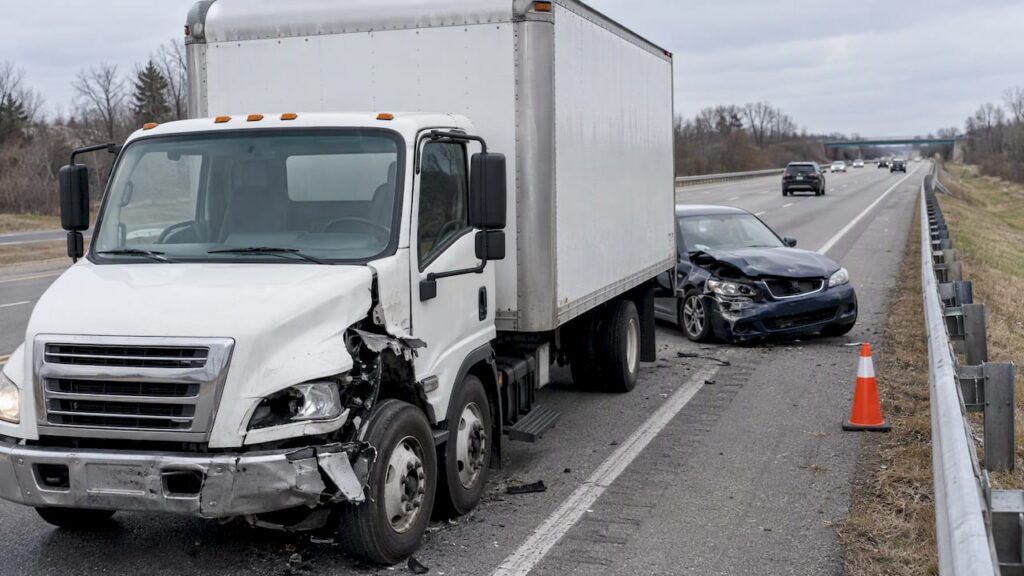
A commercial vehicle accident in Indiana is a crash involving a work vehicle such as a semi-truck, a heavy pickup, a bus or a hazmat carrier. These crashes are legally different from ordinary car wrecks because more than one party may be responsible, federal safety rules apply, and the evidence can disappear quickly. This guide explains what counts as a commercial vehicle, why these crashes happen, who can be held responsible, which deadlines matter, and what to do in the first days. We wrote it for injured drivers, passengers and families who need clear answers before they talk to an insurance adjuster.
TL;DR
- Indiana’s crash database counted 14,221 collisions involving commercial vehicles in 2020. Many involve more than the driver: the carrier, a loader or a maintenance contractor may share fault.
- Indiana bars recovery if you are more than 50% at fault, and reduces your damages by your percentage if you are 50% or less. Insurers use this rule, so protect your side of the story early.
- Trucking evidence, such as electronic data, driver logs and maintenance records, can be overwritten or discarded. A preservation letter sent early helps.
- Most injury and wrongful death claims in Indiana generally have a two-year filing window, and claims against government entities can require much earlier notice.
- Our consultations are free, and we collect a fee only if your case is won or settled.
Table of Contents
- What counts as a commercial vehicle in an Indiana crash
- Why these crashes happen on Indiana roads
- Who may be responsible after a commercial vehicle crash
- Evidence that decides these cases
- Compensation after a commercial vehicle crash
- When a loved one dies in a commercial crash
- Deadlines you should not miss
- Our perspective
- How we can help
- FAQ
- Sources
What counts as a commercial vehicle in an Indiana crash
Indiana’s crash reporting system, known as ARIES, treats a vehicle as commercial when it falls into one of several groups. According to the Indiana University Public Policy Institute’s commercial vehicle report, these include large trucks, combination vehicles, pickup trucks over 10,000 pounds, buses carrying 15 or more passengers, school buses, and vehicles displaying hazmat placards.
That definition is wider than most people expect. A crash with a delivery box truck, a dump truck, a tour bus or a heavy work pickup can qualify. The same report recorded 14,221 Indiana collisions involving at least one commercial vehicle in 2020. For federal figures, the Indiana commercial vehicle safety plan filed with the FMCSA lists 5,345 large-truck and bus crashes for 2023 in its summary data. The two numbers differ because the definitions and reporting thresholds differ, but both show how common these crashes are.
For injured people, the label matters for a practical reason. A commercial vehicle usually comes with a business behind it: an employer, an insurer with a larger policy, and a paper trail that federal regulations require it to keep. We covered several vehicle types in more detail, including dump truck crashes and rental truck accidents.
Why these crashes happen on Indiana roads
It is easy to picture commercial crashes as interstate pileups. The data points elsewhere. In the state’s safety plan, an analysis of 2021 commercial vehicle injury crashes found that 62% happened on US routes, state roads, county roads and local roads rather than on interstates. Rural highways and city streets are where many of these collisions occur.
The same document lists the five leading driver-related factors in Indiana:
- Following too closely
- Disregarding regulatory signs
- Failure to yield
- Speeding
- Failure to stay within a lane
It also notes that distracted driving is hard to prove and may be underreported, and that fatigue can accompany lane-departure crashes. That is a point we raise with clients often: the cause on the police report is a starting point, not the final word.
Timing matters too. The Public Policy Institute found that commercial vehicle collisions peak on weekday work hours, around 2 p.m. to 3 p.m., which differs from the later afternoon peak of other crashes. The pattern fits what we know of delivery schedules and working shifts.
Driver error is the most common coded mistake
The federal Large Truck Crash Causation Study found that recognition and decision errors were the most frequently coded mistakes for both truck drivers and passenger vehicle drivers. That finding dates from 2006, but it is a useful reminder that fault is not always one-sided. Our article on how truck driver error causes Indiana crashes explains how investigators separate inattention, fatigue and poor judgment.
Common crash types include jackknifes, rollovers, underride collisions, wide-turn crashes, rear-end collisions and lost cargo. Equipment failures, including brakes, are another cause, and we have written about whether “I couldn’t stop” actually explains a truck brake failure.
Who may be responsible after a commercial vehicle crash
In an ordinary car accident, the other driver is usually the only defendant. In a commercial crash, responsibility can be spread across several parties. Depending on the facts, these may include:
- The driver, for negligent driving or hours-of-service violations.
- The motor carrier, for hiring, training, dispatching or supervision failures, and for the driver’s actions on the job.
- A maintenance contractor or the carrier itself, for brakes, tires, steering or lighting that were not properly inspected or repaired. Our overview of federal and state laws regulating Indiana truck maintenance lists the standards.
- A shipper or loading company, when cargo was loaded or secured badly.
- A manufacturer, if a defective part contributed to the crash.
Cargo is a good example of why the details matter. In 2021 the Indiana Supreme Court decided Wilkes v. Celadon Group and adopted the federal Savage rule. Under that rule, the carrier ordinarily has the primary duty to load and secure cargo safely. A shipper takes on liability only when it undertook the loading and the defect was latent or concealed. When the defect is apparent, the carrier stays responsible. In practice, this means we look at who loaded the truck, who inspected it, and what the driver could have seen.
For a fuller walk through of these theories, see our guide to liability in Indiana commercial truck crashes.
Shared fault and the 51% bar
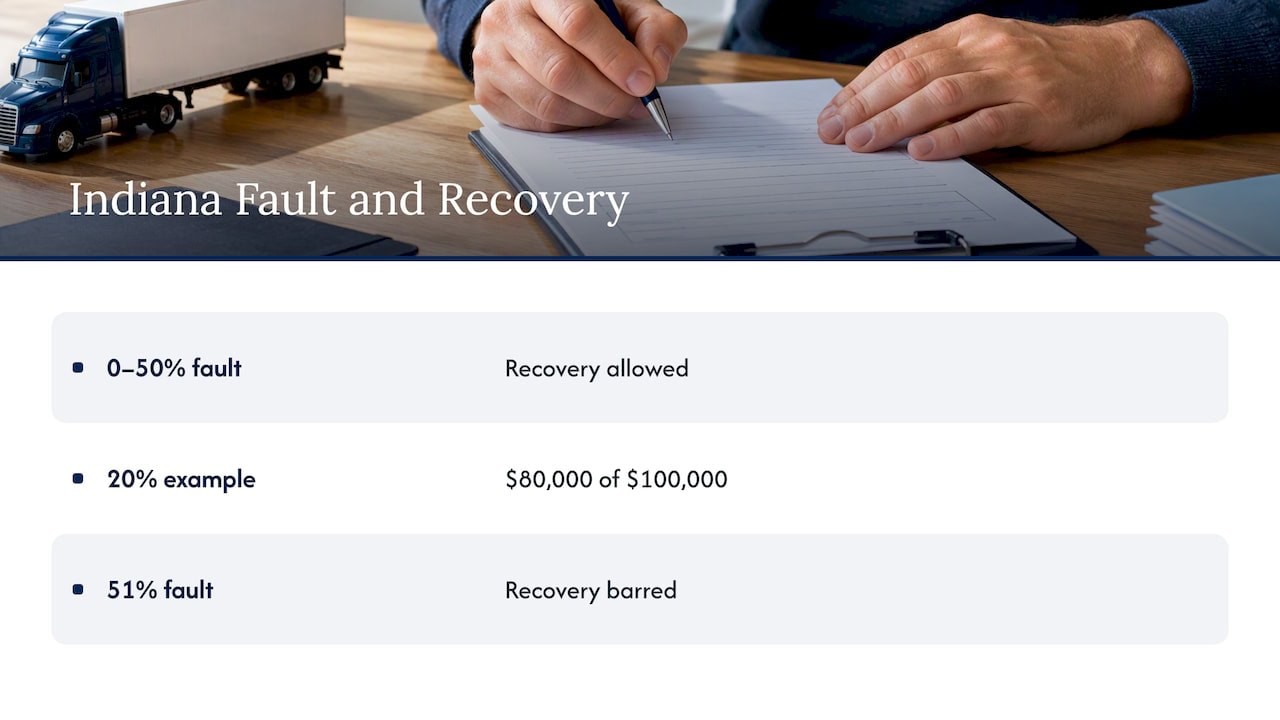
Indiana follows a modified comparative fault system. Under Indiana Code § 34-51-2-6, recovery is barred when the claimant’s fault is greater than the fault of all the people whose fault proximately contributed to the damages. If you are not more than 50% at fault, your damages are reduced in proportion to your share.
A simple illustration: if a jury found damages of $100,000 and assigned you 20% of the fault, you would be able to recover $80,000. If it assigned you 51%, you would recover nothing. The figures are only an example, not a prediction.
When several defendants are involved, Indiana Code § 34-51-2-8 directs the fact-finder to compute each defendant’s percentage and enter judgment against each for its own share of the total damages. It also lets the fact-finder consider nonparties who contributed. This is why naming the right defendants early, and gathering evidence against each, shapes the outcome of the case.
Evidence that decides these cases
Trucking companies often have their own investigators at the scene or on the road within hours. You will not match that on your own, but you can avoid losing the evidence that matters most.
What to do at the scene and in the first days
- Get medical care first. Some injuries, including head and internal injuries, show up late. Records made close to the crash also connect the injury to the event.
- Call the police and ask for a report. Indiana State Police policy calls for investigation of crashes on a public trafficway when a person is hurt or killed, or when property damage reaches at least $2,500. The same policy has officers submit reports through ARIES by the third day after a crash, so ask how and when you can get a copy.
- Photograph everything. Capture vehicle positions, skid marks, damage, the truck’s DOT number and company name, and road conditions.
- Collect names. Get contact details for witnesses and the truck driver’s employer.
- Do not give a recorded statement to the trucking insurer before speaking with a lawyer, and avoid social media posts about the crash.
Evidence only the carrier controls
Some of the most important proof sits with the trucking company: electronic logging data, dispatch records, driver qualification files, maintenance and inspection records, and onboard camera or event data. Federal rules require carriers to keep some records for set periods, and one example is an accident register. Even so, records age out and data can be overwritten in routine use.
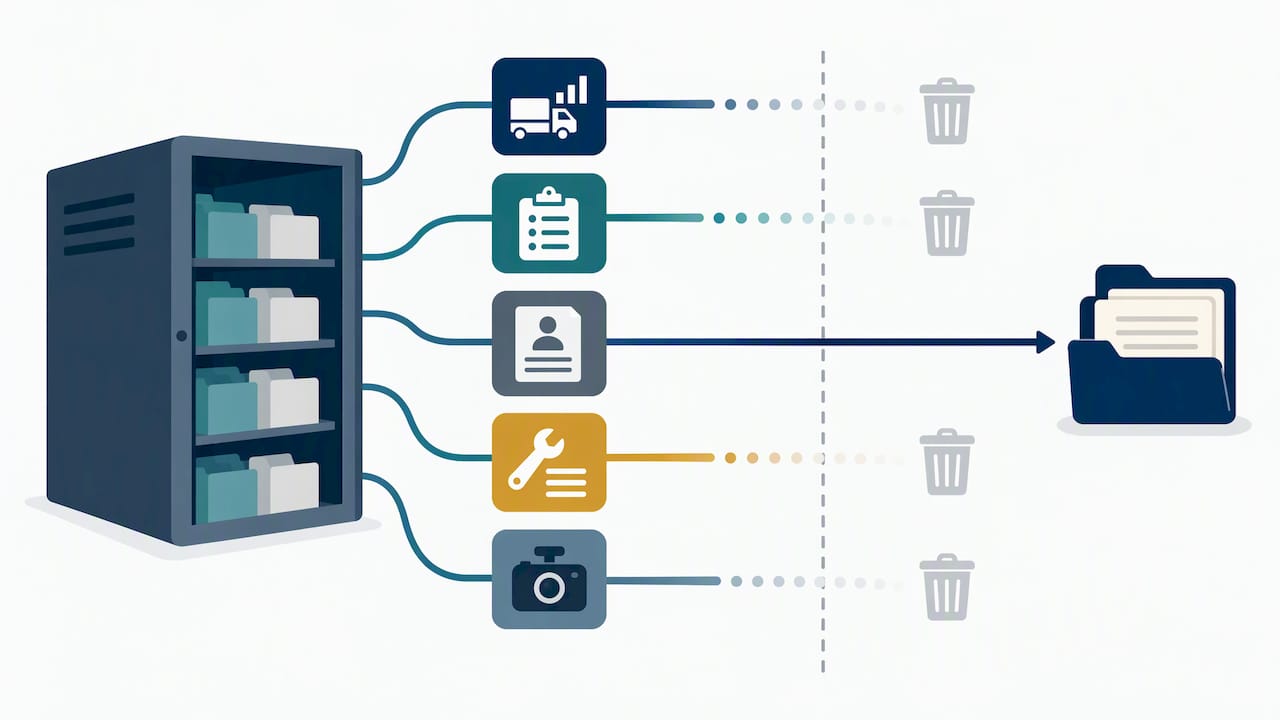
That is why a prompt written preservation demand matters. It puts the carrier on notice that litigation is likely, which supports a spoliation claim if evidence is later destroyed. We explain the process in our article on protecting evidence after an Indiana truck crash. Our guide to commercial truck driving laws in Indiana shows which rules those records are measured against.
Compensation after a commercial vehicle crash
Injured people in Indiana can generally seek compensation for economic losses, such as medical bills and lost income, and for non-economic harm, such as pain and loss of enjoyment of life. The amount depends on the severity of the injury, how long recovery takes, whether you can return to work, and how fault is divided. We do not promise outcomes, and no honest firm can. What we can do is document the full picture of your losses, including future care, so that an insurer’s first offer is measured against real numbers.
Why do commercial cases often involve larger claims? Serious injuries are one reason. Another is that carriers typically carry commercial liability coverage, so there may be more than one insurer to deal with. That also means more parties with an interest in limiting what they pay.
When a loved one dies in a commercial crash
Wrongful death claims follow special rules. Under Indiana’s general wrongful death statute, only a personal representative may bring the action on behalf of eligible beneficiaries, as the Indiana Supreme Court explained in Estate of Sears v. Griffin. For the death of an adult with no dependents, the statute likewise provides that only the personal representative may maintain the action. Families often need to open an estate and have a representative appointed before a claim can move forward.
Who qualifies as a beneficiary, and what damages are available, depends on whether the person who died was a child, an adult with dependents, or an adult without dependents. If you have lost someone, speak with an attorney about which category applies. We handle these cases with care and do not rush families through the first conversation.
Deadlines you should not miss
Indiana generally gives two years to file a personal injury lawsuit, and wrongful death claims generally run two years from the date of death. Those are general rules. Claims against a city, county, state agency or school district follow different notice rules and can require notice within months, not years. A school bus crash or a collision with a public works truck can fall in that category.
Waiting also hurts the case in practical ways: witnesses move, camera footage is overwritten, and the carrier’s records age out. Do not treat two years as a target. Treat it as the outer limit. To confirm the deadline in your own situation, speak with an Indiana personal injury attorney as soon as you can.
Our perspective
We have handled thousands of cases against large insurance companies, and commercial vehicle claims are where we see the gap between a prepared claim and an unprepared one most clearly. The trucking company’s side starts building its defense in the first hours. A family that waits weeks to call a lawyer is often starting behind.
Three things guide how we approach these cases. First, we look past the driver. The carrier’s hiring, scheduling and maintenance decisions often explain why a crash happened. Second, we treat evidence as time-sensitive, because electronic data and logs do not wait for a claim to be filed. Third, we keep clients informed. You will have direct access to attorneys and paralegals, and you will hear from us in plain language about where your case stands.
If you are hurt and unsure what to do next, the most useful step is a conversation before you sign anything with an insurer.
— Adam
How we can help
We represent people hurt in crashes with semi-trucks and other commercial vehicles in Indiana, as well as families who have lost someone. Your free case evaluation costs nothing, and because we work on a contingency fee, you owe us no fee unless we win your case. We will review the crash, tell you honestly what we see, and explain your options.

If your crash involved a truck, you can learn more about our semi truck accident representation or read our guide on immediate steps after an accident.
FAQ
Is a commercial vehicle accident claim different from a regular car accident claim in Indiana?
Yes. A commercial claim may involve the driver, the carrier, a loader or a maintenance contractor, and federal safety rules and record-keeping duties apply. The evidence is also held mostly by the company, so early preservation matters. The basic fault rules, including the 51% bar, still apply.
What if I was partly at fault for the crash?
You may still recover. Under Indiana Code § 34-51-2-6, you can recover if you are not more than 50% at fault, but your damages are reduced by your percentage. If your share is above 50%, recovery is barred. This is why insurers often try to shift blame to the injured driver.
How long do I have to file a lawsuit?
Indiana generally allows two years for personal injury and wrongful death claims, but claims against government entities can require notice much sooner. Because exceptions exist, contact an attorney promptly to confirm the deadline for your situation.
Should I talk to the trucking company’s insurance adjuster?
We advise against giving a recorded statement or signing a release before speaking with a lawyer. Adjusters are trained to gather information that limits what the company pays. You can provide basic contact details, then refer them to your attorney.
Does it cost anything to speak with 2keller about my crash?
No. The case evaluation is free, and our fee is a percentage of the recovery, collected only if we win or settle your case.
Sources
- Commercial Vehicles 2020, Indiana University Public Policy Institute
- Indiana FY23 Commercial Vehicle Safety Plan, FMCSA
- Large Truck Crash Causation Study, FMCSA and NHTSA
- Wilkes v. Celadon Group, Indiana Supreme Court
- Indiana Code Title 34, Article 51, Chapter 2
- Estate of Sears v. Griffin, Indiana Supreme Court
- Indiana Code § 34-23-1-2
- Crash Investigation/Reporting Timelines, Indiana State Police