
Yes, Indiana recognizes third-party diminished value claims. If another driver caused your accident, you can pursue the at-fault driver’s liability insurer for the loss in your vehicle’s resale value, and if that driver was uninsured, your own uninsured/underinsured motorist property damage (UM/PD) coverage acts as the backstop. Your own collision policy usually won’t pay this loss unless you added specific coverage for it.
You have two years from the date of the crash to file suit under Ind. Code § 34-11-2-4, so the clock is already running. Three things matter more than anything else right now.
- Order a professional appraisal. A USPAP-grade or certified market-comparable valuation is the single strongest piece of evidence you can produce.
- Preserve every record. Save the police report, repair invoices, and photos from before and after the fix.
- Pull comparable listings fast. Pre-accident market data gets stale, so gather it while it still reflects your car’s condition.
Key Takeaways
Indiana lets you recover diminished value from an at-fault driver’s insurer using a market-backed appraisal, but the two-year statute of limitations makes early action the deciding factor in most outcomes.
| Point | Details |
|---|---|
| Indiana claims are recognized | You can pursue the at-fault driver’s liability insurer or your UM/PD coverage if they’re uninsured. |
| Two-year deadline applies | File suit within two years of the accident under Ind. Code § 34-11-2-4. |
| Three proof methods accepted | Use before-and-after value, cost of repair, or a combination, backed by a certified appraisal. |
| Insurers use predictable tactics | Counter lowball formulas like 17c with market comparables and written denial reasons. |
| 2keller evaluates claims free | Contingency-based representation helps with appraisals, negotiation, and litigation if needed. |
Table of Contents
- What Diminished Value Means Under Indiana Law
- The Three Types of Diminished Value You Might Be Facing
- How Indiana Law Treats Diminished Value Claims
- How to Prove Diminished Value in Indiana
- Step-By-Step: Filing Your Diminished Value Claim
- How Long a Diminished Value Claim Takes in Indiana
- Insurance Company Tactics and How to Beat Them
- When to Hire an Indiana Diminished Value Attorney
- Your Evidence Checklist and Demand Letter Outline
- How Keller & Keller Handles Indiana Diminished Value Claims
- Frequently Asked Questions
- Sources
What Diminished Value Means Under Indiana Law
Diminished value is the drop in your vehicle’s fair market value caused by another driver’s negligence, even after a shop restores it to pre-accident condition mechanically and cosmetically. Indiana treats this as part of your property damage claim, not a separate injury or a bonus payout. It’s the difference between what a buyer would have paid for your car the day before the wreck and what that same buyer would pay for it today, knowing it has an accident on its title history.
A few scope points matter before you go further:
- Who can file: the vehicle’s owner, or a lienholder standing in the owner’s shoes if a loan or lease is involved.
- Which lane applies: the at-fault driver’s liability insurer in most cases, or your UM/PD carrier if the other driver had no insurance.
- What it isn’t: most standard collision policies exclude diminished value entirely, so don’t expect your own insurer to volunteer a check unless your policy specifically covers it.
The Three Types of Diminished Value You Might Be Facing
Appraisers and courts generally sort diminished value into three buckets, and knowing which one applies to your situation shapes how you prove it.
- Inherent diminished value is the market stigma that sticks to a vehicle simply because it now carries an accident history on Carfax or AutoCheck, even after a flawless repair. This is the most common type pursued in Indiana claims.
- Immediate or temporary diminished value reflects the loss in value at the moment of the crash, before repairs happen, or while the vehicle sits unrepaired.
- Repair-related diminished value accounts for any residual loss tied to the repair process itself, such as mismatched paint, aftermarket parts, or frame work that a trained eye or a future buyer’s inspector would flag. Some claims blend two or more of these categories into a single valuation.
How Indiana Law Treats Diminished Value Claims
Indiana courts accept three methods for proving the reduction in fair market value: a straight before-and-after comparison, a cost-of-repair approach when repairs genuinely restore most of the value, or a combination of both, sometimes referred to informally as the Wiese-GMC framework. This settled approach gives you flexibility depending on how much documentation you have. The Shield v. Forster decision from the Indiana Court of Appeals reinforced this in 2020, holding that an insurer cannot defeat a diminished value claim just by asserting that “quality repairs” restored the car when solid market-value evidence says otherwise.
Two structural rules shape every claim:
- The two-year statute of limitations under Ind. Code § 34-11-2-4 applies to property damage the same way it applies to injury claims, so waiting even a year to start gathering evidence puts you closer to the wall than you’d like.
How to Prove Diminished Value in Indiana
Proof is where most claims succeed or fail, and Indiana insurers will not take your word for a number. You need a report that stands up to scrutiny, built on one of three accepted methods: comparing verified pre-accident and post-repair fair market values, calculating loss based on cost of repair when the shop work substantially restores the car, or blending both approaches when neither alone tells the full story. Indiana recognizes all three, which gives you room to pick whichever fits your documentation best.
A USPAP-grade appraisal or a certified market-comparable report carries more weight than anything you could put together yourself, because it follows recognized appraisal standards rather than a guess. A solid report should include:
- Selection of genuinely comparable vehicles, matched by year, make, model, and trim.
- Adjustments for mileage, condition, and options that separate your car from the comparables.
- Clear calculations showing exactly how the appraiser arrived at the final dollar figure.
Beyond the appraisal itself, build out a supporting file: the police report from the crash, itemized repair invoices, photos taken before and after the repair, and any dealer trade-in offers or written statements confirming a lower value because of the accident. A Carfax or AutoCheck report showing the accident on record is often the piece that convinces an adjuster the stigma is real and permanent, not speculative.
Pro Tip: Order your appraisal before you trade the car in or sell it. Once the vehicle is out of your hands, you lose the ability to have an appraiser physically inspect it, and a desk review from photos alone carries less weight with an adjuster or a judge.
Step-By-Step: Filing Your Diminished Value Claim
Once you understand the legal basis, the process itself is straightforward if you follow it in order.
- Order your appraisal and collect documentation. Get the market-comparable or USPAP-grade report started immediately, and gather your repair records and other proof alongside it.
- Draft an insurer-ready demand letter. State the legal theory (reduction in fair market value), cite supporting precedent, and attach the appraisal along with every piece of documentation.
- Submit the demand. Send it to the at-fault driver’s liability insurer, or to your UM/PD carrier if the other driver had no coverage.
- Negotiate. Respond to the adjuster’s questions and pushback with additional evidence rather than concessions.
- File suit before the statute of limitations expires if a fair settlement doesn’t materialize.
Your demand letter should set a firm, reasonable deadline for a response, typically two to three weeks. If the dollar amount is modest, Indiana’s small claims courts offer a faster, less formal path than a full civil case; larger disputes involving contested valuations usually belong in civil court, where discovery tools let you compel more insurer documentation.
How Long a Diminished Value Claim Takes in Indiana
Most insurers respond to a well-documented demand within 30 to 45 days, though contested valuations or adjuster turnover can stretch that timeline considerably. Don’t let a slow response lull you into complacency.
- The two-year statute of limitations is a hard deadline, not a suggestion, so start your appraisal within weeks of finishing repairs while comparable listings are still fresh.
- If you’re filing in small claims, check your county’s docket scheduling early since hearing dates can add weeks to resolution.
- Civil court cases involving disputed diminished value amounts typically take longer than small claims, sometimes several months to over a year depending on caseload.
Insurance Company Tactics and How to Beat Them
Adjusters have a playbook, and it rarely changes. Watch for these common moves:
- Claiming the repairs “fully restored” the car’s value, despite market evidence to the contrary.
- Applying a proprietary formula, most commonly the 17c rule, which starts with an arbitrary 10% value cap before applying mileage and damage multipliers that shrink your payout further.
- Requesting excessive or irrelevant documentation to slow the process down.
- Opening with a lowball offer designed to see if you’ll accept it before pushing back.
Counter each of these with hard evidence: a USPAP-grade appraisal, contemporaneous market comparables, and dealer trade-in quotes that reflect what your car is actually worth today. Ask the adjuster for itemized, written reasons for any denial or reduced offer, and keep every communication documented. If an insurer’s conduct crosses into genuinely unfair territory, Indiana’s insurance regulator accepts consumer complaints against carriers operating in the state.
Pro Tip: Never accept a verbal explanation for a denied or reduced diminished value claim. Insist on it in writing. A written denial creates a paper trail that becomes valuable if your case ends up in front of a judge.
When to Hire an Indiana Diminished Value Attorney
Not every diminished value claim needs a lawyer, but several situations tip the scale firmly toward hiring one:
- The claimed amount is significant relative to what you’re likely to recover on your own.
- The insurer flatly refuses to negotiate or won’t respond to a documented demand.
- Valuation is contested and the insurer’s numbers conflict sharply with your appraisal.
- Multiple parties share fault, complicating who pays what.
- The statute of limitations is approaching and settlement talks have stalled.
An experienced Indiana attorney sources qualified appraisers, drafts a demand grounded in Indiana case law like Shield v. Forster, negotiates directly with insurance counsel, and files suit in small claims or civil court if that becomes necessary, including pursuing discovery when an insurer withholds relevant data.
Your Evidence Checklist and Demand Letter Outline
Keep this list handy as you build your file:
- Professional appraisal report with a case or reference number.
- Comparable sales data from the local market.
- Itemized repair invoices.
- Police report from the accident.
- Before-and-after photos of the vehicle.
- Carfax or AutoCheck report showing the accident.
- A log of every communication with the insurer.
- Dealer trade-in offers or written valuation statements.
A short demand letter should follow this structure:
- One paragraph stating the legal basis (reduction in fair market value) with supporting citation.
- The attached appraisal, referenced by number.
- An itemized list of supporting documents.
- A clear deadline for the insurer’s response.
- A statement that litigation follows if no resolution is reached.
A Worked Example of the Before-and-After Method
Say pre-accident comparable listings for your model average $18,500. After the repair, comparable listings for similar vehicles carrying a disclosed accident history average $15,800.
- Pre-accident average value: $18,500.
- Post-repair average value with accident history: $15,800.
- Resulting diminished value: $2,700.
A certified appraiser will refine this number further, adjusting for your car’s exact mileage, condition, and options. Treat this as a demonstration of the method, not a substitute for a real report.
What Most Clients Get Wrong About Timing and Evidence
The biggest mistake I see is waiting. Clients often assume a single repair invoice or a friendly word from the dealer’s service manager will carry a diminished value claim, and it won’t. Adjusters expect a real appraisal, and without one, your demand looks like an opinion instead of a documented loss.
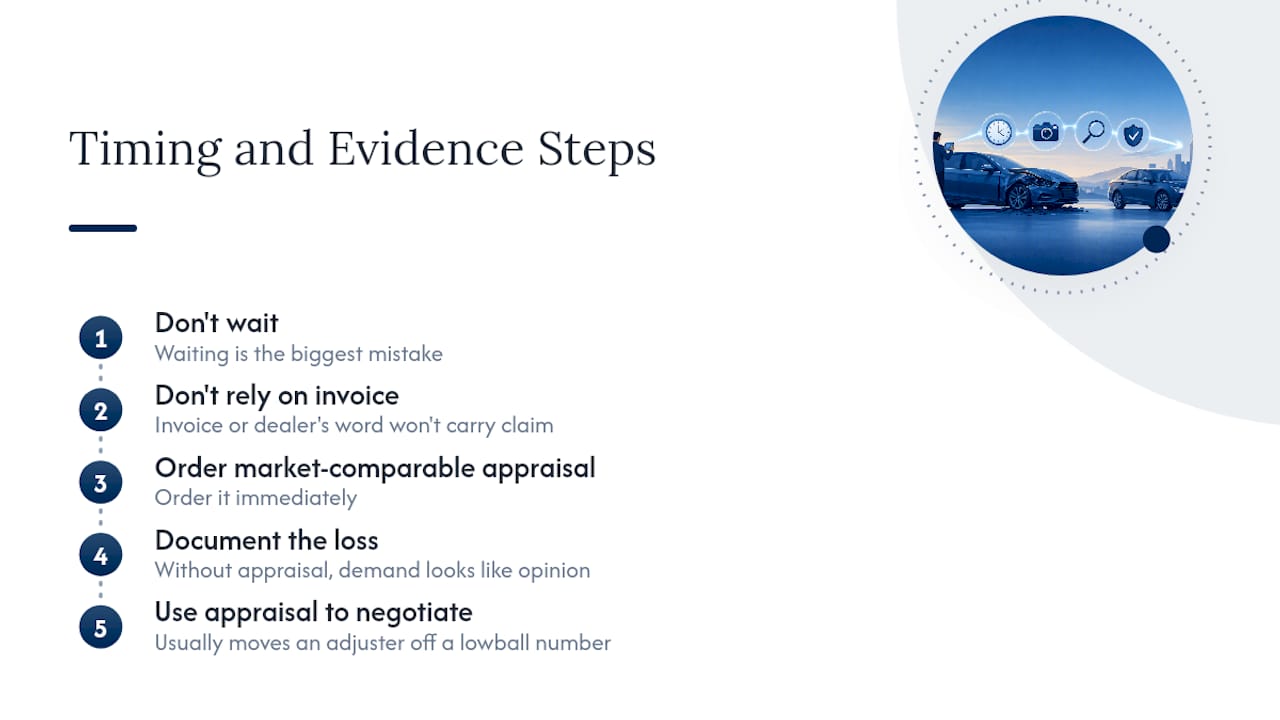
If there’s one move that changes the trajectory of a claim faster than anything else, it’s ordering the market-comparable appraisal immediately. It’s usually the single document that moves an adjuster off a lowball number.
How Keller & Keller Handles Indiana Diminished Value Claims
Chasing an insurer for the true value of your car while also managing repairs, rental cars, and possibly an injury claim is a lot to carry alone, and Indiana’s evidence and deadline requirements leave little room for guesswork.

2keller works Indiana diminished value claims on contingency, so there’s no upfront cost to find out where you stand. Our team helps clients:
- Get a free, no-obligation case evaluation.
- Coordinate with certified appraisers to build a court-ready valuation.
- Assemble the full evidence package, from repair records to comparable sales data.
- Negotiate directly with insurance adjusters, and litigate if a fair settlement doesn’t come.
If an insurer has already pushed back on your claim or ignored your demand, our page on why insurers deny injury claims walks through the tactics you’re likely facing and what to do next. Reach out today to schedule your free case evaluation and find out exactly where your diminished value claim stands.
Frequently Asked Questions
Does Indiana recognize diminished value claims?
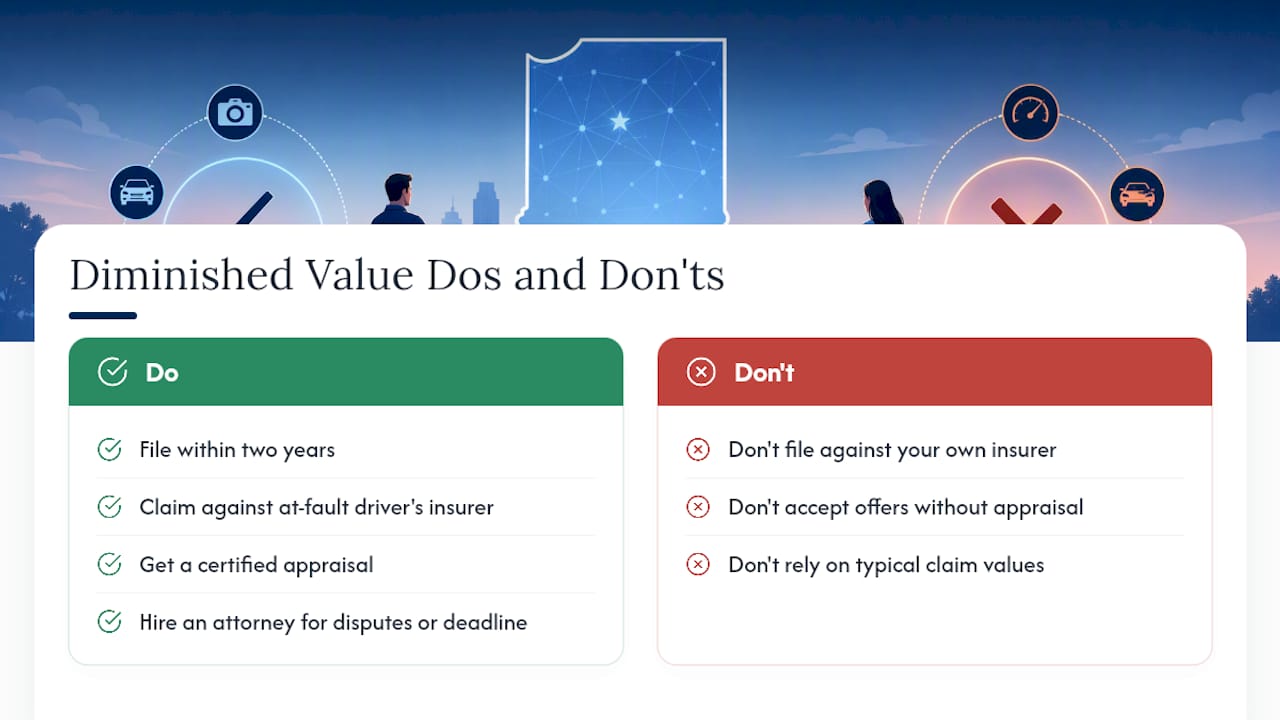
Yes. Indiana accepts third-party diminished value claims against an at-fault driver’s liability insurer, using before-and-after market value, cost-of-repair, or a combination method as proof.
What’s the statute of limitations for a diminished value claim in Indiana?
You generally have two years from the date of the accident under Ind. Code § 34-11-2-4 to file suit for property damage, including diminished value.
Can I file a diminished value claim against my own insurance?
Usually not, unless your policy specifically includes diminished value coverage or you’re using UM/PD coverage because the other driver was uninsured.
How much is a typical diminished value claim worth in Indiana?
It depends entirely on your vehicle’s pre-accident value, the severity of the damage, and market comparables. A certified appraisal is the only reliable way to get an accurate figure for your specific car.
Do I need a lawyer to file a diminished value claim?
Not always, but hiring one makes sense when the insurer refuses to negotiate, the valuation is disputed, multiple parties share fault, or your statute of limitations deadline is approaching.
Sources
- Indiana Car Accident Statute of Limitations
- Indiana Diminished Value Claim: 2-Year SOL | MyFairClaim
- Shield v. Forster (Court of Appeals of Indiana, 2020)
- Indiana car accident settlement process and timeline | FindLaw