
An hours-of-service (HOS) violation is any breach of the driving-time limits, on-duty windows, or recordkeeping requirements established by the Federal Motor Carrier Safety Administration under 49 CFR Part 395. The moment an inspector identifies one at roadside, the consequences are immediate: an out-of-service (OOS) order that legally prohibits the driver from moving the vehicle, civil fines, and a hit to the carrier’s Safety Measurement System (SMS) score that can follow the company for months. If you are a driver or carrier facing a citation right now, the single most important step is to stop driving, preserve every ELD file and supporting document you have, and do not alter any records.
Key immediate consequences of an HOS violation include:
- Out-of-service order: The driver cannot legally move the vehicle until the OOS period expires or the issuing officer releases it. Violating an OOS order can result in CDL disqualification and severe additional penalties.
- Civil fines: Penalties apply to both the driver and the carrier, with higher amounts for knowing or willful violations.
- CSA/HOS BASIC impact: Each violation carries a severity weight that raises the carrier’s percentile in FMCSA’s Safety Measurement System, increasing the risk of a compliance review or intervention.
- Record of the stop: The inspection report becomes part of the enforcement file and can surface in litigation if a crash is involved.
“FMCSA enforcers take the 11-hour driving limit to the minute — inspectors will issue an out-of-service order even for a one-minute overage in many circumstances.”
Summary of Hours of Service Regulations | FMCSA
Key Takeaways
HOS violations under 49 CFR Part 395 carry immediate out-of-service consequences, lasting SMS score damage, and serious civil liability exposure when a crash is involved.
| Point | Details |
|---|---|
| What makes an HOS violation | Any breach of FMCSA driving-time limits, on-duty windows, or recordkeeping rules under 49 CFR Part 395. |
| Immediate response | Stop driving, comply with the OOS order, preserve ELD files, and do not alter any records. |
| Top three violations | Exceeding the 11-hour driving limit, exceeding the 14-hour on-duty window, and false records of duty status. |
| Downstream consequences | SMS severity weights affect carrier percentiles, broker access, and insurance rates for months after a citation. |
| When to call 2keller | Contact 2keller immediately after a crash where HOS violations may be involved; evidence windows close quickly. |
Table of Contents
- What are the hours of service violations drivers most commonly commit?
- Realistic scenarios of common HOS violations at roadside
- What are the penalties for hours of service violations?
- How do inspectors detect HOS violations?
- What should you do immediately after an HOS citation?
- A practical compliance checklist for drivers, dispatchers, and carriers
- When should you consult a lawyer about an HOS violation?
- An editorial perspective on HOS evidence and legal outcomes
- How 2keller can help if you were harmed in a crash tied to HOS violations
- Sources
What are the hours of service violations drivers most commonly commit?
Understanding which rules are broken most often starts with knowing exactly what each rule requires. The FMCSA’s HOS summary and the regulatory text at 49 CFR Part 395 set the following limits for property-carrying drivers:
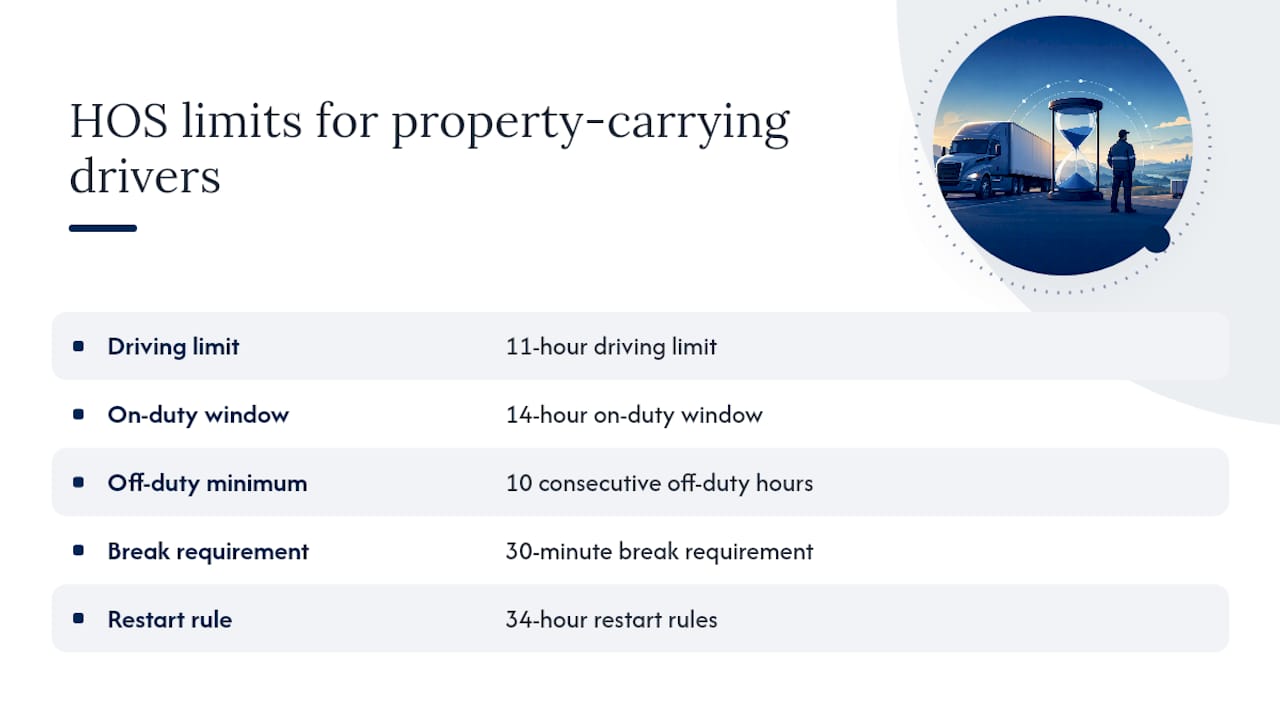
The core driving and on-duty limits
11-hour driving limit. A driver may drive a maximum of 11 hours after taking 10 consecutive hours off duty. The clock starts from the moment the driver comes on duty after that rest period, and inspectors check it to the minute.
14-hour on-duty window. Once a driver comes on duty, a 14-hour window opens. Driving is only permitted within that window. Critically, the clock does not stop for breaks, meals, or fuel stops, with one narrow exception: certain sleeper-berth splits can pause the window under specific conditions.
10 consecutive hours off duty. Before a new driving period begins, a driver must take at least 10 consecutive hours off duty. The 34-hour restart provision allows drivers who have exhausted their weekly on-duty hours to reset by taking at least 34 consecutive hours off duty, which must include two periods from 1:00 AM to 5:00 AM.
30-minute break requirement. Under the HOS Final Rule, a driver who has accumulated 8 cumulative hours of driving time without at least a 30-minute interruption must take that break before driving again. The break can be satisfied by any non-driving duty status, including on-duty not driving, so a driver who spends 30 minutes at a shipper’s dock counts it, provided the status is logged correctly.
Weekly limits and how drivers recover hours
60/70-hour on-duty limits. Drivers operating for carriers that run vehicles every day of the week are subject to a 70-hour limit over 8 consecutive days. Carriers that do not operate every day of the week apply a 60-hour limit over 7 consecutive days. Hours are recovered by dropping the oldest day off the rolling window or by using the 34-hour restart.
Exceptions that change the math
The 2020 HOS Final Rule amendments introduced meaningful flexibility — but each exception comes with precise eligibility conditions that, if misread, can create violations.
Sleeper-berth splits (8/2 and 7/3). A driver using a sleeper berth may split the required 10-hour off-duty period into two segments: one of at least 8 hours in the sleeper berth and one of at least 2 hours either in the sleeper berth or off duty. Alternatively, a 7/3 split is permitted. Neither segment counts against the 14-hour window, which is paused during the shorter segment. The FMCSA HOS Final Rule clarified both split options.
Adverse driving conditions extension. When a driver encounters unexpected weather, road closures, or other adverse conditions not foreseeable at the start of the trip, the rules allow up to 2 additional hours of driving beyond the 11-hour limit and a corresponding extension of the 14-hour window.
150 air-mile short-haul exception. Drivers who operate within a 150 air-mile radius of their normal work reporting location and return to that location each day may qualify for the short-haul exception, which eliminates the ELD requirement and the 30-minute break rule. The HOS Final Rule expanded this exception to 150 air miles and extended the on-duty window to 14 hours for eligible drivers.
Realistic scenarios of common HOS violations at roadside
Knowing the rules in the abstract is one thing. Seeing how violations actually happen on a real run is what helps drivers and carriers catch problems before an inspector does.
-
Exceeding the 11-hour driving limit after detention. A driver picks up a load and gets detained at the shipper for three hours. To make the delivery window, the driver pushes through, logging 11 hours and 22 minutes of driving. The inspector at a weigh station pulls the ELD graph and issues an OOS order on the spot. What inspectors check: the driving-time total since the last 10-hour break. Regulation cited: 49 CFR 395.3(a)(1).
Pro Tip: Set an in-cab alert at 10 hours and 30 minutes of driving. That 30-minute buffer gives you time to find a legal parking spot before the clock runs out.
-
Exceeding the 14-hour window despite unused driving time. A driver starts the day at 6:00 AM, spends four hours at a receiver waiting for a dock, and is still on the road at 8:15 PM — 14 hours and 15 minutes after coming on duty. The driver has only logged 8 hours of actual driving, but the 14-hour window has closed. Driving another mile is a violation regardless of unused driving hours. Regulation cited: 49 CFR 395.3(a)(2).
-
Missing the 30-minute break through misinterpretation. A driver logs 8 hours and 10 minutes of driving across two segments, with a 20-minute on-duty not-driving period in between for a fuel stop. Because the on-duty period was less than 30 minutes, the break requirement was not satisfied. The driver believed any interruption counted. What inspectors check: whether a continuous 30-minute non-driving period appears in the log after 8 cumulative driving hours. Regulation cited: 49 CFR 395.3(a)(3)(ii).
-
Exceeding the 70-hour weekly limit late in the week. A dispatcher schedules a driver for a long Friday run without auditing the driver’s rolling 8-day total. By Friday evening, the driver has accumulated 71.5 hours of on-duty time. The violation is discovered during a compliance review triggered by a separate roadside stop. Regulation cited: 49 CFR 395.3(b).
-
Personal conveyance misuse flagged as falsification. A fleet manager directs a driver to reposition a loaded trailer to a nearby yard after the driver’s 14-hour window has closed. The driver logs the movement as personal conveyance (PC). Under FMCSA guidance on personal conveyance, PC is only valid for personal, non-business trips. Moving a truck at a fleet manager’s direction to reposition freight is frequently flagged as falsification and often results in the harshest penalties available.
-
ELD malfunction without proper documentation. A driver’s ELD loses connectivity at 9:00 PM. The driver continues driving without annotating the malfunction in the device or switching to paper logs within 24 hours as required. By the time of the next roadside inspection, the driver has a secondary citation for failure to follow ELD malfunction procedures on top of any underlying driving-time issue. Regulation cited: 49 CFR 395.34.
What are the penalties for hours of service violations?
Penalties for HOS violations operate on two tracks: the immediate enforcement action at roadside and the longer-term regulatory and business consequences that follow.
Fines and out-of-service orders
Civil penalties under federal law are assessed per violation, per day. The FMCSA distinguishes between standard violations and those that are knowing or willful, with the latter carrying substantially higher exposure for both drivers and carriers. An OOS order is not merely a fine — it is a formal legal command. The driver is prohibited from moving the vehicle until the OOS timeframe has elapsed or the issuing officer releases it. Violating an OOS order can lead to CDL disqualification and a separate, severe penalty.
Penalty ranges reflect federal statutory maximums subject to annual inflation adjustment. Actual assessed amounts vary by severity and enforcement discretion.
HOS violations feed directly into the HOS Compliance BASIC within FMCSA’s Safety Measurement System. Each violation carries a severity weight and a time weight — recent violations count more heavily — and a rising percentile can trigger a compliance review or intervention.
Record falsification and CDL consequences
Falsifying logs carries a severity weight of 10 in the SMS, the highest possible. Repeated falsification findings can trigger a carrier-level investigation and, for drivers, potential CDL disqualification. The downstream effects extend beyond the regulatory file: brokers increasingly filter carriers with elevated HOS BASIC percentiles, insurers re-rate policies after compliance reviews, and some shippers terminate contracts outright.
How do inspectors detect HOS violations?
Detection happens at two levels: the roadside inspection and the carrier compliance review. Both rely heavily on ELD data, but inspectors are trained to look for patterns that paper logs and manual entries cannot easily hide.
Roadside inspection steps
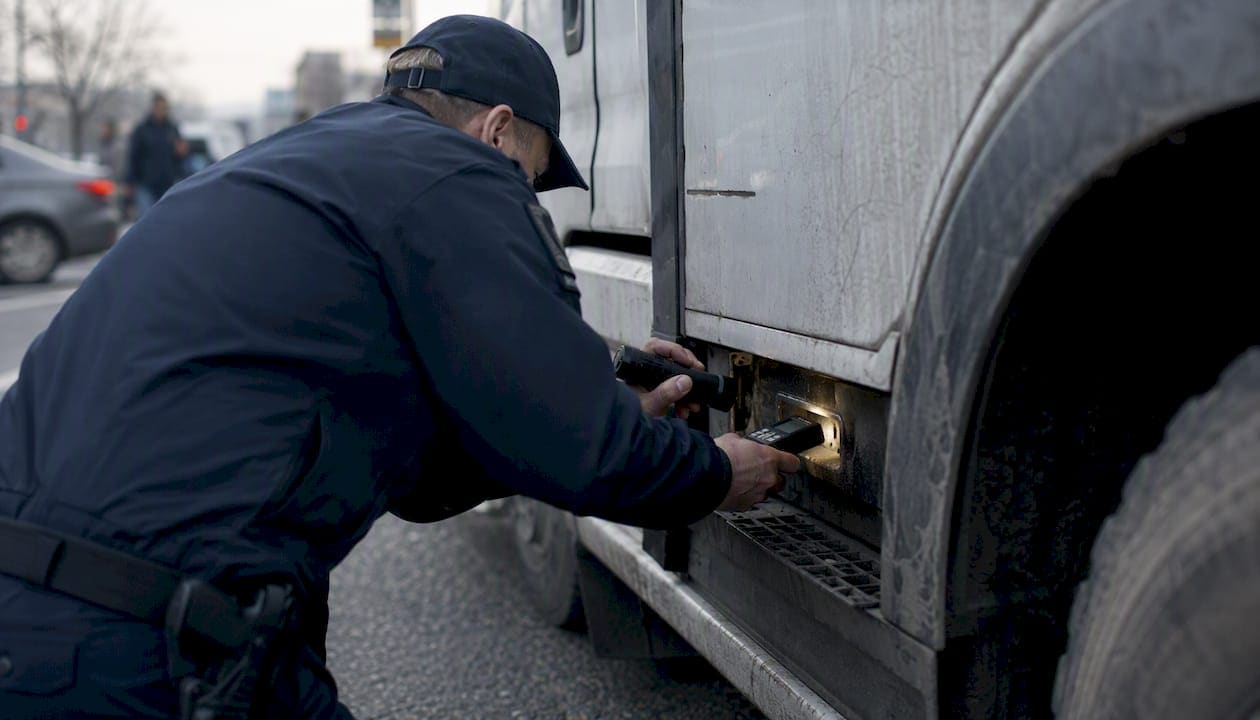
Inspectors conducting a Level 1 or Level 3 inspection will typically follow this sequence:
- Request the driver’s current ELD display and verify the device is registered and not on the FMCSA revoked list.
- Initiate an ELD data transfer (Bluetooth, USB, or web service) to pull the official log file.
- Review the previous 7 days of records of duty status (RODS), including the current day.
- Compare annotations and driver remarks against supporting documents on hand.
- Check for unassigned driving time and ask the driver to review and accept or reject those segments.
- Flag any edit history entries for review.
If an ELD transfer fails, that failure itself can generate a secondary citation. Practitioners advise taking an immediate screenshot or photo of the failed transfer screen as documentation.
Self-audit checklist before a trip or inspection
- Verify ELD is powered, registered, and syncing correctly.
- Confirm available driving hours for the current cycle.
- Review the previous 7 days of logs for unresolved unassigned driving time.
- Check that all supporting documents (BOLs, fuel receipts) are accessible and consistent with logged duty statuses.
- Confirm any ELD malfunction from a prior shift was properly annotated and paper logs were maintained during the outage.
What should you do immediately after an HOS citation?
The actions taken in the first hour after a roadside citation or OOS order have a direct effect on what happens next, both in the enforcement file and in any subsequent legal proceeding.
Immediate steps at the stop
Comply with the OOS order without argument. Disputing an OOS order at the roadside does not suspend it, and any movement of the vehicle while under OOS can result in CDL disqualification. While stopped, document everything: photograph the inspection report, note the officer’s name and badge number, and record the exact time and location. Request a copy of the inspection report before leaving the scene — you are entitled to one.
Preserve ELD files immediately. Do not allow the device to overwrite data. If the device permits a manual export, initiate it and save the file to a secondary location.
Pro Tip: Keep a small notepad in the cab specifically for inspection stops. Write down the inspector’s name, the citation numbers, the time, and any verbal statements made during the stop. That contemporaneous record can be valuable months later if the citation is contested.
Short-term actions for carriers
Within 24 to 48 hours of the stop, carriers should:
- Pull the full ELD history for the driver and the vehicle for the relevant period.
- Collect all supporting documents: dispatch communications, BOLs, fuel receipts, GPS reports, and maintenance records.
- Flag and preserve any ELD edit history entries without altering them.
- Review dispatch logs for any instructions that may have contributed to the violation.
Record retention and ELD malfunction documentation
Under 49 CFR 395.22 and 395.34, carriers must retain driver records for at least 6 months. ELD data, supporting documents, and malfunction annotations should be retained for the same period at minimum, and longer if litigation is anticipated. When an ELD malfunction occurs, the driver must note the malfunction in the remarks field, notify the carrier within 24 hours, and reconstruct logs on paper until the device is repaired or replaced, which must happen within 8 days.
Contesting a citation
Administrative review of a roadside citation is available through the DataQs system, FMCSA’s online portal for challenging inspection data. The most effective challenges are supported by ELD data, GPS records, and supporting documents that directly contradict the cited violation. Timelines for DataQs review vary, but submitting a challenge promptly, with complete documentation, gives the reviewing agency the clearest picture. If the citation involves falsification allegations or an OOS order violation, the stakes are high enough that legal counsel should be involved before any submission is made.
A practical compliance checklist for drivers, dispatchers, and carriers
Preventing hours of service violations is primarily a systems problem, not a willpower problem. Drivers who violate HOS rules are often responding to scheduling pressure, ELD confusion, or a misunderstanding of an exception’s eligibility conditions.
Role-specific responsibilities
| Role | Daily Action | Key Prevention Focus |
|---|---|---|
| Driver | Pre-trip HOS check: verify available hours, ELD operation, and prior-day log accuracy | Avoid the “almost there” push past the 14-hour window |
| Dispatcher | Audit driver hours before assigning a load; flag drivers within 2 hours of any limit | Never direct a driver to use personal conveyance for company-directed movement |
| Fleet Safety Manager | Weekly ELD data review; resolve unassigned driving time within 48 hours; monthly internal log audits | Monitor HOS BASIC percentile monthly; set intervention thresholds before FMCSA does |
Driver daily checklist
- Check available driving hours before starting the engine.
- Verify ELD is functioning and syncing; document any malfunction immediately.
- Confirm the 30-minute break has been logged correctly if 8 cumulative driving hours have been reached.
- Log personal conveyance only for genuinely personal, non-business movement.
- Review and accept or reject any unassigned driving time from the prior shift before beginning a new one.
Dispatcher and carrier best practices
Dispatchers are the first line of defense against scheduling-driven violations. A dispatcher who assigns a load without checking a driver’s rolling 8-day total is creating the conditions for a 60/70-hour violation before the driver turns a wheel. Carriers should build hour audits into the load-assignment workflow, not treat them as optional.

Pro Tip: Fleet management platforms like Geotab offer automated HOS alerts that flag drivers approaching limits in real time, giving dispatchers a window to adjust assignments before a violation occurs rather than after.
ELD governance matters as much as the device itself. Carriers should maintain a device registry, schedule quarterly firmware checks, and establish a written malfunction response protocol so drivers know exactly what to do when a device fails at 2:00 AM on a highway.
When should you consult a lawyer about an HOS violation?
Not every HOS citation requires legal counsel. A single, minor form-and-manner violation that is uncontested and carries a low severity weight can often be handled administratively. But several situations justify calling a lawyer before taking any further action.
Situations that justify immediate legal help
- A crash caused injury or death and HOS records are potentially relevant to liability.
- An inspector or investigator has alleged falsification of records or improper personal conveyance use.
- A carrier has received a notice of a compliance review or a proposed civil penalty.
- A driver faces CDL disqualification proceedings.
- There is evidence of carrier coercion — a dispatcher or manager directing a driver to violate HOS rules.
What legal counsel can do
An attorney experienced in truck-crash litigation and FMCSA enforcement can preserve evidence through litigation holds and subpoenas, obtain carrier records that would otherwise be unavailable, coordinate ELD forensics experts who can reconstruct driving histories, and advise on contesting fines through the administrative process. In civil cases, HOS violations are powerful evidence of negligence per se, meaning a violation of the regulation can establish the duty and breach elements of a negligence claim without requiring additional expert testimony on the standard of care.
For a deeper look at how liability in Indiana commercial truck crashes is analyzed, including the role of driver conduct and HOS compliance, that resource walks through the key factors courts and insurers examine.
What to bring to an initial legal consultation
- The roadside inspection report (Form MCSA-5875 or equivalent).
- ELD download or export from the relevant period.
- Dispatch communications, including text messages and load assignment records.
- Maintenance records for the vehicle involved.
- Photographs taken at the scene or during the stop.
- Contact information for any witnesses.
Pro Tip: If you are an injured person rather than a driver or carrier, bring your medical records and any documentation of the crash scene. The attorney will pursue the carrier’s HOS records through discovery — your job is to preserve your own evidence and get to the consultation quickly.
Understanding the importance of driver log books in truck-crash cases gives additional context on why ELD data is so central to both enforcement and civil litigation.
An editorial perspective on HOS evidence and legal outcomes
HOS records are among the most underestimated pieces of evidence in truck-crash litigation. When our team reviews a case involving a commercial truck, the ELD data is often the first thing we request, and for good reason. A driver who was 12 minutes past the 11-hour limit when a crash occurred is not just a regulatory statistic. That 12 minutes represents a decision, or a series of decisions, by the driver, the dispatcher, and the carrier that put a fatigued person behind the wheel of an 80,000-pound vehicle.
What I find most striking is how often the pattern of violations tells a clearer story than any single event. Repeated edits to logs, unresolved unassigned driving time, and a history of personal conveyance use on company-directed moves are not random errors. They are signals of a compliance culture, and courts and juries understand that. A carrier that has been warned through elevated CSA scores and still failed to act faces a very different liability exposure than one that had a single, isolated violation.
For anyone in Indiana, Michigan, or New Mexico who has been harmed in a crash where driver fatigue or HOS noncompliance may be a factor, the time to act is now. Evidence preservation is not something that can wait until after you have recovered physically. ELD data can be overwritten, and carriers have legal teams working from the moment a crash is reported.
How 2keller can help if you were harmed in a crash tied to HOS violations
If you or a family member was injured in a truck crash and you suspect the driver was over hours, 2keller offers free consultations with no obligation and handles truck accident cases on a contingency fee basis, meaning you pay nothing unless we win or settle your case.

Our team pursues HOS evidence aggressively: we issue litigation holds, subpoena ELD data and dispatch records, and work with forensic experts to reconstruct the driver’s hours in the days leading up to a crash. We serve clients in Indiana, Michigan, and New Mexico, and we know how commercial truck driving laws in Indiana intersect with federal HOS rules to establish carrier liability.
To get started, bring your inspection report, any photos from the scene, your medical records, and any communications you have received from the carrier or its insurer. Schedule a free consultation through our serious injury claim guide or call us directly. The sooner we can review the evidence, the stronger your case will be.
For civil litigation questions that extend beyond our geographic coverage, the team at ULG Law handles civil litigation matters and may be a resource for readers outside Indiana, Michigan, and New Mexico.
Sources
These are the primary regulatory and agency sources to consult for official rule text, enforcement guidance, and self-check tools.
- Summary of Hours of Service Regulations | FMCSA
- 49 CFR Part 395 – Hours of Service of Drivers | eCFR
- Hours of Service of Drivers | Federal Register
The FMCSA’s online HOS testing tool, accessible through the FMCSA hours-of-service guidance page, allows drivers and carriers to input a record of duty status and check it against current rules before a trip or an inspection — a practical self-audit resource that takes minutes to use.
This article is general information, not a substitute for advice from a qualified lawyer. Consult a qualified legal professional about your own circumstances before acting on anything here.
Recommended
- Indiana Semi-Truck Drivers and The Importance of Their “Log Book” – Keller & Keller
- Semi-Truck Mechanical Failures and Defects Can Be Prevented – Keller & Keller
- Commercial Truck Driving Laws in Indiana – Keller & Keller
- Negligent Truck Driver Hiring Practices Endanger Motorists – Indianapolis Granger – Keller & Keller