
Indiana law lets survivors recover medical bills, funeral costs, lost earnings, and loss of companionship, but that last category carries a hard $300,000 cap under Indiana’s Adult Wrongful Death Statute. Juries never learn about that ceiling before they deliberate. A personal representative must file suit, typically within two years of the death, or the claim is likely barred.
TL;DR:
- The $300,000 cap applies only to loss-of- companionship damages under the Adult Wrongful Death Statute, and juries are unaware of this limit during trial.
- Adult wrongful death claims under AWDS cannot include damages for grief or punitive damages, unlike claims under the general statute.
- The applicable statute heavily influences the potential recovery, with the general statute allowing uncapped damages and AWDS imposing strict limits on companionship awards.
- Insurance policies, rather than personal assets, typically fund wrongful death recoveries, and early record gathering is crucial to maximizing settlement value.
- If the decedent is found more than 50% at fault, the wrongful death claim is barred; documentation and evidence of relationships are vital to reduce the impact of contributory fault.
Table of Contents
- How Indiana’s Wrongful Death Law Is Organized
- What Damages You Can Recover: Economic vs. Non-Economic
- Caps, Limits, and How Courts Handle Excess Verdicts
- How Damages Are Valued: Evidence, Experts, and Calculation Approaches
- Who May File, and How Damages Get Divided
- Timing and Next Steps After a Wrongful Death
- Keller & Keller’s Perspective on Indiana Wrongful Death Claims
- Insurance Considerations Relevant to Wrongful Death Damages
- Impact of Contributory Negligence on Damages Recovery
- Comparisons of Wrongful Death Damages Limits in Indiana vs. Other States
- Process of Proving Damages in Wrongful Death Lawsuits
- When You Actually Need a Wrongful Death Lawyer
- Get a Free Case Evaluation From Keller & Keller
- Sources
- FAQ
How Indiana’s Wrongful Death Law Is Organized
Indiana splits wrongful death claims into three statutory tracks, and which one applies changes everything about what you can recover.
- IC 34-23-1-1 (the general statute) covers most adult decedents who leave behind dependents or a spouse. It permits medical, hospital, funeral, and burial expenses plus lost earnings, with the expense portion paid to the estate.
- IC 34-23-1-2, the Adult Wrongful Death Statute (AWDS), covers unmarried adults with no dependents. It caps loss of companionship damages and blocks certain evidence the general statute allows.
- Chapter 2 (child wrongful death) applies when the decedent is a minor and opens up different, often broader, categories of loss tied to a parent-child relationship.
Figuring out which statute governs your case is the first real decision point, and it usually determines the size of any eventual recovery.
What Damages You Can Recover: Economic vs. Non-Economic
Indiana wrongful death damages fall into two buckets: money that reimburses actual financial loss, and money that compensates for the relationship itself.
- Medical and hospital expenses. These flow to the decedent’s estate and cover treatment between the injury and death.
- Funeral and burial costs, along with reasonable estate administration expenses, are also paid to the estate under IC 34-23-1-1.
- Lost earnings or lost services are recoverable under the general statute, calculated from the decedent’s income and life expectancy. AWDS claims cannot include this category at all.
- Loss of love and companionship compensates surviving spouses, parents, or children for the relationship lost. Under the general statute it is uncapped; under AWDS it maxes out at $300,000 total.
What AWDS explicitly forbids matters just as much as what it allows. Adult-person claims under IC 34-23-1-2 cannot include damages for grief, and punitive damages are off the table entirely. That distinction trips up a lot of families who assume every wrongful death case works the same way.
Caps, Limits, and How Courts Handle Excess Verdicts
The $300,000 figure isn’t a suggestion. It’s an aggregate ceiling on loss-of-love-and-companionship awards under AWDS; it applies no matter how many survivors are splitting the money.
Statistic callout: Under IC 34-23-1-2(e), Indiana law caps aggregate loss-of-companionship damages at $300,000, and the statute directs that juries are never told this number exists during trial.
That last part produces some unusual outcomes:
- A jury unaware of the cap can, and sometimes does, award far more than $300,000 for a loss-of-companionship claim.
- When that happens, the trial court simply reduces the non-economic portion down to the statutory cap after the verdict comes in.
- Courts also specify how much of an award belongs to the estate (medical, funeral) versus the individual survivors (companionship damages), which affects who actually receives a check.
That reduction step catches families off guard, and it’s worth building into your expectations before trial rather than after.
How Damages Are Valued: Evidence, Experts, and Calculation Approaches
Economic damages are the easier half to prove. You need documentation, not persuasion.
- Medical and hospital bills, itemized and dated
- Funeral home invoices and burial costs
- Payroll records, tax returns, and employer statements to establish lost earnings
- Actuarial or economist testimony projecting future earnings against life expectancy
Loss of companionship works differently, and it’s the harder value to pin down. Attorneys typically build this case through testimony from family members, friends, and sometimes counselors, describing the day-to-day closeness of the relationship, paired with life expectancy tables comparing the decedent and the surviving spouse, parent, or child. The Riley Bennett Egloff analysis of Indiana wrongful death damages notes that courts and juries weigh the intimacy and permanence of the relationship, not just its existence.
Pro Tip: Start gathering wage records and relationship evidence, like photos, texts, and shared calendars, within the first few weeks. Memory fades fast, and payroll departments don’t keep records forever.
Who May File, and How Damages Get Divided
Only the personal representative of the decedent’s estate can bring a wrongful death lawsuit in Indiana. That’s true whether you’re pursuing a claim under the general statute or AWDS, and it’s a common point of confusion for grieving spouses or parents who assume they can sue directly.
- The personal representative is appointed through probate court, often a spouse, adult child, or estate attorney.
- Medical and funeral expense awards inure to the estate, where they typically pay outstanding bills first.
- Loss-of-companionship awards under AWDS go to the surviving spouse or, if there’s no spouse, to dependent children or dependent next of kin.
- Under IC 34-23-1-2(f), a nondependent parent or child must affirmatively prove a genuine, substantial, and ongoing relationship with the decedent before recovering any companionship damages. This isn’t presumed. It has to be established with evidence.
Timing and Next Steps After a Wrongful Death
Indiana gives you two years from the date of death to file suit under the general wrongful death statute, and missing that window typically ends the case regardless of its merits.
- Preserve records immediately. Medical bills, funeral invoices, wage statements, and anything documenting the relationship with the decedent should be collected within the first few weeks.
- Confirm the personal representative is appointed. Probate delays can eat into your filing window without anyone noticing.
- Expect a multi-phase process. Investigation and evidence-gathering typically run several months, followed by a demand and negotiation period, and, if no settlement is reached, litigation that can extend well past a year.
Waiting to see how you feel, or hoping an insurance adjuster will make a fair offer without pressure, rarely works in the family’s favor.
Keller & Keller’s Perspective on Indiana Wrongful Death Claims
This article reflects the statutory framework applied in wrongful death claims arising from car crashes, motorcycle collisions, and other fatal accidents in Indiana. This piece walks through the AWDS cap and general statute distinctions in plain language.
For related reading, see our breakdown of Indiana’s wrongful death statute and how wrongful death claims are allocated among survivors.
Insurance Considerations Relevant to Wrongful Death Damages
Most wrongful death recoveries in Indiana come from an insurance policy, not the defendant’s personal assets. That fact shapes strategy from day one.
Auto liability policies carry limits, and Indiana’s minimum bodily injury coverage is often far lower than the value of a wrongful death claim involving lost earnings and companionship damages. When the at-fault driver’s policy limit is exhausted, survivors sometimes turn to the decedent’s own underinsured motorist coverage, which can fill part of the gap if the policy was active.
Commercial and trucking cases work differently, since business insurance policies typically carry much higher limits, but they also come with defense teams working to minimize the payout from the start. Insurers routinely dispute the value of loss-of-companionship claims because that category is inherently subjective, and adjusters know courts give juries wide discretion.
A few practical points matter here. First, recorded statements to an adjuster early in a claim can be used against the estate later, so families should be cautious about what they say before consulting an attorney. Second, insurers sometimes offer a quick settlement shortly after a death, betting that grieving families will accept less than the claim is worth. Third, when insurers deny or undervalue a claim, policyholders have specific rights to challenge that decision, and understanding those rights before signing anything protects the eventual recovery.
Life insurance proceeds are separate from wrongful death damages and don’t reduce what a negligent party owes.
Impact of Contributory Negligence on Damages Recovery
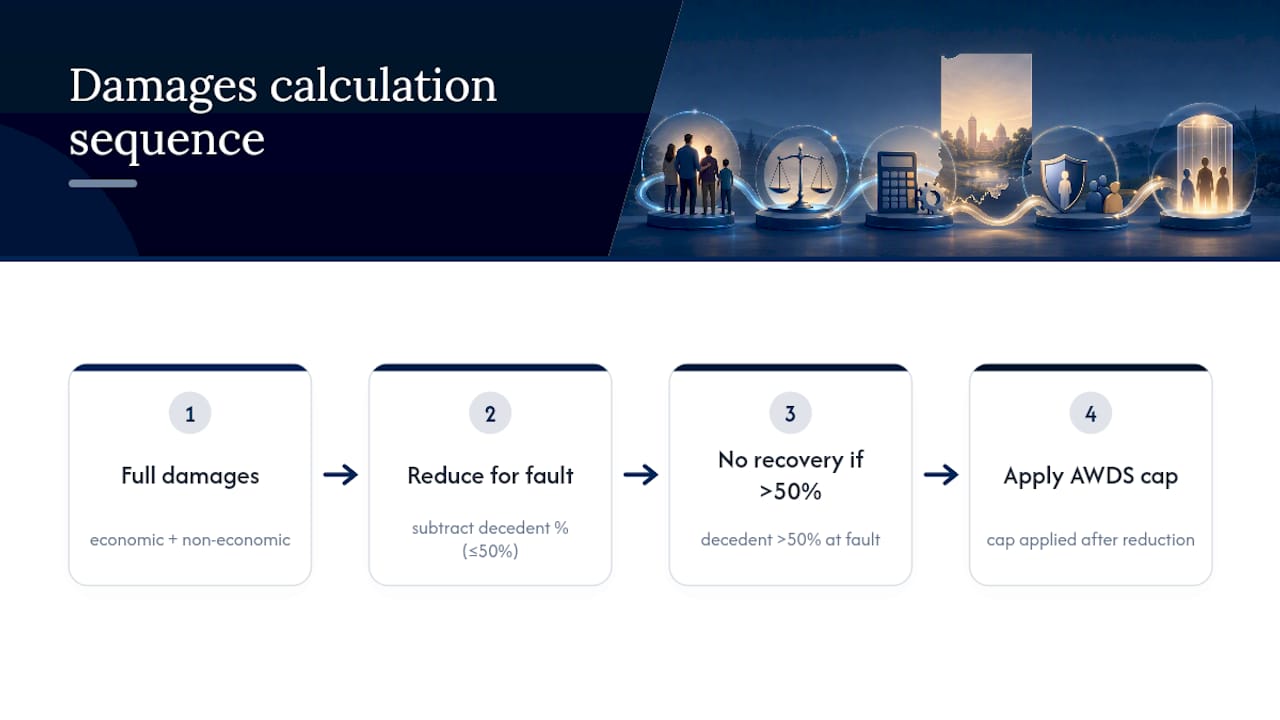
Indiana follows a modified comparative fault rule, not the old contributory negligence bar. Under the Comparative Fault Act, if the decedent is found more than 50% at fault for the accident that caused their death, the estate recovers nothing at all.
Below that threshold, damages get reduced proportionally. This calculation applies to the full damages award, both economic and non-economic, before any statutory cap is applied under AWDS.
Fault allocation becomes contested territory fast, especially in multi-vehicle accidents or cases involving comparative allegations like speeding, distraction, or failure to yield. Defense attorneys and insurance companies routinely argue partial fault against the decedent specifically because it reduces or eliminates payout exposure. This is one of the most common battlegrounds in Indiana wrongful death litigation, and it’s why evidence like event data recorder downloads, witness statements, and accident reconstruction often matter as much as medical documentation.
Families should expect the defense to raise comparative fault early, sometimes before liability is even fully established, as a negotiating tactic to lower settlement value.
Comparisons of Wrongful Death Damages Limits in Indiana vs. Other States
Indiana’s $300,000 cap on loss-of-companionship damages under AWDS puts it in the middle of the national range, not at either extreme.
Some states impose no cap at all on non-economic wrongful death damages, letting juries award whatever they find the evidence supports. Others cap damages far lower than Indiana, and a handful of states extend caps to economic damages as well, which Indiana does not do. Indiana’s general wrongful death statute, by contrast, places no ceiling on lost earnings or the value of medical and funeral expenses.
What makes Indiana’s approach distinctive is the split itself. Rather than applying one cap to every wrongful death case, the state carves out narrower protections for unmarried, dependent-free adults under AWDS while leaving the general statute largely uncapped for spouses and dependents. A surviving spouse under the general statute can pursue an open-ended non-economic claim, while a surviving parent of an unmarried adult child with no dependents is bound by the $300,000 ceiling. Two similar fatal accidents can produce very different maximum recoveries depending purely on the decedent’s marital and dependent status at the time of death.
This is one reason the initial statute determination matters so much. Families sometimes learn only after consulting counsel which track their case falls under, and that answer changes the realistic settlement range before a single dollar figure gets discussed.
Process of Proving Damages in Wrongful Death Lawsuits
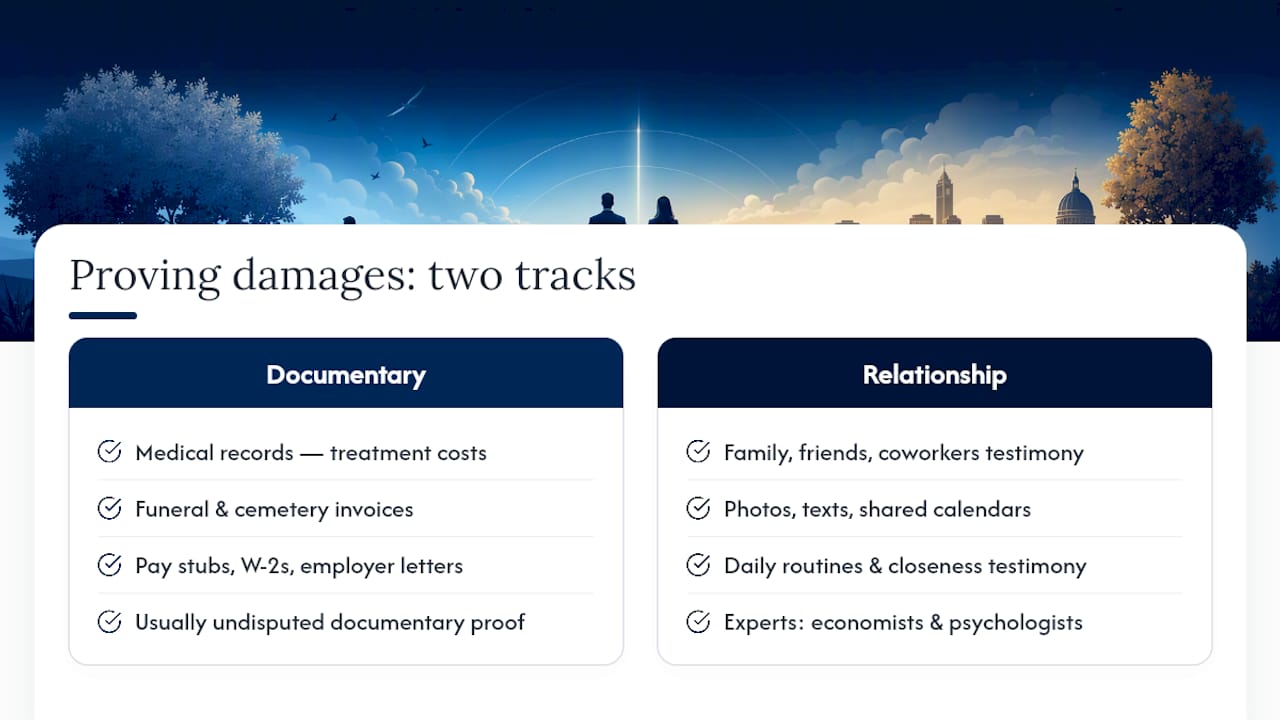
Proving wrongful death damages in Indiana runs on two parallel tracks: proving the loss happened, and proving what it’s worth.
The first track is documentary. Medical records establish the treatment costs incurred before death. Funeral home invoices and cemetery receipts establish burial expenses. Pay stubs, W-2s, and employer letters establish the earnings history needed to calculate lost income under the general statute. None of this is particularly contested in most cases; insurers rarely dispute a funeral bill’s authenticity.
The second track, valuing the relationship itself, is where cases get argued. Attorneys typically build this through testimony from family members, friends, coworkers, and sometimes clergy or counselors, describing the closeness and permanence of the relationship with the decedent. Photographs, text message histories, shared calendars, and testimony about daily routines all serve as evidence that the relationship was genuine and substantial, which matters directly for the AWDS burden discussed earlier.
Expert testimony often enters at this stage too. Economists project lost future earnings using life expectancy tables and wage growth assumptions. In some cases, grief counselors or psychologists testify about the observable impact of the loss on surviving family members, even though AWDS bars damages for grief itself. The distinction between compensable companionship loss and non-compensable grief is subtle, and it’s typically litigated through careful witness preparation rather than a bright-line rule.
Settlement negotiations usually begin once both tracks have enough evidence assembled to support a demand letter with a specific dollar figure attached.
When You Actually Need a Wrongful Death Lawyer
Not every wrongful death claim requires litigation, but most benefit from legal representation once liability is contested, multiple parties share fault, or the non-economic claim could approach the $300,000 AWDS cap. Contingency fee arrangements mean you pay nothing upfront, and the firm only collects a percentage if you recover money. A first consultation usually clarifies which statute applies and what your realistic range looks like, whether the case ultimately settles or heads to trial.
— Adam
Get a Free Case Evaluation From Keller & Keller
If you’re navigating a wrongful death claim in Indiana, you don’t have to sort out AWDS caps, comparative fault, and insurance tactics on your own while also grieving. This law firm represents Indiana families in wrongful death claims on a contingency fee basis, meaning there is no cost to you unless compensation is recovered, and initial case evaluations are offered free of charge.

Bring what you have to that first conversation: medical and funeral bills, any insurance correspondence, and basic details about how the accident happened. From there, we’ll walk you through what to expect during a case evaluation, identify which statute applies to your situation, and outline next steps for preserving evidence before deadlines close in. Reach out to schedule that free consultation and find out where your claim actually stands.
This article is general information, not a substitute for advice from a qualified lawyer. Consult a qualified legal professional about your own circumstances before acting on anything here.
Sources
- Indiana Code § 34-23-1-2. Wrongful Death Actions (Justia)
- Indiana Code § 34-23-1-1. Death From Wrongful Act or Omission (Justia)
- Indiana’s Wrongful Death Damages – A “Cheat Sheet” For What Damages Are Recoverable (Riley Bennett Egloff LLP)
FAQ
What’s the Average Wrongful Death Payout in Indiana?
There’s no fixed average because outcomes depend on which statute applies, the strength of liability evidence, and comparative fault. Economic damages like medical bills and lost earnings are uncapped, while AWDS loss-of-companionship awards top out at $300,000.
What Is the Loss-of-Companionship Cap for Survivors in Indiana?
Under IC 34-23-1-2(e), the Adult Wrongful Death Statute caps aggregate loss-of-love-and-companionship damages at $300,000 for unmarried, dependent-free adult decedents.
What Damages Are Available for Wrongful Death in Indiana?
Recoverable damages include medical and hospital expenses, funeral and burial costs, lost earnings under the general statute, and loss of love and companionship, subject to the AWDS cap where applicable.
What Are the Odds of Winning a Wrongful Death Lawsuit in Indiana?
Success depends heavily on liability evidence and comparative fault; if a jury finds the decedent more than 50% at fault, the estate recovers nothing under Indiana’s comparative fault rules. Strong documentation and early evidence preservation meaningfully improve the odds of a favorable outcome.
Who Can File a Wrongful Death Claim in Indiana?
Only the personal representative of the decedent’s estate may bring the lawsuit, though the recovered funds are then distributed to the estate or specific survivors depending on the damage category.