A medical lien in a personal injury case is a legal claim that gives medical providers the right to collect repayment directly from your settlement before you receive a single dollar. Understanding medical liens is not optional for anyone pursuing a personal injury claim. Liens from hospitals, doctors, private insurers, Medicare, and Medicaid can collectively consume a significant portion of your gross recovery. The personal injury lien process is governed by a mix of federal law, state statutes, and contract law, making it one of the most complex parts of any settlement. This guide breaks down every type of lien, how each affects your payout, and what you can do to protect your net recovery.
What is a medical lien in personal injury cases?
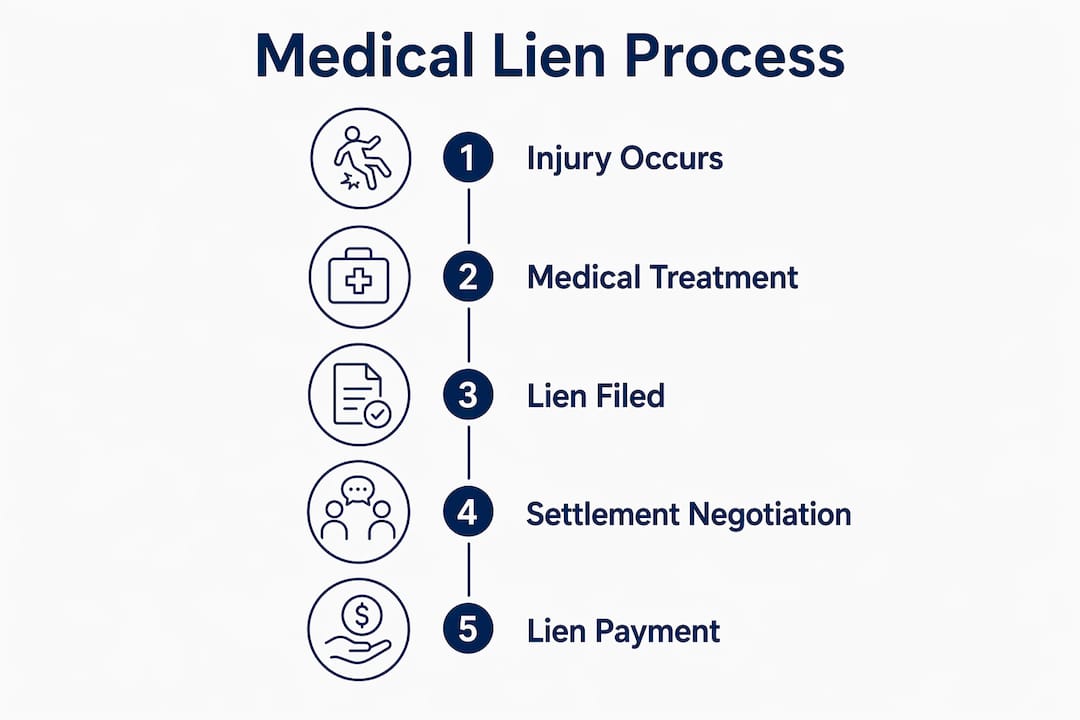
A medical lien is a legal instrument that secures a healthcare provider’s right to payment from the proceeds of a personal injury settlement or judgment. The lien attaches to the settlement funds, not to the plaintiff personally. That distinction matters because it means the provider cannot garnish your wages or sue you for the debt while your case is active. Instead, they wait for the settlement and collect from the pool of funds before you receive your share.
The legal foundation for medical liens varies by state. Most states have hospital lien statutes that automatically grant hospitals a lien on emergency and inpatient charges. Physician liens, by contrast, are typically contractual and depend on the specific agreement between the provider and the patient. New Mexico, Indiana, and Michigan each have their own statutory frameworks governing how and when these liens attach, which is why medical lien personal injury NM cases can look different from those in other states.

A Letter of Protection, or LOP, is frequently confused with a lien. An LOP is a contractual agreement that defers payment to the provider until the case resolves. The lien is the legal claim that secures that deferred payment. The LOP creates the right; the lien enforces it. Knowing the difference helps you understand what you have actually signed and what obligations follow.
What types of medical liens exist in personal injury lawsuits?
Medical liens in lawsuits fall into several distinct categories. Each type carries different legal rules, negotiation flexibility, and priority in the payment order.
-
Medical provider liens. Hospitals and physicians assert these liens based on state statutes or contracts. Statutory hospital liens are automatic in most states. Physician liens require a signed agreement. Both are generally negotiable, and medical provider liens are frequently reduced by 30–50% off the billed amount through skilled negotiation.
-
Private health insurance subrogation claims. When your health insurer pays your medical bills, it acquires a subrogation right to recover those payments from your settlement. These claims are governed by your policy contract and state law. Private health insurance subrogation claims can often be reduced by 20–40%, particularly when the made-whole doctrine applies and the settlement does not fully compensate you for all losses.
-
Medicare liens. Medicare is governed by the Medicare Secondary Payer Act, codified at 42 U.S.C. § 1395y(b)(2). Federal law requires Medicare’s conditional payments to be repaid before any settlement funds are disbursed. Medicare also receives a mandatory procurement cost reduction, which lowers the lien amount by the proportional share of attorney fees and litigation costs.
-
Medicaid liens. Medicaid liens use state-specific reduction formulas based on proportional allocation of the settlement to past medical expenses. The proportionality principle limits Medicaid’s recovery to the portion of the settlement that compensates for medical costs, not for pain and suffering or lost wages.
-
ERISA liens. Employer-sponsored health plans governed by the Employee Retirement Income Security Act of 1974 (ERISA) have more limited negotiation flexibility due to federal preemption. ERISA liens can sometimes be disputed using the common fund or made-whole doctrines, but the plan language controls and must be reviewed carefully.
-
Workers’ compensation liens. If a workers’ comp carrier paid your medical bills for a work-related injury, it holds a lien on any third-party personal injury recovery. These liens are governed by state workers’ comp statutes and are often subject to reduction formulas.
How do medical liens affect your personal injury settlement payout?
Medical liens can consume 20–40% or more of the gross settlement amount. That figure does not include attorney fees or case costs, which typically reduce your recovery further. The result is that the number on your settlement check often looks very different from the amount you actually take home.
The typical payment priority order from a personal injury settlement works as follows:
- Attorney fees and litigation costs are deducted first, usually as a percentage of the gross settlement.
- Government liens (Medicare, Medicaid, ERISA, workers’ compensation) are paid next because federal and state law mandates their priority.
- Private health insurance subrogation claims are resolved after government liens.
- Medical provider liens from hospitals and physicians are paid from the remaining funds.
- The plaintiff receives the net recovery after all liens, fees, and costs are satisfied.
Consider a concrete example. A $100,000 settlement with a 33% attorney fee leaves $67,000. If Medicare holds a $15,000 lien and a hospital holds a $20,000 lien, the plaintiff receives $32,000 before any negotiation. Skilled lien negotiation can change that outcome significantly. Effective lien negotiation can recover $10,000–$30,000 or more for clients compared to paying liens at face value. That gain often exceeds what additional negotiation with the at-fault insurer would produce.
A common misconception is that a settlement large enough to cover all medical bills means all bills are paid. Liens only cover the bills that were actually submitted and verified. Unverified or disputed charges can still appear on a lien statement. Verifying every line item before disbursement protects you from paying inflated or duplicate charges.
Pro Tip: Request an itemized lien statement from every lienholder before your case closes. Compare each charge against your medical records. Errors and inflated charges appear more often than most claimants expect.
What strategies work best for negotiating medical liens?
Lien negotiation is a skill, not a formality. The goal is to reduce the total lien balance so more of the settlement reaches you. Several proven strategies apply across lien types.
Request itemized statements and audit every charge
Every lien statement should list individual services, dates, and amounts billed. Compare the statement against your explanation of benefits and medical records. Duplicate charges, services never rendered, and inflated rates are all grounds for reduction. Providers frequently bill at chargemaster rates, which are far higher than what insurers actually pay.
Apply the common fund doctrine
The common fund doctrine holds that a lienholder who benefits from your attorney’s work in securing the settlement should contribute to the cost of that work. Courts in most states recognize this doctrine. It allows your attorney to request that the lienholder reduce its claim by a proportional share of attorney fees and litigation costs. This doctrine applies most cleanly to hospital liens and private insurance subrogation claims.
Use the made-whole rule
Not all lien amounts are final. The made-whole rule holds that a lienholder cannot recover from your settlement unless you have been fully compensated for all your losses. If your settlement is less than your total damages, the made-whole rule can reduce or eliminate certain liens. This rule applies most strongly to private health insurance subrogation claims and varies by state.
Negotiate hospital liens to insurance payment levels
Hospitals often bill at rates two to three times higher than what Medicare or private insurers actually pay. Your attorney can negotiate the hospital lien down to the Medicare or contracted insurance rate. This single tactic frequently produces the largest dollar reduction in the entire lien resolution process.
Handle Medicare liens through the statutory process
Medicare’s mandatory procurement cost reduction is automatic. Beyond that reduction, you can dispute conditional payment amounts by submitting evidence of charges unrelated to the injury. The Centers for Medicare and Medicaid Services (CMS) has a formal dispute process, and using it correctly can lower the final lien balance before disbursement.
Diligent identification and negotiation of liens before fund disbursement is the single most effective way to protect your net recovery. Waiting until the day of settlement to address liens leaves no time for negotiation and forces you to pay at full value.
What are the legal risks of ignoring medical liens?
The legal obligations surrounding medical liens are not suggestions. Failing to comply carries real financial and legal consequences for both plaintiffs and their attorneys.
“A claimant’s biggest mistake is releasing funds before liens are confirmed and resolved. You may end up owing more than the net recovery you actually received, leaving you personally liable for debts you thought were settled.” — Medical Lien Settlement Glossary
The Medicare Secondary Payer Act imposes the strictest obligations. Failing to resolve Medicare liens before disbursement exposes the attorney to personal liability and the plaintiff to federal penalties. Medicare can pursue double damages against any party that received settlement funds without satisfying its lien first.
Attorney liability for unresolved government liens is a serious professional risk. Most state bar rules require attorneys to hold disputed lien funds in trust until the lien is resolved. Disbursing funds before a Medicare or Medicaid lien is confirmed violates both federal law and professional conduct rules. The role of liens in injury settlement resolution is therefore a core legal responsibility, not an administrative afterthought.
Letters of Protection create their own obligations. When you sign an LOP, you personally guarantee payment to the provider from your settlement proceeds. If the case settles for less than the LOP amount, you and your attorney must negotiate a reduction or pay the difference. Understanding what you sign at the outset prevents surprises at the end of the case.
Lien verification before settlement is non-negotiable. Every lienholder must confirm the final balance in writing before funds are disbursed. Verbal confirmations are not sufficient. Written confirmation protects you if a lienholder later claims a higher balance than what was agreed.
Key Takeaways
Medical liens are legal claims that reduce your personal injury settlement payout before you receive funds, and skilled negotiation is the most effective tool for protecting your net recovery.
| Point | Details |
|---|---|
| Liens attach to settlement funds | Medical providers collect from your settlement proceeds, not directly from you personally. |
| Multiple lien types exist | Government liens (Medicare, Medicaid, ERISA) carry stricter rules than provider or insurance liens. |
| Liens reduce net recovery significantly | Medical liens can consume 20–40% or more of a gross settlement before attorney fees are deducted. |
| Negotiation produces real gains | Skilled lien negotiation can recover $10,000–$30,000 or more compared to paying liens at face value. |
| Unresolved liens carry legal risk | Disbursing funds before liens are confirmed exposes both plaintiff and attorney to federal penalties. |
What I have learned from handling medical liens across multiple states
Working through medical liens in Indiana, Michigan, and New Mexico has taught me one consistent lesson: most claimants underestimate how much lien negotiation matters. They focus entirely on the settlement number and assume the rest works itself out. It does not.
The clients who protect the most money are the ones who get involved early. They ask their attorney for a lien inventory at the start of the case, not the week before settlement. They understand the difference between a Medicare lien and a hospital lien, and they know those two require completely different approaches. That early awareness gives the attorney time to request itemized statements, audit charges, and apply the right legal doctrines before the settlement deadline creates pressure.
The made-whole rule is the most underused tool I see in practice. Attorneys who do not raise it in cases with limited settlements leave real money on the table. If your settlement does not fully compensate you for lost wages, future medical costs, and pain and suffering, that argument belongs in every negotiation with a private insurer. The medical liens guide from 2keller covers how this plays out across the states we practice in.
My honest advice: never assume a lien balance is final. Every number on a lien statement is a starting point, not a conclusion.
— Adam
Strong injury documentation supports your lien resolution
Thorough injury documentation does more than strengthen your liability claim. It directly supports lien negotiation by establishing which medical treatments were caused by the accident and which were not. When a lien statement includes charges for pre-existing conditions or unrelated procedures, documented proof of your injury timeline gives your attorney the evidence needed to dispute those charges.

2keller’s 2026 injury documentation guide walks you through exactly what records to gather, how to organize them, and how that documentation supports every stage of your personal injury claim, including lien resolution. If you are managing a claim in Indiana, Michigan, or New Mexico, that guide is a practical starting point for protecting your recovery from the ground up.
FAQ
What is a medical lien in a personal injury case?
A medical lien is a legal claim that gives a healthcare provider the right to collect repayment from your personal injury settlement before you receive funds. The lien attaches to the settlement proceeds, not to your personal assets.
Can medical liens be negotiated down?
Medical provider liens are frequently negotiated to a 30–50% reduction off the billed amount, and private health insurance subrogation claims can often be reduced by 20–40% using doctrines like the made-whole rule or common fund doctrine.
What happens if a Medicare lien is not paid before settlement?
The Medicare Secondary Payer Act requires Medicare’s conditional payments to be repaid before any settlement funds are disbursed. Non-compliance exposes the attorney to personal liability and the plaintiff to federal penalties, including double damages.
What is the difference between a Letter of Protection and a medical lien?
A Letter of Protection is a contractual agreement that defers payment to a provider until the case resolves. The medical lien is the legal claim that secures that deferred payment. The LOP creates the obligation; the lien enforces it.
How much of my settlement can medical liens take?
Medical liens can consume 20–40% or more of the gross settlement amount. Combined with attorney fees and litigation costs, liens can substantially reduce the net amount you receive, which is why lien negotiation before disbursement is critical.