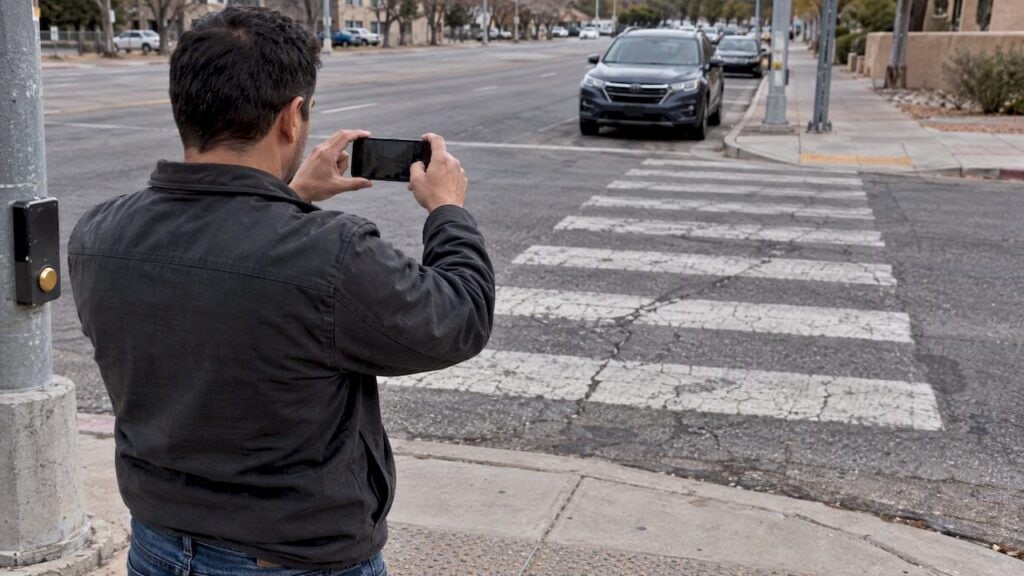
Drivers who fail to yield at crosswalks or ignore their duty of care are the parties most often found liable in a New Mexico pedestrian accident, but pedestrians who disregard traffic laws can share the blame. Ask an attorney how the rules apply to your case. Victims can still pursue medical costs, lost wages, pain and suffering, and wrongful death damages, but the clock to file starts ticking the day of the crash.
TL;DR:
- New Mexico’s pure comparative negligence rule permits recovery at any fault percentage, but insurers may contest your share, reducing compensation proportionally.
- Request nearby surveillance footage immediately because businesses may overwrite recordings within a week or two; preserve photos, medical records, witness details, and vehicle data.
- If the driver’s coverage falls short, your own uninsured or underinsured motorist policy may help, while health insurers may seek repayment from a settlement.
- A cyclist, contractor, municipality, or additional driver may share responsibility, and claims against government entities carry separate, shorter notice deadlines.
- The lawsuit filing deadline depends on the circumstances, and exceptions may shorten or extend it, so confirm your specific timeline with an attorney promptly.
Table of Contents
- How New Mexico law defines drivers’ and pedestrians’ duties
- How fault is determined and what pure comparative negligence means for your recovery
- Common evidence used to prove liability and how to preserve it
- What compensation you can seek after a pedestrian accident in New Mexico
- Practical steps to take immediately after a pedestrian crash
- Statute of limitations and deadlines: when you must act in New Mexico
- How an experienced New Mexico personal injury attorney helps with liability, fault disputes, and maximizing recovery
- Differences in liability when other parties are involved
- Impact of alcohol or drug impairment on pedestrian accident liability
- Role of insurance coverage limits and options specific to pedestrian accident claims in New Mexico
- Author’s short perspective for injured pedestrians in New Mexico
- Get a free case review from our New Mexico injury team
- FAQ
- Sources
How New Mexico law defines drivers’ and pedestrians’ duties
New Mexico traffic law sets out specific obligations for everyone sharing the road, and these statutes form the backbone of most liability determinations. Drivers must exercise due care at all times to avoid colliding with pedestrians, including slowing down, honking when needed, and watching for people near the roadway under NMSA § 66-7-337. That same due care standard requires drivers to yield the right of way to pedestrians in marked and unmarked crosswalks at intersections under NMSA § 66-7-334.
Pedestrians carry responsibilities too. Someone who crosses outside a designated crosswalk must yield to oncoming vehicles, and the law requires people to walk on sidewalks where they exist, or face oncoming traffic along the road’s edge when no sidewalk is available.
- A driver turning right on red who strikes a pedestrian in a marked crosswalk is typically liable under § 66-7-334.
- A pedestrian who darts across a street midblock, away from any crosswalk, may bear significant fault under § 66-7-335.
- A pedestrian walking against traffic on a road without sidewalks is following § 66-7-339, which can support their claim if a driver still fails to exercise reasonable care.
How fault is determined and what pure comparative negligence means for your recovery
New Mexico applies a pure comparative negligence rule, which means you can recover damages even if you were partly responsible for the crash. Your total award simply gets reduced by your percentage of fault, with no cutoff point that bars recovery entirely.
Ask an attorney to explain how fault could affect your potential recovery.
- Fault percentages come from a jury verdict at trial, a judge’s ruling, or more commonly, a negotiated settlement between your attorney and the insurance company.
Insurance adjusters often push hard to inflate a pedestrian’s share of fault because every percentage point reduces what they have to pay. This is one reason an early, informed response to a fault allocation matters before you accept a settlement offer.
Common evidence used to prove liability and how to preserve it
Building a strong pedestrian injury claim depends on gathering the right evidence quickly, before it disappears or memories fade.
- Police reports and citations often establish an initial account of fault and note any traffic violations observed at the scene.
- Photos and video, including surveillance footage, dashcam recordings, and phone images of the scene, vehicle positions, and road conditions, capture details that fade from memory within days.
- Medical records and bills connect your injuries directly to the crash and document the treatment you needed afterward.
- Witness statements, vehicle damage reports, and electronic data from a vehicle’s event data recorder can confirm speed, braking, and timing that corroborate or contradict a driver’s account.
Pro Tip: Ask nearby businesses whether their security cameras captured the crash. Footage is often overwritten within a week or two, so request it as soon as possible.
What compensation you can seek after a pedestrian accident in New Mexico
Pedestrian injuries tend to be severe since the human body has no protection against a vehicle’s mass, and New Mexico law allows recovery for both the financial and personal toll of a crash.
- Economic damages cover past and future medical expenses, lost income, and rehabilitation or therapy costs.
- Non-economic damages account for pain and suffering, emotional distress, and loss of enjoyment of life.
- Wrongful death damages are available when a pedestrian crash proves fatal, and New Mexico law allows a personal representative of the estate to bring the claim on behalf of surviving family members.
Whatever the total award, remember that your own percentage of fault reduces it proportionally.
Practical steps to take immediately after a pedestrian crash
What you do in the hours and days after a crash can shape the outcome of your claim as much as the crash itself.
- Seek medical attention right away, even if injuries seem minor, and keep every record, bill, and discharge summary.
- Call the police to the scene and get the crash report number before you leave.
- Collect the driver’s name, insurance information, and contact details for any witnesses, if it’s safe to do so.
- Take photos and videos of the scene, vehicle positions, road markings, and your visible injuries.
- Avoid giving a recorded statement to an insurance adjuster until you’ve spoken with an attorney, and keep a written log of any work you miss because of your injuries.
Statute of limitations and deadlines: when you must act in New Mexico
The deadline for injured pedestrians to file a personal injury lawsuit depends on the circumstances. Confirm the applicable deadline with an attorney as soon as possible. Waiting too long doesn’t just risk losing your right to sue. Evidence disappears, surveillance footage gets erased, and witnesses move away or forget details that mattered. Some exceptions and tolling rules can extend or shorten these deadlines depending on the facts of your case, which is another reason to get a legal opinion early rather than close to the filing window.
How an experienced New Mexico personal injury attorney helps with liability, fault disputes, and maximizing recovery
An attorney’s work on a pedestrian injury case usually starts with reconstructing the crash: gathering police reports, canvassing for witnesses, and consulting medical experts to project your future treatment needs. When an insurance company tries to shift blame onto you to shrink its payout, having someone push back on that fault allocation with evidence can change the outcome significantly. If a fair settlement isn’t on the table, your attorney can take the case to court.
Most personal injury firms, including ours, work on a contingency fee basis, meaning you owe nothing unless we recover compensation for you. For a free case evaluation, it helps to bring the date and location of the crash, your police report number, photos from the scene, and your medical records so far.
Differences in liability when other parties are involved
Pedestrian crashes don’t always involve a single driver and a single pedestrian. When a bicyclist strikes a pedestrian, New Mexico negligence principles still apply, but the analysis shifts to whether the cyclist obeyed traffic signals and rights of way, since bicycles are generally treated as vehicles under state traffic law. A multi-vehicle crash that pushes a car into a pedestrian can create shared liability between multiple drivers, each evaluated separately for their contribution to the harm.
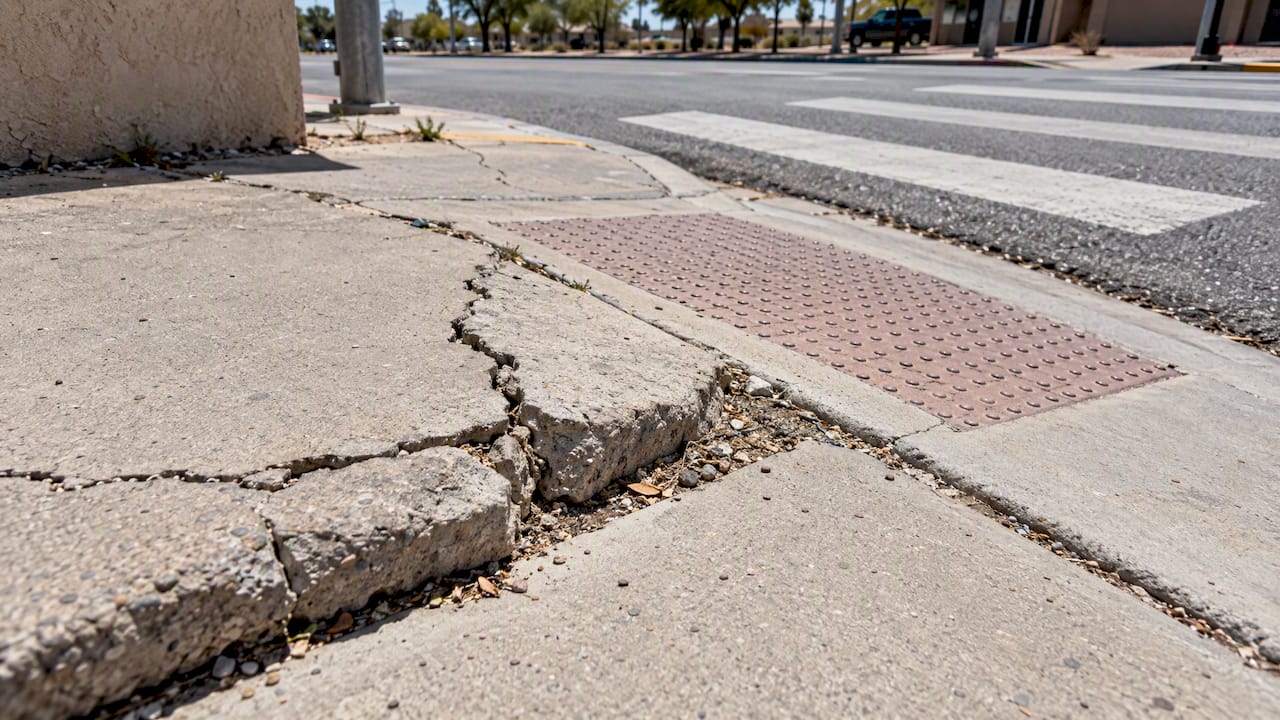
Municipalities can also bear responsibility in specific situations. A city or county that fails to maintain safe sidewalks, install adequate crosswalk signage, or repair known hazards like broken pavement or malfunctioning traffic signals may share liability for a resulting crash. These claims against government entities come with their own procedural requirements, including shorter notice deadlines than standard personal injury claims, so they need prompt attention. A crash near a construction zone can similarly raise liability questions for a contractor who failed to provide adequate pedestrian barriers or warning signs.
Because these cases often involve more than one potentially liable party, investigating all contributing causes matters. A driver’s insurance alone might not cover the full extent of a serious injury, especially one involving long-term rehabilitation, which makes identifying every responsible party part of building a complete claim.
Impact of alcohol or drug impairment on pedestrian accident liability
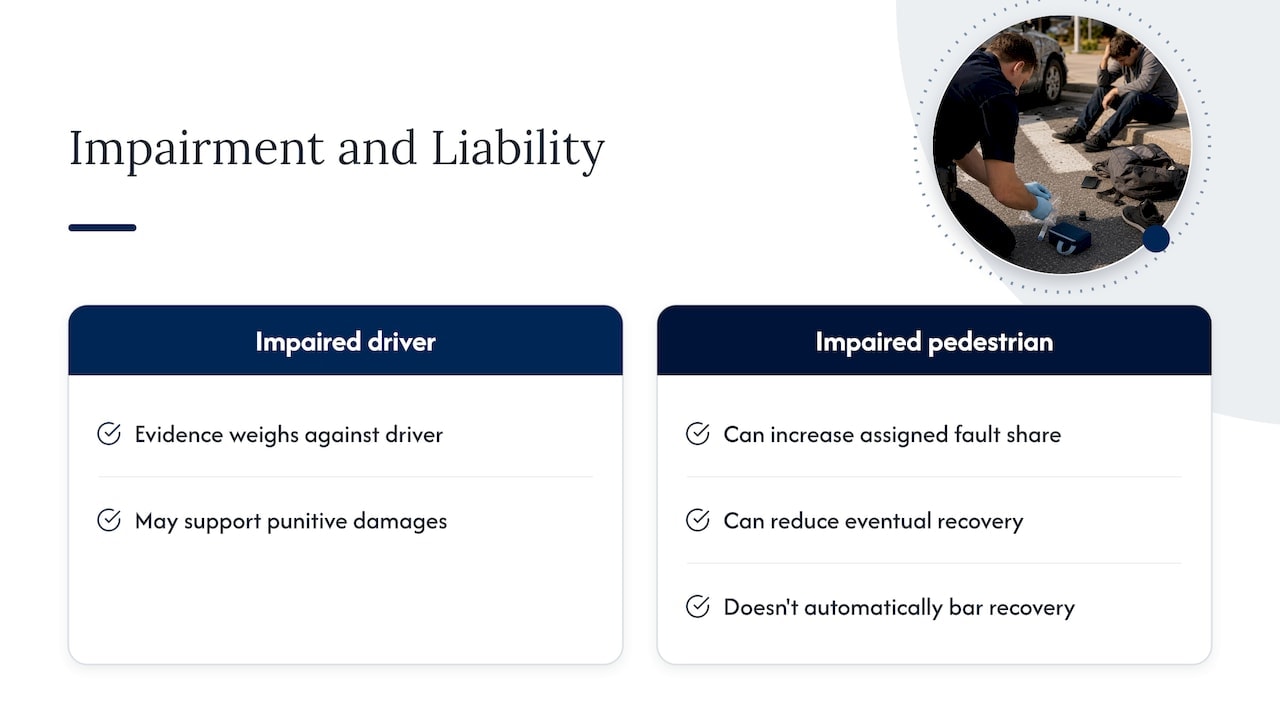
Impairment changes the liability picture substantially, whether it’s the driver or the pedestrian who was under the influence. A driver who causes a pedestrian crash while impaired faces a steep uphill climb in any fault dispute, since impairment evidence like a breath test, blood alcohol reading, or arresting officer’s report tends to weigh heavily against them in both criminal proceedings and the related civil claim. Impairment can also support a claim for punitive damages in cases involving especially reckless conduct, on top of the standard categories of compensation.
The same scrutiny applies to pedestrians. If toxicology results or witness accounts show a pedestrian was impaired at the time of the crash, that fact becomes part of the comparative negligence calculation and can increase the percentage of fault assigned to them, reducing their eventual recovery. Impairment doesn’t automatically bar a pedestrian from recovering damages under New Mexico’s pure comparative negligence rule, but it does give the insurance company a strong argument to raise the pedestrian’s fault share.
Because these determinations often hinge on technical evidence like toxicology reports and accident reconstruction, impairment-related disputes are among the more contested parts of a pedestrian injury claim. Getting that evidence preserved and independently reviewed early can make a meaningful difference in how fault ultimately gets divided.
Role of insurance coverage limits and options specific to pedestrian accident claims in New Mexico
Every pedestrian injury claim runs up against the practical limits of available insurance coverage, regardless of how clear liability is. A driver who caused the crash is typically covered under their auto liability policy, but New Mexico only requires drivers to carry minimum liability limits, which can fall well short of covering serious injuries like broken bones, traumatic brain injury, or long-term rehabilitation.
When the at-fault driver’s coverage isn’t enough, a pedestrian’s own uninsured or underinsured motorist coverage, if they have an auto policy, can sometimes fill the gap even though they weren’t driving at the time of the crash. This is one of the more overlooked aspects of pedestrian claims, since many people don’t realize their own auto policy can apply when they’re hit while walking. Health insurance also plays a role in covering immediate medical treatment, though a portion of that payout may need to be reimbursed from any eventual settlement through a subrogation claim.
Because coverage disputes can get complicated fast, especially when multiple policies or multiple at-fault parties are involved, understanding what coverage actually applies to your situation is a critical part of evaluating any settlement offer before you sign it.
Author’s short perspective for injured pedestrians in New Mexico
The biggest mistake I see injured pedestrians make is waiting. They wait to see a doctor because the pain isn’t bad yet, wait to document the scene because they assume the police report will cover it, and wait to ask questions about fault because an adjuster sounded reasonable on the phone. New Mexico’s pure comparative negligence rule means you can still recover compensation even if you share some blame, but only if the evidence to prove your version of events still exists. A free, prompt legal review costs you nothing and can preserve rights you’d otherwise lose simply by waiting too long.
— Adam
Get a free case review from our New Mexico injury team

We built our practice around direct access to attorneys and paralegals who know New Mexico’s pedestrian injury laws, not a call center that shuffles you between departments. We understand how adjusters may try to shift fault onto injured pedestrians, and we work to push back on those tactics from day one. We offer a free case evaluation and take pedestrian injury cases on contingency, so you owe us nothing unless we win your case.
Before you call, gather what you can:
- The date, time, and location of your crash.
- Your police report number, if one was filed.
- Photos from the scene and copies of your medical records so far.
Reach out through 2keller to get your free case evaluation started.
This article is general information, not a substitute for advice from a qualified lawyer. Consult a qualified legal professional about your own circumstances before acting on anything here.
FAQ
Is a hit and run a felony in New Mexico?
Whether a hit and run is charged as a felony in New Mexico depends on the severity of the injury involved, with crashes causing serious injury or death carrying harsher penalties than property-damage-only incidents. If you were hit by a driver who fled the scene, you can still pursue a civil claim for compensation separate from any criminal charges. Our guide to New Mexico hit and run accidents covers what steps to take if this happened to you.
What are 90% of car accidents caused by?
Driver error, including distraction, speeding, and failure to yield, is widely recognized as the leading cause of most car accidents, including those involving pedestrians. In pedestrian cases specifically, failing to yield at a crosswalk or failing to exercise due care are among the most common violations we see cited in police reports.
Can you claim personal injury after 3 years?
In New Mexico, the deadline to file a personal injury lawsuit depends on the circumstances, so ask an attorney to confirm the applicable deadline as soon as possible. Certain exceptions can extend or shorten this deadline depending on the facts of your case, so confirming your specific timeline with an attorney is worth doing as early as possible.
Can you sue a pedestrian?
Yes, a driver, cyclist, or another pedestrian injured by a pedestrian’s negligence, such as darting into traffic outside a crosswalk, can pursue a claim against that pedestrian. New Mexico’s pure comparative negligence rule would still apply, meaning each party’s fault percentage determines how any damages get allocated.